Claude vs ChatGPT for Marketing Teams: Tested on Real Agency Tasks
Claude wins long-context work and client documents. GPT-6 Astra gives the better first website draft. Five agency tasks, with inputs you can rerun.
 Ray GillespieCo-Founder & COO
Published 10 min read
On this page
Key takeaways
- Split the seat by task, not by brand loyalty. The entry paid seats cost the same: $20 a month for Claude Pro and for ChatGPT Plus.[1][2]
- In our work, Claude wins long-context work and client-ready documents. OpenAI's GPT-6 Astra gives us the better first website draft.
- Both list a 1M-token context window, so "the other one can't fit the transcripts" is a myth.[3] Judge context work on what the output misses.
- Independent benchmarks put the two level on reasoning: 51 vs 50 on Artificial Analysis's Intelligence Index.[3] Vendor benchmarks don't settle it, so test on your own tasks.
- On business tiers, neither vendor trains on your data by default. Consumer seats are where agencies get caught.[4]
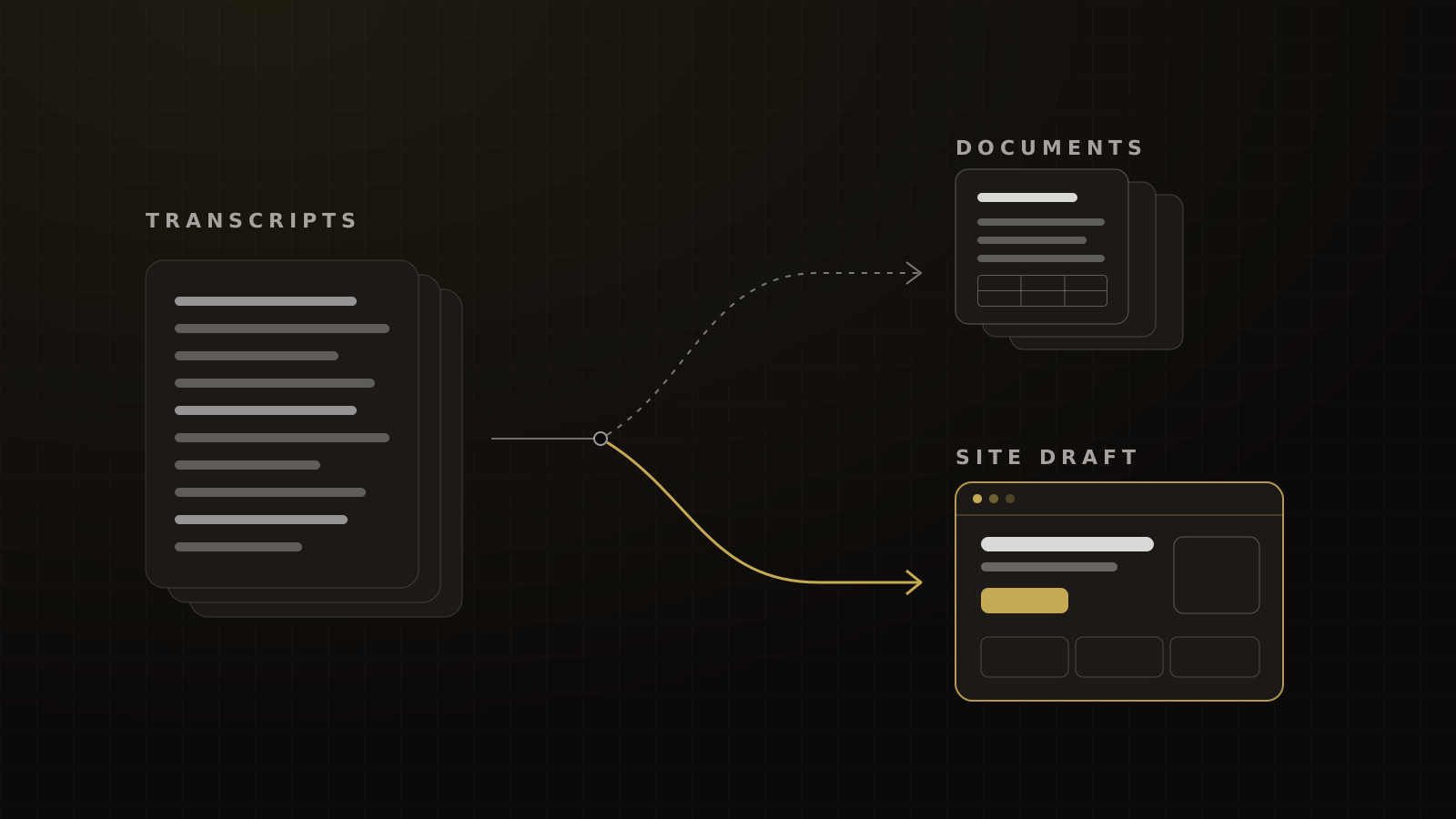
Split the seat by task. Claude is our primary tool for anything that needs a lot of context: every call transcript for a client in one thread, then a plan or a document out the other side. OpenAI's GPT-6 Astra is what we reach for when we need a first website draft.
Prices are the same at the entry tier, and the independent benchmarks are close to a tie. So the useful question is which model does each recurring job better. Below are the five jobs we split the seat on, with the inputs listed so you can rerun them on your own work. Prices and model names are as of the time of writing (October 2026).
The short answer: split the seat by task
Most comparison pages pick a winner. That's the wrong frame for a marketing team. You don't need one best model. You need the right model for each recurring job, and a rule your team follows without debating it every morning.
Marketer surveys don't agree on a default either. Ahrefs surveyed 301 marketers and found Claude used for content creation by 83.2% of AI users, against 75.7% for ChatGPT.[5] Brafton surveyed 163 marketers and found the opposite: ChatGPT at 84.7% of AI users and Claude at 29%.[6] Both samples are small and drawn from each publisher's own audience, so they tell you more about who reads Ahrefs and Brafton than about the market. The older, larger AMA survey found 62% of marketers using ChatGPT at work, in fieldwork from September 2024.[7]
The vendors' own benchmarks don't settle it either. OpenAI reports Astra at 59.3% on Agents' Last Exam against 55.5% for Claude Opus 5.[8] That comparison is against an older Claude model on benchmarks OpenAI chose. It's a reason to test on your own tasks, not a verdict.
Our lane rule is simpler: Claude for context and documents, Astra for first site drafts, a research tool for anything that needs citations. The full lane map, including Manus, Gemini and Higgsfield, is in which AI tools a marketing team should use.
How to run the test yourself
The verdicts below come from daily client work, not a lab. If you want to check them on your own work, run it like this:
- Pick five jobs you do every week. Ours are below.
- Write one brief per job and give both models the identical brief, with the same files attached.
- Have a second operator review the outputs blind, with the model names stripped.
- Score on the job, not the prose: what the output missed, which instructions it dropped, and how many edits it took before it could go to a client.
- Log the edit count. We've seen no public test that publishes inputs, outputs and a scoring rubric, which is why we tell you to keep your own.
Task 1: turn ten call transcripts into a build plan
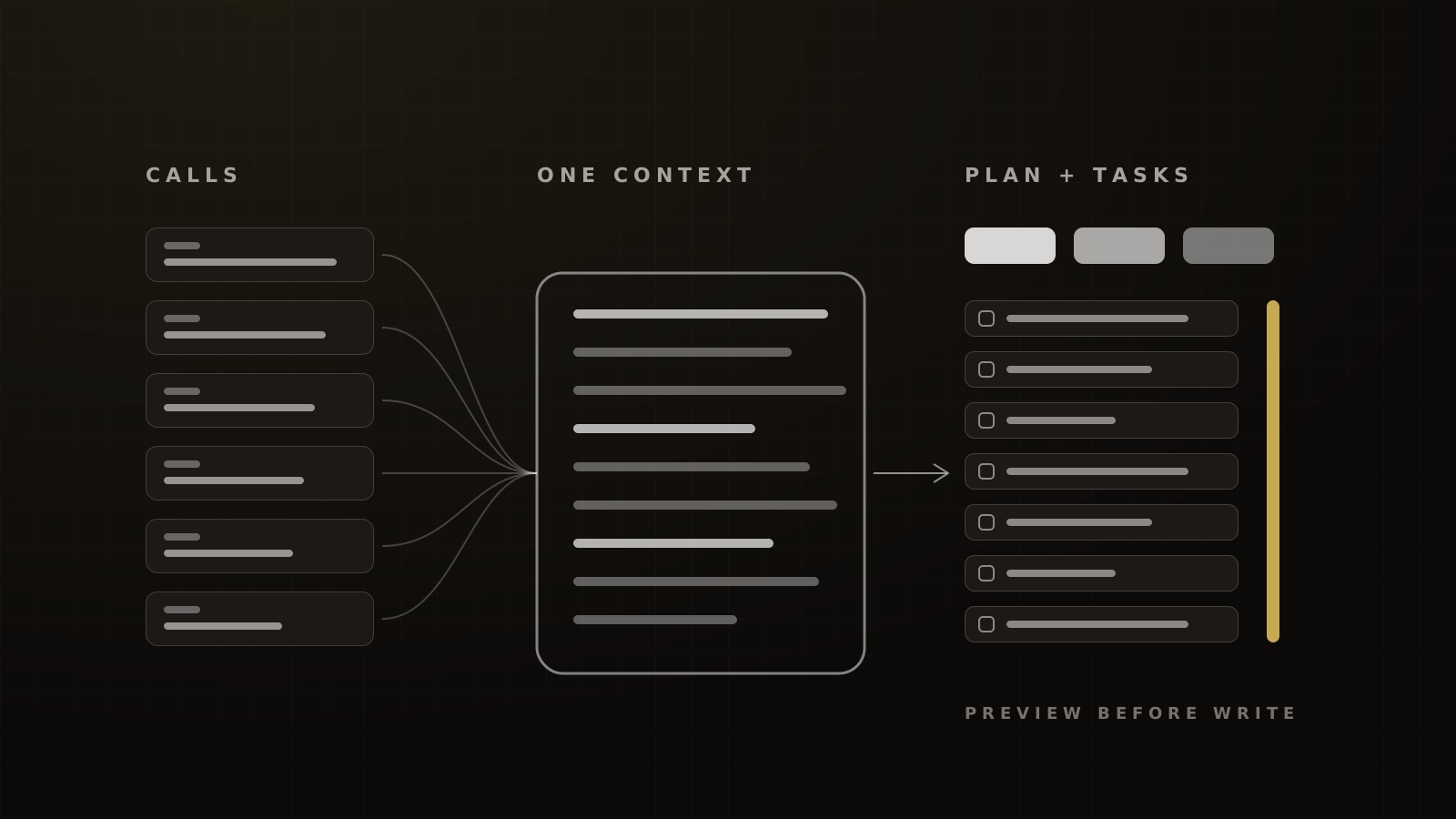
Input: every discovery and working-session transcript for one client, plus the brief: "Write a phased build plan with owners, dependencies and open questions."
Context size isn't the tie-breaker people think it is. Claude's current models, Opus 5.5 and Sonnet 5.5, carry a 1M-token context window in the API and on paid Claude plans.[9][10] Artificial Analysis lists 1M for GPT-6 Astra too.[3] Ten transcripts fit in either.
So judge the output. What did it leave out? Did it keep the instruction from transcript two when it reached transcript nine? Did it confuse what the client said with what we proposed?
Here Claude wins for us. We keep one running Claude thread per client with every transcript in it, and it holds detail across the whole stack better than anything else we've used. The independent long-context reasoning score points the same way, 84% for Claude Opus 5.5 against 80% for Astra, though that's a benchmark, not our task.[3]
In our experience, a first-draft phased plan from one discovery call takes under 30 minutes, including a person reviewing it. How we structure those threads is in how we use Claude for marketing operations.
Task 2: client-ready document output
Input: the build plan from Task 1, plus "Turn this into a client-facing proposal as a Word document, with our headings and a scope table."
This is the task that moved our own default. Ray's verdict on Claude's Word output was that it "fully converted me off of GPT."
The point isn't the file format. It's that the document comes back structured the way a client expects to read it, with headings, tables and a scope section, so the edit pass is about substance, not layout. A plan that lives only in a chat window doesn't get approved. A document the client can open, comment on and sign off does.
Score this task on edit count: how many changes before you'd send it. Verdict: Claude.
Task 3: first website draft
Input: the client's brand notes, offer and audience, plus a written design brief.
This is where Astra wins, and it isn't close.
GPT Astra is able to give us a much better first rough draft than Claude and Vercel could.
OpenAI introduced GPT-6 Astra in ChatGPT on September 3, 2026, as a limited rollout that was not yet generally available.[11] It's rolling out to Plus, Pro, Business and Enterprise users and to the API, where Enterprise admins have to switch it on. Through Sites in ChatGPT it can create, host and share a site from a prompt.[8]
Astra is OpenAI's model. What we own is the method around it:
- Claude writes the Astra prompt, from the client's thread and our design system, so the brief carries everything we know about the client.
- Astra produces several directions, not one.
- A person picks the direction, and we refine it in v0.
- We ship it ourselves, deployed on Vercel or embedded in GoHighLevel. Hosting a client's site on a chat tool's sharing feature isn't a launch plan.
When we present 3 to 5 Astra directions, our target is a client-approved homepage direction in 1 to 2 review rounds. That's our own rule of thumb; we haven't found an industry benchmark for review rounds.
Task 4: ad copy and hooks
Input: one filled-in brief using our seven variables, plus "Write ten hooks and three primary-text variants."
The brief matters more than the model. We fill in the same seven variables once per client and give them to either tool.
Framework
The seven-variable brief
- Avatar: who the ad is for.
- Problem: the pain they live with.
- Outcome: the result they want.
- Niche or context: the situation, such as "after 50" or "first event".
- Common advice: the conventional wisdom the ad will challenge.
- Surprising stat: one credible, sourced number.
- Identity markers: quick descriptors of the speaker or the avatar.
Victory's seven variables, from our ad-hooks playbook.
With that brief, both models produce usable hooks. Both need a house-style edit. Each has habits, and the habits change by model version. Graphite's September study found Claude Opus 5 using em dashes at about the human rate and Astra at 0.12 times it.[12] Its October update found Opus 5.5 down to 0.015 em dashes per 1,000 words, a 99% drop, with a new tell: "this matters" at 116 times the human rate.[13]
So don't edit against one tell. Keep a running list of each model's habits and update it when the model changes. Ray's standing note on Claude copy is too many two-word sentences.
On preference, Claude leads. Arena's October 2 creative-writing snapshot put Claude Opus 5.5 at 1516, around second, and GPT-6 Astra at 1449, around 39th.[14] That's what readers prefer in blind pairs, not what converts on Meta. Verdict: either, with an edit pass. Let the ad account pick the winner.
Task 5: research with citations
Input: "Find the latest benchmark for X, with the source, sample and date."
Neither is our first choice. A chat model will give you a plausible number. We need the URL, the sample and the fieldwork dates, and we open every source ourselves. That job sits in Perplexity's lane, with a person checking the source. Verdict: neither.
Price, limits and data tier
At the time of writing, the seats line up closely:
| Tier | Claude | ChatGPT |
|---|---|---|
| Entry paid seat | Pro, $20 ($17 billed annually) | Plus, $20 (Go is $8) |
| Heavy individual use | Max, from $100 | Pro, from $100 |
| Team or business seat | Team standard, $25 monthly or $20 annual | Business standard, $25 monthly or $20 annual |
| Premium business seat | n/a | Business premium, $125 monthly or $100 annual |
List prices from each vendor's pricing pages. Business-tier prices vary by country and both require at least two seats.
Sources: Claude prices from Anthropic,[1] ChatGPT Plus, Pro and Go from OpenAI,[2] and ChatGPT Business from OpenAI's Business FAQ.[15] ChatGPT Team was renamed ChatGPT Business on August 29, 2025, so older guides use the old name.[16]
On the API, Opus 5.5 lists at $4 per million input tokens and $20 per million output, against $10 and $50 for Astra.[9][8] Running Artificial Analysis's full index cost $1,627 on Opus 5.5 and $2,434 on Astra.[3]
The data tier is the real tie-breaker for an agency. Both vendors say business-tier data isn't used for training by default. Consumer seats differ: on Claude Free, Pro and Max, training is a setting you control, with retention up to five years if you allow it.[4] HubSpot's August 2026 comparison guide still says ChatGPT Team and Enterprise "require opt-out" for training,[17] which contradicts OpenAI's own enterprise privacy page. Check the vendor's page, not a roundup.
Seat price is the small number here. In our experience, AI saves our ops team 15 to 20 hours a week across call notes, task plans and reporting. In HubSpot's 2026 survey of more than 1,500 marketers, about a third of teams reported saving 10 to 14 hours a week and another third 15 or more, all self-reported.[18] At $20 to $25 a seat, the expensive mistake is running the wrong tool on the job.
The verdict
| Task | Our pick | Why |
|---|---|---|
| Ten transcripts into a build plan | Claude | Fewer omissions and better instruction retention across a long thread |
| Client-ready documents | Claude | Structured output the client can open and approve |
| First website draft | GPT-6 Astra | Better first draft; we refine and ship it ourselves |
| Ad copy and hooks | Either | The brief decides; both need a house-style edit |
| Research with citations | Neither | Use a citation tool and open every source |
If your team buys one seat per person, buy for the job they do most. If they do context-heavy planning and client documents, that's Claude. If they draft sites, add Astra. How this fits the rest of our AI operation, including the agents we've tested in what autonomous agents can and can't do, is in our AI marketing operations guide.
Want to see how we build it for a client? Book a strategy call.
Frequently asked questions
Sources
- 1.Claude pricing. Anthropic, viewed 2026-10-04.
- 2.ChatGPT pricing. OpenAI, viewed 2026-10-04.
- 3.Claude Opus 5.5 (medium) vs GPT-6 Astra (medium): model comparison. Artificial Analysis, viewed 2026-10-04.
- 4.Enterprise privacy at OpenAI (with Anthropic's plan and consumer terms). OpenAI; Anthropic, 2025-08-28 / viewed 2026-10-04.
- 5.How marketers use AI for content creation. Ahrefs, 2026-09-30.
- 6.The AI tools marketers actually use. Brafton, 2026-07-02.
- 7.Generative AI takes off with marketers. American Marketing Association, 2024-12-12.
- 8.Introducing GPT-6 Astra. OpenAI, 2026-09 (page updates dated 2026-09-22, 2026-09-29).
- 9.Models overview. Anthropic (Claude Docs), viewed 2026-10-04.
- 10.How large is the context window on paid Claude plans?. Anthropic Help Center, updated week of 2026-10-04.
- 11.ChatGPT release notes. OpenAI Help Center, 2026-09-03.
- 12.AI tells: em dashes and other habits across nine models. Graphite (Five Percent), 2026-09-16.
- 13.AI tells: the Claude Opus 5.5 update. Graphite (Five Percent), 2026-10-01.
- 14.Text Arena leaderboard: creative writing. Arena (LMArena), 2026-10-02 snapshot.
- 15.ChatGPT Business general FAQ. OpenAI Help Center, viewed 2026-10-04.
- 16.ChatGPT Business rename FAQ. OpenAI Help Center, viewed 2026-10-04.
- 17.Claude vs ChatGPT for marketers. HubSpot, 2026-08-17 (updated).
- 18.2026 State of Marketing (marketing industry trends report). HubSpot, 2026-04-10 (updated).
Written by
Ray GillespieCo-Founder & COO
Ray runs day-to-day operations across every Victory engagement, building the systems, automations and AI-powered workflows that hold the machine together. He has overseen operations behind more than $120M in revenue.
Part of the guide: AI Marketing Operations: How a Modern Agency Runs Funnels with Claude, Agents and Automation