Which AI Tools Should a Marketing Team Use? Our Lane Map for Claude, Manus, Gemini, Perplexity, Higgsfield and Astra
Give every AI tool one job and score each lane on time saved, effort cut and who owns the judgment. Our lane map, with prices and a rule for cancelling.
 Ray GillespieCo-Founder & COO
Published 8 min read
On this page
Key takeaways
- Give every tool one job. If two tools share a lane, cancel one.
- Score each lane on Hormozi's value equation: does the tool cut time delay and effort, and does a person still own the judgment?
- Our lanes: Claude for context-heavy work, Manus for long tasks, Gemini for video review, Perplexity for cited research, Higgsfield for creative volume, GPT-6 Astra for website drafts, Lovable or v0 for interactive tools.
- Every lane has a named human owner. AI does the work; a person signs it off.
- Sprawl is the default: the average organisation carries about seven overlapping generative AI tools.[1]
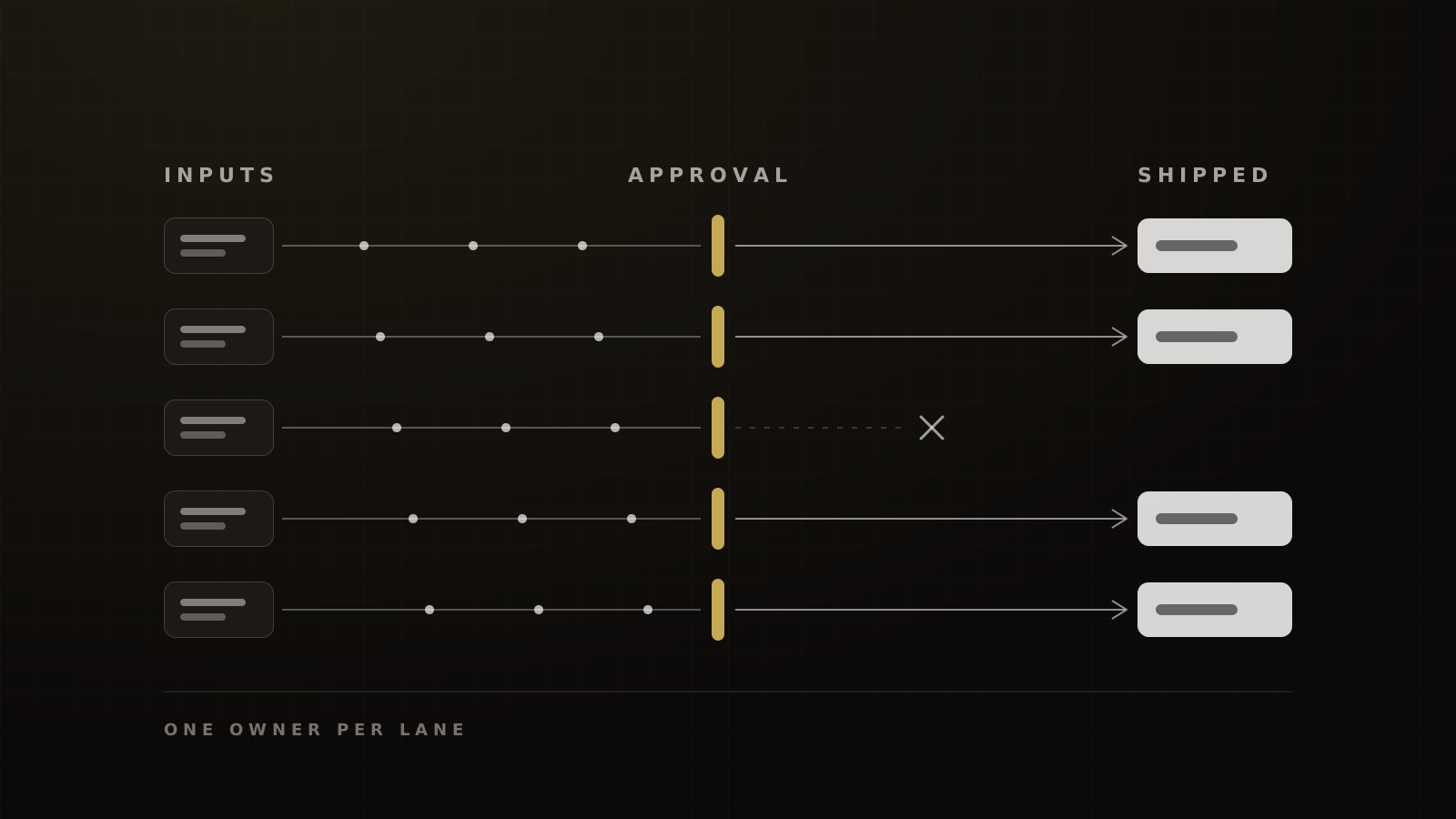
Give every tool one job. That's the whole rule. Most marketing teams didn't choose an AI stack; they collected one, a subscription at a time, and now three tools half-do the same thing while nobody owns the output.
Below is the lane map we run, what each tool can't do, who owns each lane, and a worksheet for scoring your own stack. Prices are at the time of writing (October 2026). There are no affiliate links on this page.
The rule: one job per tool
We score each lane with Hormozi's value equation. Value rises with the dream outcome and the likelihood of getting it, and falls with the time it takes and the effort it costs. His point is that the best offers shrink the bottom of the equation. AI mostly attacks exactly that: time delay and effort.
So every tool has to answer three questions:
- Time: does it make a recurring job faster?
- Effort: does it remove work, or add a new review step that eats the saving?
- Judgment: does a named person still own the decision?
A tool that fails the third question isn't saving you anything. It's moving risk somewhere you can't see it.
The payoff is real when lanes are clear. In our experience, AI saves our ops team 15 to 20 hours a week across call notes, task plans and reporting. In HubSpot's 2026 survey of 1,500+ marketers, about a third of teams self-reported saving 10 to 14 hours a week and a third 15 or more.[2]
A mechanic is only as good as his tools, and the tools are only as good as the mechanic.
The lane map
| Tool | Lane | Can't do | Human owner | Entry price |
|---|---|---|---|---|
| Claude | Transcripts, plans, documents, code | Verify its own facts | Account lead | Pro $20; Team $25 ($20 annual) |
| Manus | Long, multi-step tasks | Approve its own changes | Media buyer | Pro from $20 |
| Gemini | Video and tonality review | Catch fast cuts reliably | Creative lead | AI Pro $19.99 |
| Perplexity | Research with citations | Guarantee the citation is right | Whoever publishes the number | Pro $17 (annual) |
| Higgsfield | Creative volume | Judge which ad will win | Creative lead | Plus $59 ($47 annual) |
| GPT-6 Astra | Website first drafts | Own the brand direction | Designer | In ChatGPT Plus, $20 |
| Lovable or v0 | Quizzes and calculators | Maintain itself | Developer | Lovable Pro from $25; v0 Plus $30 |
List prices per user per month at the time of writing. Check each vendor before you buy.
Sources for prices: Claude,[3] Manus,[4] Gemini,[5] Perplexity,[6] Higgsfield,[7] ChatGPT,[8] v0[9] and Lovable.[10]
Claude: context-heavy work
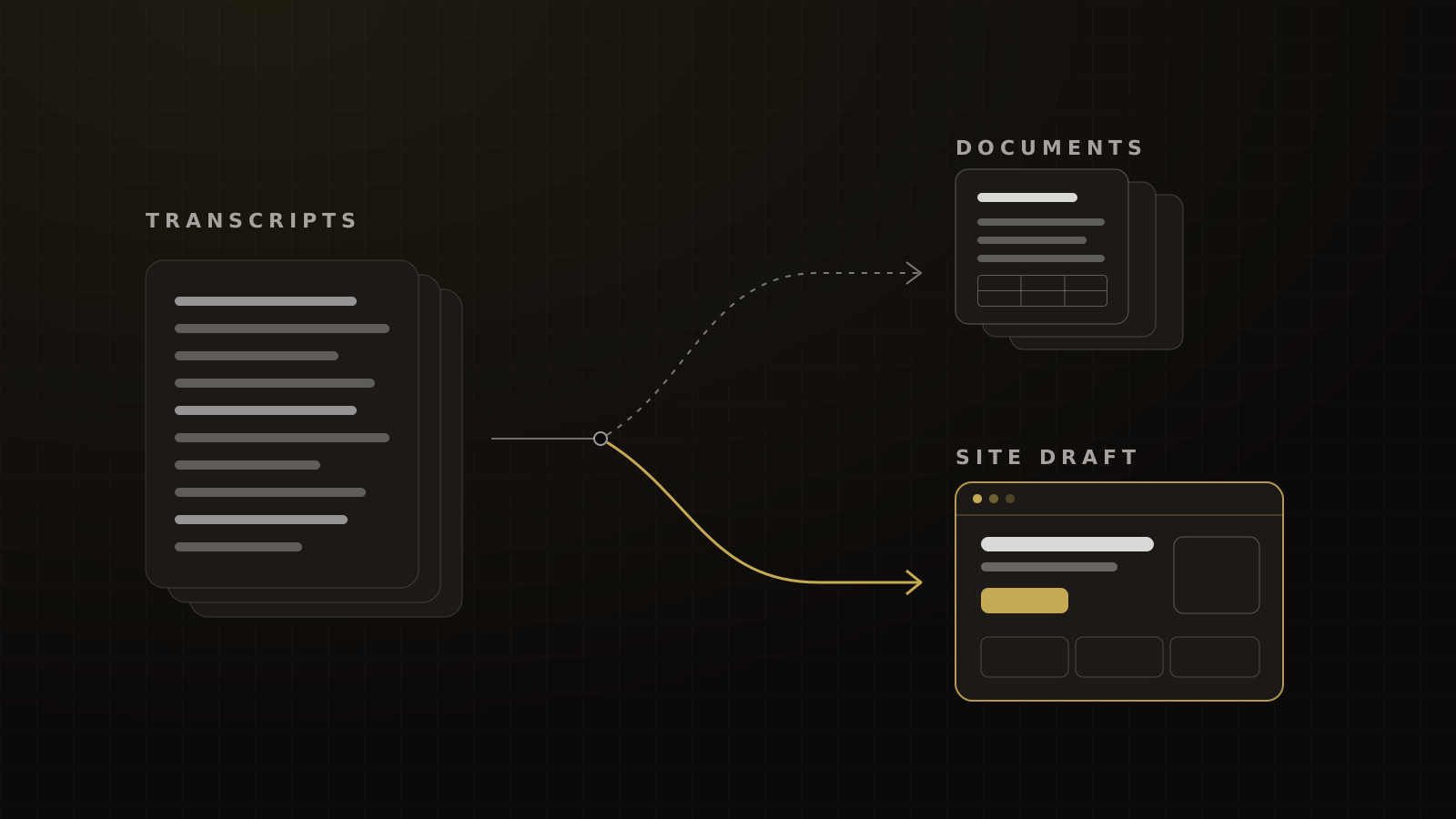
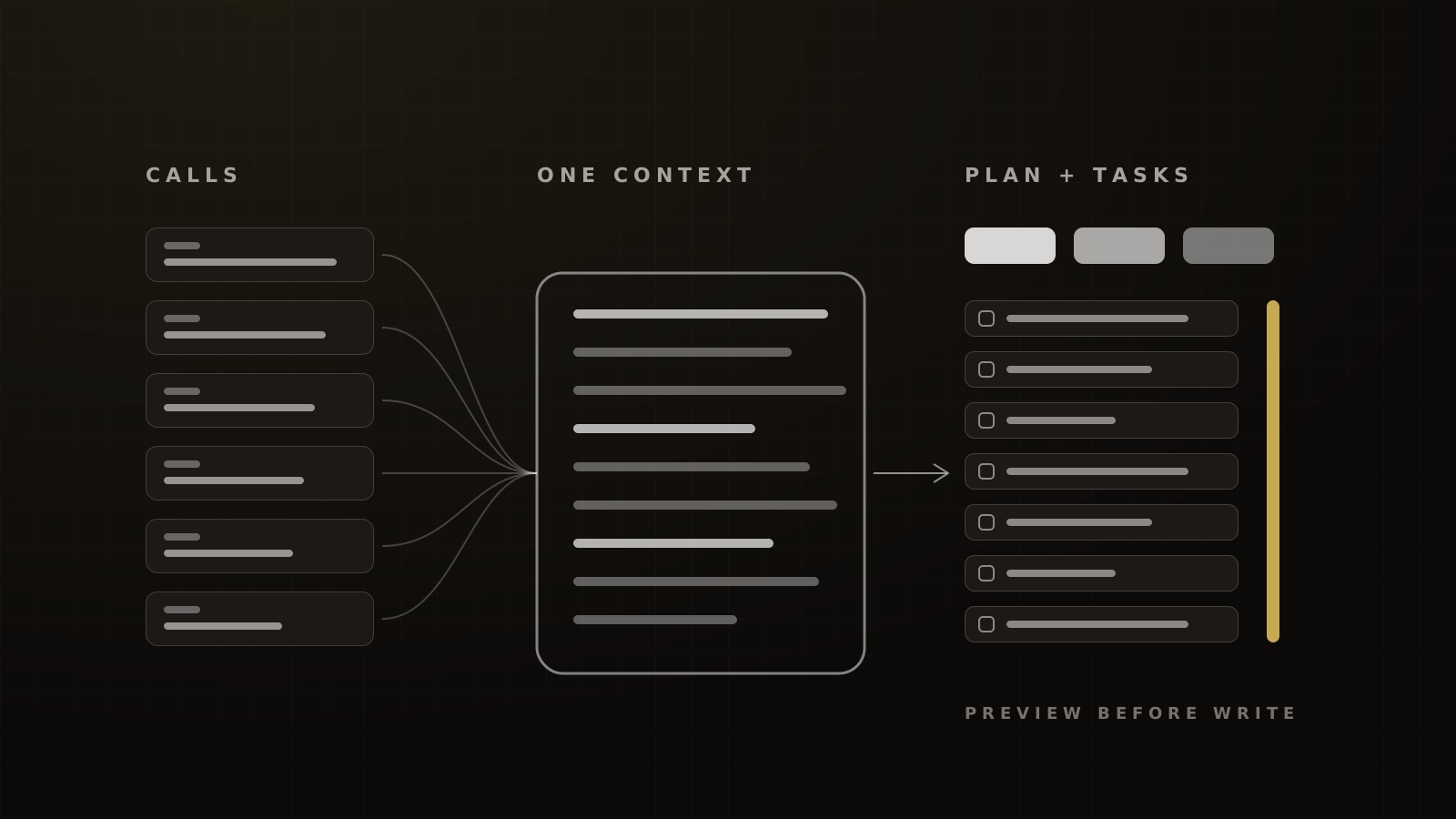
Claude is our primary tool. Its current models carry a 1M-token context window on paid plans,[3] which is what lets us keep one running thread per client with every meeting transcript in it. Plans, task lists, client documents and Claude Code builds come out of that thread.
In our experience, a first-draft phased build plan from one discovery call takes under 30 minutes, including a person reviewing it.
Can't do: check its own facts. Every number it writes into a client document gets traced. How we run it is in how we use Claude for marketing operations, and how it compares with ChatGPT task by task is in Claude vs ChatGPT for marketing teams.
Usage surveys disagree on how common Claude is. Among 309 product marketers, 84% used ChatGPT and 62% Claude.[11] Brafton's 163 marketers put Claude at 29%.[12] Pick by lane, not by popularity.
Manus: long tasks
Manus runs long, multi-step jobs without someone babysitting the chat: a full audit of a competitor's ad library, or a monitoring pass over an ad account. Its Pro plan starts at $20 a month with up to 20 concurrent tasks and 20 scheduled automations; the free plan runs one task at a time.[4]
Human owner: the media buyer. We run one monitoring agent per active ad account, and a person reviews every flagged change before it's applied. That's our operating rule. It matches the market: McKinsey found no more than 10% of organisations scaling agents in any single function.[13] Anthropic's own marketing team describes the same pattern, an ads workflow that flags negative keywords and waits for approval before changing anything.[14]
We've tested other autonomous agents, including Hermes, but haven't put them into production. What agents can and can't do yet is in our agent evaluation.
Gemini: video and tonality review
Gemini's lane is watching video. Its API can describe, segment and timestamp video, up to 3 hours at low resolution or 1 hour at high resolution on its 1M-context models.[15] Google reports Gemini 3.7 Flash at 85.4% on the LVBench long-video benchmark, a vendor-run score, not an accuracy rate on ad footage.[16]
Can't do: catch everything. The API samples video at 1 frame per second,[15] so a fast-cut ad can hide a frame it never sees. We use it to review delivery and tone, then a person watches the final cut.
Perplexity: research with citations
Perplexity finds sources fast. Pro costs $17 a month and Max $167, both billed annually.[6]
Can't do: guarantee the citation. In a 2025 Tow Center test of 1,600 queries, eight AI search tools misidentified the source of a news excerpt more than 60% of the time, and Perplexity got 37% wrong.[17] Those were older models on a narrow task, but the lesson holds. Verification is part of the lane: whoever publishes the number opens the source.
Higgsfield: creative volume
Higgsfield produces image and video ad variations at a volume no shoot can match. Claude studies the competitor ads and writes the Higgsfield prompts; Higgsfield makes the assets. Plus costs $59 monthly or $47 a month billed annually, for 1,200 credits, and every generation through its MCP integration costs credits.[7]
Cost: in our experience, an active client creative program runs $300 to $2,000 a month in AI video credits, with statics and GIFs making up most of the output. Can't do: pick the winner. The ad account does that. Our full workflow and its limits are in Higgsfield for ad creative.
GPT-6 Astra: website first drafts
OpenAI's GPT-6 Astra builds the best first website draft we've seen. Through Sites in ChatGPT it can create, host and share a site from a prompt, and it's available on ChatGPT Plus, Pro, Business, Enterprise and the API.[18]
Astra is OpenAI's model. Our part is the method around it: Claude writes the Astra prompt from the client's context and our design system, Astra produces several directions, a designer picks one, and we refine and ship it in v0, Vercel or GoHighLevel. When we present 3 to 5 Astra directions, our target is a client-approved homepage direction in 1 to 2 review rounds. We haven't found an industry benchmark for that.
Lovable or v0: quizzes and calculators
Interactive tools, such as a quiz funnel, an ROI calculator or a booking qualifier, go to Lovable or v0. Lovable Pro starts at $25 a month, with hosting and AI usage billed separately.[10] v0 Plus is $30 per user, and its Business tier at $100 opts out of training by default.[9]
Can't do: maintain itself. A vibe-coded tool nobody can maintain becomes a liability the day the person who prompted it leaves. A developer owns anything that goes live.
Scoring your own stack
Sprawl is the norm. Zylo's 2026 index found about seven overlapping generative AI tools in the average organisation's portfolio.[1] Spend on AI-native apps rose 108% year over year, and 78% of the 218 IT leaders it surveyed had hit unexpected AI or consumption charges.[19] Usage is spreading across functions too: HubSpot found 80.5% of teams using AI for content creation and 70.6% for advertising automation.[2]
The fix isn't another tool. It's training people on the few you keep: lack of education and training was the top barrier to AI adoption in SmarterX's 2026 survey, at 38%.[20]
Framework
The lane audit
- List every AI subscription the team pays for, and who uses it.
- Write each tool's one job in a sentence. If you can't, it has no lane.
- Score the lane: hours saved a week, review effort it adds, and the named person who owns the output.
- Find overlaps. Two tools, one job: keep the one with the better score and cancel the other.
- Check the meter. Note credit and usage charges, not just seat prices.
- Repeat quarterly. Models and prices change faster than budgets.
Victory's lane audit. Scoring test adapted from Alex Hormozi's value equation (time delay and effort).
As an illustration, not a client figure: for a 10-person agency, core stack software on a setup like ours comes to roughly $900 to $1,400 a month at list prices, before usage and excluding attribution software. Credits and messaging usage are what move that number.
Want to see how we build it for your team? Book a strategy call.
Frequently asked questions
Sources
- 1.AI inventory management (2026 SaaS Management Index findings). Zylo, 2026-08-06.
- 2.2026 State of Marketing (marketing industry trends report). HubSpot, 2026-04-10 (updated).
- 3.How large is the context window on paid Claude plans? (with claude.com/pricing). Anthropic, viewed 2026-10-04.
- 4.What is the current membership pricing for Manus?. Manus Help Center, updated week of 2026-10-04.
- 5.Google AI plans. Google One, 2026-05-19 announcement; viewed 2026-10-04.
- 6.Perplexity Pro and Max. Perplexity, viewed 2026-10-04.
- 7.How do I connect Higgsfield to an AI agent? (with Higgsfield pricing). Higgsfield, 2026-09-24 / viewed 2026-10-04.
- 8.ChatGPT pricing. OpenAI, viewed 2026-10-04.
- 9.v0 pricing. Vercel, viewed 2026-10-04.
- 10.Subscription plans. Lovable Docs, viewed 2026-10-04.
- 11.AI in product marketing survey. The Product Marketer, 2026.
- 12.The AI tools marketers actually use. Brafton, 2026-07-02.
- 13.The state of AI in 2025: Agents, innovation, and transformation. McKinsey, 2025-11-05.
- 14.How Anthropic's marketing team uses Claude Cowork (webinar). Anthropic, 2026-06-04.
- 15.Video understanding (Gemini API). Google AI for Developers, 2026-09-23.
- 16.Gemini 3.7 Flash model card. Google DeepMind, 2026-08-13.
- 17.We compared eight AI search engines. They're all bad at citing news. Tow Center / Columbia Journalism Review, 2025-03-06.
- 18.Introducing GPT-6 Astra. OpenAI, 2026-09 (page updates dated 2026-09-22, 2026-09-29).
- 19.2026 SaaS Management Index. Zylo, 2026-01-29.
- 20.2026 State of AI for Business: executive summary. SmarterX / Marketing AI Institute, 2026-05-18.
Written by
Ray GillespieCo-Founder & COO
Ray runs day-to-day operations across every Victory engagement, building the systems, automations and AI-powered workflows that hold the machine together. He has overseen operations behind more than $120M in revenue.
Part of the guide: AI Marketing Operations: How a Modern Agency Runs Funnels with Claude, Agents and Automation