GoHighLevel for Coaches, Course Creators and Event Businesses: The Operator's Guide (and the Stack Around It)
What GoHighLevel should own in a coaching, course or event business, where the all-in-one breaks, and what it costs once you add email, texting and AI.
 Ray GillespieCo-Founder & COO
Published 16 min read
On this page
- The short answer: what GoHighLevel should own in an expert business
- What HighLevel is, in numbers that mean something
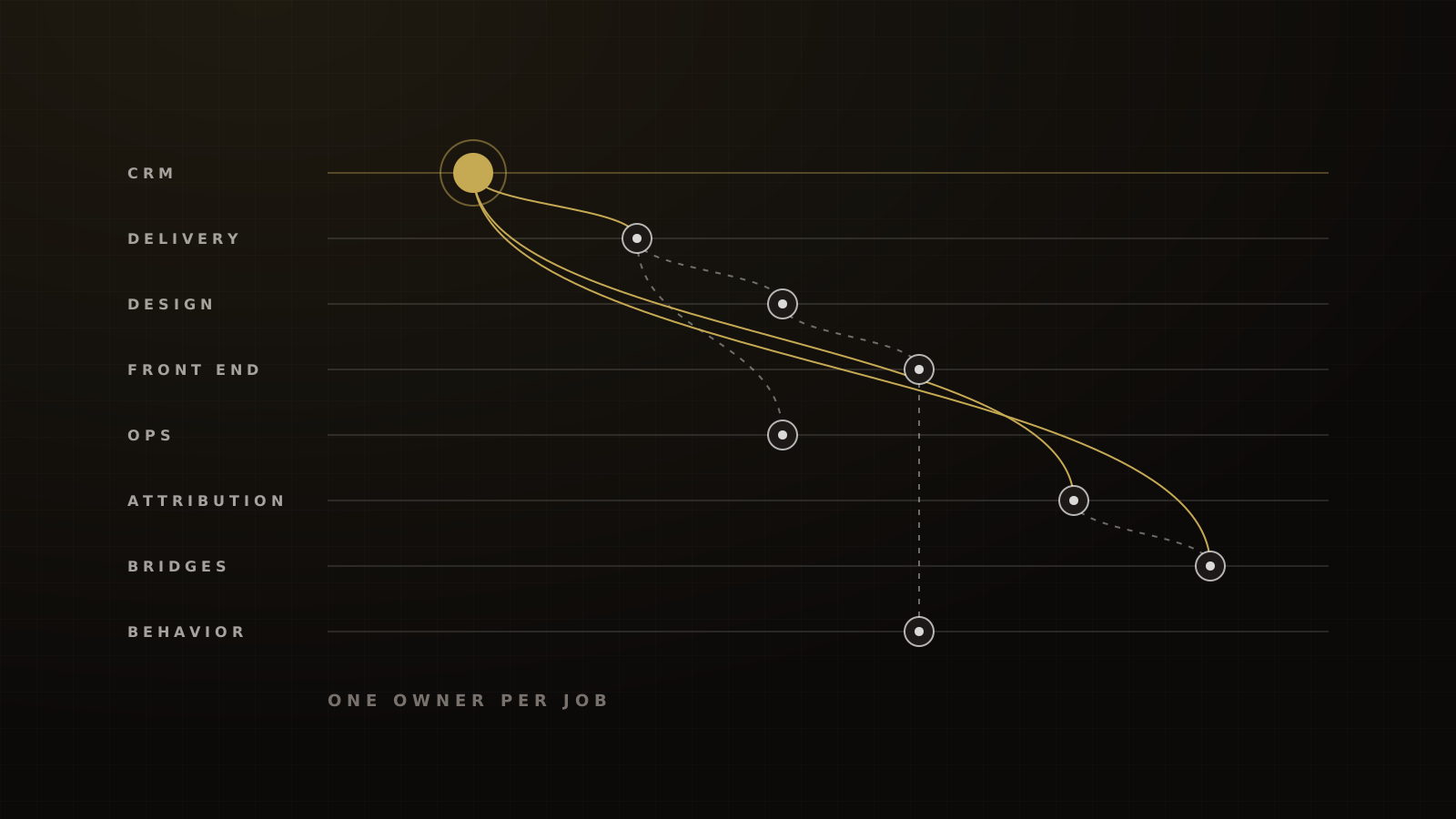
- The system-of-record map: one owner per job
- A coach, course or event lifecycle inside GHL
- Where all-in-one breaks
- What it really costs
- GHL vs ClickFunnels and Kajabi in one paragraph each
- Rescuing a messy build: our first-week audit
- How we run this at Victory
Key takeaways
- Give GoHighLevel one job: system of record for contacts, pipeline, booking, texting and email. That's where it beats a stack of separate tools.
- HighLevel says it has more than 120,000 customers and over 1 million SMBs (March 2026), but its units don't line up, so don't size it by headline counts.[1]
- The all-in-one breaks in five predictable places: attribution, reporting on custom data, course depth, complex checkout, and backups.
- The plan is $97 to $497 a month. For a business that texts its registrants at volume, usage costs more than the plan.[2]
- Every job outside the CRM gets one named owner: ClickUp for delivery, Figma, v0 and Vercel for custom front ends, Claude for ops, Hyros for attribution.
GoHighLevel is the right CRM for most coaching, course and event businesses, as long as you limit what you ask it to do. Let it own contacts, pipeline, booking and messaging. It gets expensive and leaky when it also has to be your LMS, your attribution tool and your design system.
We build on it every day. It's the CRM we install for clients, and it's where every lead we generate for them lands. This guide is the map we use: what HighLevel should own, where it breaks, what it really costs, and what we put around it.
The short answer: what GoHighLevel should own in an expert business
Most GoHighLevel content is written for agencies reselling it to local service businesses: roofers, dentists, med spas. Expert businesses are different. A coach, course creator or event promoter sells through webinars, live events and sales calls. Revenue depends on follow-up: the text that gets someone to show, the call that books within the hour, the reminder that fills the room.
That's the job HighLevel is built for. One contact record holds the form fill, the booked call, every text and email, the pipeline stage and the payment. Workflows move people from stage to stage without a person touching them.
So our answer is narrow on purpose:
- HighLevel owns contacts, pipeline, calendars and booking, SMS and email, forms, and the workflows that connect them.
- HighLevel does not own project delivery, multi-touch attribution, custom-designed front ends or deep course experiences. Each of those gets its own named owner.
When a build goes wrong, it's almost always because someone asked HighLevel to do a job on the second list. The fix is rarely a better workflow. It's moving the job to the right tool and wiring the data back to the contact record.
What HighLevel is, in numbers that mean something
HighLevel is big and growing fast. In March 2026 it said it had "more than 120,000 customers and over 1 million SMBs" across more than 150 countries.[1] In 2024 its platform executed 120 billion workflow actions, and 1.11 million accounts created 1.76 billion contacts.[5]
The money behind it is real too. A PeakEquity-led group invested more than $60 million in 2021.[6] General Atlantic made an undisclosed minority growth investment in 2024, describing HighLevel as "growing more than 5x while maintaining profitability" over the prior three years.[7]
Demand is there as well. Semrush estimates 90,500 US searches a month for "gohighlevel" (August 2026 data).[8] That's an estimate from a model, not Google data, but it tells you buyers are actively looking.
None of that tells you whether HighLevel fits your business. Scale proves the vendor will be around. It doesn't prove the platform does your job.
Customers vs accounts vs "businesses powered"
The trouble with HighLevel's numbers is the units. The company uses several, and they aren't interchangeable.
| Figure | Unit | Date | Source |
|---|---|---|---|
| 120,000+ customers, 1M+ SMBs | Customers and SMBs | March 2026 | HighLevel[1] |
| 1.76B contacts created by 1.11M accounts | Accounts | 2024 | HighLevel recap[5] |
| Over 2 million businesses | Businesses powered | November 2025 | HighLevel[9] |
| 1M businesses | Businesses powered | January 2026 | HighLevel[10] |
| 15,000+ marketing agency customers | Agencies | November 2021 | HighLevel via PRWeb[6] |
All vendor-reported. 'Accounts' and 'businesses powered' are not defined in the source posts.
Two things stand out. The "businesses powered" figure fell from over 2 million to 1 million in two months, with no explanation. And the only official agency count is five years old.
An "account" in HighLevel is usually a sub-account: one client business inside an agency. A "customer" is closer to a paying HighLevel subscriber. Neither tells you how many agencies are on the platform. We break the full set down, verified against repeated claims, in our GoHighLevel statistics page.
The system-of-record map: one owner per job
Every important piece of data in your business should have exactly one home. When two tools both think they own the customer record, they drift. Tags get out of sync, a buyer keeps getting sales texts, and nobody trusts the reports.
The opposite failure is real too. Buy a separate tool for everything and you spend your time maintaining the connections between them. A 2025 BCG survey of large companies found 39% of best-of-breed users spend more than 20% of their IT budget on integration, against 29% of suite users.[11] That's an enterprise sample, not a coaching business, but the principle carries: every connection you add is something you pay to keep alive.
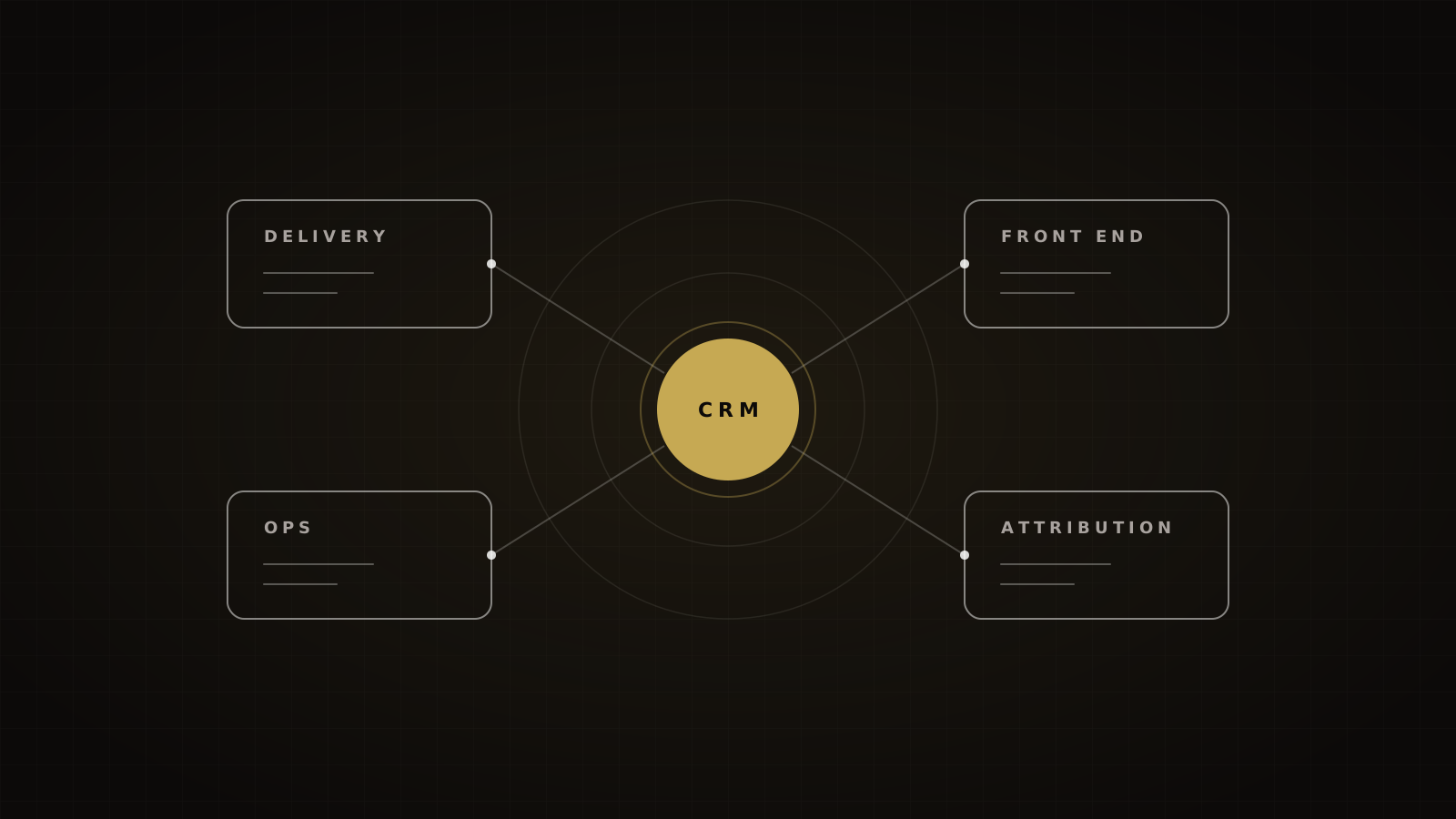
Our answer is a hub with a few spokes. HighLevel is the hub. Each spoke is a job that HighLevel does poorly, given to one tool, with data flowing back to the contact.
| Job | Owner | Why it's not in HighLevel |
|---|---|---|
| Contacts, pipeline, booking, SMS and email | HighLevel | This is the job it's built for |
| Client delivery and internal tasks | ClickUp | Delivery needs statuses, handoffs and reviews, not a sales pipeline |
| Custom-designed front ends | Figma, v0 and Vercel | Design control and page speed beyond a page builder |
| Ops: call notes, plans, reporting | Claude | Reasoning across calls, docs and data |
| Multi-touch attribution | Hyros | HighLevel records first and latest touch only |
Acquisition.com's Scaling Roadmap makes a related point: the tools you need change with the stage of the business, and buying the next stage's tools too early adds cost without adding revenue. A coach doing their first webinar doesn't need Hyros. A business spending heavily on ads to a high-ticket offer does.
HighLevel: contacts, pipeline, booking, SMS and email
Everything that touches a lead before and after a sale lives here. Forms and calendars create the contact. Pipelines track the stage. Texts and emails do the follow-up. Workflows fire on stage changes, not on dates someone remembered to set.
The test we use: if a salesperson or a reminder needs it, it belongs in HighLevel.
ClickUp: delivery
Once someone buys, the work shifts from selling to delivering. That work has owners, deadlines, review steps and handoffs. A sales pipeline is the wrong shape for it. We run delivery in ClickUp, and the handoff from HighLevel (the "won" stage) creates the delivery task. Our setup is in ClickUp for marketing agencies.
Figma, v0 and Vercel: custom front ends
HighLevel's page builder is fine for a quick opt-in page. When a brand needs real design control or fast mobile pages, we design in Figma, build in v0 and host on Vercel, then send the form data into HighLevel.
Our target on those rebuilt pages is all three Core Web Vitals in Google's "good" range on mobile at the 75th percentile (LCP at or under 2.5 seconds, INP at or under 200 milliseconds, CLS at or under 0.1), with LCP under 2.0 seconds. That's the bar we hold ourselves to, not an industry benchmark. The full process is in our Figma to v0 and Vercel build.
Claude: ops; Hyros: attribution
Claude runs our operations layer: call notes, build plans, weekly reporting. Each client has one running thread, so context carries from call to call. We cover the workflows in AI marketing operations.
Hyros owns attribution for clients with real ad spend, for reasons we cover below. As an illustration from October 2026 list prices, the core software for a 10-person agency on this stack runs about $900 to $1,400 a month before usage, excluding Hyros. That's our estimate, not a benchmark. The full breakdown, tool by tool, is in our agency tech stack.
A coach, course or event lifecycle inside GHL
Here is how a contact moves through a HighLevel build for an expert business. Each stage has an entry trigger, an owner and an exit. Hormozi's way of thinking about lead stages (who the person is now, and what has to happen to move them to the next stage) is the design principle behind it.
Framework
The five-stage lifecycle
- Lead. A form, calendar or chat creates the contact and records the source. Entry trigger: form submitted. The workflow tags the offer, starts the nurture, and alerts the team if the lead is high intent.
- Booked. A calendar booking moves the opportunity. Entry trigger: appointment created. The rep gets a real-time alert, and the confirmation text and email go out at once.
- Showed. Reminders run until the call or event. Entry trigger: status set to showed, or a check-in. No-shows drop into a rebooking sequence instead of a dead list.
- Sold. Payment or a won opportunity closes the sale. Entry trigger: order form paid or opportunity marked won. Sales follow-up stops the same minute.
- Onboarded. The buyer gets access, a welcome sequence and a kickoff booking, and the delivery task opens in ClickUp. Entry trigger: won stage.
Victory's build pattern for coaching, course and event businesses. Lead-stage thinking credited to Alex Hormozi.
The principle that matters most: triggers fire on stage changes, not on time alone. A buyer should never get the "last chance to book" text. A no-show should never get the same follow-up as an attendee.
In our builds, a day-one coaching or event sub-account carries 12 to 20 workflows. That's our rule of thumb, not an industry figure. Fewer usually means stages are missing. Many more usually means duplicated logic nobody can maintain.
Two stages deserve extra care.
Booked. Speed matters most here. Our target is a median first dial under one hour during staffed hours, and 100% of new leads dialed within 24 hours. The research behind response time is weaker than most people quote, and we unpack it in speed to lead: what the research actually says. HighLevel makes the alert easy. The discipline is on the team.
Showed. Reminder texts carry this stage. With drip sends, trigger links on the brand's own domain and a fresh number registered to the brand's A2P 10DLC campaign, we see 95% or more of reminders delivered. We haven't found a method-disclosed industry benchmark to compare that against. When those pieces are missing, delivery can collapse, as we found in our carrier-filtering post-mortem.
The full list of pipelines, tags, custom fields and automations we install is in the GoHighLevel setup checklist.
Where all-in-one breaks
HighLevel's pitch is that it replaces your stack. For the core jobs, it does. Past them, it has documented limits. None of these are reasons to avoid it. They're reasons to plan around it.
Attribution
HighLevel stores two attribution values on each contact: first and latest. They're recorded when someone submits a HighLevel form or survey, books a HighLevel calendar, uses the chat widget or completes an order form. Supported third-party forms can be tracked through External Tracking.[12]
That's first-touch and last-touch. It isn't multi-touch revenue attribution. For a high-ticket funnel, where a buyer might see six ads, attend a webinar, watch a replay and book a call two weeks later, first and latest touch can't tell you which campaign paid for itself.
So for clients spending real money on ads, we add Hyros and track every step of the funnel. HighLevel still owns the contact. Hyros owns the answer to "which ad made this money".
Reporting and custom objects
HighLevel added custom objects to all plans in an October 2025 release. They're useful for things that aren't contacts or opportunities: event sessions, programs, properties. But the limits are firm. There's a hard cap of 10 custom objects per sub-account, up to 300,000 records each, and custom objects can't be used in email campaigns, bulk email or SMS, conversations, or dynamic content on funnels and websites.[13]
In practice, that means you can store custom data but not market from it directly. If your reporting depends on data that lives in a custom object, plan to export it or report on it elsewhere.
Course and community depth
HighLevel's course builder covers modules, lessons, quizzes and assignments, with access through the Client Portal.[14] For a coaching program where the course supports the coaching, that's enough. Oussama, who leads our builds, prefers keeping courses and community inside HighLevel when it lets members use one login.
If the course is the product, the bar is higher. Learners compare your course experience to the best platforms they've used. Don't assume HighLevel's course area matches a dedicated course host. Test it against your own requirements before you migrate a flagship program.
Complex checkout and payment methods
Which payment providers and methods work in HighLevel depends on where you're taking the payment. HighLevel publishes a matrix covering order forms, courses, communities and invoices, and support differs across them.[15]
If you sell with payment plans, buy-now-pay-later, ACH or multiple processors, check every cell you need before you build. The usual failure is a payment method that works on the order form and not in the place you actually need it.
Snapshots aren't backups, and outages happen
Snapshots are one of HighLevel's best features. You can package a build and install it in a new sub-account in minutes. But a snapshot is a template, not a backup. Contacts, appointments, conversations, messages, reputation data, Stripe connections and third-party integrations don't transfer.[16]
And like every platform, HighLevel has incidents. Its public status page recorded course pages loading slowly for about two hours on 23 July 2026.[17] On 19 August 2026, some public APIs errored and some marketplace workflow triggers and actions may have been skipped.[18]
Design for that. Keep exports of anything you can't rebuild. Add checks for workflows that must fire (payment confirmations, event access). And don't let one sub-account be the only copy of your customer history.
What it really costs
HighLevel's list prices are simple: Starter at $97 a month, Unlimited at $297 and Agency Pro at $497, with a 14-day free trial.[2] Most comparison pages stop there. The real bill starts with usage.
As of October 2026, HighLevel's published usage rates include:
- LC Email: $0.675 per 1,000 emails.[19]
- US texts: $0.00747 per segment, outbound and inbound, plus carrier fees per outbound text (AT&T $0.0035, T-Mobile $0.0045, Verizon $0.0050).[20]
- Phone numbers: $1.15 a month for a local number.[20]
- A2P 10DLC: a one-time registration of $22.50 or $64.00, plus $1.50 to $10.00 a month per campaign.[21]
- Markup: HighLevel applies a 5% markup to some pass-through charges, including A2P fees and carrier fees. Its A2P fee article says there's no markup, so the two documents conflict.[22] Check a real wallet transaction.
- AI Employee: $50 or $97 a month per sub-account, with Voice AI at $0.045 a minute for the engine plus text-to-speech.[23]
Here is what that looks like for a modest month.
| Line | Volume | Cost |
|---|---|---|
| Starter plan | 1 | $97.00 |
| LC Email | 100,000 emails | $67.50 |
| US texts | 1,000 single-segment texts | $7.47 |
| Carrier fees | 1,000 outbound texts | ~$4.00 |
| Local number | 1 | $1.15 |
| A2P campaign (standard) | 1 | $10.00 |
| Total | ~$187 |
Hypothetical volumes, not a client bill. Excludes AI, calls, replies, the one-time A2P registration and payment processing. Recompute with current rates.
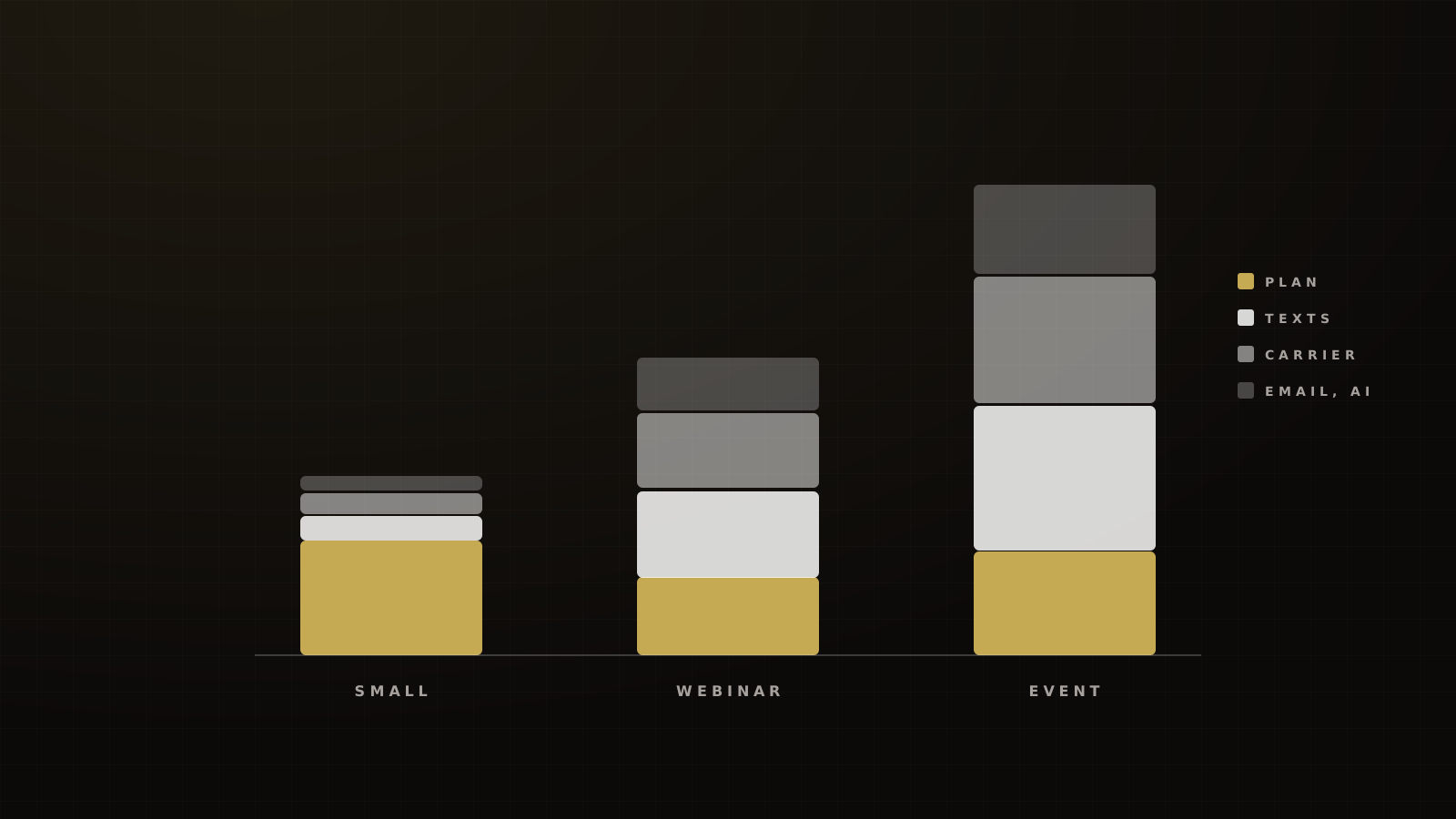
At that modest texting volume, the plan is still about half the bill. Scale the texting up to event volume and the share falls fast. In our experience, the plan fee is only 25% to 40% of a texting event business's monthly HighLevel bill. There's no industry benchmark for that, so set it beside the published rates above and run your own numbers.
On the event funnels we run, usage runs 1.5 to 3 times the plan fee in launch months. Again, that's our experience, not a published figure. The worked example at three volumes, with segments, inbound texts and the markup range, is in the true cost of GoHighLevel.
If you do decide to start a trial, our referral link is /ghl (paid link: we earn a commission if you sign up through it, and the trial is HighLevel's own).
GHL vs ClickFunnels and Kajabi in one paragraph each
ClickFunnels starts at $97 a month on Launch ($81 billed annually), with one workspace, 10,000 contacts, 50,000 emails a month and three courses. Scale is $197 and Optimize is $297.[24] It's a funnel builder first. If your business runs on pages and checkouts and you rarely text, it's a reasonable home. If follow-up by text and pipeline is the bottleneck, HighLevel does more of that natively.
Kajabi starts at $179 a month on Basic ($143 billed annually), with five products, 2,500 contacts, one website and one community. Growth is $249 and Pro is $499.[25] It's a course platform first. If the course experience is the product, Kajabi is a strong host, and keeping it for courses while HighLevel runs the CRM is often the right answer.
The decision isn't feature against feature. It's CRM-first against course-first. When we migrate a course business, the scope is smaller than people expect. In a typical migration, only 20% to 35% of existing funnels have had traffic in the last 90 days, and those are the only ones we rebuild. A move into HighLevel usually retires three to five tools: email, SMS, scheduler, forms and a pipeline tool. Neither figure has an industry benchmark. They're our experience. The full migration test, including what HighLevel's importers do and don't carry, is in GoHighLevel vs Kajabi, ClickFunnels and Kartra.
Rescuing a messy build: our first-week audit
Many of the HighLevel accounts we inherit weren't built badly on purpose. They grew. A workflow got cloned for each launch, tags multiplied, three people each built their own pipeline. The fix starts with an audit, not a rebuild.
First-week audit
- Map the stages. Write down the real lifecycle (lead, booked, showed, sold, onboarded) and match every pipeline to it. Delete or archive pipelines nobody uses.
- List every workflow and its trigger. Mark which ones fire on stage changes and which fire on dates. Find duplicates that send the same message twice.
- Read the message logs. Look at failed texts by error code and at email bounce and spam rates. Delivery problems hide here.
- Check the phone setup. Confirm every sending number sits on the brand's registered A2P campaign and that links resolve on the brand's own domain.
- Trace one lead end to end. Submit a test lead from an ad link and follow it through the form, booking, reminders and payment. Note where data drops off.
- Count the tools around it. List every integration and what it owns. Anything that duplicates a HighLevel job is a candidate to retire.
- Export what you can't rebuild. Contacts, opportunities and custom fields go out to a file before anything changes.
Our own day-one build for a coaching or event sub-account goes live in five to seven business days. There's no verified industry benchmark for that; it's the standard we hold. A rescue takes longer when the audit turns up data problems, because cleaning the contact records comes before anything else.
The order matters. Clean data first, then stages, then workflows, then messaging. Rebuilding workflows on top of messy tags just automates the mess.
How we run this at Victory
We're builders, not resellers, and we've told you about our referral link and template work above. For our unvarnished view of the platform, strengths and failures both, read our GoHighLevel review. It carries no referral link at all.
If you're evaluating HighLevel or untangling a build that grew out of control, book a strategy call. We'll map your stages, your tools and your real monthly bill, and tell you what to keep, move or cut.
Frequently asked questions
Sources
- 1.How HighLevel customers built real momentum in 2025. HighLevel, 2026-03-02.
- 2.HighLevel pricing. HighLevel, accessed 2026-10-04.
- 3.Affiliate Program Services Agreement. HighLevel, updated June 2026.
- 4.16 CFR 255.5: Disclosure of material connections. FTC (text via Cornell LII), 2023 revision.
- 5.HighLevel 2024 recap. HighLevel, 2025-01-09.
- 6.HighLevel secures over $60M investment, doubles down as the market-leading agency-focused sales and marketing platform. HighLevel via PRWeb, 2021-11-06.
- 7.HighLevel announces minority growth investment from General Atlantic. General Atlantic, 2024-04-11.
- 8.gohighlevel.com domain overview. Semrush, Aug 2026 data, updated 2026-09-17.
- 9.HighLevel named to Deloitte's 2025 Technology Fast 500 list. HighLevel, 2025-11-19.
- 10.HighLevel 2025: a year in review. HighLevel, 2026-01-15.
- 11.Seven questions for a smarter applications strategy. BCG, 2025-08-05.
- 12.Understanding attribution source (ad reporting). HighLevel Help Center, modified 2026-08-26.
- 13.Custom objects in all plans (higher limit). HighLevel Help Center, modified 2026-06-15.
- 14.How to build courses and membership sites. HighLevel Help Center, modified 2026-09-19.
- 15.Supported payment providers and methods by product area. HighLevel Help Center, modified 2026-02-17.
- 16.Snapshots overview. HighLevel Help Center, modified 2026-09-30.
- 17.Incident: course page latency and loading timeouts. HighLevel status page, 2026-07-23.
- 18.Incident: Marketplace API degradation. HighLevel status page, 2026-08-19.
- 19.HighLevel pricing guide. HighLevel Help Center, modified 2026-08-22.
- 20.LC Phone pricing and billing guide. HighLevel Help Center, modified 2026-09-29.
- 21.A2P 10DLC messaging fees: registration, monthly and carrier costs. HighLevel Help Center, modified 2026-09-24.
- 22.Understanding the 5% markup on phone system pass-through charges. HighLevel Help Center, modified 2026-09-09.
- 23.AI product pricing. HighLevel Help Center, modified 2026-09-28.
- 24.ClickFunnels pricing. ClickFunnels, accessed 2026-10-04.
- 25.Kajabi pricing. Kajabi, accessed 2026-10-04.
- 26.GoHighLevel on Reddit: what users say. The Stack Insiders, 2026.
Written by
Ray GillespieCo-Founder & COO
Ray runs day-to-day operations across every Victory engagement, building the systems, automations and AI-powered workflows that hold the machine together. He has overseen operations behind more than $120M in revenue.