Our Agency Tech Stack: GoHighLevel, ClickUp, Figma, v0/Vercel and Claude, and What Each One Owns
One owner per job: the eight tools we run, what each is the system of record for, the handoffs between them and what the stack costs a 10-person agency.
 Ray GillespieCo-Founder & COO
Published 9 min read
On this page
Key takeaways
- Give every job one owner. GoHighLevel holds contacts and pipeline, ClickUp holds delivery, Figma holds design, v0 and Vercel hold custom front ends, Claude holds ops.
- Three specialists sit alongside: Hyros for attribution, n8n for bridges between systems, Microsoft Clarity for on-page behavior.
- Most stack pain lives in the handoffs. Name what crosses each boundary, what triggers it and who owns it.
- Buy for your stage, not ours. Acquisition.com's Scaling Roadmap is a good guide to what a business actually needs at each headcount.
- For a 10-person agency, this core stack runs roughly $900–$1,400 a month at list prices, before usage and excluding Hyros.
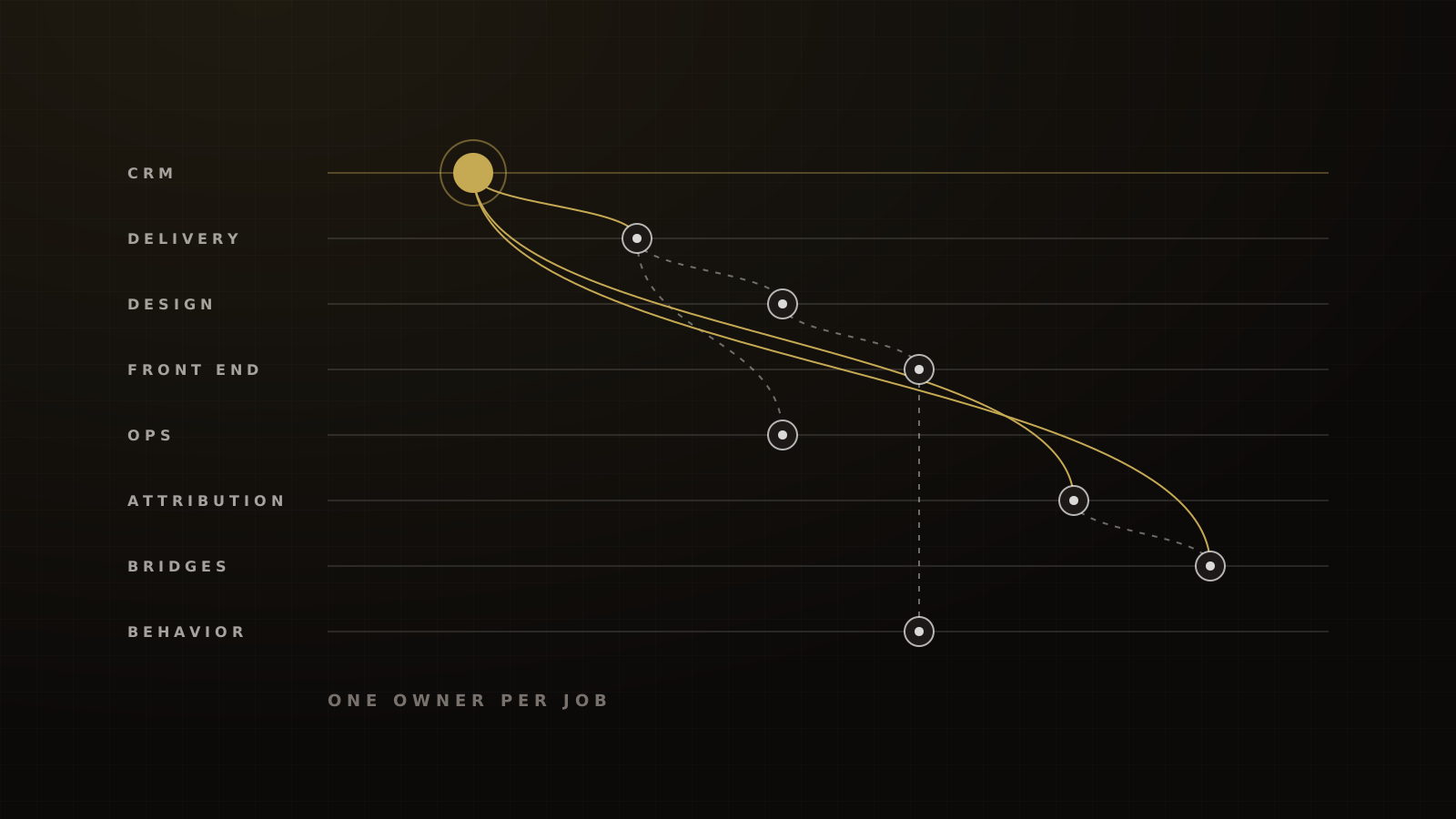
Every job in the business gets one owner, and no tool owns two. That's the rule our stack is built on.
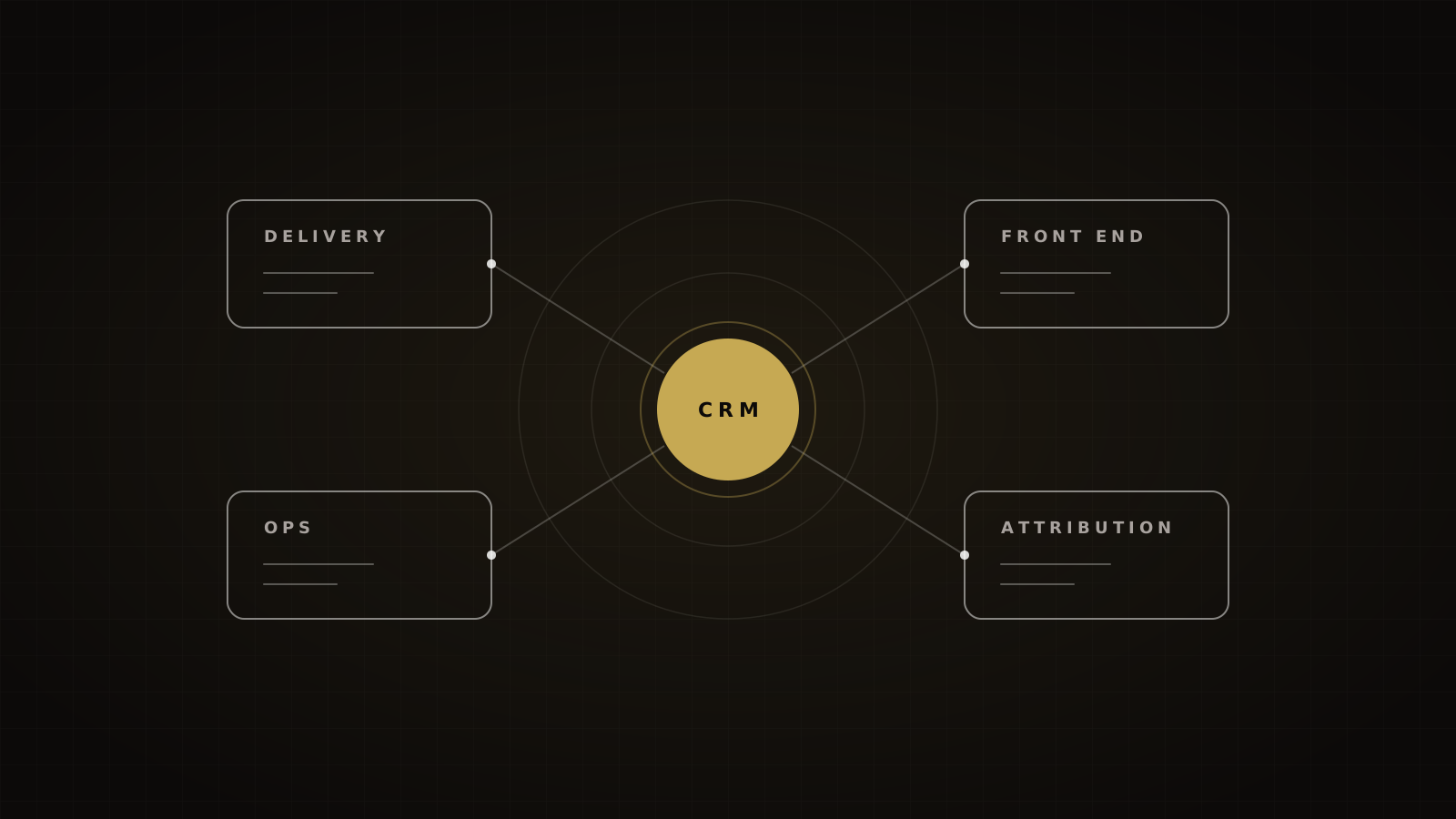
GoHighLevel holds contacts, pipeline and messaging. ClickUp holds delivery. Figma holds design. v0 and Vercel hold custom front ends. Claude holds operations. Hyros holds attribution, n8n bridges the systems, and Microsoft Clarity shows what people do on the page.
Here is what each one owns, what crosses between them, and how to buy for your stage instead of copying ours.
The ownership map
There are more tools than ever to choose from: 15,505 products in the 2026 martech map, though the count grew only 0.79% that year.[3] Choice isn't the problem. Overlap is. Zylo's 2026 index found the average organization runs 305 SaaS apps and leaves 36% of its licenses unused.[4] That's enterprise data, but the habit scales down.
So we start with a map, not a shopping list.
| Job | Owner | System of record for | Must not own |
|---|---|---|---|
| Contacts, pipeline, SMS and email | GoHighLevel | People, deals, consent, messages | Project tasks |
| Delivery | ClickUp | Tasks, owners, due dates, reviews | Customer records |
| Design | Figma | Comps, components, tokens | Production code |
| Custom front ends | v0 + Vercel | Page code, previews, deploys | Leads (forms post to GoHighLevel) |
| Operations | Claude / Claude Code | Drafts, summaries, plans | Final approval |
| Attribution | Hyros | Ad-to-revenue matching | Contact data |
| Bridges | n8n | Events between systems | Business logic that belongs in a tool |
| On-page behavior | Microsoft Clarity | Sessions, heatmaps, friction | Conversions |
System of record means the one place that's right when two tools disagree.
In our experience, consolidating a business into GoHighLevel retires three to five tools: usually separate email, SMS, scheduling, forms and pipeline software. We haven't found an industry benchmark for that number.
Replacement data shows where stacks churn. In a small MarTech survey of 154 marketers who replaced a tool in 2025, 18.5% replaced work or project management, up from 16.2%, and 9.7% replaced their CRM, down from 22.1%.[5] CRMs are settling. Project tools are where teams are still searching.
GoHighLevel owns contacts and pipeline
GoHighLevel is the record for every person, deal and message. Plans run from $97 to $497 a month at list price.[6] Start a HighLevel account (paid link).
One limit decides what sits next to it. GoHighLevel stores First and Latest attribution on each contact, from HighLevel forms, calendars, chat and order forms.[7] That's first-touch and last-touch, not multi-touch revenue attribution. Once ad spend is serious, that gap is why Hyros exists in our stack.
How we set it up, and where all-in-one breaks, is in our operator's guide to GoHighLevel.
ClickUp owns delivery
When a deal is won, the work moves to ClickUp. Unlimited is $7 per user a month and Business is $12, both billed yearly. Business includes 5,000 automations a month, and the Brain AI add-on is $9 per user.[8] ClickUp's MCP server, in public beta on all plans, lets an AI assistant create and update tasks, assignees, priorities and due dates.[9]
The status that matters most on our boards is "Ready for Review". Nothing closes without a second set of eyes. Between 15% and 25% of tasks bounce back from that status at least once, which is the gate doing its job, not a failure rate. We know of no industry benchmark for it.
The full setup is in ClickUp for marketing agencies.
Figma, v0 and Vercel own design and custom front ends
Figma is the record for design, and Dev Mode is where a developer inspects properties, views generated code and downloads assets.[10] A Full seat is $16 a month.[11]
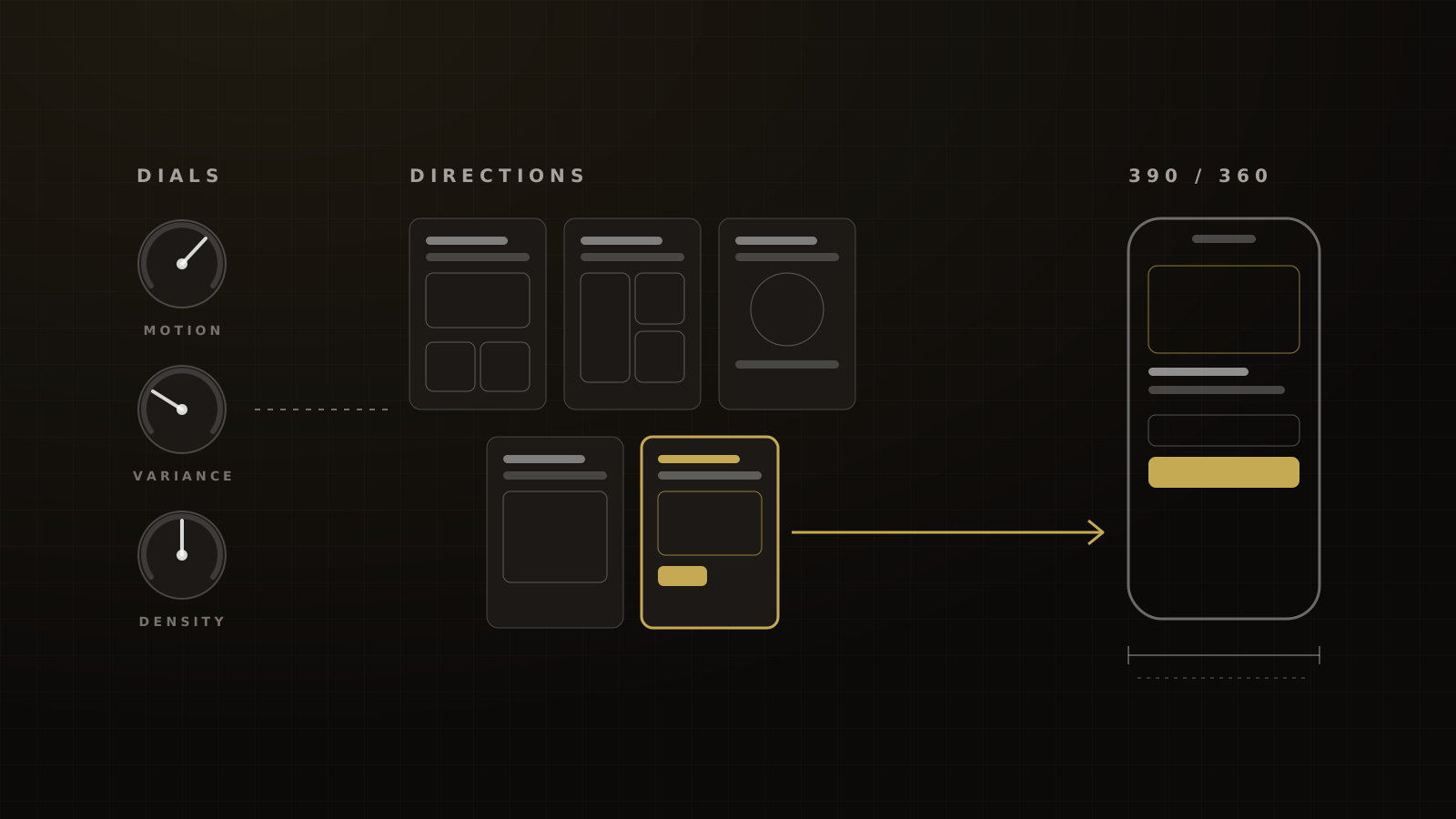
v0 turns approved designs into real code and deploys to Vercel.[12] Vercel gives every push a preview deployment, deploys production from the production branch and rolls back instantly.[13] v0 Plus starts at $30 per user a month.[14] Vercel's free Hobby tier is for personal projects, so client sites go on Pro at $20 a month.[15]
Our target for rebuilt pages is all three Core Web Vitals "good" on mobile at the 75th percentile, with LCP under 2.0 seconds against Google's 2.5-second bar.[16] The forms on those pages still post to GoHighLevel, so the CRM stays the record. The design process is in our Claude-to-Astra-to-v0 method, and the build chain in Figma to v0 to Vercel.
Claude owns ops
Claude drafts; humans approve. We run one Claude thread per client with every call transcript in it, and use it for call notes, task plans, build plans and reporting.
In our experience, that saves our ops team 15 to 20 hours a week. For comparison, in HubSpot's 2026 survey of 1,500+ marketers, about a third of teams self-reported saving 10 to 14 hours a week with AI and another third 15 or more.[17] We also get a first-draft phased build plan from one discovery call in under 30 minutes, including review. The only public comparison is a vendor anecdote: Anthropic says its marketing team cut case-study drafts from 2.5 hours to 30 minutes.[18]
Claude Code covers the scripted jobs. It can be piped and scripted, and it runs scheduled routines in the cloud.[19] That's how call notes become ClickUp tasks without anyone copying and pasting.
We're not unusual. In a February 2026 survey of 119 digital-agency leaders, 34% had already implemented AI across the business and 28% were implementing it.[20] Claude Team seats are $20 a month billed annually or $25 monthly, and Premium seats $100 or $125.[21] More on how we run it is in our AI marketing operations guide.
Hyros, n8n and Clarity: attribution, bridges, behavior
Hyros owns attribution. It matches ad clicks to revenue across the funnel. Public pricing starts at $230 a month for up to $20,000 of tracked revenue, with agency rates by quote.[22] Its docs say an embedded iframe is tracked as a separate page and needs its own script.[23] We build attribution before we scale spend, not after.
n8n owns the bridges. It's a workflow automation tool that runs in the cloud or self-hosted.[24] We use it where two systems need to talk and neither does it natively: webinar attendance into GoHighLevel, sales dispositions into Hyros. n8n bills per workflow execution, not per step; cloud Starter is €20 a month for 2,500 executions and Pro is €50 for 10,000, billed annually.[25]
Bridges need an owner because they fail quietly. MuleSoft's 2026 survey of 1,050 IT leaders found the average organization runs 957 applications and only 27% are connected.[26] Every n8n workflow we run has a named owner and a failure alert.
Clarity owns on-page behavior. Microsoft calls it "a free service forever", and it shouldn't be used on sites aimed at under-18s.[27] We use its recordings and heatmaps to find where people rage-click or quit. After a Clarity and Claude fix pass, sessions on the fixed step showing any friction signal fall to 25–30% in our experience. Contentsquare's 2026 benchmark puts the average at 35.2% of sessions affected by friction, across 99 billion sessions.[28] The two tools detect friction differently, so read that as context, not a head-to-head.
The handoffs are the stack
Tools rarely fail on their own. The boundaries between them do. So every boundary gets a trigger, a payload and a human owner.
Framework
The handoff map
- Deal won in GoHighLevel → project in ClickUp. The stage change fires an n8n event that opens the project from a template, with the deal value, scope and client contact attached. Owner: ops lead.
- Discovery call → task plan. Claude turns the transcript into a phased plan; a human edits it, then it becomes ClickUp tasks with owners and due dates. Owner: project lead.
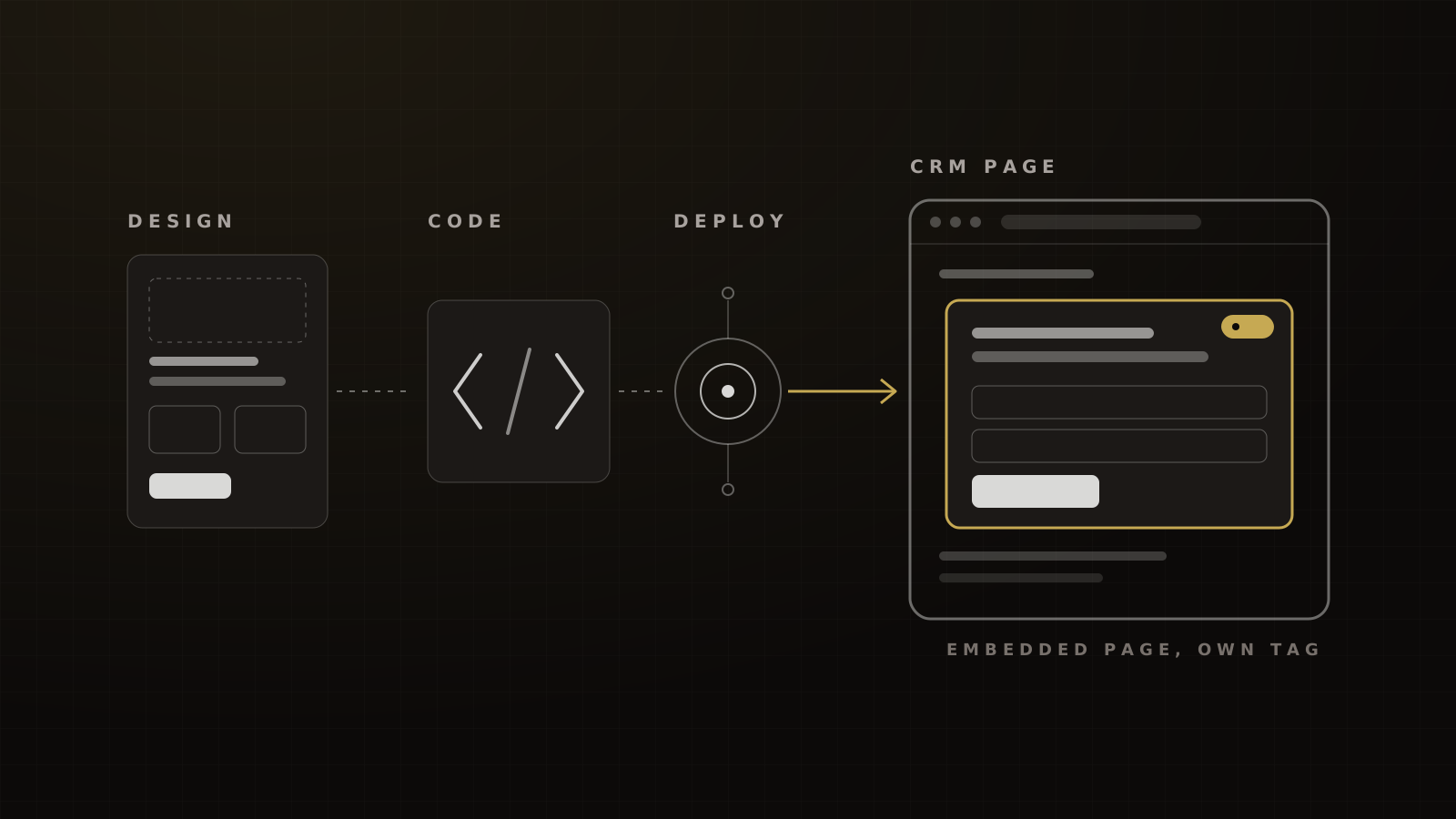
- Figma → v0 → Vercel preview. Approved comps go to v0 on a branch; the client signs off on the preview URL. Owner: designer.
- Preview → production. A human merges the pull request. No AI tool ships to production on its own. Owner: builder.
- Live page → Clarity → improvement task. Friction found in recordings becomes a ClickUp task with the session link attached. Owner: CRO lead.
- Sale → Hyros. Payments and dispositions flow to attribution, and a $0 test order proves the chain before spend. Owner: media buyer.
Victory's operating model.
If a handoff has no named owner, it will break the week that person is on vacation.
Buy for your stage
Our stack fits a team that runs paid acquisition for several clients at once. Yours may not need half of it.
Acquisition.com's $100M Scaling Roadmap stages a business by headcount rather than revenue, with one binding constraint at each stage. Early on, the job is getting people to try the offer and fixing things by hand; tooling matters more later, once you're hiring, specializing and optimizing. Buy the tool that removes your current constraint, not the one a bigger agency uses.
Hormozi's Core Four helps here too. He groups every way of getting attention into four: warm outreach, posting content, cold outreach and paid ads. Map each tool to the channel it serves. If you aren't running paid ads yet, you don't need attribution software yet.
Suites versus best-of-breed is a real trade-off. In BCG's 2025 survey of large companies, 39% of best-of-breed users spent more than 20% of their IT budget on integration, against 29% of suite users.[30] That's why GoHighLevel sits at the center and specialists only join when they earn it.
What it costs
| Tool | Assumption | Monthly |
|---|---|---|
| GoHighLevel | Unlimited or Agency Pro | $297–$497 |
| ClickUp | Business, 10 users, plus Brain AI | $210 |
| Figma | 2 Full seats | $32 |
| v0 | Plus, 2 builders | $60 |
| Vercel | Pro | $20 |
| Claude | Team, 10 standard seats, monthly | $250 |
| n8n | Pro, annual | €50 |
| Microsoft Clarity | Free | $0 |
| Total | ~$920–$1,120, rising toward $1,400 with premium AI seats |
An illustration built from list prices, not a benchmark. Excludes usage (SMS, email, AI credits, hosting overages) and Hyros. Seat counts are assumptions; adjust for your team.
Add Hyros from $230 a month once attribution earns its place.[22] And watch usage: the GoHighLevel plan fee is only 25–40% of a texting event business's total HighLevel bill in our experience, so read the true cost of GoHighLevel before you budget.
Want us to map your stack? Book a strategy call and we'll show you how we build it.
Frequently asked questions
Sources
- 1.Affiliate Program Services Agreement. HighLevel, last updated June 2026.
- 2.FTC's Endorsement Guides: What People Are Asking. Federal Trade Commission, undated page (2023 update).
- 3.2026 Marketing Technology Landscape Supergraphic: peak martech achieved (maybe). chiefmartec (Scott Brinker), 2026-05-05.
- 4.2026 SaaS Management Index. Zylo, 2026-01-29.
- 5.MarTech Replacement Survey 2025. MarTech.org, 2026-03.
- 6.HighLevel pricing. HighLevel, checked 2026-10-04.
- 7.Understanding attribution source (ad reporting). HighLevel Help Center, 2026-08-26 (modified).
- 8.ClickUp pricing. ClickUp, checked 2026-10-04.
- 9.Connect an AI assistant to ClickUp's MCP server. ClickUp Developer Docs, living doc, checked 2026-10-04.
- 10.Guide to Dev Mode. Figma Help Center, living doc, checked 2026-10-04.
- 11.Figma pricing. Figma, checked 2026-10-04.
- 12.v0 documentation. v0 by Vercel (docs), living doc, checked 2026-10-04.
- 13.Deploying Git repositories with Vercel. Vercel Docs, living doc, checked 2026-10-04.
- 14.v0 pricing. v0 by Vercel, checked 2026-10-04.
- 15.Vercel pricing. Vercel, checked 2026-10-04.
- 16.Web Vitals. Google (web.dev), living doc, checked 2026-10-04.
- 17.2026 State of Marketing. HubSpot, 2026-04-10 (updated).
- 18.How Anthropic uses Claude in marketing. Anthropic (Claude blog), 2026-01-26.
- 19.Claude Code overview. Anthropic Docs, living doc, checked 2026-10-04.
- 20.2026 State of Digital Services: digital agency industry research. Promethean Research, 2026-03.
- 21.Claude pricing. Anthropic, checked 2026-10-04.
- 22.Hyros pricing. Hyros, checked 2026-10-04.
- 23.Troubleshooting iframes and missing leads. Hyros Docs, undated, checked 2026-10-04 (search snippet of the official page).
- 24.n8n documentation. n8n, living doc, checked 2026-10-04.
- 25.n8n pricing. n8n, checked 2026-10-04.
- 26.2026 Connectivity Benchmark Report. MuleSoft, 2026-02-05.
- 27.About Clarity. Microsoft Learn, 2025-10-23 (last updated).
- 28.2026 Digital Experience Benchmark: frustration. Contentsquare, 2026-04-01.
- 29.Clarity consent management. Microsoft Learn, 2025 (effective 2025-10-31).
- 30.Seven questions for a smarter applications strategy. BCG, 2025-08-05.
Written by
Ray GillespieCo-Founder & COO
Ray runs day-to-day operations across every Victory engagement, building the systems, automations and AI-powered workflows that hold the machine together. He has overseen operations behind more than $120M in revenue.
Part of the guide: GoHighLevel for Coaches, Course Creators and Event Businesses: The Operator's Guide (and the Stack Around It)