Speed to Lead: What the Research Actually Says, and the Rule We Use
We traced the 21x, 391% and 'Harvard study' speed-to-lead stats to their sources. What each one measured, what's untraceable, and our calling rule.
 Devin AlexanderCo-Founder & CEO
Published Updated 7 min read
On this page
Key takeaways
- Calling a new lead within minutes beats calling hours later. Every study points that way.
- But the famous numbers measure contact and qualification, not closed sales, and the most-quoted studies are 12 to 19 years old.
- "21x" comes from a 2007 InsideSales.com study, not Harvard. "391%" comes from a 2012 Velocify report that never states its baseline.[2][3]
- Most companies are still slow. In a 2026 test of 114 B2B companies, none called back within 5 minutes.[9]
- Our rule: real-time rep alerts, a median first dial under one hour during staffed hours, every lead dialed within 24 hours, and at least six attempts.
Call new leads within minutes. The research supports that clearly. What it doesn't support is most of the numbers people quote to prove it.
We traced every speed-to-lead statistic that shows up in sales decks and vendor blogs back to its source. Some hold up. Some measured something narrower than people claim. A few have no source we could find. Here is each one, and the rule we actually run on our clients' sales floors.
| As quoted | Real source | What it actually measured |
|---|---|---|
| "7x more likely to qualify within an hour" | HBR, March 2011[1] | Odds of qualifying a lead, 1.25M leads at 42 firms |
| "21x more likely if called in 5 minutes" | InsideSales.com and Oldroyd, 2007[2] | Odds of qualifying, 5 vs 30 minutes, 6 companies |
| "391% more conversions within a minute" | Velocify, 2012[3] | A lift against a baseline the report doesn't define |
| "78% buy from the first to respond" | Not found | No report, sample or date located |
Ages are as of October 2026.
What HBR 2011 actually measured
"The Short Life of Online Sales Leads", by James Oldroyd, Kristina McElheran and David Elkington, ran in Harvard Business Review in March 2011. It contains two separate datasets, and they get merged constantly.[1]
The first is an audit. The authors sent test web leads to 2,241 US companies. 37% responded within an hour, 16% in one to 24 hours, 24% after more than 24 hours, and 23% never responded. Among companies that replied within 30 days, the average response took 42 hours.[1]
The second is an analysis of 1.25 million leads received by 29 B2C and 13 B2B companies. Firms that tried to contact a lead within an hour were nearly 7 times as likely to qualify it, meaning a meaningful conversation with a decision maker, as firms that tried an hour later. They were more than 60 times as likely as firms that waited 24 hours or longer.[1]
Two caveats. Qualifying isn't closing. And co-author Elkington was the CEO of InsideSales.com, a company that sold lead-response software. The data is real; it's also old and not independent.
Share of 2,241 US companies that never responded to a test web lead
Where 21x comes from
The most-quoted number in speed to lead is "21 times more likely to convert if you call within five minutes". It's usually credited to Harvard or MIT. It comes from the Lead Response Management Study, released by InsideSales.com with James Oldroyd (then at MIT Sloan) and presented at a MarketingSherpa summit in October 2007.[2]
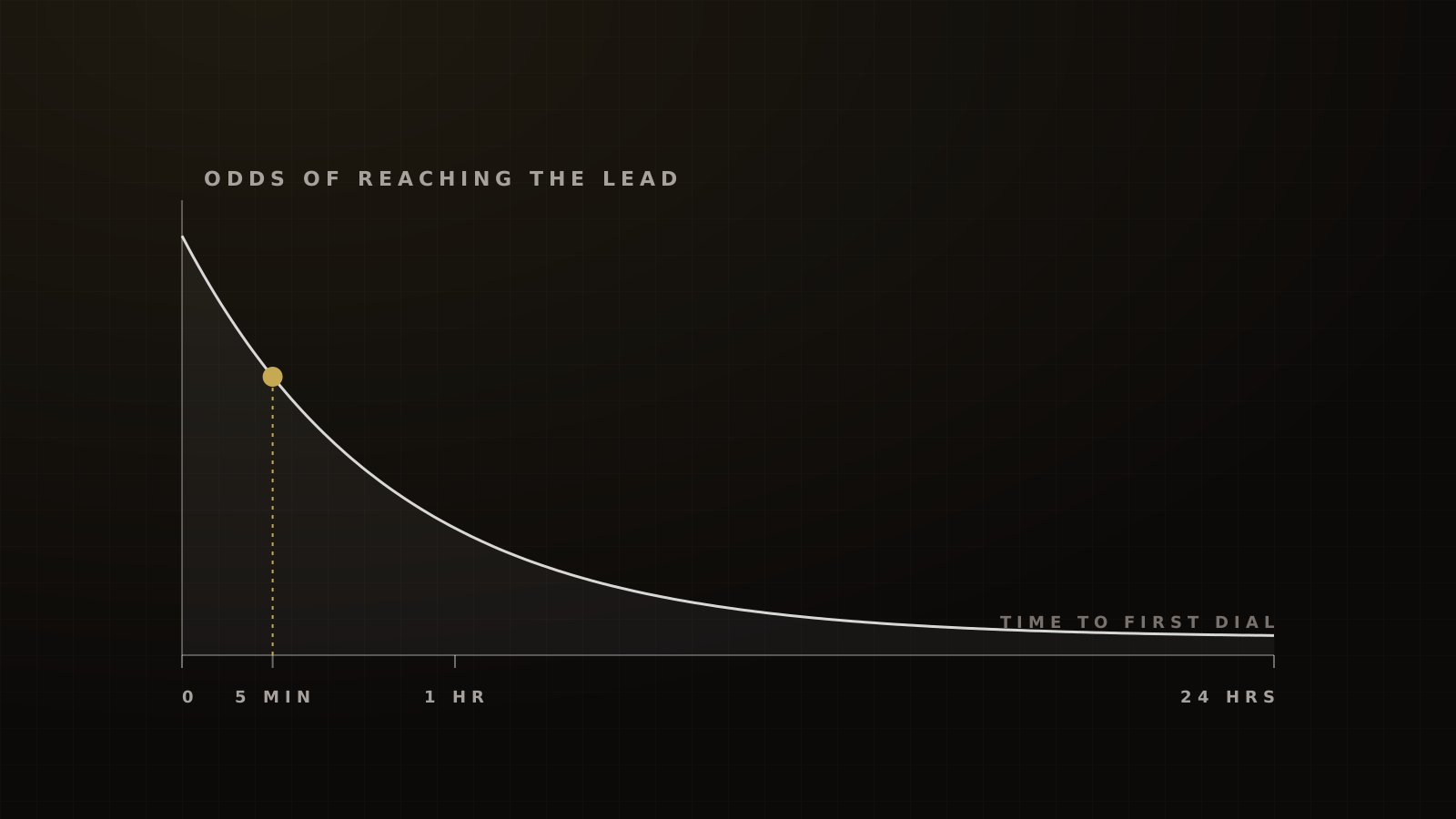
The study used InsideSales.com system data: six companies, three years, more than 15,000 web leads and more than 100,000 call attempts. Leads called within 5 minutes were 21 times more likely to be qualified than leads called at 30 minutes, and 100 times more likely to be contacted. The odds dropped fourfold between 5 and 10 minutes.[2]
And the study says plainly that it didn't address close ratios.[2] So 21x is a contact-and-qualification finding from six companies' 2000s data. It is not a sales multiplier, it's not peer reviewed, and it's not a Harvard study.
Where 391% comes from, and what it can't tell you
"Call within a minute and get 391% more conversions" comes from Velocify's The Ultimate Contact Strategy, a report built on about 3.5 million leads from more than 400 client companies in the first half of 2012, mostly in mortgage, insurance and education.[3]
Its chart shows a 391% improvement in lead conversion at one minute, 160% at two minutes, 62% at 30 minutes and 17% at 24 hours.[3] The problem: the report never says what the improvement is measured against. A 391% lift over what? Without the baseline, you can't turn it into an expected result for your team.
The same report has a finding we find more useful: 93% of converted leads were reached by the sixth call attempt.[3] Speed matters on the first dial. Persistence matters on every dial after it.
How fast companies actually respond, 2013 to 2026
Every audit since 2011 finds the same thing: most companies are slow, and many never respond at all.
| Year | Source | Sample | Finding |
|---|---|---|---|
| 2014 | InsideSales/XANT[4] | 9,538 companies | Median first call 3h 8m; 47% never responded |
| 2016 | InsideSales[5] | 4,723 companies | 38.35-hour average; 7.7% within 5 minutes |
| 2017 | Drift[6] | 433 B2B SaaS companies | 7% responded within 5 minutes |
| 2022 | Chili Piper[7] | Not disclosed | 4h 50m average; about 30% never replied |
| 2024 | RevenueHero[8] | 1,000 B2B websites | 635 never replied |
| 2026 | Workato[9] | 114 B2B companies | None called within 5 minutes; mean call response 14h 29m |
Each audit uses its own method and sample. Compare direction, not exact values.
The newest vendor data still points toward speed. InsideSales' 2021 analysis of 5.7 million leads reported an 8x higher conversion rate when contact was attempted within 5 minutes than at 6 minutes or later, though it doesn't define "conversion" clearly.[10]
Stats with no traceable source
These circulate widely. We couldn't find an original for any of them:
- "78% of customers buy from the first company to respond." Chili Piper's 2022 study repeats it as previous research, without a link.[7] No report, sample or date turned up.
- "35% to 50% of sales go to the vendor that responds first." Usually credited to InsideSales. The 2007 study explicitly didn't measure sales.[2]
- "47-hour average response time." Often credited to Drift's 433-company study. Drift's 2017 original has no 47-hour figure.[6]
- "Only 27% of leads ever get contacted." InsideSales published it in 2015 as in-house research with no sample.[11] A vendor claim at most.
None of this means speed doesn't matter. It means you should quote what was measured.
The rule we use
Alex Hormozi splits leads into five stages: uncontacted, contacted, engaged, qualified and sold. That's the right lens for this research. The studies above show speed moves leads from uncontacted to contacted and qualified. Closing is still the job of the sale.
Framework
Victory's speed-to-lead rule
- Alert in real time. Every new lead or buyer triggers an instant text to the rep on shift, with the contact's details. Nobody waits for a CRM refresh.
- Dial fast during staffed hours. Our target is a median time to first dial under one hour while the team is on. Faster is better; the hour is the line we hold.
- Twenty-four hours is the outer limit, not the target. Every lead gets dialed within 24 hours, including the ones that come in overnight.
- Six attempts minimum. At least six call attempts on every unconverted new lead within its first two weeks.
- Measure your own clock. Track time to first attempt, first conversation, booked, showed and sold, per rep, every week.
You kind of got to get them on the phone within the first 24 hours.
Our 24-hour line is looser than the five-minute studies, and we say so on purpose. Five minutes is the ideal. Twenty-four hours is the floor for intake teams that are drowning. When a team can't hit the floor, the fix is usually capacity, not more leads.
The same logic applies after the first call. Speed to the appointment matters too. In our experience, booked high-ticket sales calls show 82% to 88% of the time when they're booked no more than about three days out. Leave the calendar open two weeks ahead and the show rate drifts down.
Calling fast without breaking the rules
Speed creates compliance risk when you automate it. A few points every team should know:
- A form fill isn't blanket consent. Autodialed or prerecorded marketing calls and texts generally need prior express written consent.
- AI voices count as artificial voices. The FCC said so in a February 2024 declaratory ruling.[13]
- The one-to-one consent rule is gone. The Eleventh Circuit vacated the FCC's one-to-one consent requirement in January 2025.[12] Don't describe it as in force.
- Opt-outs still apply. The FCC delayed the cross-category "revoke all" provision to January 31, 2027, but ordinary revocations must still be honored.[14]
- Calling hours. The FTC's Telemarketing Sales Rule bars outbound telemarketing calls before 8 a.m. or after 9 p.m. local time.[15]
Common mistakes
- Quoting 21x as a close-rate multiplier. It measured qualification at six companies in the 2000s.
- Letting closers work only booked calls. Unbooked leads then go uncalled, and nobody owns them.
- Stopping after one or two attempts. Most converted leads take several.
- Automating calls before fixing consent. Speed with a TCPA problem is a liability, not a sales system.
Frequently asked questions
Sources
- 1.The Short Life of Online Sales Leads. Harvard Business Review (Oldroyd, McElheran, Elkington), 2011-03.
- 2.Lead Response Management Study. InsideSales.com and James Oldroyd, 2007-10-16.
- 3.The Ultimate Contact Strategy. Velocify, 2012-12 (approx.).
- 4.Annual 2014 Lead Response Report. InsideSales.com (XANT), 2014.
- 5.Companies are getting slower at lead response. InsideSales.com (XANT), 2016-10-20.
- 6.Lead response survey. Drift (hosted by Salesloft), 2017-02-27.
- 7.Chili Insights: vendor response time. Chili Piper, 2022-02-04.
- 8.B2B lead response times. RevenueHero, 2024-03-20.
- 9.Lead response time study. Workato, 2026-03-19.
- 10.Lead Response Management 2021 (infographic). InsideSales, 2021-02.
- 11.Sales lead follow-up test. InsideSales.com, 2015-08-04.
- 12.Insurance Marketing Coalition v. FCC, No. 24-10277. US Court of Appeals, Eleventh Circuit, 2025-01-24.
- 13.Declaratory Ruling FCC 24-17 (AI-generated voices under the TCPA). Federal Communications Commission, 2024-02-08.
- 14.Order DA 26-12 (revocation rule effective date extended). Federal Communications Commission, 2026-01-06.
- 15.Complying with the Telemarketing Sales Rule. Federal Trade Commission, current, checked 2026-10-04.
Written by
Devin AlexanderCo-Founder & CEO
Devin architects Victory's revenue systems: team structure, comp plans, scripts and the accountability frameworks that make sales floors predictable. He has generated more than $150M in sales and trained more than 250 closers.
Part of the guide: Building a High-Ticket Sales Team: Setters, Closers, Comp Plans and Show Rates