Using AI to Audit Every Sales Call: Rep Scorecards and an Objection Bank
How to have AI score every recorded sales call, send a weekly rep scorecard and build an objection bank, plus the consent and data rules to settle first.
 Devin AlexanderCo-Founder & CEO
Published 9 min read
On this page
Key takeaways
- Connect your call recorder to an AI model, score every call by category out of 10, send each rep a weekly report, and pool every objection into one shared bank.
- Most reps aren't getting call feedback now. In Salesforce's 2026 survey, 46% of Gen Z reps said they rarely get feedback on their sales conversations.[1]
- Settle two things before you build: recording consent, because several states require every party's consent, and where the transcript data goes.
- Make every score checkable: a quote and a timestamp behind each number, and human calibration before you rank anyone.
- The objection bank is the part most teams miss. It feeds your ads and your pre-call sequences, which closes the gap between sales and marketing.
Pull every recorded sales call out of your recorder automatically and have an AI model score it against a fixed rubric. Send each rep a weekly scorecard with one win to keep and one thing to fix. Pool every objection into a shared bank that marketing uses for ads and pre-call sequences.
Before any of that, get two things right: recording consent on every call, and a clear answer on where the transcripts go and how long they stay there.
Here is the build, step by step, and the rules around it.
Why managers never review calls
Every sales manager agrees call review matters. Almost none do enough of it, because it takes hours a manager doesn't have.
The gap shows up in the data. Salesforce's 2026 survey of 4,050 sales professionals found 46% of Gen Z reps rarely get feedback on their sales conversations, even though 87% of sales organizations use some form of AI.[1] Over half of reps said courses and guides don't give them the skills they need.[2]
Estimates of how much time managers spend coaching swing widely. Highspot's 2025 survey reported 13 hours a week, but it doesn't say how many respondents were managers or how coaching was defined.[3] Estimates swing with how coaching is defined. Either way, nobody listens to every call.
AI changes the cost. In our experience, AI saves our ops team 15 to 20 hours a week across call notes, task plans and reporting. That's in line with HubSpot's 2026 survey, where about a third of marketing teams said AI saves them 10 to 14 hours a week and another third said 15 or more.[4] Scoring every call used to be a staffing decision. Now it's a setup task.
The build in five steps
Step 1: get the recordings out
Start with the recorder you already use. We use Fathom as the example here, but the pattern is the same for any tool with an API.
Fathom's API keys are per user and cover meetings you recorded or that were shared with you or your team. The meetings endpoint can include transcripts with each line attributed to a speaker.[5] Webhooks push meeting data, including the summary, transcript and action items, to your own URL after each meeting.[6]
Each webhook request is signed with ID, timestamp and signature headers.[6] Verify the signature before you process anything, so nobody can feed fake transcripts into your scorecards.
Step 2: decide where the data goes
A sales call holds a buyer's finances, goals and sometimes health details. Know what happens to it before it leaves your recorder.
- Anthropic says it doesn't use inputs or outputs from its commercial products, including the API, to train its models by default.[7] API inputs and outputs are deleted within 30 days, except for longer-retention features, zero-data-retention agreements, or legal and policy holds.[8]
- OpenAI says it hasn't trained on API data by default since March 1, 2023, and keeps abuse-monitoring logs for up to 30 days by default.[9]
Consumer chat plans can work differently, so check the terms for the exact product you use. Strip card numbers and health details from transcripts before they reach a prompt, and ask your provider whether a zero-data-retention agreement is available.
Step 3: the scorecard
The scorecard is the "document" in Hormozi's Document, Demonstrate, Duplicate: it writes down what a good call looks like, so every rep is measured against the same thing.
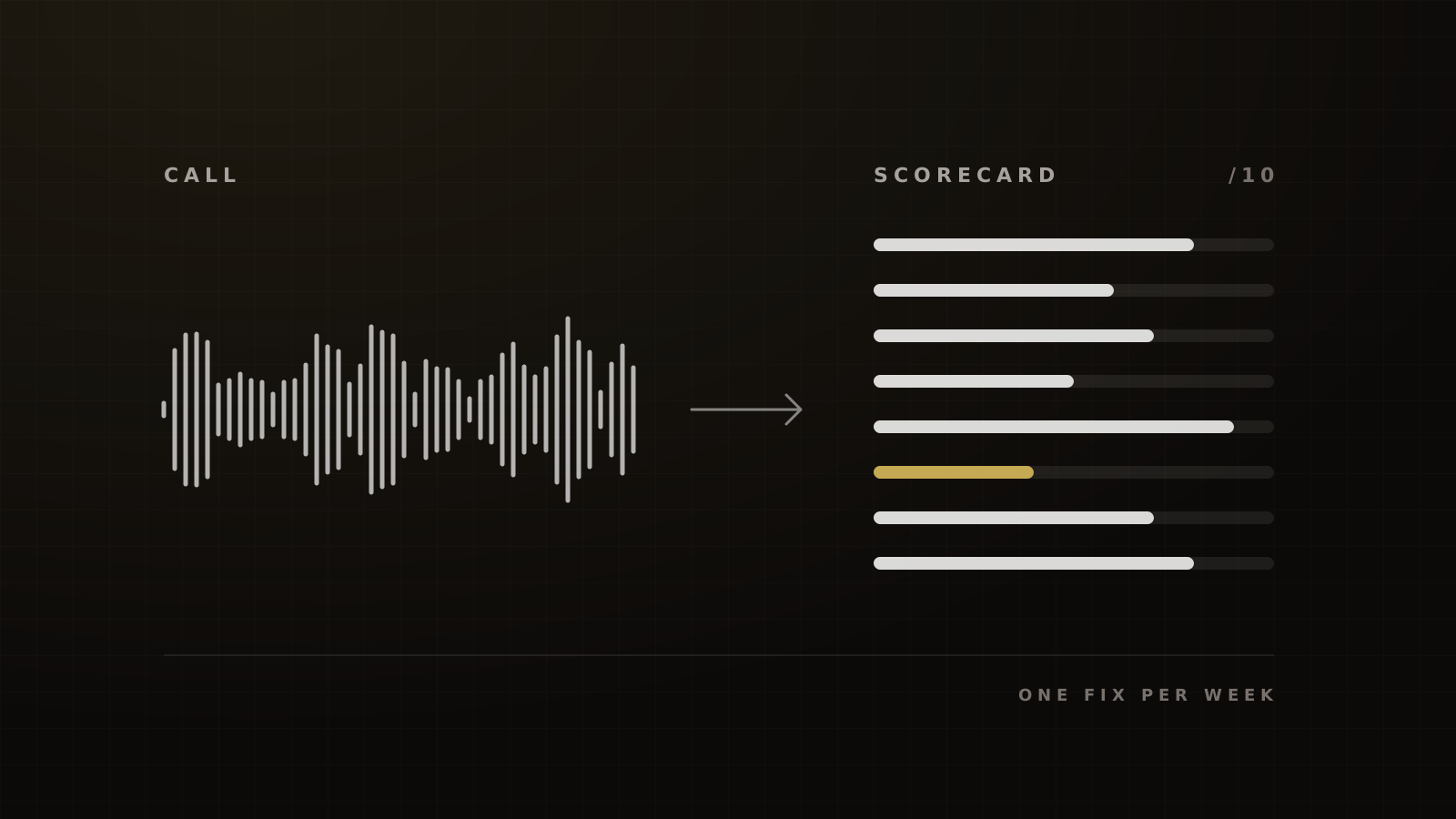
Score each stage of a high-ticket call out of 10:
High-ticket call scorecard
- Opener: sets the agenda and earns permission to ask questions
- Discovery: gets the buyer's situation, goals and timeline
- Pain: finds the real cost of not changing, in the buyer's words
- Offer: presents the program against that pain, not as a feature list
- Objections: names the real objection and answers it
- Close: asks clearly for the decision
- Talk ratio: lets the buyer do most of the talking
- Next step: ends with a booked next action, whatever the outcome
Three rules make the scores usable. Allow "not observable" when a stage never happened, so the model doesn't invent a score. Require a quote and a timestamp for every score, so a manager can check it in seconds. And keep the rubric fixed for a full month before you change it, or week-to-week comparisons mean nothing.
Talk ratio is the one category you can measure directly. Gong's call analysis linked winning calls to about 43% talking and 57% listening, and talking more than 65% of the call to lower win rates.[10] It's B2B data with no restated sample, so treat it as a prompt, not a target.
Can a model score reliably against a rubric? Research on medical training dialogues found the best model reached agreement with experts close to the experts' agreement with each other.[11] That isn't sales data, so calibrate before you trust the scores (more below).
Step 4: the weekly report
Every recorded call gets scored within 24 hours, and every rep gets a weekly scorecard. There's no industry benchmark for audit coverage; that's the standard we run.
Keep each report short:
- Average score by category, against last week
- One win to praise, with the clip
- One thing to fix, with the clip and what good sounds like
- New objections heard this week
One fix per rep is deliberate. A list of eight problems gets ignored. One clear fix gets practiced.
Acting on the audit is what matters. Gong Labs' analysis of more than 1 million opportunities across 1,418 organizations found deals where reps completed all the AI-recommended to-dos had 50% higher win rates.[12] It's observational vendor data, so it shows association, not cause. But the lesson is clear: a score nobody acts on changes nothing.
Step 5: the objection bank
Every objection in every call goes into one shared bank: the exact quote, the timestamp, the rep, the lead source and whether the call closed.
After a month you can see which objections come up most, which lead sources bring which objections, and which answers actually close. Approved answers go into the closer playbook. Unapproved ones stay out until a manager signs off.
Close the loop: objections into ads and pre-call sequences
This is where most teams stop short. The objection bank isn't just a sales tool. It's the best market research you have, recorded in your buyers' own words.
Devin calls it removing the "departmental conversational gap" between sales and marketing. Here's how we use it:
- Ads. The objections buyers raise on calls become angles and hooks that answer them before the click.
- Pre-call sequences. The top three objections get handled in the emails, texts and videos a lead sees before the call. The closer starts the call further along.
- Show rates. A lead who has had their doubts answered is more likely to turn up. In our experience, booked high-ticket calls show 82% to 88% of the time when they're booked no more than about three days out. We cover the full approach in how to reduce sales call no-shows.
One rule: only approved claims go into ads. An objection bank must never turn into a source of income or results promises your business can't substantiate.
Recording consent: one-party vs all-party
Federal law allows recording when one party to the call consents.[13] Several states require every party's consent, and your buyer may be in one of them.
| State | Statute | Note |
|---|---|---|
| California | Penal Code §632[14] | Confidential calls; fines up to $2,500 per violation |
| Florida | §934.03[15] | All parties' prior consent |
| Washington | RCW 9.73.030[16] | A recorded announcement counts as consent |
| Pennsylvania | 18 Pa.C.S. 5704[17] | All parties' prior consent |
| Maryland | CJP 10-402[18] | All parties' prior consent |
| New Hampshire | RSA 570-A:2[19] | Consent of all parties |
| Massachusetts | c.272 §99[20] | Turns on recording "secretly" |
| Illinois | 720 ILCS 5/14-2[21] | Turns on "surreptitious" recording of private conversations |
Not a complete list. Connecticut, Delaware, Nevada, Montana and Michigan have rules that need a lawyer's reading, so they aren't listed here.
The simplest safe practice: announce at the start of every call that it's recorded and analyzed by AI, and get a clear yes. Washington's statute treats a recorded announcement as consent.[16]
AI notetakers are already in court. In August 2026, a federal judge in California let parts of a wiretap class action against Otter.ai proceed past the motion to dismiss.[22] That's a pleading-stage ruling, not a finding of liability. The lesson still holds: disclose the bot, the recording and the AI analysis.
Keep a human in the loop
AI scores are a starting point, not a verdict. Models have habits, such as scoring generously or rewarding long answers, and a manager has to catch them.
The research is honest about this. In the SIGDIAL 2025 study, the best model reached a kappa of 0.68 against 0.71 for human experts. The experts themselves agreed only 65% of the time at first.[11] Humans disagree too, which is why calibration matters more than the model.
Before you rank reps, have two managers score the same 10 calls by hand. Compare their scores with the model's and adjust the rubric where they split. Repeat monthly.
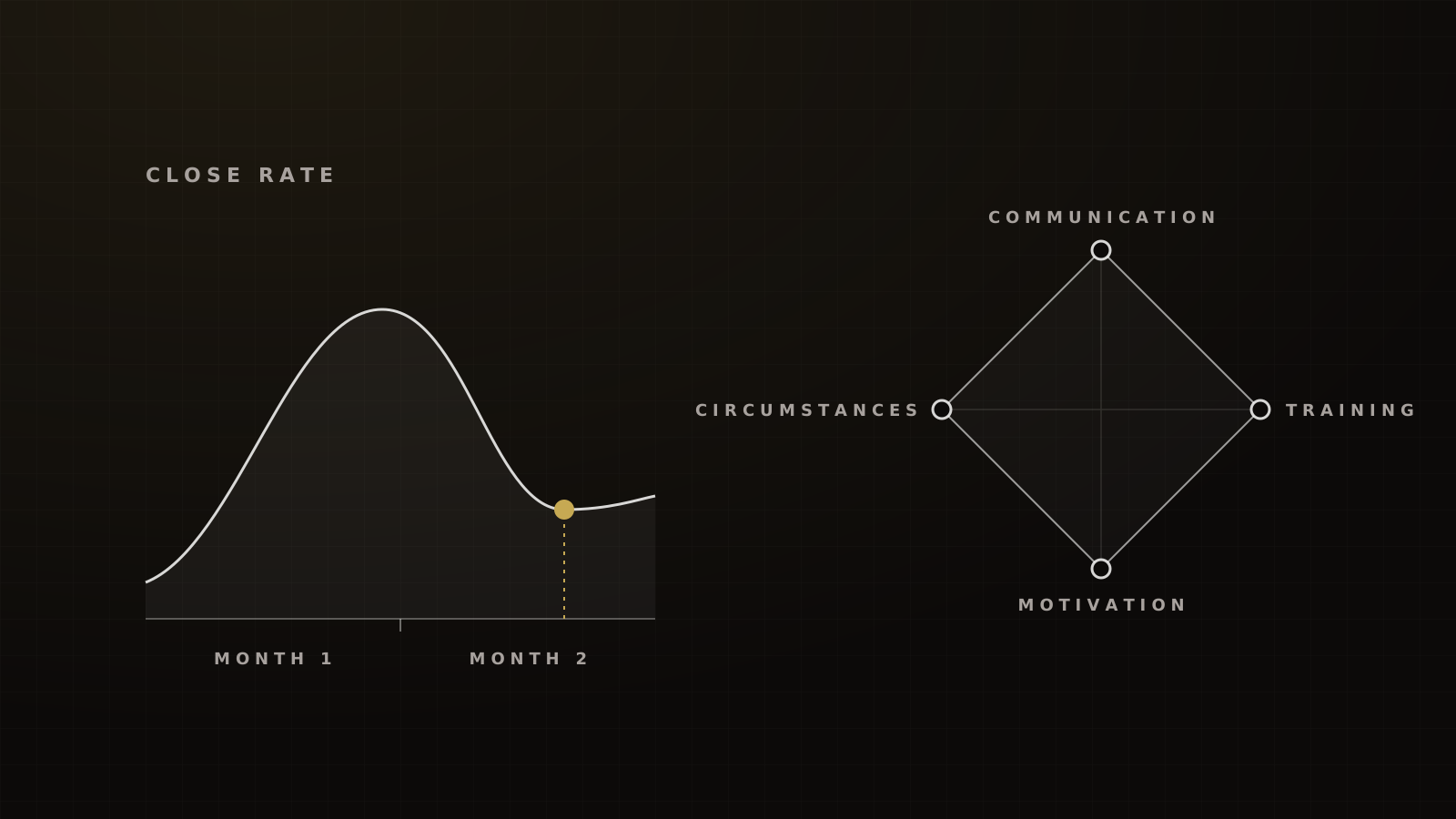
When a rep's scores drop, the scorecard tells you where, but not always why. Use it alongside Hormozi's Performance Diamond to work out whether it's a communication, training, motivation or circumstances problem. Our guide to diagnosing a month-two slump walks through it.
Common mistakes
- Scoring without consent. Fix the call disclosure before you connect anything.
- Trusting raw scores. Calibrate against your managers first.
- Reporting everything. One fix per rep per week beats a wall of numbers.
- Keeping objections in sales. The bank is worth most when marketing uses it.
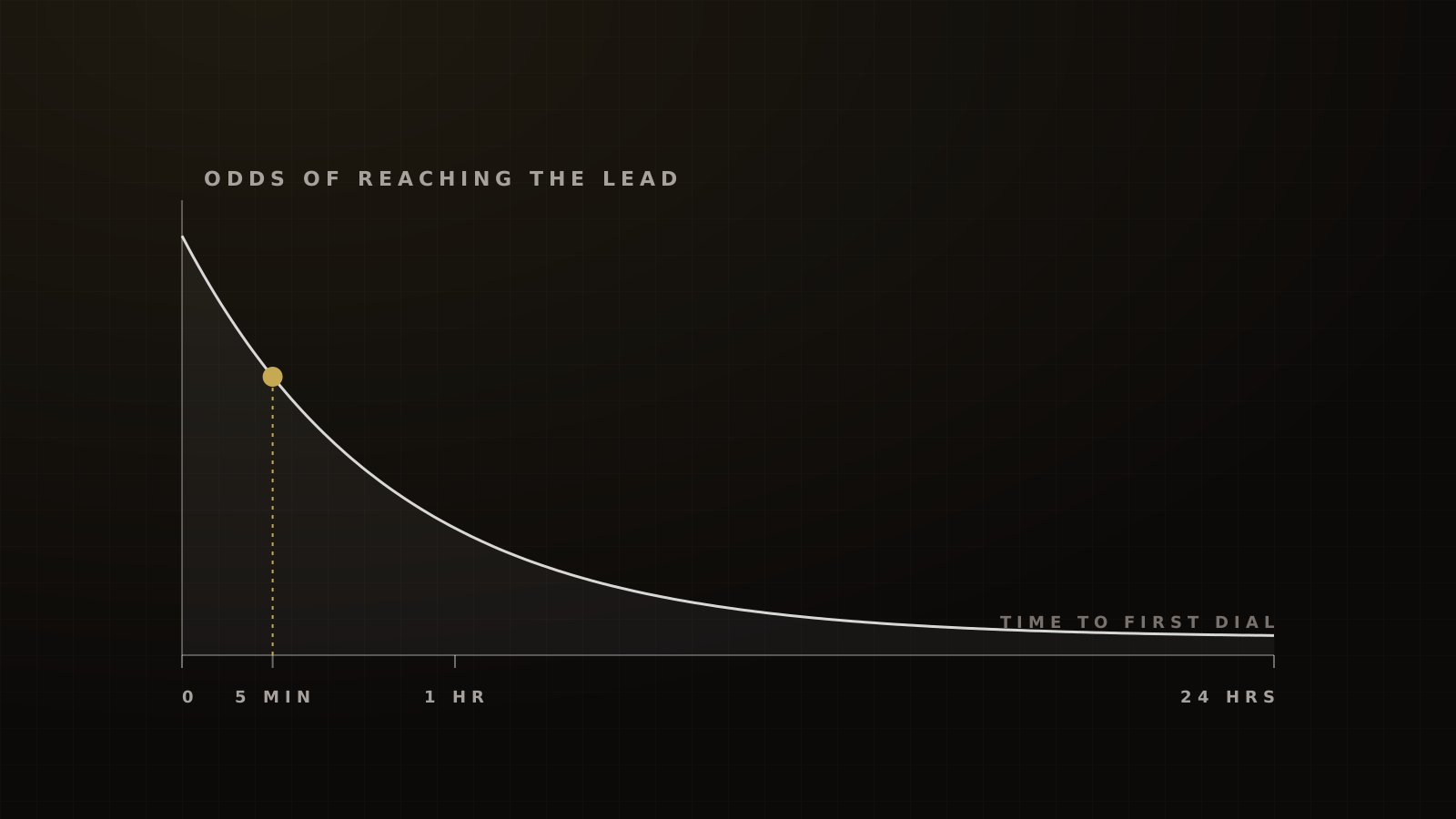
- Scoring slow follow-up instead of fixing it. If leads wait a day for a call, start with speed to lead.
Call audits are one part of a working sales floor. For the rest, read our guide to building a high-ticket sales team, and for how we use AI across the agency, see AI marketing operations. Want to see how we build it for your team? Book a strategy call.
Frequently asked questions
Sources
- 1.State of Sales 2026 announcement. Salesforce, 2026-02-03.
- 2.State of Sales, 7th edition. Salesforce, 2026.
- 3.State of Sales Enablement 2025. Highspot, 2025-06-26.
- 4.2026 State of Marketing. HubSpot, 2026-04-10 (updated).
- 5.Quickstart. Fathom Developers, 2026-08-10.
- 6.Webhooks. Fathom Developers, 2026 (live page, checked 2026-10-04).
- 7.Is my data used for model training?. Anthropic Privacy Center, 2026-08-18.
- 8.How long do you store my organization's data?. Anthropic Privacy Center, 2026-07-01.
- 9.Your data (API docs). OpenAI, 2026 (live page, checked 2026-10-04).
- 10.Talk-to-listen conversion ratio. Gong, 2025-08-21.
- 11.LLM vs human expert grading of transcribed dialogues against a rubric. Schiott et al., SIGDIAL 2025 (ACL Anthology), 2025-08.
- 12.We measured the ROI of AI in sales. Gong Labs, 2024-02-15.
- 13.18 U.S.C. 2511. Cornell Legal Information Institute (US Code), current, checked 2026-10-04.
- 14.California Penal Code section 632. California Legislature, current, checked 2026-10-04.
- 15.Florida Statutes section 934.03. Florida Senate, 2024.
- 16.RCW 9.73.030. Washington State Legislature, current, checked 2026-10-04.
- 17.18 Pa.C.S. 5704. Pennsylvania General Assembly, current, checked 2026-10-04.
- 18.Courts and Judicial Proceedings 10-402. Maryland General Assembly, current, checked 2026-10-04.
- 19.RSA 570-A:2. New Hampshire General Court, current, checked 2026-10-04.
- 20.General Laws chapter 272, section 99. Massachusetts Legislature, current, checked 2026-10-04.
- 21.720 ILCS 5/14-2. Illinois General Assembly, current, checked 2026-10-04.
- 22.In re Otter.AI Privacy Litigation, No. 5:25-cv-06911-EKL, order on motion to dismiss. US District Court, N.D. Cal., via Courthouse News, 2026-08-13.
Written by
Devin AlexanderCo-Founder & CEO
Devin architects Victory's revenue systems: team structure, comp plans, scripts and the accountability frameworks that make sales floors predictable. He has generated more than $150M in sales and trained more than 250 closers.
Part of the guide: Building a High-Ticket Sales Team: Setters, Closers, Comp Plans and Show Rates