Why Your Sales Team Fell Off in Month Two: Diagnosing Closers With Hormozi's Performance Diamond
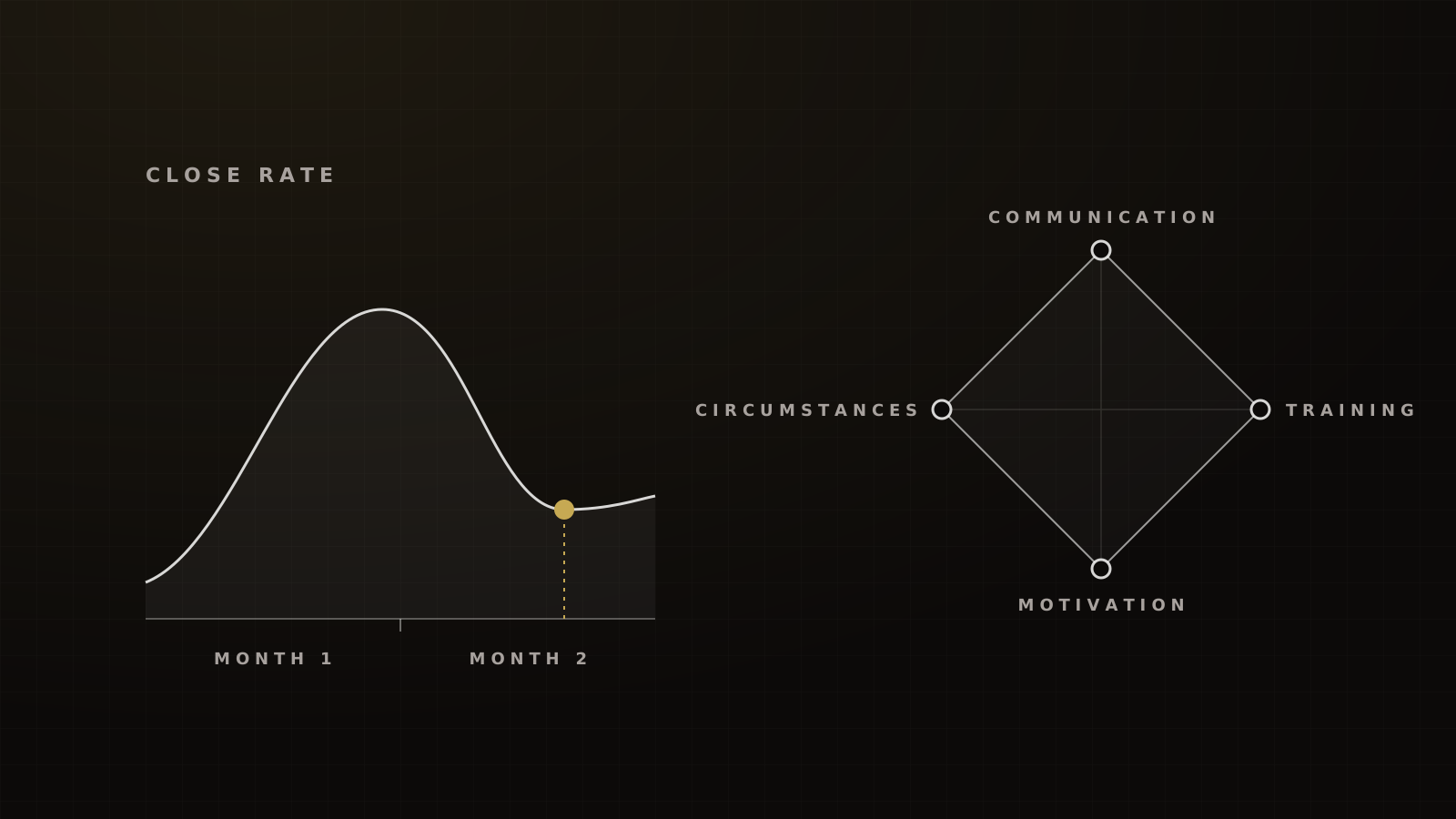
Closers who started strong and then slumped usually have one of four problems. How to diagnose which with Hormozi's Performance Diamond and call audits.
 Devin AlexanderCo-Founder & CEO
Published 9 min read
On this page
Key takeaways
- A closer who starts strong and then slumps almost always has one of four problems: communication, training, motivation or circumstances. That's Alex Hormozi's Performance Diamond.[1]
- Check them in that order. The early causes are cheaper to find and fix, and they're usually yours, not the closer's.
- A dip isn't proof of a bad hire. Even in mature B2B teams, only 48% of account executives hit quota.[2]
- Diagnose from call recordings, not opinions. Compare month-one and month-two calls on similar leads at the same price.
- Hire experienced closers so you have less to diagnose later. Trainability is the second filter, not the first.
When a closer starts strong and slumps in month two, don't reach for a pep talk. A pep talk fixes none of the four things that usually cause it.
Check four causes, in order. Communication: do they know exactly what you want? Training: can they show you they can do it? Motivation: is the pay and lead flow worth their hour? Circumstances: is something blocking them, such as worse leads, a price change or a broken calendar?
Then fix the real cause, using call audits as evidence. And for the next hire, start with experience.
What a month-two slump looks like (and when it's normal)
The pattern is familiar. Month one goes well. The closer is fresh, the founder is watching, and the warmest leads are in the calendar. Then numbers slide, and the founder starts wondering whether they hired the wrong person.
Sometimes they did. Often they didn't. Ramp is hard even for well-run B2B teams:
- In Bridge Group's 2026 survey of 158 B2B companies, account executives took 6.2 months on average to ramp, and 48% were at quota.[2]
- Its 2025 SDR study put ramp at 3.0 months and median annual attrition at 40%.[3]
- In Xactly's 2024 survey of 230 companies, 47% expected 10% or more of new account executives not to last through ramp. 26% didn't know.[4]
So a dip is a signal to inspect, not a verdict. Here's the yardstick we use to tell a slump from a ramp. In our experience, an experienced closer placed into a working offer reaches a full call load in 2 to 4 weeks, and a trained closer reaches 70% to 90% of the founder's close rate by day 60. There's no industry benchmark for either; they're the bars we hold.
A closer below that line at day 60, on leads and pricing that haven't changed, has a real problem. Now find out which one.
Hormozi's Performance Diamond, applied to closers
Hormozi describes four reasons someone's performance drops, and he checks them in a fixed order: communication, training, motivation, circumstances.[1] He credits Leila Hormozi with the habit at its core: instead of asking "do you understand?", have the person tell you what they heard.
An older model points the same way. Thomas Gilbert's Behavior Engineering Model, from 1978, says to check a person's environment (information, tools and incentives) before the person (knowledge, capacity and motives), because environmental fixes are usually cheaper.[5]
The order matters because most month-two problems start on the manager's side of the desk.
Framework
The month-two diagnostic
- Communication. Ask the closer to repeat back the priorities: which leads come first, the offer, the price, what they can and can't promise. If their answer differs from yours, you found it.
- Training. Have them run a role-play of the hardest part of the call. Watching them do it tells you more than asking whether they know how.
- Motivation. Do the commission-per-hour math on their current lead flow. If the answer has dropped, so has the effort.
- Circumstances. List everything that changed since month one: price, lead source, ad angle, calendar settings, booking window, tech.
Performance Diamond credited to Alex Hormozi (feedback question credited to Leila Hormozi). Document, Demonstrate, Duplicate from Hormozi's $100M Leads. Applied to closers by Victory.
Communication: priorities repeated back
A closer can't hit a target they've only half heard. Role ambiguity is one of the strongest negative drivers of sales performance in the research: a 2011 meta-analysis put it at −.25, against .28 for selling knowledge.[6]
In practice, communication failures look like a closer chasing old leads instead of new ones, or pitching the old package after the offer changed. Have them repeat the priorities back, every time something changes.
Training: demonstrate, don't ask "do you understand?"
Most reps say they don't get enough training or feedback. In Salesforce's 2026 survey of 4,050 sales professionals, over half said courses and guides don't give them the skills they need, and many said they don't get enough feedback on their calls.[7]
The fix is Hormozi's Document, Demonstrate, Duplicate method. Write down how the call should go. Run it in front of the closer. Have them run it in front of you, and adjust the document until their results match yours.
Recordings show training gaps quickly. Gong's call analysis links winning calls to a talk-to-listen ratio of about 43:57, and talking more than 65% of the call to lower win rates.[8] That's B2B data with no restated sample, so use it as a prompt to listen, not a target.
Coaching quality matters more than frequency. A study of 1,246 pharmaceutical reps found managers' coaching skill drove goal attainment, while more frequent coaching actually hurt when that skill was low.[9]
Motivation: commission per hour, not pep talks
Closers do the math even when founders don't. Run it for them (an illustration, not a client result):
| Month one | Month two | |
|---|---|---|
| Calls a day | 5 | 5 |
| Close rate | 20% | 10% |
| Commission per sale (10% of a $5,000 offer) | $500 | $500 |
| Commission per call | $100 | $50 |
Hypothetical figures. In our experience a full-time closer holds 4 to 6 high-ticket calls a day; swap in your own price, close rate and commission.
Halve the close rate, whether from worse leads or a harder price, and the closer's hour is worth half as much. Effort follows.
The broader data shows how much pay pressure there is. Xactly's 2025 report found 87% of companies say their sales teams struggle to meet or exceed quota, and 62% are shifting to performance-based pay.[10] Paying people correctly matters too: 66% of B2B compensation leaders in CaptivateIQ's 2025 survey said they had over- or underpaid commissions in the past year.[11] QuotaPath's leader survey estimated 22% of reps have a commission dispute each year and 9% quit over commission errors.[12]
Plan mechanics change effort as well. When one company removed quotas and earnings caps from its sales plan, revenue rose 9%.[13] We cover how to structure pay in how to pay high-ticket closers.
Circumstances: price changes, lead shifts, calendar breaks
This is the leg founders skip, because it's usually their own doing. Things that change a closer's results without changing the closer:
- A price increase. New price, new objections, new buyer.
- A lead-source shift. A new ad angle or audience brings different people to the call.
- An overfilled calendar. We cap closer calendars at 75% to 80% of available slots. Above that, follow-up disappears.
- A falling show rate. In our experience, booked high-ticket calls show 82% to 88% of the time when booked no more than about three days out. A wider booking window means more empty slots. See how to reduce sales call no-shows.
- A role change. Success in one job doesn't guarantee success in the next. Research on 131 US firms found companies promote their best salespeople, who then tend to do worse as managers.[14] Promoting a setter to closer isn't the same move, but the lesson carries.
The case: a strong month one, then a price change
A coach-training company brought in an outsourced sales team. Month one came in just short of its revenue goal. Then two things changed at once: the offer price went up by about two-thirds, into five figures, and a setter was promoted to closer. Results fell off. The team was closing 18 of 95 qualified calls.
Run it through the Diamond:
- Circumstances. The price change created a different sale, with different buyers and different objections.
- Training. The promoted setter had booked calls, not closed them, and had never sold at the new price.
- Motivation. A closer who doesn't believe in the price doesn't sound convinced on the call. Devin's diagnosis was closer state and experience.
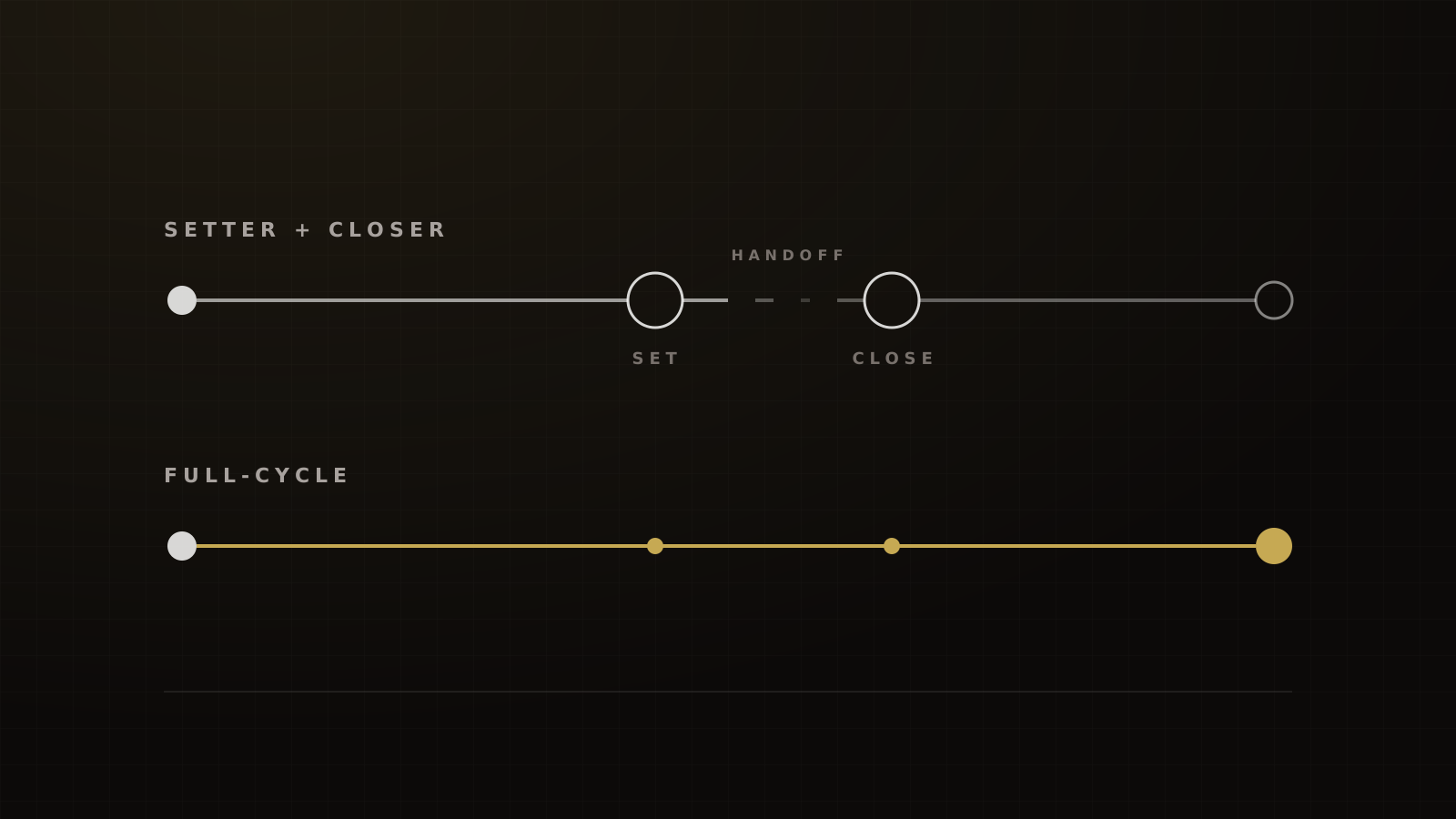
The fix wasn't a pep talk. Fix conversion before scaling spend. Move calls to the phone instead of video. And have one closer own each prospect from first touch to last, so context and trust don't get lost in a handoff.
Use call audits as evidence, not opinions
"The closer lost their edge" is an opinion. A recording is evidence.
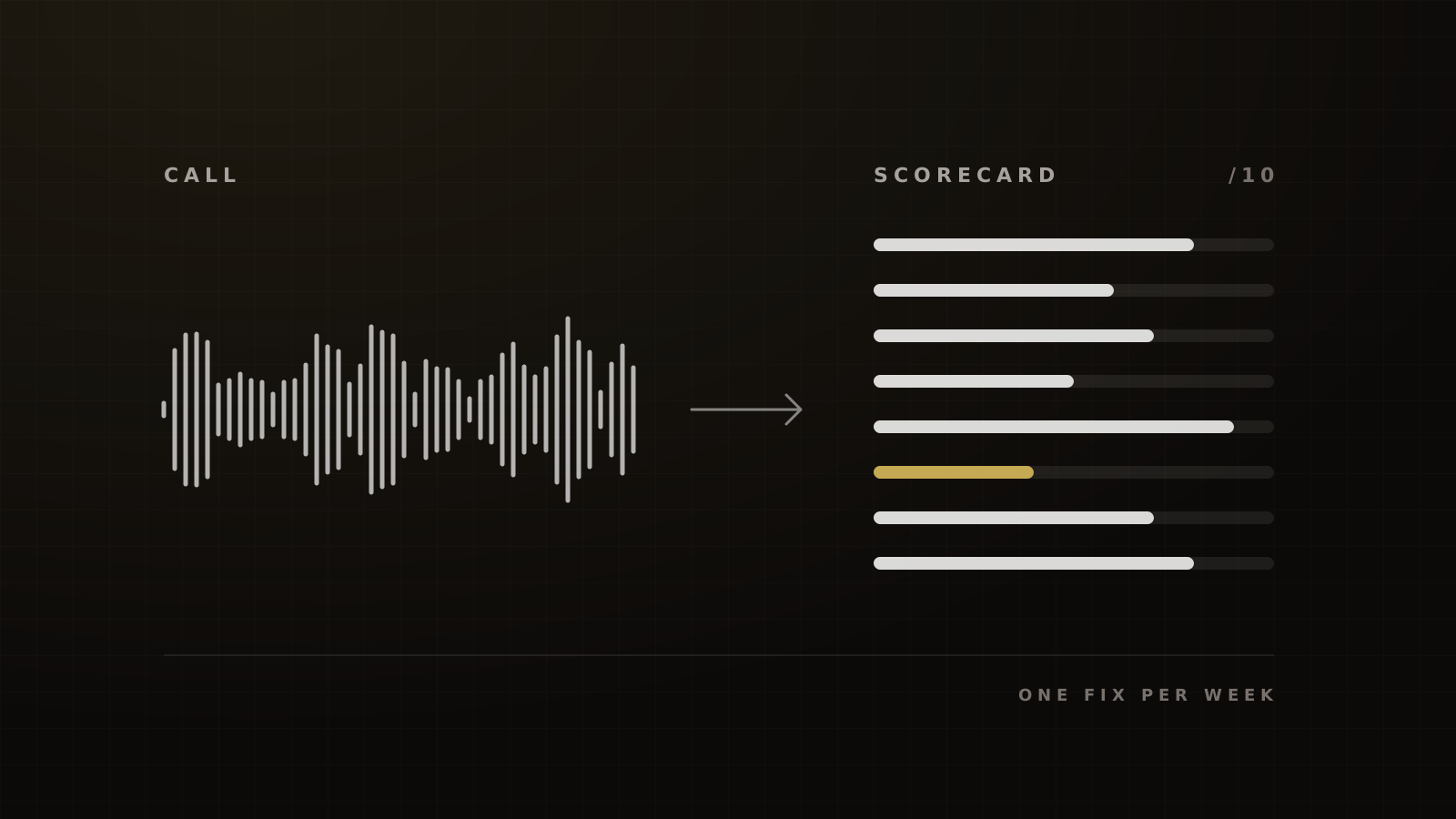
Pull calls from month one and month two with similar leads at the same price, and compare them on the same scorecard. If the calls sound the same and results dropped, look at circumstances. If the calls got worse, look at training and motivation.
Structured coaching tracks with better results. CSO Insights' 2019 study of 918 sales and enablement professionals found organizations with a dynamic coaching approach averaged a 55.2% win rate on forecast deals, against 41.8% with a random approach.[15] CEB research reported a 19% performance gap for middle-of-the-pack reps between the best and worst coaches.[16] Both are correlations, and both are old, but they point the same way.
Gong's guidance for frontline managers is at least one call per rep per week.[17] We go further: every recorded call is scored automatically within 24 hours, with a weekly scorecard per rep. Here's how we build that: using AI to audit every sales call.
Hire so you don't have to diagnose: experience first
The cheapest slump to fix is the one you never hire into.
We would never install somebody into your offer that has not had extensive sales experience.
The research backs it, with a nuance. A study tracking new hires in B2B sales and in high-end B2C direct sales found prior experience predicted stronger initial sales, and somewhat slower growth after that.[18] When a founder is handing off live calls, early production is what matters. An older meta-analysis found measures of sales ability predicted objective sales results (r = .37).[19]
Trainability still counts. Articulate, quick-thinking people can be trained well. Treat it as the second filter, after experience, and vet both with live call audits. If you're making your first hire, read when to hire your first closer.
A number to stop repeating
"Reps forget 87% of their training within 30 days" shows up in decks everywhere. Clario traced it and found no study behind it.[20] Forgetting is real. That number isn't.
For the bigger picture on setters, closers, comp and show rates, read our guide to building a high-ticket sales team. If your team has slumped and you want a second set of eyes on the calls, book a strategy call.
Frequently asked questions
Sources
- 1.24. Section D. Expanded Employees Chapter ($100M Lost Chapters audiobook). Alex Hormozi, The Game podcast, 2025-11-14.
- 2.AE Models, Motions & Metrics, 10th edition. The Bridge Group (Matt Bertuzzi), 2026-06-22.
- 3.2025 SDR Models & Metrics Report. The Bridge Group, 2025-02-06.
- 4.2024 Sales Compensation Survey. Xactly, 2023-11 (announced 2024-01).
- 5.Evidence for the Behavior Engineering Model. Boise State University, OPWL Workplace Research Center, 2025-04-21.
- 6.Drivers of sales performance: a contemporary meta-analysis. Verbeke, Dietz & Verwaal, Journal of the Academy of Marketing Science, 2011.
- 7.State of Sales, 7th edition. Salesforce, 2026.
- 8.Talk-to-listen conversion ratio. Gong, 2025-08-21.
- 9.Is coaching related to sales goal attainment?. Dahling, Taylor, Chau & Dwight, Personnel Psychology, 2016 (online 2015-12-16).
- 10.Xactly sales compensation report: 87% of sales teams struggle to meet or exceed quotas. Xactly, 2025-02-11.
- 11.2025 State of Incentive Compensation Management. CaptivateIQ, 2025-05-06.
- 12.2024 Compensation Trends report. QuotaPath, 2024.
- 13.Eliminating sales quotas may stimulate profits. Stanford GSB Insights (on Misra & Nair, Quantitative Marketing and Economics), 2011.
- 14.Promotions and the Peter Principle. Benson, Li & Shue, Quarterly Journal of Economics, 2019-08-16.
- 15.5th Annual Sales Enablement Study. CSO Insights (Miller Heiman Group), 2019.
- 16.Strengthen your core (reporting CEB / Sales Executive Council research). Selling Power, 2013-02-07.
- 17.Coaching for frontline managers. Gong Help Center, 2024-06-05 (updated 2026-09-30).
- 18.Whom to hire and how to coach them: a longitudinal analysis of newly hired salesperson performance. Bolander, Satornino, Allen, Hochstein & Dugan, Journal of Personal Selling & Sales Management, 2020-04-02.
- 19.A meta-analytic review of predictors of job performance for salespeople. Vinchur, Schippmann, Switzer & Roth, Journal of Applied Psychology, 1998.
- 20.The 87% that never existed. Clario, 2026-07-14.
Written by
Devin AlexanderCo-Founder & CEO
Devin architects Victory's revenue systems: team structure, comp plans, scripts and the accountability frameworks that make sales floors predictable. He has generated more than $150M in sales and trained more than 250 closers.
Part of the guide: Building a High-Ticket Sales Team: Setters, Closers, Comp Plans and Show Rates