How to Pay High-Ticket Closers and Setters: Commission Structures and the Behavior Each One Creates
Five ways to pay closers and setters, run through one funnel to show what each rewards, plus clawbacks, payment plans, chargebacks and the legal floor.
 Devin AlexanderCo-Founder & CEO
Published 10 min read
On this page
Key takeaways
- Pay closers a percentage of cash collected and kept, not contract value. Write the refund and chargeback rules before the first sale.
- Pay setters on qualified calls that show, not on bookings.
- Check every plan the way a rep will: expected earnings per selling hour. 10% of a $50 ticket is $5, and nobody good dials for $5.
- No representative survey of high-ticket closer commission exists. The "8%–20%" bands online come with no sample.[1]
- Clawbacks are normal. One vendor survey found 71% of B2B comp plans include them.[2]
Pay closers a percentage of the cash you actually collect and keep, not of contract value. Put refund and chargeback rules in writing before the first sale. Pay setters on qualified calls that show, not on bookings.
Then check the plan the way a rep will: expected earnings per hour. If 10% of your ticket doesn't pay a good rep for their time, the fix is a higher-ticket offer or no rep at all, not a lower bar.
Below, we run five pay models through one funnel to show what each one rewards, then cover payment plans, clawbacks, chargebacks and the rules your plan has to follow.
Five pay models, one funnel
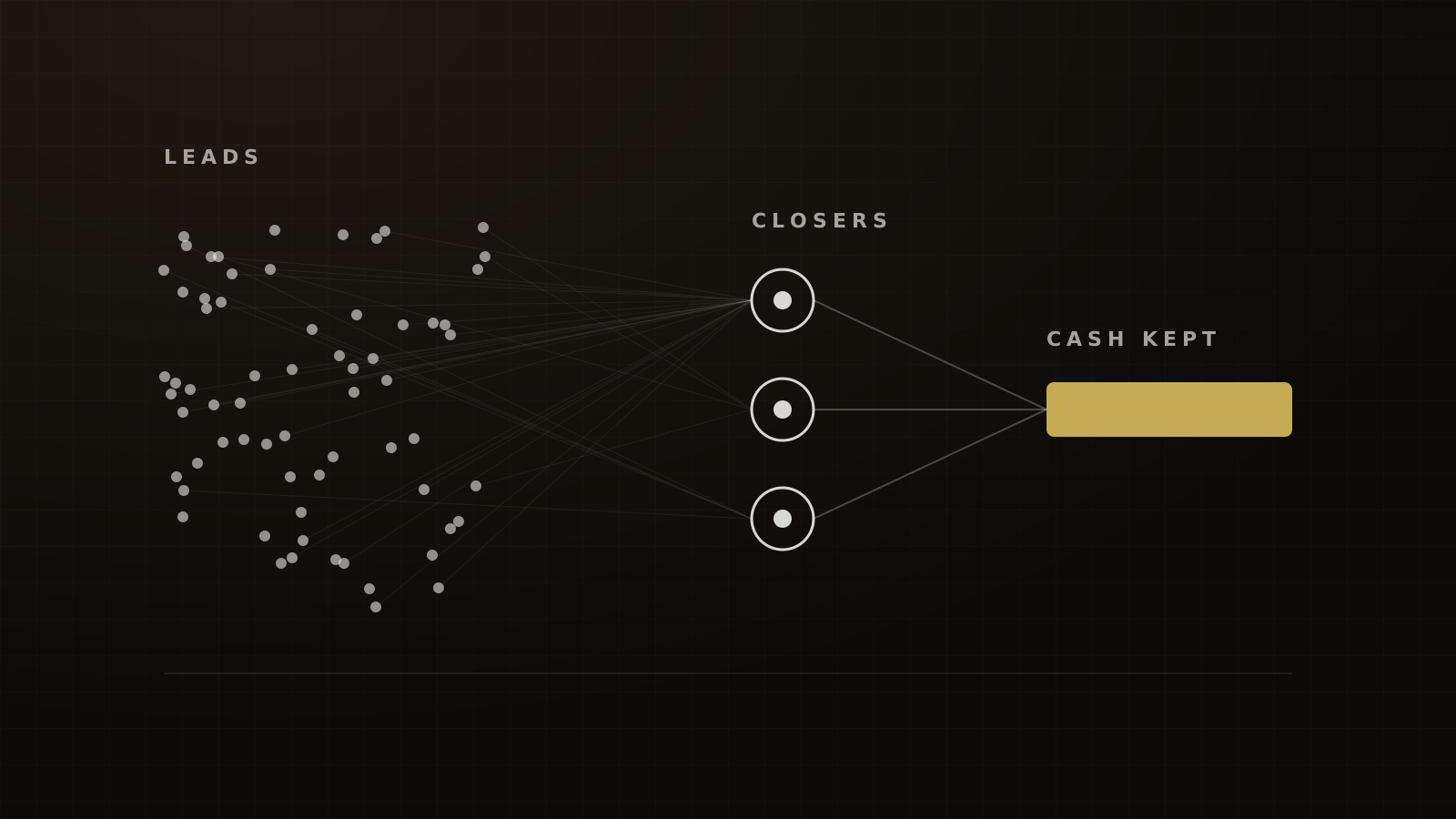
Most comp advice gives you a percentage and stops. Here's the same month run through five plans.
| Plan | Rate (illustrative) | Paid this month | Paid per kept sale | What it rewards |
|---|---|---|---|---|
| Per booked call | $50 per booking | $5,000 | $625 | Filling the calendar |
| Per show | $75 per show | $5,250 | $656 | Getting people to turn up |
| Per close | 10% of contract value | $5,000 | $625 | Getting a yes, even one that refunds |
| Cash collected and kept | 10% of cash kept | $4,000 | $500 | Sales that stick |
| Base plus commission | $3,000 + 5% of cash kept | $5,000 | $625 | Stability, team work |
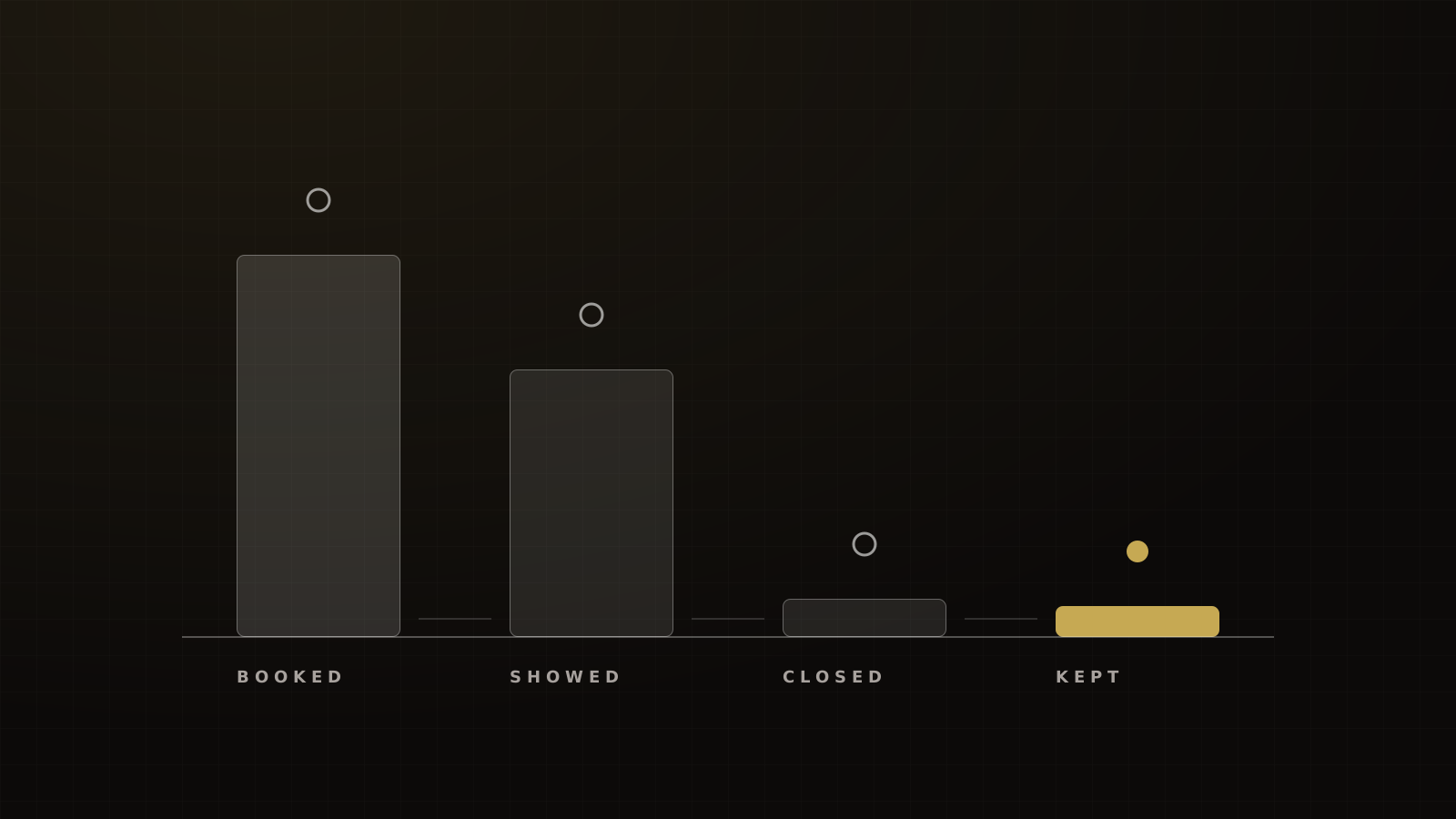
Hypothetical funnel: 100 booked, 70 showed, 10 sold at $5,000 paid in full, 2 refunded, so 8 kept sales and $40,000 kept. Pay rates are made up to make the plans cost about the same. Not benchmark data.
This month, every plan costs about the same. What differs is next month, because each plan teaches the rep something different.
On a phone-first floor the show line usually runs higher than this illustration's 70 of 100. In our experience phone calls booked no more than about three days out show at 82–88%. B2B teams average a 15.9% no-show rate, for comparison.[3]
Per booked call
This pays for activity at the top of the funnel. It rewards stuffing the calendar with anyone who'll accept a time. No-shows cost the rep nothing, so nobody owns them. Use it only with a written qualification bar and a closer who can reject bookings that miss it.
Per show
Better, because someone now cares whether the buyer turns up. It still pays the same for a show who could never afford the offer. Pair it with the same qualification bar, and it's a reasonable base for setters.
Per close
This rewards the yes, not the sale. Paid on contract value, it pays full commission on deals that refund next week and tempts reps to discount or push financing the buyer can't carry. If you pay per close, pay on net price after any discount, and claw back on refunds.
Percent of cash collected and kept
This is the plan we prefer for closers. Commission follows money that actually lands and stays. Reps stop discounting, because a discount cuts their pay. They care about fit, because refunds come back out of their check. The trade-off is slower pay and a real need for clean tracking.
Base plus commission
A base buys stability and makes it easier to ask for non-selling work, like call reviews or training a new hire. It also lowers the marginal push per sale, and you carry the cost when lead flow dips. B2B mostly runs this way; the Alexander Group reports a 60/40 base-to-incentive mix as the most common, with only 15% of plans at 50/50 or more variable.[4]
Nothing motivates people more than money… generous commission, we get the best results.
Why a rep won't dial for 10% of a $50 ticket
Reps don't think in percentages. They think in dollars per hour.
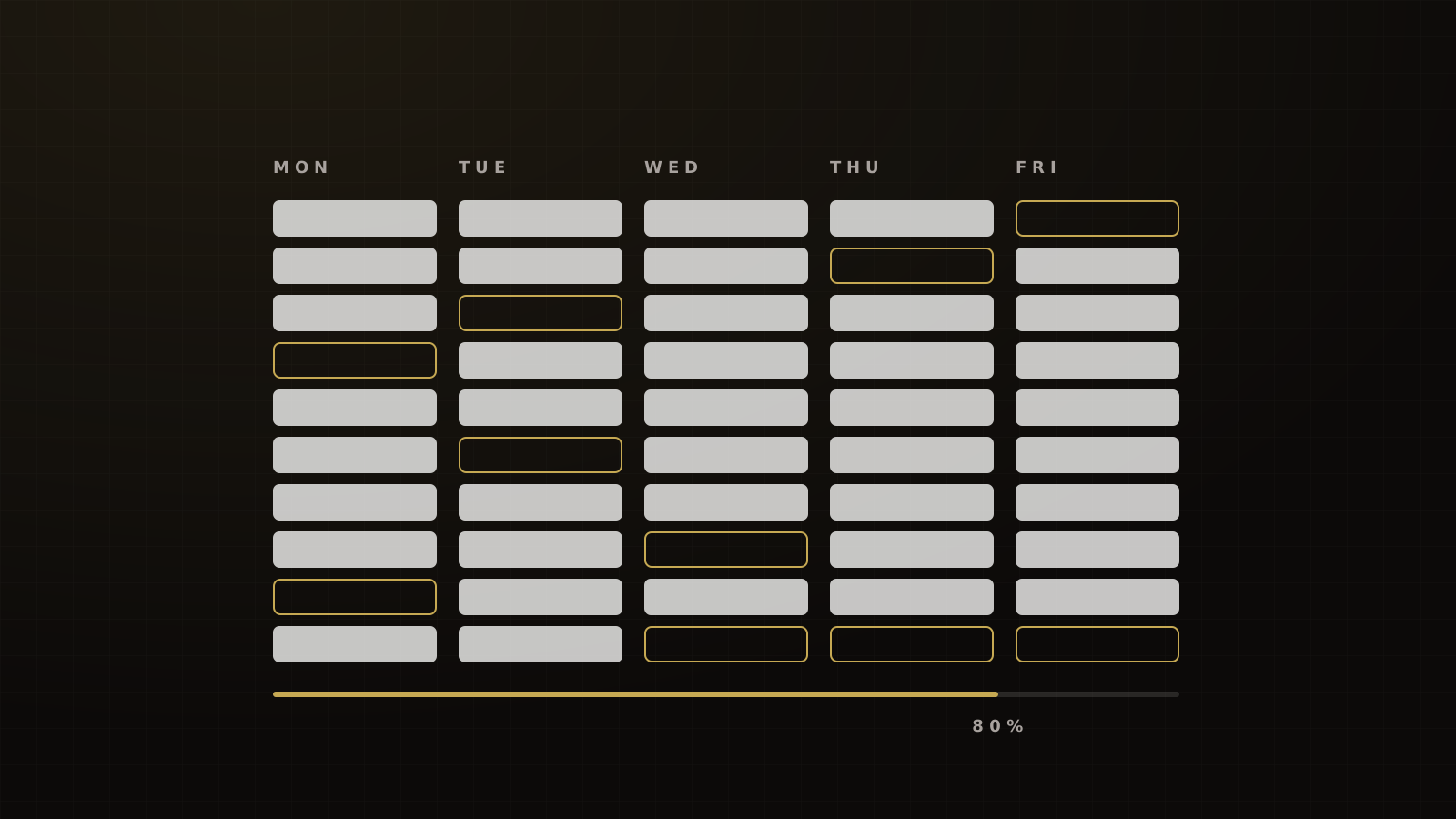
The math: commission per sale, times close rate, times calls per hour. In our experience a full-time closer holds 4–6 high-ticket calls a day at 80% calendar fill, which is a working assumption, not a benchmark. We cap fill at 75–80% so there's time for follow-up, so the hourly math uses calls held, not hours logged.
Take a closer who holds 5 calls a day and closes 20% of them:
- On a $5,000 offer at 10% of cash kept, each held call is worth $100 to the rep on average. That's about $500 a day.
- On a $500 offer at the same 10%, each call is worth $10. That's about $50 a day.
- On a $50 ticket, it's $1 a call.
That's why our rule of thumb is reps for offers from about $1,000 to $50,000, and straight-to-checkout below that. On free or $50 tickets, a rep costs more than they add.
There's one more rule to write down if you sell on webinars. On the $1,000 to $10,000 webinar offers we run, 40–60% of sales typically close through the "talk to a closer" door rather than pay-now checkout. There's no industry benchmark for that. If a buyer talks to a closer and then pays through a checkout link, decide in advance who gets credit. Otherwise reps fight over attribution instead of calling leads.
What the credible pay data says (and why the listicles don't count)
There's no representative survey of what high-ticket closers or setters earn. Here's what exists, and what each figure actually is.
| Figure | Source | What it is |
|---|---|---|
| $69,990 median; middle half $47,670 to $100,480 | BLS, sales reps of services, May 2025[5] | Federal wage data, commissions included[6] |
| $54,960 mean | BLS, all sales occupations, May 2025[7] | Every sales job, retail to enterprise |
| $35,450 median | BLS, telemarketers, May 2025[8] | The nearest federal proxy for phone setting |
| $80,000 OTE ($55,000 base, $25,000 variable) | Bridge Group, 2025, 351 B2B companies[9] | Target pay for B2B SDRs, not realized pay |
| $200,000 OTE; 48% of reps at quota | Bridge Group, 2026, 158 B2B companies[10] | B2B account executives on much larger deals |
| 10% to 20% of cash collected | Consultant blog, 2026[11] | Proposed band, no sample |
| "Commonly 8%–20%" | Recruiting blog, 2026[1] | Proposed band, no sample |
| $50 to $150 per qualified booked call, or $75 per show plus 3% | Job marketplace blog, 2026[12] | Proposed setter pay, no sample |
| Setter base plus $25 per booking; closers 10%, 15% or 20% of cash collected by tier | Agency blog, 2026[13] | One agency's recommended plan |
The bottom four rows may be roughly right. They're not evidence. Most don't say whether the percentage is of contract value, first payment or cash kept, and that difference is worth more than the percentage itself.
The direction of travel is clear, though. In Xactly's 2025 survey of 160 companies, 62% said they're shifting toward performance-based pay.[14]
Clawbacks, refunds, payment plans and chargebacks
Credited vs earned vs payable
Write three definitions into the plan:
- Credited: the sale counts toward the rep's numbers.
- Earned: the conditions for commission are met, such as cash received and the refund window closed.
- Payable: the date the money goes out.
Most disputes with reps come from blurring these. CaptivateIQ found 77% of B2B plans hold 26–75% of commission until invoicing or payment, though its sample isn't published.[2] Errors are common even with rules: in its 2025 survey of 200+ compensation leaders, 66% said they'd over- or underpaid commissions in the past year.[15]
Installments and financing
On an installment plan, pay commission on each payment as it clears, not on the contract total. On a financed sale, pay when the lender funds, on the amount funded.
Let the lender handle credit disclosures. Reps should present the financing options you've approved and never improvise terms.
Refund and chargeback windows
Set a clawback window that matches your refund policy, and say how clawed-back amounts are recovered: from future commission, never as a surprise bill.
Chargebacks need their own rule, because card networks police them. Visa's US monitoring program flagged merchants at a ratio of 220 basis points (with at least 1,500 monthly fraud and dispute reports) from June 2025, and lowered the line to 150 basis points on April 1, 2026.[16] That ratio is fraud reports plus disputes over card-not-present transactions. It isn't your refund rate.
On event sales where the program kicks off the next day, our target is a dispute ratio under 0.5% of transactions. Paying reps on cash kept is one of the ways we hold it.
Leavers and tails
Decide now what a rep is owed when they leave: commission on installments that land after their last day, for how long, and minus which clawbacks. New York's rules for commission salespeople require the written agreement to cover payment on termination.[17]
Put it in writing: the legal floor
- California requires commission contracts in writing, explaining how commissions are computed and paid, with a signed copy given to the rep.[18]
- New York requires a signed written agreement for commission salespeople, and earned commissions paid at least monthly, no later than the last day of the following month.[17]
- Remote closers aren't "outside sales." The federal exemption needs work customarily away from the employer's place of business, and a home or office used for phone selling counts as one.[19] Commission-only pay doesn't exempt a nonexempt employee from minimum wage or overtime rules.
- A 1099 doesn't settle contractor status. The Department of Labor proposed rescinding its 2024 contractor rule on February 26, 2026, and no longer applies that rule in investigations.[20] How the work is controlled still decides it.
- Clawbacks and deductions from earned wages are state-regulated. Word them with counsel.
Coach the claims, not just the close
A comp plan that rewards closing creates pressure to promise. If your offer helps people make money, a rep's "most clients earn it back in 90 days" is your earnings claim, and you own it.
The FTC is active here. It sent more than $2.4 million in refunds to buyers of the Lurn business-coaching scheme over deceptive earnings claims.[21] A 2025 case led to an order banning Ascend Ecom and its owners from business-opportunity marketing.[22] In January 2025 the FTC proposed extending its Business Opportunity Rule to business coaching that claims to help people earn income; that's still a proposal, not a final rule.[23] The federal click-to-cancel rule was vacated by the Eighth Circuit in July 2025,[24] but state auto-renewal laws still apply to continuity offers.
Give reps approved language, and score calls for it. When a buyer stalls on price, the move is a bonus aimed at the objection, not a discount. Alex Hormozi, crediting Jason Fladlien, puts it flatly in $100M Offers: "Whenever trying to close a deal, never discount the main offer." Building those bonuses into the offer is covered in our guide to offer architecture.
To size the team your plan has to support, run your numbers in the sales team capacity calculator, and see how comp fits the wider build in building a high-ticket sales team. If setters are part of the plan, read the setter-closer model first. Or book a strategy call and we'll model your plan against your funnel.
Frequently asked questions
Sources
- 1.How much does a high-ticket closer make?. Backpack Closers, 2026-07-27.
- 2.Finance and GTM alignment (State of Sales Compensation survey). CaptivateIQ, 2024-01-31.
- 3.Ways to reduce no-show rates in sales calls. RevenueHero, 2025-08-18.
- 4.5 keys to using incentive comp to lift performance, profits and innovation. WorldatWork Workspan Daily (Alexander Group authors), 2024-12-26.
- 5.Occupational Employment and Wages, May 2025: Sales Representatives of Services (41-3091). US Bureau of Labor Statistics, 2026 (May 2025 data).
- 6.OEWS technical notes. US Bureau of Labor Statistics, current, checked 2026-10-04.
- 7.Occupational Employment and Wages, May 2025: major occupational groups (table 1). US Bureau of Labor Statistics, 2026-05-15 (May 2025 data).
- 8.Occupational Employment and Wages, May 2025: Telemarketers (41-9041). US Bureau of Labor Statistics, 2026 (May 2025 data).
- 9.2025 SDR Models, Motions & Metrics Report (10th edition). The Bridge Group, 2025-02-06.
- 10.2026 AE Models, Motions & Metrics (10th edition). The Bridge Group, 2026-06-22.
- 11.How to hire high-ticket closers. Kyle Koschel, 2026-08-05.
- 12.Appointment setter salary. RepSelect, 2026-03-07.
- 13.The setter-closer model for coaching. AdvLaunch, 2026-05-19.
- 14.Xactly Sales Compensation Report: 87% of sales teams struggle to meet or exceed quotas. Xactly, 2025-02-11.
- 15.2025 State of Incentive Compensation Management. CaptivateIQ, 2025-05-06.
- 16.Visa Acquirer Monitoring Program fact sheet. Visa, 2025, with April 2026 update.
- 17.New York Labor Law section 191. New York State Senate, current, checked 2026-10-04.
- 18.California Labor Code section 2751. California Legislature, current, checked 2026-10-04.
- 19.Fact Sheet #17F: Exemption for outside sales employees under the FLSA. US Department of Labor, Wage and Hour Division, current, checked 2026-10-04.
- 20.2026 independent contractor rulemaking. US Department of Labor, Wage and Hour Division, 2026-02-26.
- 21.FTC sends more than $2.4 million to consumers harmed by deceptive business coaching scheme Lurn. Federal Trade Commission, 2024-06-06.
- 22.FTC case leads to order banning Ascend Ecom and its owners from business opportunity marketing. Federal Trade Commission, 2025-06-23.
- 23.FTC proposes rule changes and new rule to deter deceptive earnings claims. Federal Trade Commission, 2025-01-13.
- 24.Click-to-cancel just got cancelled: Eighth Circuit vacates FTC's negative option rule. Cooley LLP, 2025-07-11.
Written by
Devin AlexanderCo-Founder & CEO
Devin architects Victory's revenue systems: team structure, comp plans, scripts and the accountability frameworks that make sales floors predictable. He has generated more than $150M in sales and trained more than 250 closers.
Part of the guide: Building a High-Ticket Sales Team: Setters, Closers, Comp Plans and Show Rates