Building a High-Ticket Sales Team: Setters, Closers, Comp Plans and Show Rates
When a coaching or event business should hire closers, how to pay them on cash kept, and the speed, show-rate and calendar rules we run.
 Devin AlexanderCo-Founder & CEO
Published 17 min read
On this page
- The short answer: when a sales team pays for itself
- Do you need a team yet? Three tests
- Setters, closers or full-cycle closers
- Comp plans modeled on funnel economics
- Speed to lead: what the research says and the rule we run
- Show rate: booking window, phone and pre-call sequence
- Calendar capacity: why 80% full is the ceiling
- Hiring, vetting and the month-two slump
- Contractor or employee, and the rules reps must follow
- Common mistakes
Key takeaways
- Hire closers when two things are true: the offer can pay a good rep well per hour, and the founder's calendar is what caps revenue. Below about $1,000, let checkout sell.
- Pay on cash collected and kept, not contract value. Write the refund and chargeback rules before the first sale.
- No credible survey of high-ticket commission rates exists. The "10–20%" bands online come with no sample, and most never define what the percentage is of.[1]
- Call every lead fast, open the calendar only about three days ahead, and default to phone. No-shows climb with every day between booking and call.[2]
- Never fill a closer past 75–80% of their slots. The slack is where follow-up, rebooking and lead calling happen.
Build a sales team when two things are true. Your offer is priced high enough to pay a good rep well for an hour of their time. And your own calendar has become the ceiling on revenue. Until both are true, a team adds cost and a management job without adding sales.
Once both are true, the build is mostly economics, not scripts. Who owns the prospect. What each pay trigger rewards. How fast leads get called. How far ahead people can book. How full a calendar can get before follow-up dies.
This guide covers each of those. It uses the research that holds up, flags the numbers that don't, and lays out the rules we run on the sales floors we build for coaching, education and event businesses.
The short answer: when a sales team pays for itself
Our rule of thumb is a price-point rule. Below about $1,000, send traffic straight to checkout. From about $1,000 to $50,000, put trained closers on the phone.
The line sits there because a rep's pay has to be worth their hour. 10% of a $50 ticket is $5. Nobody good dials for $5. 10% of a $5,000 program is $500, and that gets dialed all day.
It also follows how buyers behave. On the $1,000 to $10,000 webinar offers we run, 40–60% of sales typically close through the "talk to a closer" door rather than pay-now checkout. No industry benchmark exists for that split, so read it as our experience, not a law. It's why we never leave a mid-ticket buyer alone with a checkout page.
Once you have reps, five rules carry most of the weight:
- One owner per prospect wherever volume allows.
- Pay on cash kept, with refund and chargeback rules in writing.
- Call every lead fast, with a 24-hour backstop.
- Open the calendar about three days ahead, phone by default.
- Cap calendars at 75–80% of available slots.
Model each of these against the whole funnel (booked, confirmed, showed, closed, cash net of refunds) before you copy anything from a job post.
Do you need a team yet? Three tests
The calendar test
Count the hours you spend each week on sales calls, follow-up and rebooking. Then count the qualified leads who didn't get a call because you had no slot. If the second number isn't zero, your calendar caps revenue.
The founder's calendar is also a single point of failure. When you're traveling, sick or deep in delivery, follow-up stops. It shows up weeks later as missed rebooks, stale leads and new buyers who don't get the attention that keeps them from asking for a refund.
The price-per-hour test
Work out what a closer would earn per selling hour on your offer: expected sales per week, times commission per sale, divided by selling hours.
Here's an illustration with made-up numbers. A closer holds 20 calls a week and closes 20% of them, so 4 sales. On a $5,000 offer at 10% of cash collected, that's $2,000 across 25 selling hours, or $80 an hour. Put the same closer, at the same rates, on a $500 offer and they earn $8 an hour.
If the hourly number wouldn't attract someone who can close for you, no comp plan fixes it. The fix is a higher-ticket offer, or no rep at all.
The lead-volume test
Then check whether lead flow can keep a closer busy. In our experience one full-time closer holds 4–6 high-ticket calls a day at 80% calendar fill. That's a working assumption, not an industry benchmark. The closest public figure is B2B: SDRs average 4.1 quality conversations a day, and 4.6 on phone-centric teams.[3]
If your leads can't fill most of that, you'll pay for an idle seat. Good closers don't stay in idle seats.
For timing, Acquisition.com's $100M Scaling Roadmap is a useful frame. It stages a business by headcount and gives each stage one binding constraint. Our reading for sales: take the founder out of the selling seat when sales capacity is the binding constraint, not on day one.
Setters, closers or full-cycle closers
What each role owns
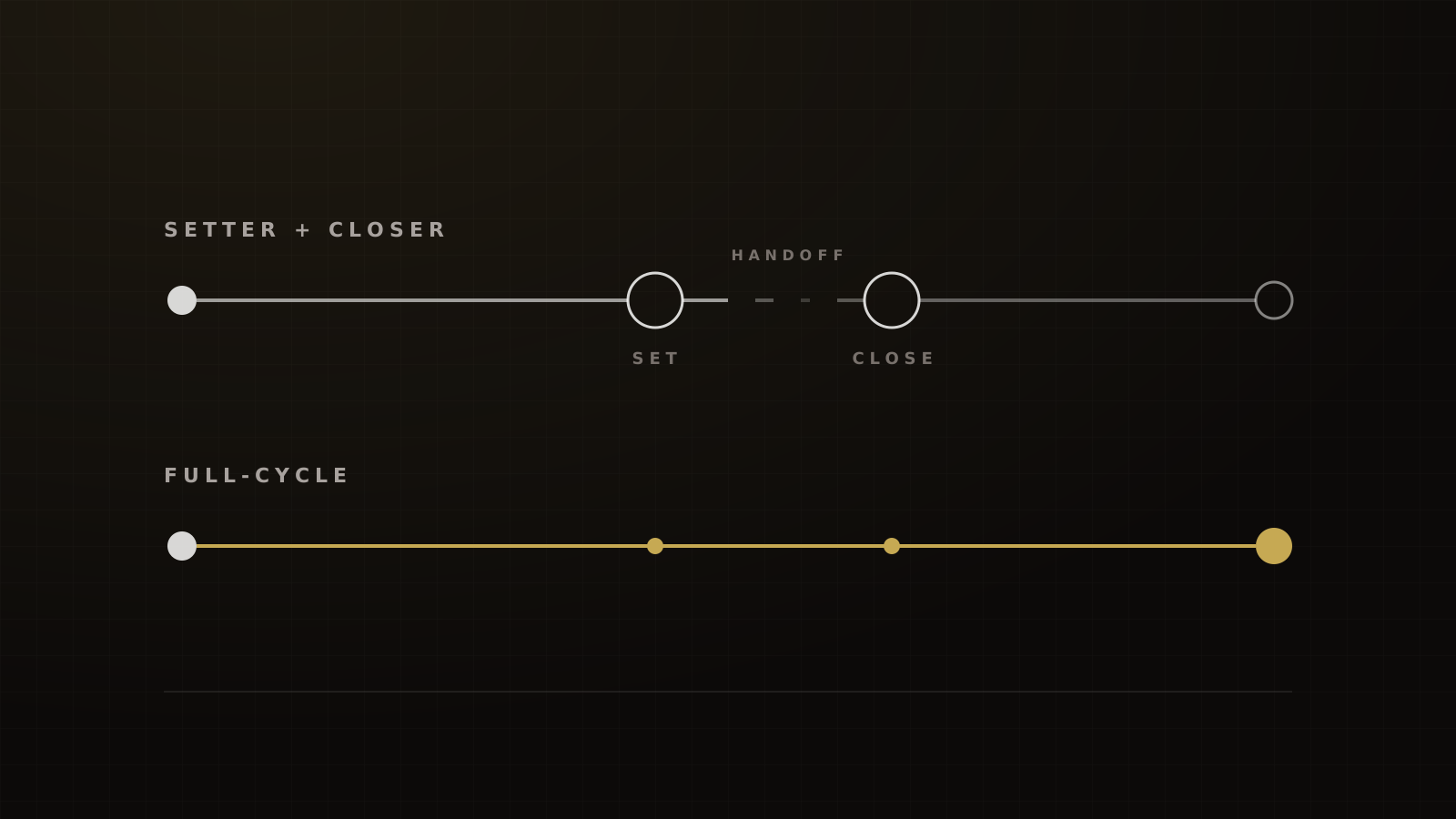
- Setter: reaches new leads, qualifies them and books the call. On a split team, the setter owns every uncalled lead.
- Closer: runs the sales call, handles objections and takes payment.
- Full-cycle closer: does both. Books their own calls, follows up and closes, from first touch to cash.
Russell Brunson's high-ticket application funnel popularized the split for coaching offers: an application pre-qualifies the buyer, a setter gathers background and goals, and a closer runs the sale. His point that the expert shouldn't be the one on the phone holds up. The split itself is a choice, not a requirement.
Where handoffs leak
Every handoff loses something.
- Context. The closer starts without everything the setter heard. The buyer repeats themselves.
- Rapport. The person the buyer warmed to isn't the person on the call.
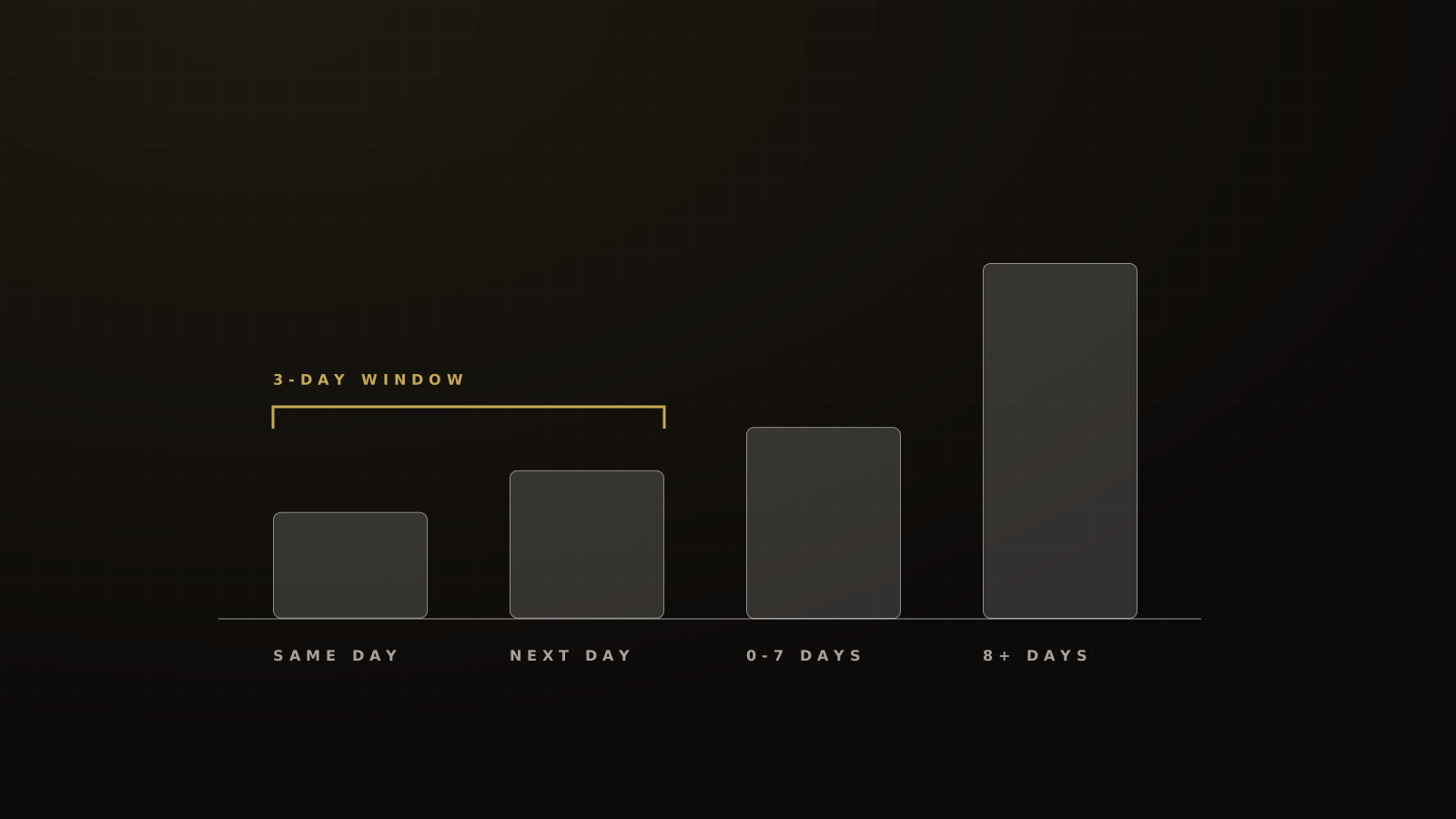
- Timing. Every day between the set and the sales call costs shows. In Reply.io's data on 2,900 booked demos, no-shows ran 6.9% for same-day meetings and 23% for meetings booked 8 or more days out.[2]
Our view, from running both models: when one person owns the prospect from first touch to close, the relationship is stronger and conversions follow. A full-cycle closer with a no-show doesn't sit idle. They open the lead list and start calling.
Having first to last touch be handled by one person builds a better relationship… therefore increasing conversions.
When a setter is worth it
We sell setters as well as closers, so this isn't "never." It's "not yet." The trigger we use: add a setter only when closers' calendars are at 75–80% and more than about 20% of new leads are still uncalled after 24 hours. That's our rule, not an industry figure.
For scale, B2B SaaS teams run about 1 SDR for every 2.4 account executives.[3] Those are larger, longer deals with a different buyer, so don't copy the ratio. Copy the logic: a setter pays when there are more leads than closers can work.
Alex Hormozi's lead stages (uncontacted, contacted, engaged, qualified, sold) are the cleanest way to see the gap. If leads pile up in "uncontacted," you need intake capacity. If they reach "qualified" and don't buy, a setter won't help; that's a sales problem. The full volume test is in our guide to the setter-closer model.
Comp plans modeled on funnel economics
Same funnel, five pay triggers
Most comp advice gives a pay band and stops. A pay band means nothing until you know what it's a percentage of, and what behavior the trigger rewards. Run every option through one funnel.
| Pay trigger | Paid on | What it rewards | Where it breaks |
|---|---|---|---|
| Per booked call | 100 bookings | Filling the calendar | Unqualified bookings and no-shows nobody owns |
| Per show | 70 shows | Getting people to turn up | Shows that were never going to buy |
| Per close | 10 sales | Getting a yes | Discounting, pushy financing, refunds after the rep is paid |
| % of cash collected and kept | $40,000 | Sales that stick | The rep waits longer for pay; you need clean tracking |
| Base plus commission | Salary + a smaller % | Stability and team work | A weaker push per sale; you carry the cost when leads dry up |
Hypothetical funnel: 100 booked, 70 showed, 10 sold at $5,000 paid in full, 2 refunded, so 8 sales and $40,000 kept. Not benchmark data.
The pattern is simple. The earlier in the funnel you pay, the more you pay for activity instead of revenue. Per-booking pay makes sense only where someone else owns the show and the close, and even then it needs a qualification bar with teeth.
Pay on cash kept
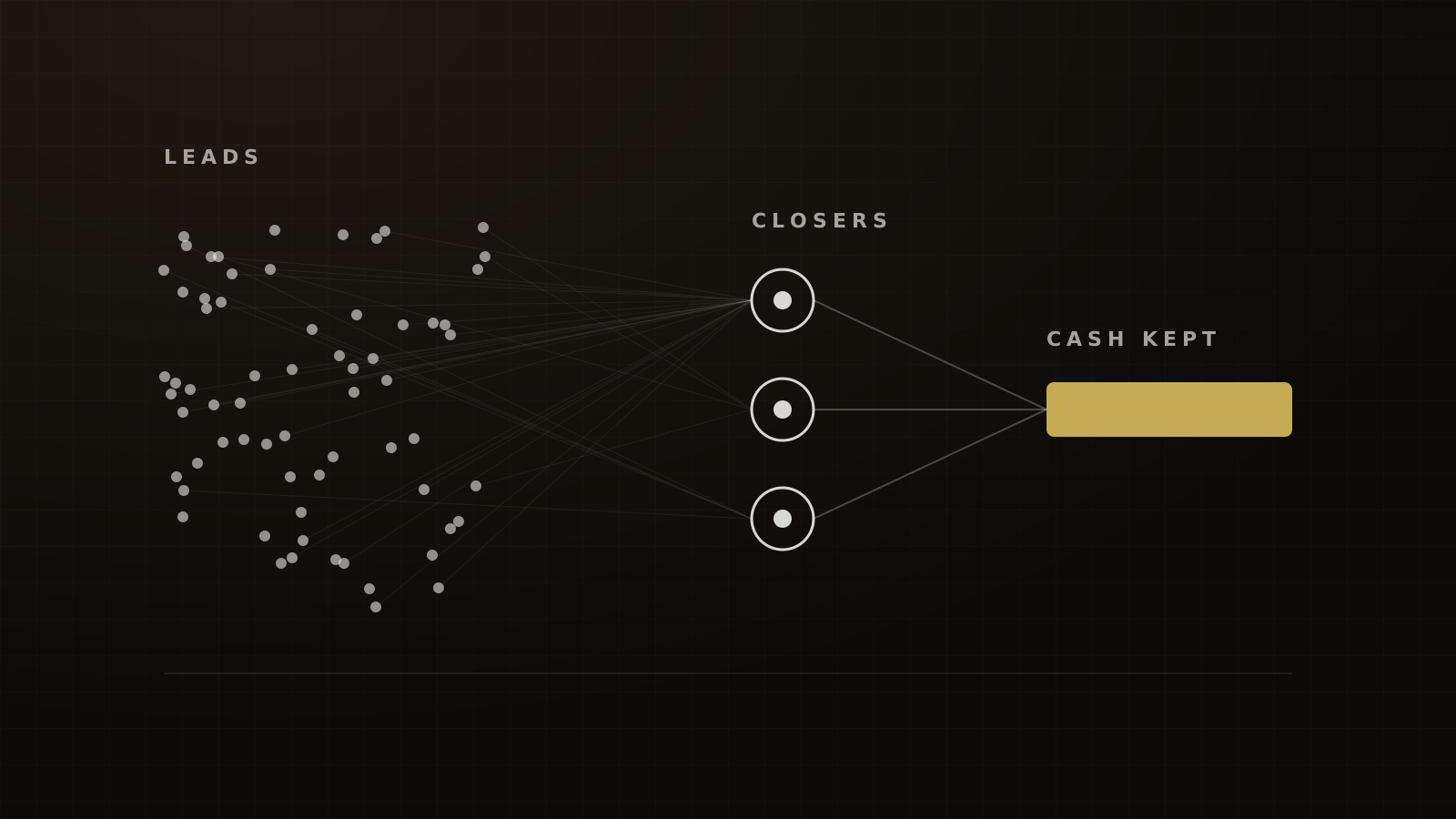
For closers, pay a percentage of cash collected, and make it final only after the refund window closes. That one choice removes most of the bad incentives in the table.
Write down the mechanics before the first sale:
- Deposits and installments. Pay commission on each payment as it lands, not on the contract value.
- Financing. Pay when the lender funds, on the amount funded.
- Refunds and chargebacks. Claw back commission on money that goes back, within a defined window.
- Leavers. Decide what a rep is owed on installments that land after they leave.
Clawbacks are normal practice in B2B. CaptivateIQ reports that 71% of plans include them and 77% hold 26–75% of commission until invoicing or payment, though the survey's sample isn't published.[4]
Disputes are worth watching for a second reason: card networks police them. From April 1, 2026, Visa's US program flags merchants at a fraud-and-dispute ratio of 150 basis points (1.5%).[5] On event sales where the program kicks off the next day, our target is a dispute ratio under 0.5% of transactions.
When a buyer stalls on price, the closer's move is a bonus aimed at the objection, not a discount. That's Hormozi's rule, which he credits to Jason Fladlien. Pay on cash kept, and reps stop wanting to discount anyway.
What the credible pay data says
There is no representative survey of high-ticket closer or setter commission rates. Here is what does exist:
- Federal wage data. Sales representatives of services earned a median $69,990 in May 2025, with the 10th to 90th percentile running $37,980 to $148,840.[6] Telemarketers, the nearest federal proxy for phone setting, had a median of $35,450.[7] Both figures include commissions.[8]
- B2B SaaS surveys. The median SDR on-target earnings figure is $80,000, split $55,000 base and $25,000 variable.[3] The median account executive OTE is $200,000, and only 48% of reps hit quota.[9] Different deals, different buyers.
- The listicles. Recruiting and consulting blogs propose 10–20% of cash collected for commission-only closers[1] or "commonly 8%–20%".[10] Agency pages suggest setters earn $25[11] to $150[12] per booked call. None publishes a sample or method.
Those bands may be roughly right. They're not evidence, and most don't say whether the percentage is of contract value, first payment or cash kept. We cover the plan design in full, including payment plans and leavers, in how to pay high-ticket closers and setters.
Speed to lead: what the research says and the rule we run
Every speed-to-lead article quotes the same handful of numbers. Here is what each one actually measured.
| Source | What it measured | Headline | Caveat |
|---|---|---|---|
| HBR, 2011 | Response audit of 2,241 US companies, plus 1.25M leads | 37% replied within an hour and 23% never did; contact within an hour made qualifying nearly 7x as likely as an hour later[13] | Qualification, not sales; 15 years old |
| InsideSales.com and MIT's James Oldroyd, 2007 | 15,000+ web leads at 6 companies | Calling within 5 minutes vs 30 gave 21x the odds of qualifying[14] | The study says it didn't address close rates |
| Velocify, ~2012 | ~3.5M leads, 400+ companies | A first call within one minute showed a "391% improvement" in conversion[15] | Baseline not stated |
| InsideSales (XANT), 2014 | Test leads to 9,538 companies | Median first call 3h 8m; 47% never responded[16] | 12 years old |
| Chili Piper, 2022 | Manual demo requests to software vendors | Average response 4h 50m; about 30% never responded[17] | Sample size not stated |
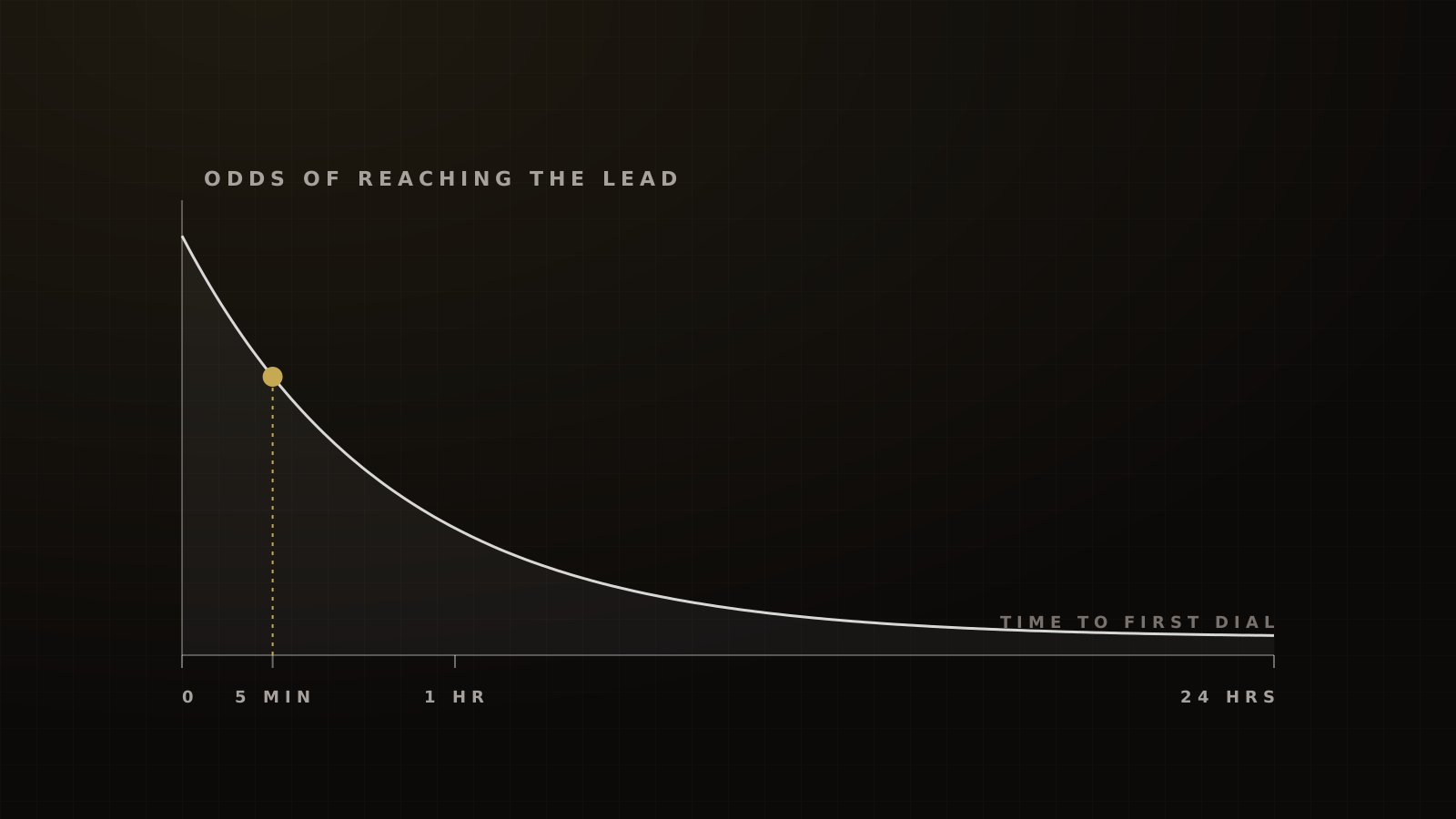
Two things are true at once. Minutes matter for reaching and qualifying a lead. And most companies still take hours, or never call at all.
None of these studies measured closed sales on a high-ticket coaching offer. So we hold a rule we can staff, not a five-minute promise we'd miss:
- Real-time alerts. Every rep gets a new buyer's or lead's details by text the moment they come in.
- First dial fast. A median time to first dial under one hour during staffed hours.
- 24-hour backstop. 100% of new leads dialed within 24 hours.
- Persistence. At least six call attempts on every unconverted lead in its first two weeks. Velocify found 93% of converted leads were reached by the sixth attempt, yet half of leads never got a second call.[15]
Fast doesn't mean anything goes. Calls must respect consent, the Do Not Call registry and the Telemarketing Sales Rule's 8 a.m. to 9 p.m. local-time window.[18] The full source trail is in speed to lead: what the research actually says.
Show rate: booking window, phone and pre-call sequence
A closer's day is only as good as the calls that show. The commonly quoted "20–35% average no-show" comes with no sample.[19] Better data exists, though almost all of it is B2B.
Average no-show rate on booked B2B sales meetings, across RevenueHero customers booking 50+ meetings a month
Education and e-learning software had the highest no-show rate of 15 industries in a one-week RevenueHero snapshot, at 18.1%.[21] No traceable benchmark exists for consumer high-ticket sales calls. In our experience, phone calls booked no more than about three days out show at 82–88%.
Open the calendar about three days out
No-shows rise with every day between booking and call. Reply.io's demos went from 6.9% no-show same day to 9.6% next day, 12.4% within a week and 23% at 8 or more days.[2] Healthcare shows the same slope at a much larger scale: across 1.26 million appointments, no-shows rose from 4.31% at 0–15 days lead time to 7.73% at 60 or more days.[22]
So we open closer calendars only about three days ahead. A buyer who wants to talk next Thursday usually wants to talk now.
Phone vs Zoom
We default to phone. Many buyers don't have the confidence to get on camera, and a video link can feel invasive to someone who isn't sure yet. On the calls we run, phone calls show up more. We go by what the data shows, not what we'd prefer.
There's a real counterpoint. Gong's 2020 analysis of 12,282 B2B opportunities found deals were 127% more likely to close when video was used.[23] That measures win rates in B2B, not whether consumers attend. We haven't found a study testing phone vs video on consumer sales-call shows. Offer video to buyers who want it, and default to phone for everyone else.
Pre-call sequences that handle objections
Reminders confirm the time. A pre-call sequence earns the show. Send short pieces that answer the top objections before the call: the price question, the "is this for someone like me" question, the time question.
The best source for those objections is your own recorded calls. We pool every objection into a bank and turn the most common ones into the sequence. Our standard is 100% of recorded calls auto-scored within 24 hours, with a weekly scorecard per rep. More on that in using AI to audit every sales call.
When someone doesn't show, the closer calls within minutes. In our experience 30–40% of no-shows get rebooked within 48 hours. No credible industry benchmark exists for that, so treat it as our number. The full playbook is in how to reduce sales call no-shows.
Calendar capacity: why 80% full is the ceiling
Never fill a closer's calendar past 75–80% of available slots. The other 20–25% is not idle time. It's where follow-up, no-show recovery, rebooking and lead calling happen. A full calendar looks productive and quietly kills everything that isn't a scheduled call.
Reps already lose most of their week to other work. In Salesforce's 2026 survey of 4,050 sales professionals, reps said they spend 40% of their week selling.[24]
The second rule: book slots for booked calls, not expected shows. You don't know in advance which calls will no-show, so every booking holds a slot.
| Planning on | Calls to cover | Slots per closer | Closers needed |
|---|---|---|---|
| Expected shows, 100% fill | 84 | 30 | 3 |
| Booked calls, 100% fill | 100 | 30 | 4 |
| Booked calls, 80% fill | 100 | 24 | 5 |
Hypothetical: 6 one-hour slots a day, 5 days a week, 84% show rate. Swap in your own numbers.
The founder who plans on shows hires three closers and wonders why follow-up collapses. The one who plans on bookings at 80% hires five and has a team that can call its no-shows back. Run your own numbers in the sales team capacity calculator.
The same math sets your ad budget. The spend level at which closers pass 80% is your current ceiling. Raise spend past it without hiring and you pay for leads nobody calls.
Hiring, vetting and the month-two slump
We never install a closer without extensive sales experience. A high-ticket call rewards conviction and judgment that take years to build, and a buyer can hear the difference in the first two minutes.
Experience also shortens ramp. In our experience an experienced placed closer reaches a full call load within 2–4 weeks. The B2B benchmark for account executives is a 6.2-month ramp, on much larger deals.[9] Our target for performance is a trained closer at 70–90% of the founder's close rate by day 60. There's no industry benchmark for that; it's the bar we hold.
Vet with live calls, not interviews. Listen to the candidate sell, then keep listening once they're on your offer.
Most new closers start strong and slip in month two. Before you blame motivation, run Hormozi's Performance Diamond, which he credits partly to Leila Hormozi. Check four causes in order: communication (do they know what you want?), training (do they know how?), motivation (do they want to?) and circumstances (is something in the way?). Most slumps are the first two.
Fix training with Hormozi's "document, demonstrate, duplicate" from $100M Leads. Write down how the founder runs the call, run calls in front of the closer, then have the closer run calls in front of you, and fix the checklist until their results match. We go deeper in why your sales team fell off in month two.
Expect turnover either way. Bridge Group puts median annual SDR attrition at 40%.[3] A documented process is what keeps a leaver from taking your close rate with them.
Contractor or employee, and the rules reps must follow
Commission-only remote closers aren't "outside sales." The federal outside-sales exemption requires the employee to work customarily and regularly away from the employer's place of business, and a home or office used for phone selling counts as a place of business.[25] A closer dialing from a home office doesn't qualify.
A 1099 label doesn't settle contractor status. The Department of Labor proposed rescinding its 2024 independent-contractor rule on February 26, 2026, and says it no longer applies that rule in its investigations.[26] No final rule had replaced it when we checked. Classification still turns on how the work is actually controlled.
Put the plan in writing. California requires commission contracts to be in writing, to explain how commissions are computed and paid, and to be given to the rep as a signed copy.[27] New York requires a signed written agreement for commission salespeople, including what happens to commissions on termination.[28]
Reps can't improvise income claims. If your offer helps buyers make money, a rep's "most clients make it back in 90 days" is your earnings claim. The FTC sent more than $2.4 million in refunds to buyers of the Lurn business-coaching scheme over deceptive earnings claims.[29] In January 2025 it proposed extending its Business Opportunity Rule to cover business coaching that claims to help people earn income. That's a proposal, not a final rule.[30]
Calling and texting rules still apply. Speed to lead works inside consent, Do Not Call and calling-hour limits. The FCC's one-to-one consent rule was vacated by the Eleventh Circuit in January 2025, so don't treat it as a live requirement.[31] The underlying consent rules still stand.
Common mistakes
- Copying a commission rate from a job post. Without a denominator and a refund rule, the percentage tells you nothing.
- Paying setters per booking with no show or qualification bar. You'll get a full calendar of people who were never going to buy.
- Hiring on expected shows. Every booking holds a slot. Plan capacity on bookings, at 80% fill.
- Opening the calendar two weeks out. You're buying no-shows.
- Scaling ad spend past closing capacity. The ads get blamed for leads nobody called. Fix intake first, then spend. Our scaling roadmap covers what breaks at each stage.
If you want a second set of eyes on your funnel math, comp plan or calendar rules before you hire, book a strategy call.
Frequently asked questions
Sources
- 1.How to hire high-ticket closers. Kyle Koschel, 2026-08-05.
- 2.How to fight demo no-shows. Reply.io, 2023-08-08.
- 3.2025 SDR Models, Motions & Metrics Report (10th edition). The Bridge Group, 2025-02-06.
- 4.Finance and GTM alignment (State of Sales Compensation survey). CaptivateIQ, 2024-01-31.
- 5.Visa Acquirer Monitoring Program fact sheet. Visa, 2025, with April 2026 update.
- 6.Occupational Employment and Wages, May 2025: Sales Representatives of Services (41-3091). US Bureau of Labor Statistics, 2026 (May 2025 data).
- 7.Occupational Employment and Wages, May 2025: Telemarketers (41-9041). US Bureau of Labor Statistics, 2026 (May 2025 data).
- 8.OEWS technical notes. US Bureau of Labor Statistics, current, checked 2026-10-04.
- 9.2026 AE Models, Motions & Metrics (10th edition). The Bridge Group, 2026-06-22.
- 10.How much does a high-ticket closer make?. Backpack Closers, 2026-07-27.
- 11.The setter-closer model for coaching. AdvLaunch, 2026-05-19.
- 12.Appointment setter salary. RepSelect, 2026-03-07.
- 13.The Short Life of Online Sales Leads. Harvard Business Review (Oldroyd, McElheran, Elkington), 2011-03.
- 14.Lead Response Management Study. InsideSales.com and James Oldroyd, 2007-10-16.
- 15.The Ultimate Contact Strategy. Velocify, 2012-12 (approx.).
- 16.Annual 2014 Lead Response Report. InsideSales.com (XANT), 2014.
- 17.Chili Insights: B2B vendor response time to demo requests. Chili Piper, 2022-02-04.
- 18.Complying with the Telemarketing Sales Rule. Federal Trade Commission, current, checked 2026-10-04.
- 19.How to handle no-shows. Chili Piper, 2020-10-01.
- 20.Ways to reduce no-show rates in sales calls. RevenueHero, 2025-08-18.
- 21.No-show benchmark: week of December 2, 2024. RevenueHero, 2024-12-13.
- 22.Outpatient no-shows by booking lead time, Marshfield Clinic Health System (Shour et al.). BMC Health Services Research, 2023-09-14.
- 23.How video really impacts remote sales in 2020, according to data. Gong Labs, 2020-09-01.
- 24.State of Sales, 7th edition. Salesforce, 2026.
- 25.Fact Sheet #17F: Exemption for outside sales employees under the FLSA. US Department of Labor, Wage and Hour Division, current, checked 2026-10-04.
- 26.2026 independent contractor rulemaking. US Department of Labor, Wage and Hour Division, 2026-02-26.
- 27.California Labor Code section 2751. California Legislature, current, checked 2026-10-04.
- 28.New York Labor Law section 191. New York State Senate, current, checked 2026-10-04.
- 29.FTC sends more than $2.4 million to consumers harmed by deceptive business coaching scheme Lurn. Federal Trade Commission, 2024-06-06.
- 30.FTC proposes rule changes and new rule to deter deceptive earnings claims. Federal Trade Commission, 2025-01-13.
- 31.Insurance Marketing Coalition v. FCC, No. 24-10277. US Court of Appeals, 11th Circuit, 2025-01-24.
Written by
Devin AlexanderCo-Founder & CEO
Devin architects Victory's revenue systems: team structure, comp plans, scripts and the accountability frameworks that make sales floors predictable. He has generated more than $150M in sales and trained more than 250 closers.