How to Reduce Sales Call No-Shows: Booking Windows, Phone vs Zoom and Pre-Call Sequences
Reminders aren't enough. Open the calendar about three days out, default to phone and send a pre-call sequence that handles objections first.
 Devin AlexanderCo-Founder & CEO
Published 8 min read
On this page
Key takeaways
- Most no-show advice stops at reminders. Three levers do more: a short booking window, phone by default, and a pre-call sequence that handles objections.
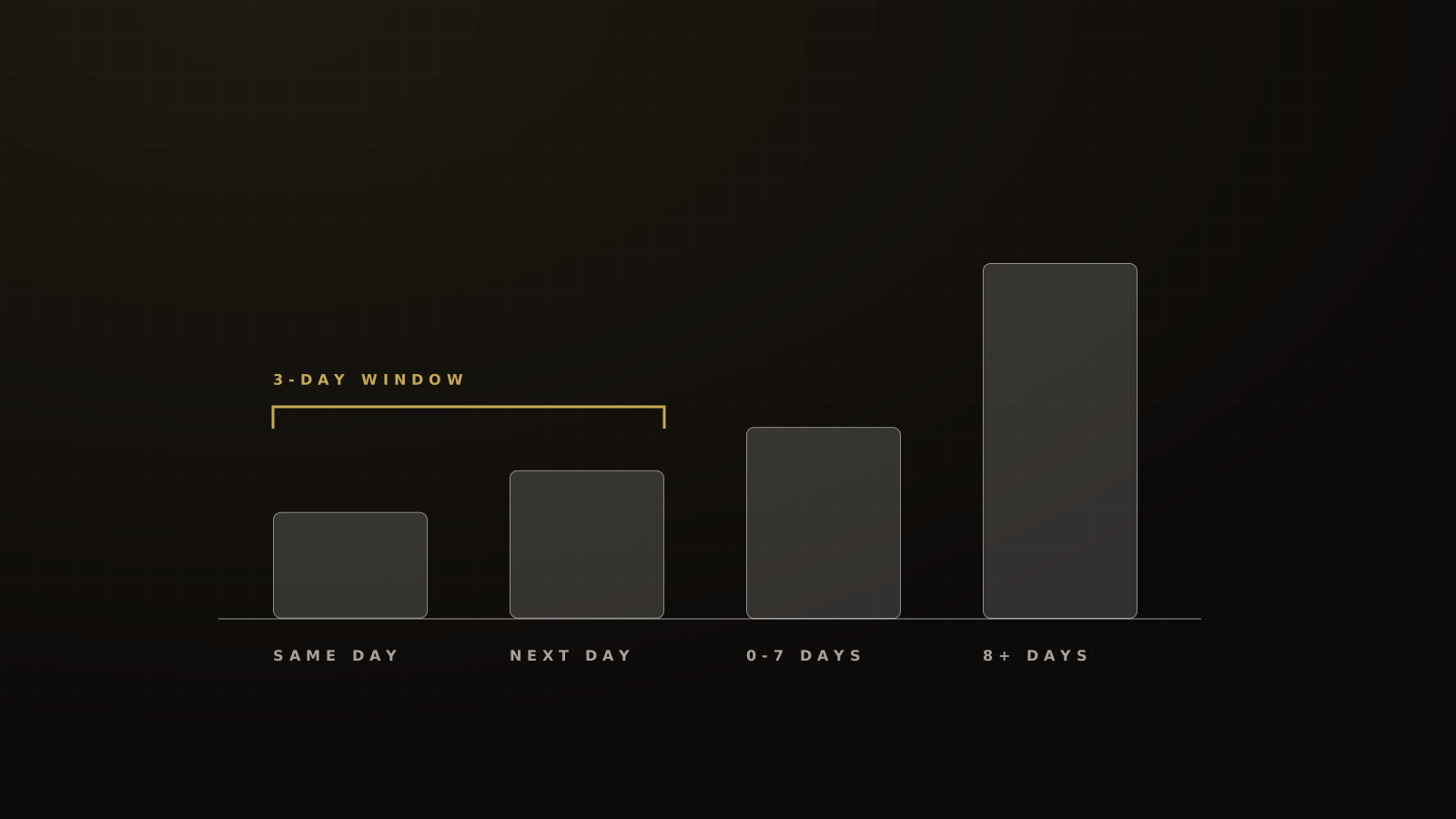
- No-shows climb with every day between booking and call, from 6.9% same day to 23% at 8 or more days in one vendor's data.[1]
- No traceable benchmark exists for consumer high-ticket sales calls. On the phone calls we run, booked no more than about three days out, 82–88% show.
- Video helps B2B win rates,[2] but healthcare data shows phone appointments are missed less often than video ones.[3]
- When someone doesn't show, call within minutes. In our experience 30–40% of no-shows rebook within 48 hours.
Most no-show advice stops at reminders. Three levers do more:
- Open the calendar only about three days ahead, because no-shows climb with every day between booking and call.
- Default to phone, because many buyers won't get on camera.
- Send a pre-call sequence that answers the top objections before the call.
Then call every no-show within minutes and rebook. Here's the evidence for each, where it's thin, and how we run it.
What a normal no-show rate looks like, and how to measure yours
Start with the denominator. A booked call ends one of four ways: held, no-show, cancelled or rescheduled. Some are still pending when you run the report. Count them separately, or your show rate means nothing.
Vendor snapshots get this wrong all the time. In one RevenueHero week, 6.5% of 6,428 meetings were no-shows, but 1,114 meetings were still pending, so the "93.5% show rate" a quick reader would infer isn't real.[4]
The best B2B baseline comes from RevenueHero's customers booking 50 or more meetings a month.
Average no-show rate on booked B2B sales meetings across RevenueHero customers
In the one-week snapshot, education and e-learning software had the highest no-show rate of 15 industries, at 18.1%.[4] The "20–35% average" you'll see quoted comes from a vendor FAQ with no sample.[6]
Consumer data is thinner. Medspas on Zenoti's platform logged 4% no-shows and 14% cancellations in 2025, but those are mostly treatment visits, not sales consults.[7] We found no traceable 2023–2026 benchmark for consumer high-ticket sales calls.
What we can tell you is what we see. In our experience, phone calls booked no more than about three days out show at 82–88%.
One more metric to track: attended calls per qualified lead. Heavy screening can push the show rate up while fewer buyers ever reach a closer. The rate should rise without that number falling.
Lever 1: open the calendar only about three days out
The longer the gap between booking and call, the more people forget, cool off or find something else. Reply.io's data on 2,900 booked demos shows the slope:
| Booked | No-show rate |
|---|---|
| Same day | 6.9% |
| Next day | 9.6% |
| Within 7 days | 12.4% |
| 8+ days out | 23% |
Reply.io's own SaaS demos, 2023. One vendor's data, not a consumer benchmark.
Source: Reply.io.[1]
Healthcare shows the same pattern at far larger scale. Across 1.26 million appointments in a rural US health system, no-shows rose from 4.31% at 0–15 days lead time to 7.73% at 60 or more days.[8] Another analysis of the same system found 2.3% no-shows for appointments booked less than a day ahead, 6.6% within two weeks and 9.3% at the longest lead times.[9] In Turin, each extra day of waiting raised the odds of a no-show by about 1%.[10]
It's not the only lever. A 2026 study of 17,614 arthroplasty patients found lead time wasn't significant after statistical correction; prior no-show history and confirmation were stronger predictors.[11] So a short window helps, and confirmation matters as much.
How we run it:
- Open closer calendars only about three days ahead. A buyer who wants to talk next Thursday usually wants to talk now.
- Book at the moment of intent. Put scheduling on the form or the thank-you page. Chili Piper found 66.7% of qualified demo forms booked a meeting, and 69.2% when a live-call option was offered.[12]
- Call fast when they don't self-book. Calling within 5 minutes instead of 30 gave 100 times the odds of reaching the lead in the InsideSales.com and MIT study.[13] Our standard is a median first dial under one hour in staffed hours.
Lever 2: default to phone
Many buyers don't have the confidence to get on camera, and a video link can feel invasive to someone who isn't sure yet. On the calls we run, phone calls show up more.
It doesn't matter what I want. We look at the data.
Healthcare data leans the same way. Across 1.22 million scheduled primary-care visits at NYC Health + Hospitals, non-attendance was 25.7% for phone visits, 35.6% for video and 26.5% in person.[3] A study of 3.1 million clinic visits found phone visits had half the odds of a no-show compared with in-person visits, while video cut the odds far less.[14] Neither is a sales study, and video was a small share of the NYC visits. Treat them as support, not proof.
Now the counterpoint. Gong's 2020 analysis of 12,282 B2B opportunities found deals were 127% more likely to close when video was used.[2] That measures B2B win rates, not attendance, and it's observational. But it's real, and it's why we don't ban video.
Our rule: phone by default, video when the buyer asks for it.
Lever 3: a pre-call sequence that handles objections first
Reminders confirm the time. A pre-call sequence gives the buyer a reason to keep it.
What to send and when
Keep it short: three to five touches between booking and call, each answering one objection your closers hear often.
- Right after booking: confirm the time, say what will happen on the call and who they'll talk to. Ask them to reply with the one question they most want answered.
- The next touch: a short proof piece for the "will this work for someone like me" objection.
- The day before: the price or time objection, handled plainly. If the offer has bonuses, show them here rather than hinting at a discount on the call. That follows Hormozi's rule of adding a bonus instead of cutting price.
- The morning of: a firm confirmation that makes cancelling easy. A cancel frees the slot for another buyer. A silent no-show wastes it.
The question in step one is a small commitment, and it works. In an NHS practice, having patients write down their own appointment details cut missed appointments 18% against the prior six-month average.[15] It's also friction in Hormozi's sense: a small step that filters out the least serious bookings before they take a slot.
Turning call recordings into the sequence
The best source for those objections is your own calls. We pool every objection from recorded calls into a shared bank, then turn the most common ones into the sequence and into ad angles. Our standard is 100% of recorded calls auto-scored within 24 hours, with a weekly scorecard per rep. How we build it is in using AI to audit every sales call.
No controlled study we found shows a pre-call objection sequence raises consumer sales-call shows. This lever is our operating view, built from watching which calls show and which don't.
Reminders that work
Reminders help, within limits. A Cochrane review of healthcare trials found text reminders raised attendance compared with no reminder (risk ratio 1.14), and texts worked about as well as phone-call reminders.[16] A Kaiser Permanente trial found a second text cut no-shows by 7% in primary care and 11% in mental health, relative to one text.[17]
A human call adds more. In a 2025 randomized project at a safety-net clinic, a volunteer call before the visit plus automated reminders lifted attendance from 54.1% to 68.0%, though it made no difference for telehealth visits.[18] On a sales floor, that call is the closer's short "looking forward to talking" text or call the day before.
Calendly reports a 28% average drop in no-shows from automated reminders, but it publishes no sample or method.[19]
Reminders only work if they arrive. After fixing an SMS setup with drip sends, trigger links on the brand's own domain and an A2P-registered number, we hold reminder delivery at 95% or better. No method-disclosed industry delivery benchmark exists, so that's our standard, not a comparison. The rules behind it are in our email and SMS deliverability guide.
Skip no-show fees. A Danish randomized trial found a fine had no effect: 4.95% no-shows with the fine, 4.86% without.[20]
When they don't show: call within minutes and rebook
A no-show isn't a lost buyer yet. Most people who miss a call meant to take it. Something came up, or nerve failed.
The closer calls within minutes of the missed start time, then texts. The tone is helpful, not hurt: "We had you down for 2:00, still want to talk today?" In our experience 30–40% of no-shows get rebooked within 48 hours. No credible industry benchmark exists for that, so treat it as ours.
The rest of the hour isn't wasted either. On a full-cycle team, the closer works the lead list. We explain why in the setter-closer model.
Every no-show still holds a slot, so plan capacity on bookings: our sales team capacity calculator does the math. For the full build, see building a high-ticket sales team and the research on speed to lead. Running live events too? Event attendance has its own levers, covered in event marketing and show rates. Or book a strategy call and we'll look at your booking flow.
Frequently asked questions
Sources
- 1.How to fight demo no-shows. Reply.io, 2023-08-08.
- 2.How video really impacts remote sales in 2020, according to data. Gong Labs, 2020-09-01.
- 3.Non-attendance by visit format in primary care, NYC Health + Hospitals. Journal of General Internal Medicine, 2022-10-11.
- 4.No-show benchmark: week of December 2, 2024. RevenueHero, 2024-12-13.
- 5.Ways to reduce no-show rates in sales calls. RevenueHero, 2025-08-18.
- 6.How to handle no-shows. Chili Piper, 2020-10-01.
- 7.Medspa cancellation rate (2026 Beauty and Wellness Benchmark Report, Medspa Edition). Zenoti, The Check-In, 2026-07-17.
- 8.Outpatient no-shows by booking lead time, Marshfield Clinic Health System (Shour et al.). BMC Health Services Research, 2023-09-14.
- 9.No-show rate by appointment lead time (Shour and Onitilo). Clinical Medicine & Research, 2023-12.
- 10.Waiting time and appointment no-shows in Turin (Russotto et al.). Healthcare (Basel), 2025-07-30.
- 11.Scheduling lead time and no-shows in an arthroplasty clinic. Arthroplasty Today, 2026-08-04.
- 12.2025 Benchmark Report on Demo Form Conversion Rates. Chili Piper, 2025-02-18.
- 13.Lead Response Management Study. InsideSales.com and James Oldroyd, 2007-10-16.
- 14.No-show odds for phone and video visits vs in-person visits (Shao et al.). Journal of Telemedicine and Telecare, 2024-04-01.
- 15.Patients writing their own appointment details (Martin, Bassi and Dunbar-Rees). Journal of the Royal Society of Medicine, 2012-03.
- 16.Mobile phone messaging reminders for attendance at healthcare appointments. Cochrane (Gurol-Urganci et al.), 2013-12-05.
- 17.One vs two text reminders before high-risk visits (randomized). The Permanente Journal (Kaiser Permanente Washington), 2022.
- 18.Volunteer outreach calls and new-patient attendance (Chen et al.). Journal of Evaluation in Clinical Practice, 2025-09.
- 19.How to reduce no-show rates for sales calls. Calendly, 2020-06-05.
- 20.Effect of a no-show fine in an orthopaedic outpatient clinic (randomized trial). BMJ Open, 2018-04-13.
- 21.Complying with the Telemarketing Sales Rule. Federal Trade Commission, current, checked 2026-10-04.
- 22.Order DA 26-12: revocation rule effective date extended. Federal Communications Commission, 2026-01-06.
- 23.Insurance Marketing Coalition v. FCC, No. 24-10277. US Court of Appeals, 11th Circuit, 2025-01-24.
Written by
Devin AlexanderCo-Founder & CEO
Devin architects Victory's revenue systems: team structure, comp plans, scripts and the accountability frameworks that make sales floors predictable. He has generated more than $150M in sales and trained more than 250 closers.
Part of the guide: Building a High-Ticket Sales Team: Setters, Closers, Comp Plans and Show Rates