Higgsfield AI for Ad Creative: Our Claude-to-Higgsfield Workflow, Costs and Limits
How we pair Claude and Higgsfield for ad variations: the workflow, real credit cost per clip, the Meta and FTC policy check, and where human footage wins.
 Ray GillespieCo-Founder & COO
Published 10 min read
On this page
Key takeaways
- Higgsfield is a volume engine, not a strategy. Claude studies the competitor ads and writes the hooks and prompts, Higgsfield renders the statics, GIFs and short clips, and a person decides what launches.
- Through the MCP connector, every generation costs credits on every plan. "Unlimited" models and free generations are web-only.[1]
- Budget per finished asset, not per plan. At list rates, a 15-second Seedance 2.0 clip at 1080p burns about 135 credits, so Plus's 1,200 credits buys about 8 clips before retakes.[2]
- Meta puts its "AI info" label next to "Sponsored" when an ad shows a photorealistic AI person, and the FTC bans testimonials from people who don't exist.[3][4]
- No independent study has tested AI-avatar ads against human testimonial footage on cost per acquisition. The closest research says AI ads win attention and lose on conversion, so keep a human control cell.[5]
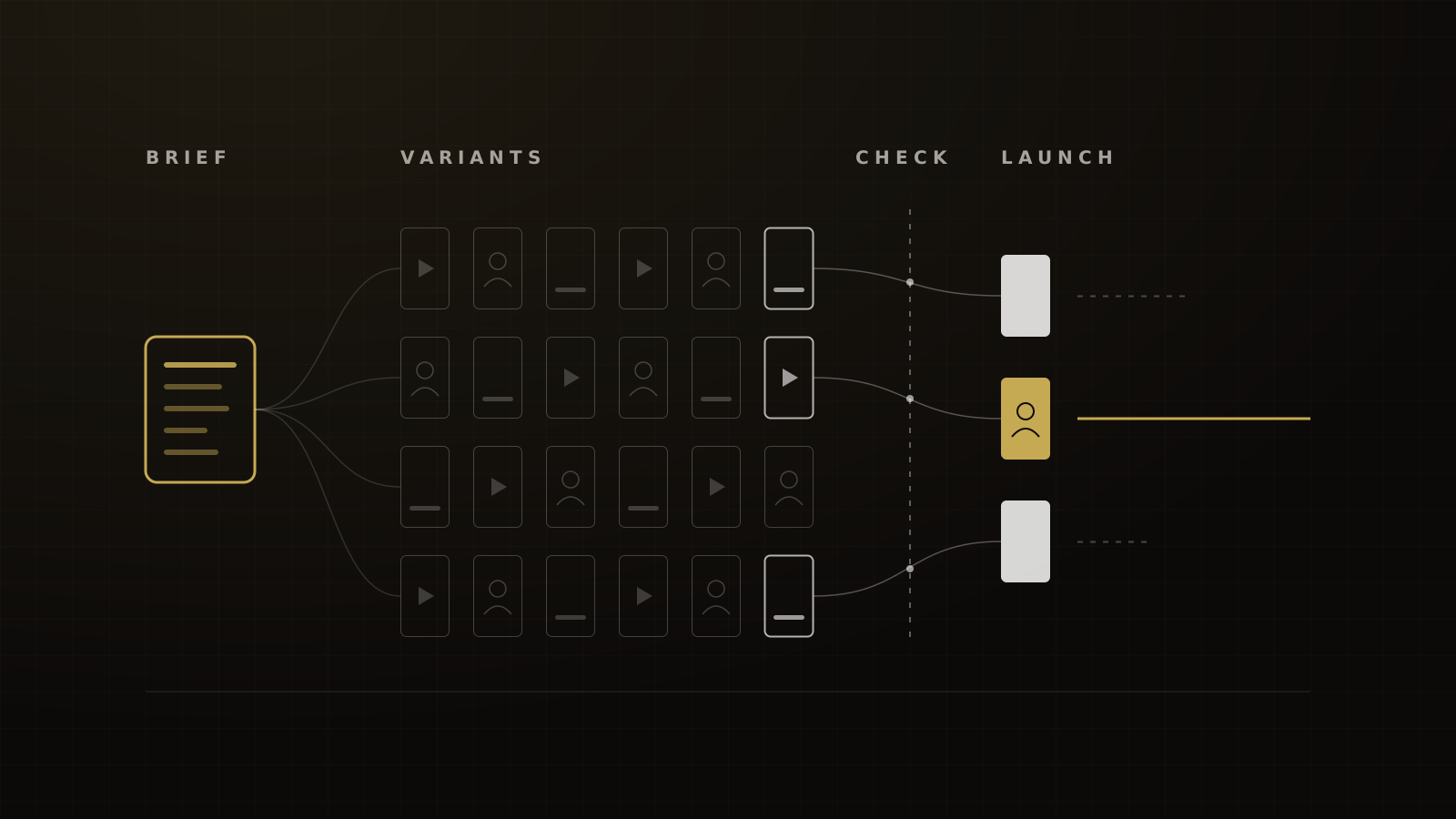
Higgsfield makes ad variations faster and cheaper than any shoot. It doesn't decide what to say, and it can't prove anything. We run it as a volume engine inside a fixed process: Claude researches and writes the prompts, Higgsfield renders, every asset passes a policy check, and real human footage stays in the account for the moments that need proof.
Below: the workflow, the real credit cost per clip, the pre-launch check, and the honest state of the evidence.
What Higgsfield is good for (and what it isn't)
AI creative is no longer a side experiment. In HubSpot's 2026 State of Marketing, 74.9% of marketers said they use AI for media creation and 70.6% for advertising automation.[6] Meta reported in December 2024 that more than 1 million advertisers were making more than 15 million ads a month with its own generative AI tools.[7]
Higgsfield reports more than 32 million users and nearly 1 million paying subscribers (company figures, September 2026).[8] It puts many image and video models behind one account, which suits three jobs:
- Volume. Many hooks on one offer, so the ad account picks the winner.
- Variation. The same message as a static, a GIF and a short clip.
- Speed. A new angle in market this week, not after the next shoot.
It can't choose the angle, know the audience or stand in for a real customer. Brunson's paid-ads lesson, which he credits to his ads lead John Parkes and Dean Graziosi's team, is that constant creative volume is the edge. Higgsfield supplies the volume. Direction still comes from people.
Brief to launch: our Claude-to-Higgsfield workflow
Claude studies the competitor ads
Every program starts with research, not prompts. We put the competitor ads that have run longest in the Meta Ad Library, plus the client's call and webinar transcripts, into one Claude project. Claude reports which hooks repeat, which objections recur, and which claims competitors make that we won't.
A full audit of a big library goes to an agent; see our evaluation of Manus, Hermes and Claude agents. How each client's context lives in Claude is in Claude for marketing operations.
Claude writes the hooks, then the prompts
Claude writes hooks using our seven variables as the schema: avatar, problem, outcome, niche or context, the common advice we're challenging, a sourced surprising stat, and identity markers. Filling those in once per client keeps every variant on-message. The hook types themselves are in our ad hooks playbook.
Then Claude turns each approved hook into a Higgsfield prompt: scene, avatar look and delivery, captions, and a disclaimer line where needed. A person approves the hook list before any credits are spent. Killing a hook in text is free. Killing it after rendering isn't.
Ray's description is that the setup helps "compress time and my learning curve." It speeds up someone who already knows a good ad. It doesn't replace them.
Connect Higgsfield to Claude via MCP
Higgsfield runs a remote MCP server at https://mcp.higgsfield.ai/mcp. You add it in Claude as a custom connector and sign in with OAuth. It needs an active paid subscription.[1]
No more copy-paste, but it changes the billing (see below).
The 15-second rule and caption burn-in
We cap avatar clips at 15 seconds: cheaper to render, cheaper to retake, faster to judge. Captions are burned in, and we review every clip with the sound off.
A variant earns budget by clearing the same bar as any ad. In our experience, a working cold Meta ad for a webinar or event runs a 1.8% to 2.5% link CTR. LocaliQ's 2026 benchmarks put Education & Instruction lead campaigns at 1.74% and all industries at 2.70%.[9] An AI variant below that range doesn't scale, however good it looks.
What credits really cost
At the time of writing, Higgsfield's Starter plan is $19 a month for 270 credits. Plus is $59 billed monthly or $47 a month billed annually, for 1,200 credits. Ultra is $129 monthly or $99 a month annually, with 3,000, 6,000 and 9,000-credit tiers. The page was running an annual-billing promotion when we checked, so recheck before you budget.[2]
The burn rate, which depends on the model, matters more than the plan. Seedance 2.0 costs about 22 credits per 5 seconds at 720p, 45 at 1080p and 110 at 4K. Kling 3.0 costs about 7, 8 and 30.[2] From Kling at 720p to Seedance at 4K, the same five seconds of video varies about 15x in cost.
A worked example (illustration, not a client result)
| Line | Seedance 2.0, 1080p | Kling 3.0, 1080p |
|---|---|---|
| Credits per 15-second clip | about 135 (3 × 45) | about 24 (3 × 8) |
| Clips from 1,200 credits | about 8 | about 50 |
| List cost per clip | about $7 | about $1.18 |
| Cost per keeper if 1 in 3 renders is usable | about $22 | about $3.50 |
Credit rates from Higgsfield's pricing page at the time of writing. The one-in-three keeper rate is a hypothetical to show how retakes multiply cost.
Higgsfield's own Claude walkthrough estimates about 85 credits, roughly $4.25, per 15-second variant.[10] That sits between our columns because it mixes models, and it's per generated variant. It excludes rejected renders, which is where budgets actually go.
"Unlimited" doesn't apply through Claude
Some plans advertise unlimited generations on certain models. Those, and free generations, are web-only. Every generation through MCP or an agent deducts credits, on any plan.[1] Move from the web app to a Claude workflow and the bill changes, even though the plan didn't.
The pre-launch policy check
Meta's "AI info" label
Meta adds an "AI info" label to ads created or significantly edited with its own or third-party AI tools. Minor edits such as resizing or color correction aren't labelled.[11] When an ad shows an AI-generated photorealistic person, Meta places the label next to "Sponsored", where every viewer sees it. It detects third-party tools through industry-standard signals.[3] Assume a Higgsfield avatar will be labelled.
Write the ad so it works with the label. In IAB research from January 2026, 73% of young consumers said an AI label raises or doesn't change their likelihood to buy. But only 45% of Gen Z and Millennial consumers felt positive about AI ads, against 82% of ad executives who thought they did.[12] Stated attitudes aren't conversions, but don't assume your audience likes AI as much as the industry does.
Social issue and political ads
For social issue, electoral or political ads, Meta requires you to disclose photorealistic AI images or video and realistic AI audio, including a realistic person who doesn't exist. Ads that don't disclose are rejected, and repeat failures bring penalties. From June 1, 2026, Meta's automated detection can also apply AI info labels on its own.[13] If an ad touches any public debate, check the category first.
No fake customers: the FTC rule
The FTC's August 2024 rule bans reviews and testimonials that misrepresent that they come from someone who doesn't exist, such as AI-generated fake reviews, or from someone with no real experience of the product. It allows civil penalties against knowing violators.[4]
An AI avatar can present, explain or dramatize. It can't pose as a customer describing their results. Paid creators still need the usual endorsement disclosure.
Likeness and IP
Higgsfield doesn't claim ownership of your inputs or outputs and doesn't restrict commercial use. You're responsible for copyright, trademark and likeness rights, and you can't upload other people's images without permission.[14] Don't build an avatar from a real person's photo without their written consent, and don't recreate a competitor's spokesperson.
TikTok and the EU
TikTok requires its AIGC label or your own clear disclaimer on AI-generated ad content, and it rejects or restricts ads that don't disclose.[15] In the EU, Article 50(4) of the AI Act requires deployers to disclose deep fakes from August 2, 2026. The duty covers AI content that resembles real people, places or events and would falsely appear authentic, not every AI ad.[16] Check for later amendments before relying on that reading.
Where lo-fi human footage still wins
The honest answer first: no independent study has tested AI-avatar ads against human testimonial footage on cost per lead or cost per acquisition. We looked. What exists is adjacent:
- A randomised field test of more than 150 video ads (June 2026) found AI-generated ads won more clicks and attention but were less likely to convert. The abstract gives no effect sizes.[5]
- An Ipsos and Syracuse University pretest showed 20 ads, 10 human-made and 10 AI-generated, to 3,000 US consumers. The human ads scored 14% stronger on Ipsos's short-term index and 17% stronger on its long-term index, and most viewers couldn't tell which ads were AI.[17] That's a pretest, not in-market CPA.
- A Columbia study of Taboola image ads from 2023 found no significant CTR difference between AI and human images within the same campaign.[18] Images, not video, and no avatars.
- Meta's video-generation beta, across more than 130,000 ads, reported 10% higher CTR and 8% higher conversion rate for heavy users.[19] That's studio-style product video, measured by Meta, not AI people.
- Gallup and Bentley University's August 2026 survey found 62% of US adults reject AI-created people or voices in ads, even when the ad discloses them, while 75% accept AI for brainstorming and early drafts.[20] That's stated attitude, not in-market behavior, but it's the clearest signal yet that the avatar itself carries risk.
None of these puts an AI avatar against a real person on camera. Pages quoting a precise "AI UGC beats human UGC" percentage repeat figures we couldn't trace to any primary dataset.
What the evidence supports is judging AI creative on conversions, not clicks. That matches what we see. Lo-fi, selfie-style footage of a real person tends to beat polished production, and lo-fi means authentic, not sloppy. Testimonials, founder credibility and real-experience claims stay human: the FTC rule requires it, and proof is what converts.
So run a control: a human testimonial cell in every account using AI creative, with both cells judged on cost per lead and cost per acquisition. In our experience, a curiosity-led event opt-in on cold Meta traffic should land at $15 to $25 per lead, against LocaliQ's 2026 all-industry average of $27.39.[9] If the AI cell's leads are cheap but don't buy, the CPA will show it.
Budgets and retargeting structure are in our paid ads guide for coaches.
Our checklist
Before any AI asset launches
- The hook was approved in text before anything was rendered.
- The clip is 15 seconds or shorter, with captions burned in.
- The asset is logged with its model, resolution and number of renders.
- No AI person poses as a customer or gives a testimonial.
- No real person's likeness is used without written consent.
- The ad still works with Meta's "AI info" label next to "Sponsored".
- The social issue and political category is checked, and AI is disclosed if it applies.
- TikTok versions carry the AIGC label or a clear disclaimer.
- EU-facing ads are checked against the AI Act's deep-fake definition.
- A human-footage control cell is live and judged on CPL and CPA.
Higgsfield earns its place inside a process: judgment up front, volume in the middle, a policy check and a human control at the end. Where it sits in our stack is in our lane map of AI tools for marketing teams and the AI marketing operations guide.
Want this running on your offer? See how we build it.
Frequently asked questions
Sources
- 1.How do I connect Higgsfield to an AI agent?. Higgsfield Help Center, 2026-09-24.
- 2.Higgsfield pricing (plans and model credit costs). Higgsfield, viewed 2026-10-04.
- 3.Expanding generative AI transparency in Meta's ads products. Meta Newsroom, 2025-02-03, updated 2026-06-01.
- 4.Federal Trade Commission announces final rule banning fake reviews and testimonials. US Federal Trade Commission, 2024-08-14.
- 5.Attention without conversion: AI-generated versus human-created video ads. Li and Li, Hong Kong Baptist University, 2026-06-12.
- 6.2026 State of Marketing report. HubSpot, 2026-04-10 (updated).
- 7.Meta Andromeda: supercharging Advantage+ automation with the next-gen personalized ads retrieval engine. Meta Engineering, 2024-12-02.
- 8.Higgsfield: $1B annualized revenue run rate. Higgsfield, 2026-09-29.
- 9.Facebook advertising benchmarks. LocaliQ / WordStream, 2026-09-23.
- 10.Full ad campaign inside Claude. Higgsfield, 2026-08-12.
- 11.AI info labels on ads. Meta Help Center, living doc, checked 2026-10-04.
- 12.The AI gap widens. IAB and Sonata Insights, 2026-01.
- 13.Ads about social issues, elections or politics. Meta Transparency Center, living doc, checked 2026-10-04.
- 14.Who owns my generations, and can I use them commercially?. Higgsfield Help Center, 2026-09-12.
- 15.TikTok ads policy: misleading and false content. TikTok, 2026-04 (updated).
- 16.Regulation (EU) 2024/1689 (Artificial Intelligence Act). EUR-Lex, 2024-07-12.
- 17.AI ads: just good enough?. Ipsos and Syracuse University, 2026-05.
- 18.AI in disguise (working paper). Exner, Hartmann, Netzer and Zhang, Columbia University, 2025-01-14.
- 19.Del comercio a la cultura: cómo la IA impulsa la conexión personalizada y el crecimiento a lo largo del funnel. Meta Newsroom (Latin America), 2026-03-26.
- 20.Americans aren't sold on businesses using AI in advertising. Gallup / Bentley University, 2026-08-19.
Written by
Ray GillespieCo-Founder & COO
Ray runs day-to-day operations across every Victory engagement, building the systems, automations and AI-powered workflows that hold the machine together. He has overseen operations behind more than $120M in revenue.
Part of the guide: AI Marketing Operations: How a Modern Agency Runs Funnels with Claude, Agents and Automation