Ad Hooks for Coaching and Event Offers: The 4 Hook Formats We Test First
Four hook formats matched to awareness level, one script filmed with five to ten hooks, and a read-out rule that picks the winner on qualified pipeline.
 Marius BulaiCMO & Head of Paid Media
Published 10 min read
On this page
Key takeaways
- Don't start from a swipe file. Start from who's watching and how aware they are of the problem.
- We test four hook formats first: the Call-Out (cold audiences), the Mistake (people already trying to fix the problem), the Question (the unaware, built on a real, sourced stat) and the Personal Story (everyone).
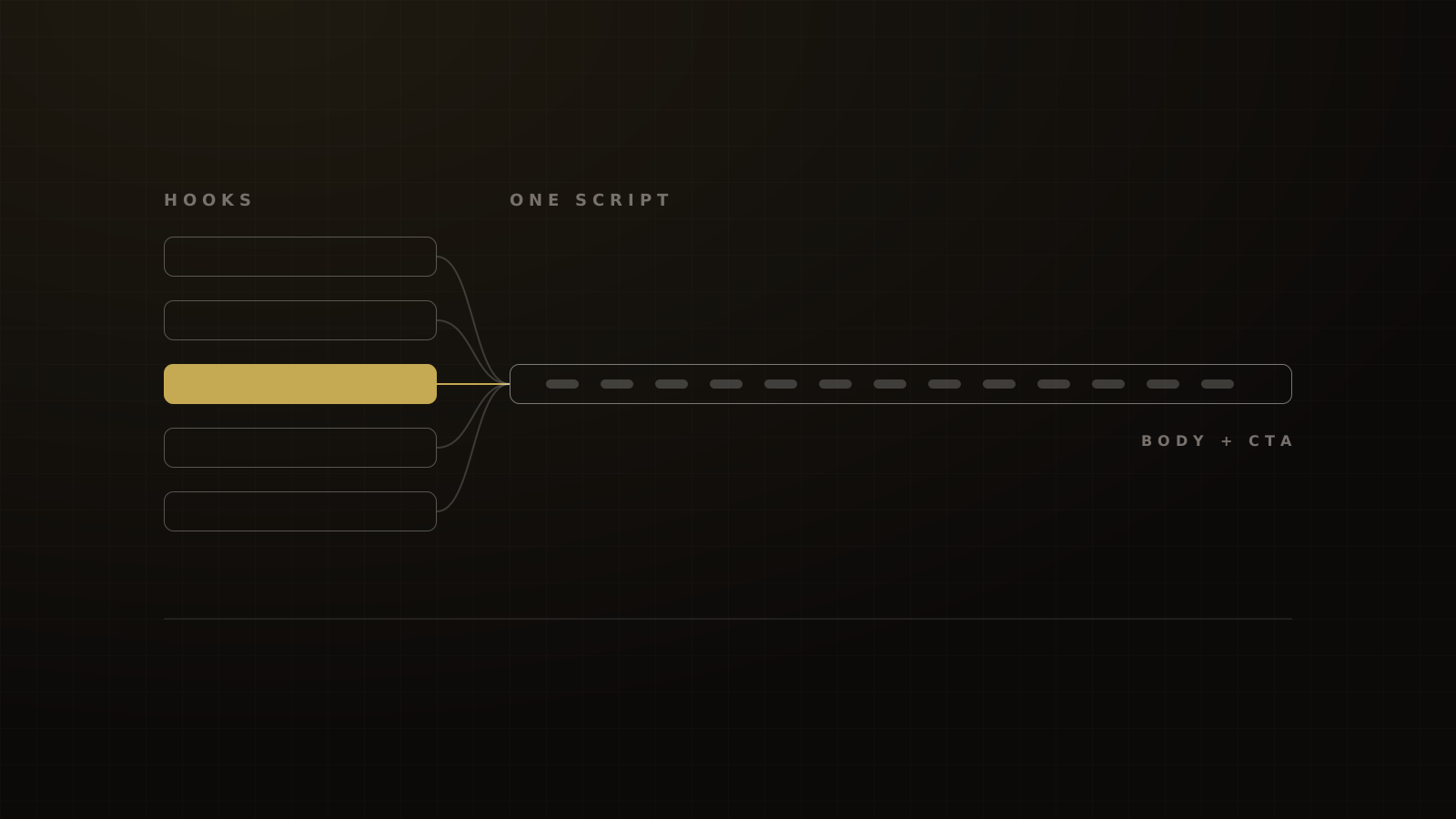
- Film one script with five to ten hooks, so the hook is the only thing that changes.
- Most creative loses. In Motion's 2026 data, only 5–8% of Meta ads became winners, which is why one script needs many hooks.[1]
- Read hook rate and CTR as early signals. Keep the winner on cost per qualified lead or booked call, not on 3-second views.
The best ad hooks for coaching and event offers don't come from a swipe file. They come from matching the opening line to how aware the viewer already is, then testing several openings on the same ad so the data tells you which one works.
We start with four formats: the Call-Out, the Mistake, the Question and the Personal Story. We film one script with five to ten hooks, so the hook is the only thing that changes. Then we keep the winner on cost per qualified lead, not on 3-second plays. Here's the method.
Why swipe files don't work
Most "ad hooks examples" pages are long lists of opening lines. The few that teach testing use ecommerce examples, and none pick the winner on what matters for a coaching or event offer: qualified pipeline.
A list can't tell you which line fits your viewer. Eugene Schwartz's five levels of awareness can. A prospect can be unaware, problem-aware, solution-aware, product-aware or most aware. The less aware they are, the more indirect your opening has to be, and the later your offer should appear.
Schwartz's second idea, market sophistication, explains why plain claims stop working. Coaching is a late-stage market, so you need a new angle, a mechanism, or a hook that makes the viewer feel recognized.
That's what a hook is for. Our internal hooks playbook puts it in one line: "the hook's only job is to stop the scroll and earn the next three seconds." Hormozi makes the same point about the whole ad in $100M Leads: each second should sell the next one. Russell Brunson's Hook, Story, Offer gives the diagnostic: when an ad underperforms, check the hook first.
The 4 hook formats we test first
Each format below comes from our Facebook Ad Hooks Playbook. We fill in seven variables once per client (avatar, problem, outcome, niche or context, the common advice we'll challenge, a surprising stat, and identity markers), then drop them into the templates.
1. The Call-Out: cold audiences
Template: "If you're [AVATAR] struggling with [PROBLEM] [NICHE/CONTEXT], this is why."
Name exactly who should be watching. The right person feels addressed and everyone else scrolls on, which improves the quality of who clicks. Pair it with B-roll of someone who looks like the avatar.
- Coaching: "If you're a coach stuck at the same revenue for two years, this is why."
- Event: "If you run a local service business and you're tired of chasing referrals, this one-day event is for you."
Question-style headlines have outperformed statements before. In two field experiments reported in 2014, question headlines drew 150% more clicks and self-referencing questions 175% more than declarative ones.[2] That's 12-year-old research on online readership, not ads, so treat it as a reason to test, not a prediction.
2. The Mistake: problem-aware
Template: "The worst thing you can do [NICHE/CONTEXT] is [COMMON ADVICE]."
Tell people already working on the problem that the popular approach is hurting them. It opens a loop they want closed. Film it as a talking head, with on-screen text that teases the point without giving away the key word.
- Coaching: "The worst thing you can do when your webinar flops is run more ads to it."
- Event: "The worst thing you can do with a free event is open registration a month early."
There's some evidence negativity pulls attention. In Upworthy's randomized headline tests (about 105,000 variations, 2013 to 2015), each extra negative word raised click-through by 2.3% for an average-length headline.[3] Those were news headlines measured on clicks, not sales. The Mistake hook stays a hypothesis you test, not a rule.
3. The Question: unaware
Template: "Did you know that [SURPRISING STAT] [AVATAR] who [ACTION] [NEGATIVE RESULT]? Here's why."
Open with a surprising, credible number framed as a question, then promise the explanation. It suits unaware audiences in an organic, educational style.
The stat has to be real and sourced, from a published study or your own verified data, with the source on file. Never borrow a number from a swipe file. And reveal a problem they feel but misunderstand, rather than educating them into one they don't feel.
- Coaching: "Did you know [sourced share] of people who register for a webinar never watch it live? Here's what the rest do differently."
- Event: "Did you know free events lose [sourced share] of their room before the doors open? Here's how to keep yours."
4. The Personal Story: every level
Template: "I'm [IDENTITY MARKERS], and [SURPRISING PERSONAL DETAIL]. Here's how I [OUTCOME]."
Lead with plain identity markers and one surprising detail, then promise the how. Similar people self-select, and personal proof makes the outcome feel reachable. Pair it with authentic lifestyle footage.
- Coaching: "I'm a former teacher with two kids under five, and I run my coaching business in four hours a day. Here's how I set it up."
- Event: "I'm a dentist who hated public speaking, and last month I filled a room of 80 people. Here's how."
Stories that pull people in do move attitudes and intentions. A 2014 meta-analysis in the Journal of Consumer Research pooled 132 effect sizes from 76 articles on narrative transportation.[4] It shows stories persuade; it doesn't measure ad lift.
| Awareness level | First hook to test | Also test |
|---|---|---|
| Unaware | Question | Personal Story |
| Problem-aware | Mistake | Call-Out |
| Solution-aware | Call-Out | Mistake |
| Product-aware or retargeting | Personal Story | Call-Out with proof |
| Cold, mixed audience | Call-Out | Personal Story |
Schwartz's levels of awareness, mapped to our four formats. Start with the primary fit, then test one alternative.
One script, five to ten hooks: the production method
We film one script with five to ten different hooks. The body and call to action stay identical, so the test stays readable.
Volume matters because most creative loses. Motion's 2026 benchmark, built on 578,750 creatives across 6,015 accounts, found only 5–8% of ads became winners.[1] Meta's own research points the same way. Its Andromeda retrieval engine announcement says increased ad diversity can improve outcomes,[7] and a Meta, AppsFlyer and Dentsu Creative analysis of 1.1 million variations reported up to 32% better CPA for diverse creative, with no disclosed method.[8] Distinct hooks, not near-duplicates, are the point.
How we shoot it:
- Bullet points, not scripts. Natural speakers sound stiff reading lines. Give them the points and let them talk.
- Message in the first seconds, in picture and sound. Meta and Toluna's Reels research found ads with the brand and main message in the first five seconds were 1.7x as likely to rank in the top 20% for purchase intent, and ads with a visual plus audio hook 1.5x as likely.[9] Sample and method weren't disclosed.
- On-screen text inside the safe zones. For Reels, keep the top 14%, bottom 35% and 6% of each side clear of text and logos.[10]
- Lo-fi, not sloppy. Selfie-style video usually beats a studio shoot in the accounts we run. Clear audio and good light still matter.
Our guide to which creative sells event tickets covers speaker-lineup and story ads for events specifically.
How we read the test
Structure. Film five to ten hooks, but don't launch ten separate ads into one ad set. Meta says too many ads means each delivers less and fewer ad sets exit learning. It recommends fewer ads per ad set with diverse creative assets, and one ad can hold up to 10 assets.[11] Adding a new ad also counts as a significant edit that can restart learning, which usually ends after about 50 results in a week.[12] So launch a shortlist of three or four hooks, or load them as assets in one ad, and rotate the rest in as losers drop.
Early signal: hook rate and CTR. Hook rate is a practitioner ratio: 3-second video plays divided by impressions. Meta publishes no benchmark for it. The one method-disclosed reference we've found is Billo's: a 25.44% average across 88,329 sales-objective video ads in the first half of 2026, up from 24.42% in the second half of 2025.[13][14] That's a mostly ecommerce average, so use it as a reference point, not a coaching target. For link CTR, a working cold webinar or event ad on the funnels we run typically sits at 1.8–2.5%, against LocaliQ's 2.70% all-industry average for lead campaigns.[15]
Keep or kill: cost per lead, then cost per booked call. On a curiosity-led event opt-in, we expect $15–25 a lead, against LocaliQ's $27.39 all-industry average.[15] A hook above that range after a fair run gets cut. The final verdict is downstream: we keep the hook whose leads book, show and buy at the lowest cost.
Test length. We judge a hook test after 7 days at the planned spend or about 50 optimization events. Meta's A/B testing guidance also recommends at least 7 days and one variable at a time.[16]
Feed the winner back. Once a hook wins on pipeline, send the downstream stages back to Meta so it finds more people like those buyers. Our article on feeding Meta better signals covers how.
Refresh before it fades. Winners wear out. Meta's analysts found the likelihood of a conversion drops by about 45% by the fourth repeated exposure to the same creative, and found no evidence of "wear-in".[17] New hooks on a proven script are the cheapest refresh you have.
Hook test checklist
- Awareness level chosen, and hook format matched to it
- Seven variables filled in, with any stat sourced and on file
- One script, five to ten hooks filmed; body and CTA identical
- On-screen text inside the Reels safe zones
- No personal-attribute questions; earnings claims substantiated
- Three or four hooks live, or hooks loaded as assets in one ad
- Read after 7 days or about 50 events
- Winner chosen on cost per qualified lead or booked call, not hook rate
Myth box: the "1.7-second" rule and other untraced numbers
- "You have 1.7 seconds." That figure is the average time mobile users spent with a feed item in Facebook IQ research on 850+ video ads from late 2014 to late 2015 (2.5 seconds on desktop). The same research found recall registered after 0.25 seconds.[18] It's a decade-old dwell time, not a deadline. The real lesson: your first frame has to work.
- "47% of the value is in the first 3 seconds." Meta reported views under three seconds drove up to 47% of campaign value, but that was brand lift from 2015-era Nielsen studies, not sales.[19]
- "Run 5–10 ads per ad set." Meta's guidance is the opposite: fewer ads, with more diverse assets inside them.[11]
For the rest of the account, see our paid ads guide for coaches and 2026 Facebook ads benchmarks for coaches.
Download the checklist above to run your next hook test, or book a strategy call and we'll build the first test with you.
Frequently asked questions
Sources
- 1.2026 creative benchmarks report: methodology and definitions. Motion, 2026 (data Sep 2025 to Jan 2026).
- 2.Question headlines attract more readers. ScienceDaily (BI Norwegian Business School release on Lai & Farbrot, Social Influence), 2014-01-08.
- 3.Negativity drives online news consumption. Robertson et al., Nature Human Behaviour, 2023-03.
- 4.The extended transportation-imagery model: a meta-analysis of narrative transportation. van Laer et al., Journal of Consumer Research, 2014-02.
- 5.Advertising standards: personal attributes. Meta Transparency Center, living doc, checked 2026-10-04.
- 6.FTC proposes rule changes and new rule to deter deceptive earnings claims. Federal Trade Commission, 2025-01-13.
- 7.Meta Andromeda: Advantage+ automation's next-gen personalized ads retrieval engine. Meta Engineering, 2024-12-02.
- 8.Report: the state of creative optimization (Meta, AppsFlyer and Dentsu Creative). Meta Business News, 2025-06-04.
- 9.Reels creative strategies. Meta Business News, 2025-12-02.
- 10.Instagram Reels ads specs. Meta Ads Guide, living doc, checked 2026-10-04.
- 11.About ad volume. Meta Business Help Center, living doc, checked 2026-10-04.
- 12.About the learning phase. Meta Business Help Center, living doc, checked 2026-10-04.
- 13.Hook rate benchmarks, H1 2026. Billo (Creative Insider), 2026-08-06.
- 14.Hook rate benchmarks, H2 2025. Billo (Creative Insider), 2026-05-27.
- 15.Facebook advertising benchmarks (2026 edition). LocaliQ, 2026-09-23.
- 16.A/B testing best practices. Meta Business Help Center, living doc, checked 2026-10-04.
- 17.Creative fatigue: how advertisers can improve performance by managing repeated exposures. Analytics at Meta (Medium), 2023-05-10.
- 18.Capturing attention in feed: the science behind effective video creative. Meta (Facebook IQ), c. 2016 (data Q4 2014 to Q4 2015).
- 19.The value of video for brands. Meta Business News, with Nielsen, 2015.
Written by
Marius BulaiCMO & Head of Paid Media
Marius runs all paid media strategy and execution at Victory. Before Victory he was Head of Analytics at Hyros, inside the data of some of the largest ad accounts in the world.
Part of the guide: Paid Ads for Coaches, Course Creators and Event Businesses: Meta, Creative and Attribution Tied to Cash