Paid Ads for Coaches, Course Creators and Event Businesses: Meta, Creative and Attribution Tied to Cash
Meta ads for coaches, course creators and event businesses: the right objective, CRM stages sent back to Meta, and spend judged on cash collected.
 Marius BulaiCMO & Head of Paid Media
Published 18 min read
On this page
- The short answer: run Meta to cash, not to Ads Manager
- Why the beginner playbook stops working above $5K a month
- Pick the objective and optimization event by business outcome
- The economics: front-end liquidation, back-end CPA
- Attribution tied to cash
- Send CRM stages back to Meta
- A creative-testing structure from accounts we run
- Budget and scaling rules
- Compliance: special ad categories and claims
- How we run this at Victory
- Common mistakes
Key takeaways
- Run Meta to cash you can see in the bank and the CRM, not to the number Ads Manager reports.
- Pick the Leads or Sales objective and optimize for the deepest event you get enough of. Traffic buys clicks, and education clicks are among the least intent-rich on the platform.[1]
- Judge the front end on how much of the ad spend it recovers, and judge the account on back-end cost per acquired client.
- Send CRM stages (booked, showed, closed) back to Meta through the Conversions API, so the algorithm looks for buyers instead of form-fillers.
- Creative is the lever you pull most often. Film one script with five to ten hooks and keep the winner on qualified pipeline, not CTR.
- Meta's average price per ad rose 12% year over year in both Q1 and Q2 2026, so every wasted dollar costs more than it did last year.[2][3]
Run Meta to cash, not to Ads Manager. That's the whole playbook for coaches, course creators and event businesses spending $5,000 a month or more.
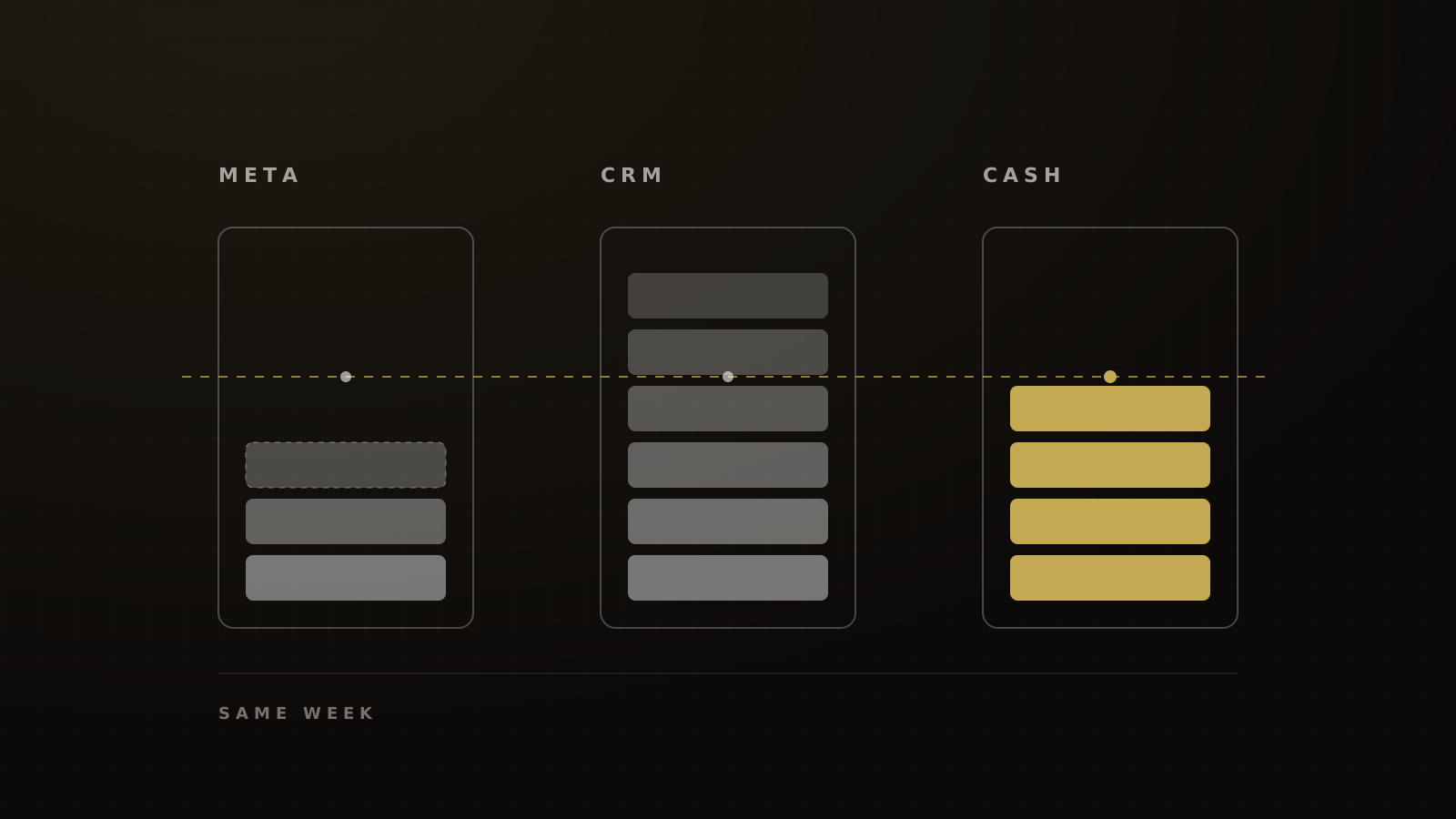
In practice it means three things. Choose the Sales or Leads objective and optimize for the deepest event you get enough of. Send your CRM stages back to Meta through the Conversions API. Then judge every campaign on two numbers: how much of the ad spend the front end recovers, and what each back-end client cost you.
Creative is the lever you'll pull most often. Attribution is the system that tells you whether pulling it worked. This guide covers both, with the structure we use on the accounts we run today.
The short answer: run Meta to cash, not to Ads Manager
Ads Manager reports what Meta can see. For a high-ticket coaching or event business, that's usually a registration, a booked call or a low-ticket purchase. It almost never sees the $5,000 sale that closes on a phone call nine days later, the payment plan that collects over six months, or the refund that comes back in week three.
So the platform number and the bank number drift apart. Founders who manage to the platform number end up scaling the campaigns that produce cheap leads, not the ones that produce clients.
Most of the advice that ranks for "facebook ads for coaches" is beginner-level. One well-ranked guide, updated in 2024, still calls the Traffic objective a good fit for most ads, including those driving to freebies and webinars.[4] Better pages recommend Leads or Sales and a CRM that connects spend to revenue, but they stop at UTMs.[5] None of them show how CRM stages get back to Meta, or how to reconcile Meta's numbers against cash collected.
That's the gap this guide fills. The order matters:
- Pick the objective and optimization event by business outcome.
- Build the economics: front-end liquidation, back-end cost per acquisition.
- Tie attribution to cash.
- Send CRM stages back to Meta.
- Run a creative-testing structure judged on pipeline.
- Scale on rules, not feel.
Why the beginner playbook stops working above $5K a month
Small accounts can survive sloppy setup. At $5,000 a month and up, the waste compounds.
Price per ad is up 12% a year
Meta's average price per ad rose 12% year over year in Q1 2026, while ad impressions rose 19%.[2] In Q2 2026 price per ad was up 12% again, with impressions up 14%.[3] For full-year 2025 the increase was 9%.[6]
Meta's average price per ad, year over year, in both Q1 and Q2 2026
Read that carefully. It's a company-wide average across every advertiser, not your CPM or your cost per lead. But the direction is clear: the same budget buys a little less each year. If a campaign was marginal in 2025, it's worse now, and the fix is better signals and better creative, not more spend.
The Traffic objective buys clicks, not buyers
Meta's current objectives are Awareness, Traffic, Engagement, Leads, App promotion and Sales. They replaced the legacy objectives, including the old Conversions and Lead generation options.[7]
Traffic optimizes for people likely to click. For education offers, those clicks are cheap for a reason. LocaliQ's 2026 benchmarks put Education and Instruction traffic campaigns at a 1.50% CTR and a $0.70 CPC, among the lowest click-through rates of any industry.[1] Cheap clicks from people who don't act are the most expensive thing you can buy.
The Leads and Sales objectives optimize for the action you actually want. That's where coaching and event budgets belong.
Pick the objective and optimization event by business outcome
Leads or Sales, matched to what you sell
Use Leads when the next step is a registration or a form: a webinar, a free event, an application. Use Sales when the next step is a purchase on your site: a low-ticket product, a paid ticket, a VIP upgrade.
Inside either objective, choose the deepest optimization event you can generate often enough. Meta's learning phase usually ends after about 50 results in the week after the last significant edit.[8] If you only get ten booked calls a week, optimizing on "booked call" starves the algorithm. Optimize on the registration or purchase and send the deeper stages back as signals (more on that below).
Advantage+ sales and leads campaigns in 2026
Meta now runs three Advantage+ campaign types: Sales, App and Leads. A campaign is in "Advantage+ state" when it uses a campaign budget, an Advantage+ audience (or a relaxed or geography-only audience) and no placement exclusions. Advantage+ Sales has replaced Advantage+ Shopping.[9]
Meta reports that Advantage+ leads campaigns delivered a 10% lower cost per lead across 20 tests run between November 2024 and January 2025, including education advertisers.[10] In the same release, sales campaigns showed similar cost per acquisition, not lower. Treat it as a reason to test Advantage+ for lead generation, not as a promise.
Decision table
| What you're selling next | Objective | Optimize on | Judge it on | What it costs |
|---|---|---|---|---|
| Free webinar registration | Leads | Registration (Lead) | Cost per live attendee, then cost per buyer | Our first cold test usually lands at $12–20 per registration, against a $28.22 Education median[11] |
| Low-ticket product ($7–$97) | Sales | Purchase | Front-end ROAS, then back-end cost per client | Front end should recover 0.8–1.2x of spend (our target) |
| Booked sales call | Leads | Registration or lead, with booked and showed sent back | Cost per held call | Depends on show rate; see the worked example |
| Free in-person event ticket | Leads | Registration | Cost per checked-in attendee | In our experience $18–24 per registration, against $26.31 for Education[1] |
Victory figures are operator estimates from the funnels we run, set beside the closest published industry figure. They are not guarantees.
The economics: front-end liquidation, back-end CPA
What a lead costs vs what a buyer costs
A lead from Meta costs roughly $26 to $28 in education. LocaliQ's 2026 figure for Education and Instruction lead campaigns is $26.31, with a 15.87% conversion rate.[1] WordStream's 2025 report, built on 1,180 campaigns, put the median at $28.22 with a 10.08% conversion rate.[11] The all-industry average in 2026 is $27.39.[1]
A buyer costs whatever your show rate and close rate make it. That's the number to manage.
On the funnels we run, a curiosity-led event opt-in on cold Meta traffic typically costs $15–25, below LocaliQ's $27.39 all-industry average. The difference usually comes from the offer and the hook, not the targeting.
Self-liquidating front end, judged on back-end CPA
We rarely run cold traffic straight at a $3,000 offer. Cold audiences don't buy high-ticket on the first touch. Instead we send them to a sub-$100 product or a paid ticket whose sales pay back most or all of the ad spend. The high-ticket sale happens later, through calls and follow-up, from a list of people who have already bought once.
Our target for that front end is 0.8 to 1.2x return on ad spend at scale. There's no public industry benchmark for this; it's the target we hold.
The mistake is judging the front end on its own ROAS. The entry offer's job is to liquidate spend and fill calendars, not to make a profit. So we judge the account on back-end cost per acquisition:
Back-end CPA = (ad spend − front-end revenue) ÷ back-end clients closed
We always run it on the pessimistic case first: lower show rates, lower close rates, higher cost per lead. If the pessimistic case works, the expected case is margin.
Our webinar numbers, and why the 2-day window matters
For years, our best webinar cost per registration was $8–10. On the weekly evening webinar program we run now, our current best is $4–5, the lowest we've ever seen. That program returns 4–7x ROAS week over week.
Set that against a $26–28 education lead benchmark and it looks too good. The conditions matter. It's a weekly evening webinar, ads run only in the two days before each session, and spend is a few thousand dollars a day. That's what's possible with a tight window and a strong offer, not a promise.
The window is the part most people get wrong. Running webinar ads two weeks out raises cost per registration and lowers show rate, in our experience. People who register 14 days ahead forget. People who register the day before show up. On cold traffic, a free single-date evening webinar on that 2-day window typically shows 25–35% of registrants live. Banzai's 2023 Demio data puts education services at 20% and hosts under $1M in revenue at 22%.[12]
Worked example (illustration, not a client result)
Say a coaching business sells a $5,000 program. It runs cold Meta traffic to a $50 starter product. Every number below is made up to show the math.
| Step | Number |
|---|---|
| Ad spend | $10,000 |
| Starter purchases at $62.50 each | 160 |
| Front-end revenue (160 × $50) | $8,000 |
| Front-end ROAS | 0.8 |
| Buyers who book a call (25%) | 40 |
| Calls held (85% show) | 34 |
| Clients closed | 6 |
| Net ad cost ($10,000 − $8,000) | $2,000 |
| Back-end CPA | about $333 |
Hypothetical figures. Swap in your own costs, show rates and close rates, and run the pessimistic case first.
Ads Manager shows a campaign losing 20 cents on every dollar. The bank shows six $5,000 clients acquired for about $333 each. A founder who kills this campaign because "ROAS is under 1" just turned off the business.
The same math explains why cost per booked call must include show rate. Forty booked calls at $2,000 net is $50 a booking. Thirty-four held calls is about $59 each. Your closers can only close the calls that happen.
Attribution tied to cash
You can't scale what you can't see. We've paused client spend until attribution was live, because scaling blind means scaling whatever Meta happens to over-report.
The idea is old. Claude Hopkins keyed every ad with a coupon or a traced return and judged it by cost per customer, not by replies. Pixels, server events and CRM stages are the modern key.
Pixel plus Conversions API
The Pixel sends events from the browser. The Conversions API sends the same events from your server, so fewer get lost to ad blockers, browser limits and closed tabs. Meta recommends running both, sending the same events.[13]
Meta deduplicates the pair when the event name and event ID match and both arrive within 48 hours.[14] Get the event ID wrong and every conversion counts twice.
Meta also scores Event Match Quality from 0 to 10, a measure of how well the customer details you send match Meta accounts.[13] Better matching means more of your conversions are attributed to the right person. Our cluster guide on the Meta Conversions API with GoHighLevel walks through setup and checks.
Meta's 17.8% claim, and what it does and doesn't prove
Meta's Conversions API page says advertisers who added the Conversions API to their web setup saw a 17.8% lower cost per result on average.[15] The method isn't disclosed, and it reads as an observational comparison, not a controlled test. Advertisers who install CAPI may simply be more sophisticated.
Use it as a reason to install CAPI, not as a forecast. The real value is accurate data, which you need regardless of lift.
The reconciliation ledger
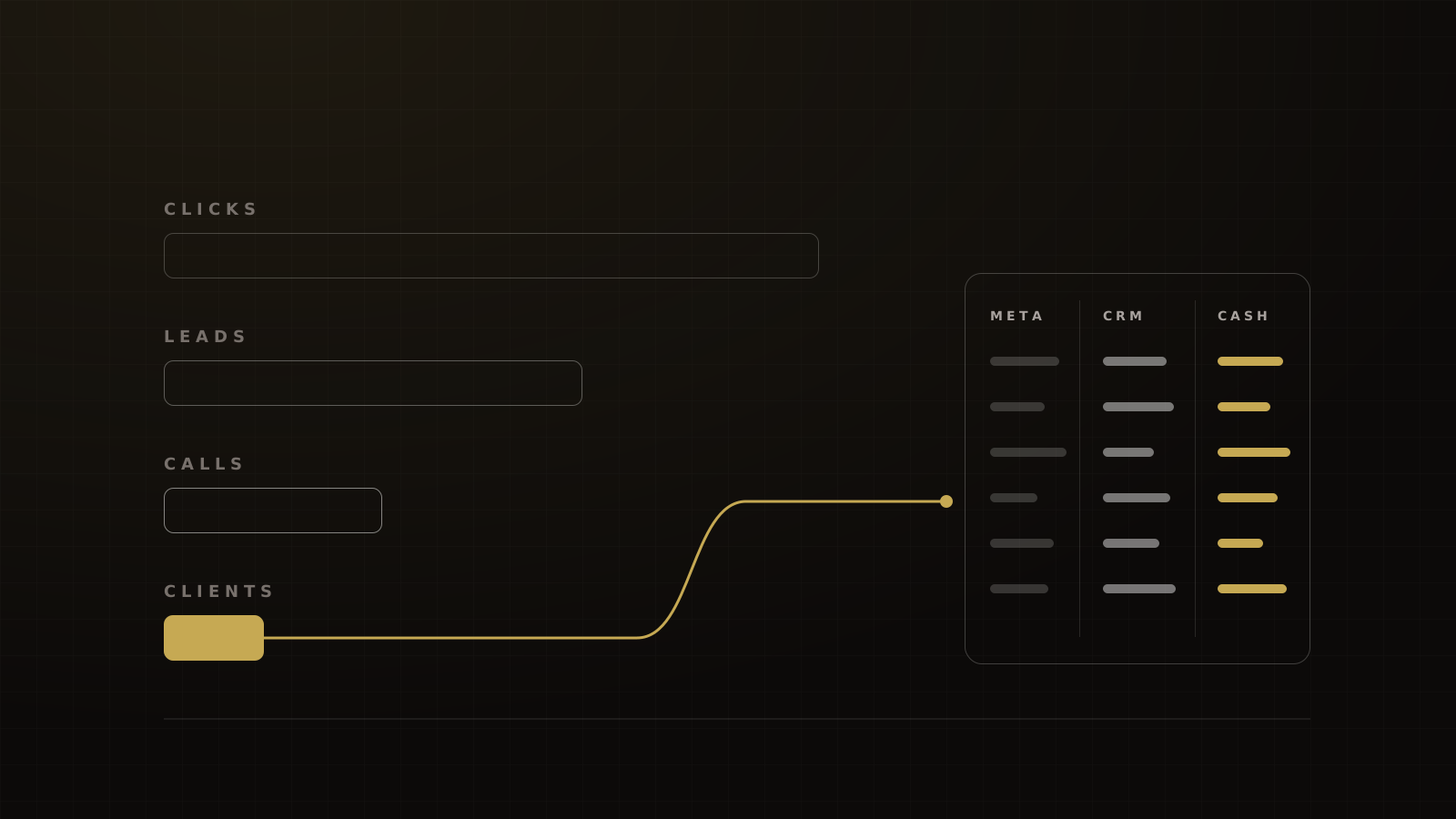
Here's the step no top-ranking guide covers. Every month, line up three sources for the same cohort of buyers:
| Meta-reported | CRM (closed-won) | Processor (cash) | |
|---|---|---|---|
| What it counts | Conversions Meta attributes to an ad | Deals marked won, with source | Money that actually landed |
| Payment plans | Usually one event at full value, or none | Contract value | Each installment as it clears |
| Refunds | Not subtracted | Often not updated | Subtracted on the refund date |
| Sales on calls | Invisible unless you send them back | Visible if reps update stages | Visible |
| Typical error | Over- or under-reports by attribution window | Missing source on deals | No ad source at all |
Record which attribution setting the Meta column uses. Changing it changes the number without changing a single sale.
When the three columns disagree, the processor is the truth about money and the CRM is the truth about source. Meta is a signal, not a ledger. If you want a tool that ties the three together for high-ticket funnels, our Hyros review covers where it helps and where it breaks.
Attribution windows changed in January 2026
Meta stopped returning 7-day-view and 28-day-view attribution data through the Ads Insights API on January 12, 2026, after announcing it on October 16, 2025.[16] If your dashboards or reports pulled those windows, your historical ROAS baselines broke that week without any change in sales.
Write down which attribution setting you report on, and compare like with like. Our piece on the KPIs that matter for event and webinar funnels covers which numbers to report.
Send CRM stages back to Meta
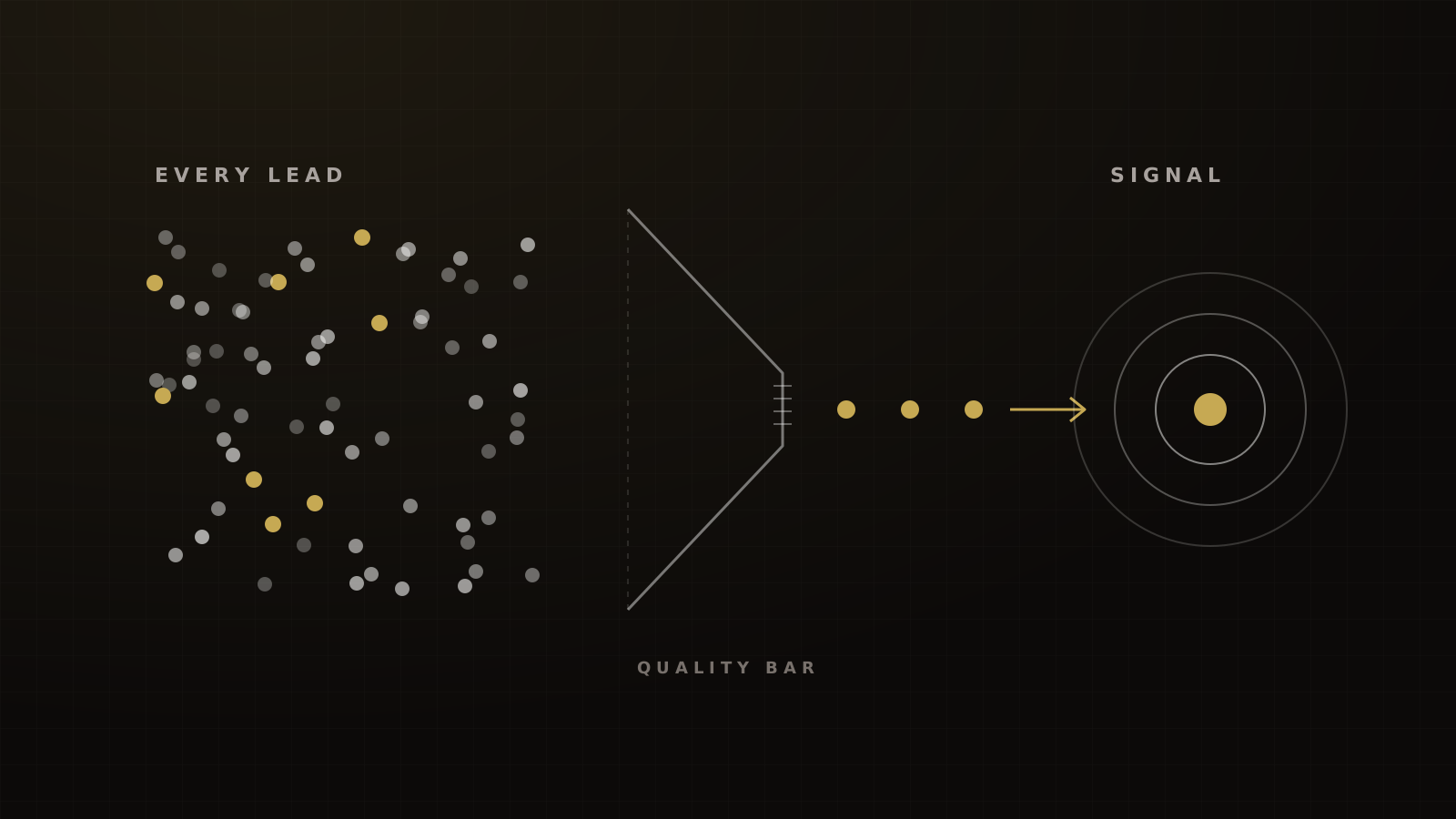
Meta optimizes toward whatever you tell it is a conversion. Tell it a form fill and it finds form-fillers. Tell it a showed call or a closed deal and it starts looking for people like your buyers.
Conversion leads optimization: who qualifies
For Instant Form leads, Meta's conversion leads optimization uses your CRM stages directly. Meta's documentation sets the bar at 200 or more leads a month, daily uploads, a downstream stage reached within 28 days, and a lead-to-stage conversion rate between 1% and 40%.[17] GoHighLevel's walkthrough says 250 leads a month, so plan for the higher number.[18]
The GoHighLevel build
In GoHighLevel the workflow is simple: a "Pipeline Stage Changed" trigger fires a Meta Conversion API action. GoHighLevel's walkthrough covers Instant Form leads, and it sends value and currency only when the stage is named Purchase.[18]
For website funnels, the same idea applies with standard or custom events: fire a qualified-stage event when a lead books, shows or buys, and build campaigns that optimize on it once it fires often enough. The full GoHighLevel build covers both paths and the gotchas.
What it does to lead quality
The best single proof is an education advertiser's A/B test from August 2024. Optimizing on conversion leads with CRM data sent through the Conversions API produced a 37% lower cost per qualified lead and 76% more qualified leads than optimizing for lead volume.[19] It's one advertiser, about two years old, published by Meta.
Meta's broader figure is a 19% lower cost per quality lead, on average, for advertisers using the Conversions API for CRM with the conversion leads goal.[20]
Send only qualified conversions
Don't send every lead back as a win. Add a wait step, enrich the lead, check it against your financial-fit questions, and only then fire the event. As Devin puts it, that's how Meta will "start showing this ad to that person as opposed to the other person."
Keep one pixel per avatar, too. If you sell to two very different buyers, one pixel trained on both learns neither. Our article on feeding Meta better signals covers seeding and dilution.
A creative-testing structure from accounts we run
Targeting has narrowed to a few switches. Creative is now the main way you tell Meta who you want. Nielsen's marketing-mix work for Meta, across 41 consumer-goods brands and three years of data, found campaigns with high-quality creative were 35% more effective.[21] That's CPG data, not coaching, but the direction holds in every account we run.
One script, five to ten hooks
We film one script with five to ten different hooks, so the hook is the only thing that changes between ads. The body and the call to action stay fixed. That turns a creative test into a clean read on the one variable that matters most.
Hormozi's structure for paid ads is a callout, then value, then a call to action. In $100M Leads he puts it as "The purpose of each second of the ad is to sell the next second of the ad." The hook is the first of those seconds.
We start with four hook formats and match them to Eugene Schwartz's levels of awareness: the Call-Out for cold audiences, the Mistake for people already trying to fix the problem, the Question (built on a real, sourced stat) for the unaware, and the Personal Story for everyone. The full method, with templates, is in the 4 hook formats we test first.
Lo-fi beats polished, within limits
People scroll past when they see an ad that's higher production.
Selfie-style video from the founder or a real client usually beats a studio shoot in the accounts we run. Lo-fi means authentic, not sloppy: clear audio, good light, captions inside the safe zones, no typos. Give natural speakers bullet points, not a script, and let them talk.
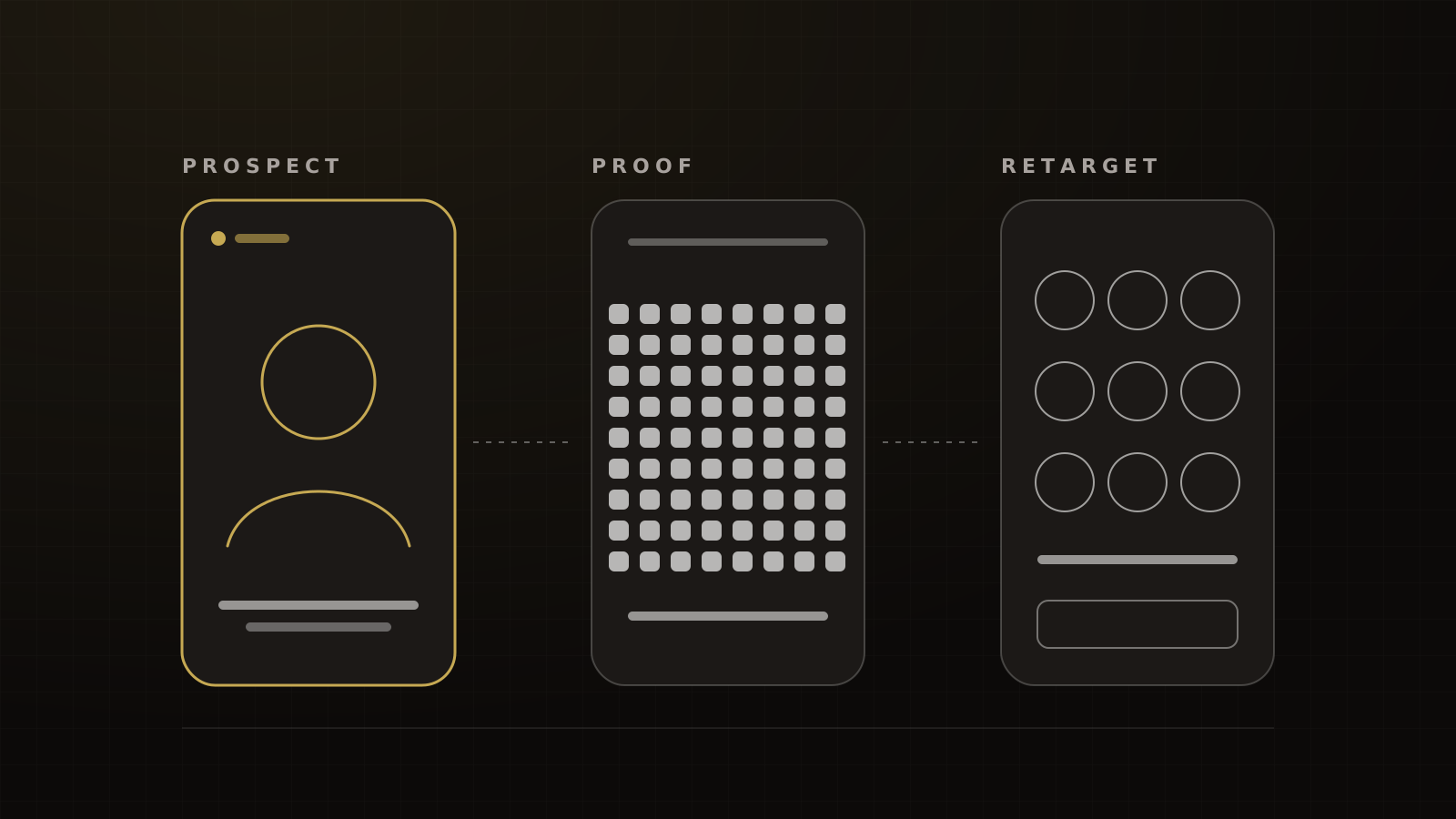
Video does the prospecting. Statics and graphics do most of their work in retargeting, where people already know who you are. AI tools now make variation cheap; in our experience a creative program spends $300–$2,000 a month on AI video credits, with statics and GIFs as most of the output.
Read-outs: early signals vs the verdict
CTR and cost per lead are early signals. On the funnels we run, a working cold webinar or event ad typically holds a 1.8–2.5% link CTR, against a 2.70% all-industry average for Meta lead campaigns.[1] An ad below that range usually has a hook problem.
But a hook that wins on CTR can lose on pipeline. We keep a winner only when its leads book, show and buy at a cost we can afford. Read the test in three stages:
- Day 1–3: hook rate and CTR. Kill the obvious losers.
- Day 4–7: cost per lead and cost per registration. Narrow to two or three.
- Week 2+: cost per booked call, cost per held call, cost per client. Pick the winner here.
Myth box: numbers to stop repeating
- "You have 1.7 seconds to hook them." The 1.7 seconds is an average time mobile users spent with a feed item in Facebook IQ research on 850+ video ads from late 2014 to late 2015, against 2.5 seconds on desktop.[22] It's a decade-old dwell time, not a deadline. The lesson is that the first frame matters.
- "47% of a video's value comes in the first 3 seconds." Meta did report that views under three seconds drove up to 47% of campaign value, but that was brand lift (recall and awareness) from 2015-era Nielsen studies, not sales.[23]
Budget and scaling rules
Start small, on pessimistic math, and earn the right to spend more.
Claude Hopkins argued in Scientific Advertising that "Almost any questions can be answered, cheaply, quickly and finally, by a test campaign." Our version: before we raise spend, we stress-test the funnel for 7 days at the planned daily budget on a capped audience, or until it produces about 50 optimization events. That matches Meta's own learning-phase threshold of about 50 results a week.[8]
Then we hold a cash rule. We want at least 1.5x fully loaded acquisition cost back in the first 30 days before we raise spend on a client funnel. That's a target, not a result. Hormozi's stated real-life minimum for customer-financed acquisition is 2x; we treat 1.5x as the floor and 2x as the goal. "Fully loaded" means ads, creative, media buying and software, not just ad spend.
Fix conversion before you add spend. Scaling a funnel with a weak opt-in rate or a weak show rate only scales the leak. Our funnel CRO guide covers where to look first.
To set a starting budget from your own numbers, use the Meta ads budget calculator. It works backward from what one client is worth.
Compliance: special ad categories and claims
Meta's special ad categories are housing, employment, financial products and services (which replaced the Credit category in January 2025), and social issues, elections or politics.[24] Ads in those categories run with restricted targeting: ages 18 to 65+, all genders, a minimum 15-mile radius, and no lookalike audiences.[24]
That matters for coaches more than most expect. A real-estate investing course, a credit-repair program or a trading education offer may fall into a category. Assess the offer, not the label you'd give it.
Two more rules of thumb. The Conversions API sends hashed customer data such as email and phone, so disclose it in your privacy policy and make sure you have a lawful basis where the law requires one. And any earnings or results claim in an ad needs substantiation, so keep "I made $X" hooks typical or clearly qualified.
How we run this at Victory
Common mistakes
- Managing to platform ROAS. A 0.8 front end that fills calendars can be the best campaign in the account.
- Optimizing on an event you rarely hit. Below about 50 results a week, the ad set rarely leaves learning.
- Double-counting conversions. Pixel and server events without matching event IDs inflate every report.
- Sending every lead back as a win. Meta finds more of whatever you reward.
- Judging creative on CTR alone. The hook that wins clicks often loses on booked calls.
- Scaling before the back end can absorb it. More leads into a broken follow-up process is more waste, faster.
If you want a second set of eyes on your numbers, book a strategy call. We'll pressure-test your objective, your economics and your tracking before you spend another dollar.
Frequently asked questions
Sources
- 1.Facebook advertising benchmarks (2026 edition). LocaliQ, 2026-09-23.
- 2.Meta reports first quarter 2026 results (Exhibit 99.1). Meta Platforms, SEC filing, 2026-04-29.
- 3.Meta reports second quarter 2026 results (Exhibit 99.1). Meta Platforms, SEC filing, 2026-07-29.
- 4.Facebook ads for life coaches. Paperbell, 2024-04-04 (originally 2021-02).
- 5.Facebook ads for coaches. Scale Growth Digital, 2026-03 (updated).
- 6.Meta reports fourth quarter and full year 2025 results (Exhibit 99.1). Meta Platforms, SEC filing, 2026-01-28.
- 7.Ad campaign reference (campaign objectives). Meta for Developers, living doc, checked 2026-10-04.
- 8.About the learning phase. Meta Business Help Center, living doc, checked 2026-10-04.
- 9.Advantage+ campaigns. Meta for Developers, living doc, checked 2026-10-04.
- 10.Maximiza el rendimiento de tu campaña con las nuevas funciones de Advantage+ (Advantage+ leads test results). Meta Newsroom (Latin America), 2025-02-06.
- 11.Facebook ads benchmarks 2025 (guide, PDF). WordStream by LocaliQ, 2025-09.
- 12.Webinar statistics 2024 (2023 Demio data). Banzai (Demio), 2024-01.
- 13.Conversions API best practices. Meta for Developers, living doc, checked 2026-10-04.
- 14.Handling duplicate Pixel and Conversions API events. Meta for Developers, living doc, checked 2026-10-04.
- 15.Conversions API (product page). Meta, 2026-04-15.
- 16.Ads Insights API metric availability updates. Meta for Developers blog, 2025-10-16.
- 17.Conversion leads integration. Meta for Developers, living doc, checked 2026-10-04.
- 18.Facebook conversion leads walkthrough. HighLevel Support Portal, 2026-06-01 (updated).
- 19.IQ Academy success story. Meta, 2024 (test 2024-08-04 to 2024-08-12).
- 20.More quality leads this Q5 with Meta's latest AI-enabled updates. Meta Business News, 2025-10-30.
- 21.Six tips and best practices to drive better ROI outcomes. Nielsen, 2022-08.
- 22.Capturing attention in feed: the science behind effective video creative. Meta (Facebook IQ), c. 2016 (data Q4 2014 to Q4 2015).
- 23.The value of video for brands. Meta Business News, with Nielsen, 2015.
- 24.Special ad categories. Meta for Developers, living doc, checked 2026-10-04.
Written by
Marius BulaiCMO & Head of Paid Media
Marius runs all paid media strategy and execution at Victory. Before Victory he was Head of Analytics at Hyros, inside the data of some of the largest ad accounts in the world.