TCPA in 2026: What's Actually in Force (One-to-One Consent Vacated, Revocation Rules, Quiet Hours)
A dated status matrix for texting brands: one-to-one consent vacated, 10-day opt-outs in force, the FCC's September 2026 order and state quiet hours.
 Ray GillespieCo-Founder & COO
Published 10 min read
On this page
Key takeaways
- The FCC's one-to-one consent rule is not in force. The Eleventh Circuit vacated it on January 24, 2025.[1]
- The 2012 prior express written consent rule for autodialed or prerecorded marketing is in force.[2]
- Opt-outs made by any reasonable method must be honored within 10 business days, since April 11, 2025.[3]
- The "revoke-all" provision is waived until January 31, 2027.[4] The FCC adopted a replacement on September 30, 2026 that isn't effective yet.[5]
- Federal quiet hours are 8 a.m. to 9 p.m. Florida, Oklahoma and Maryland cut off at 8 p.m.[2][6]
- Whether a private suit can be brought over texts is now split between courts. The FCC's rules themselves haven't changed.[7]
The short answer
As of October 4, 2026, here's where the federal texting rules stand:
- Not in force: the FCC's one-to-one consent rule. A federal appeals court vacated it on January 24, 2025.
- In force: the 2012 prior express written consent rule for autodialed or prerecorded marketing, and the rule that opt-outs made by any reasonable method must be honored within 10 business days.
- Waived to January 31, 2027: the "revoke-all" provision, under which an opt-out from one informational message would cover everything you send.
- Adopted, not yet effective: FCC 26-67, which replaces revoke-all with category-specific opt-outs. It takes effect 30 days after Federal Register publication, which hadn't happened by October 4.
- Quiet hours: federal 8 a.m. to 9 p.m., with several states stricter.
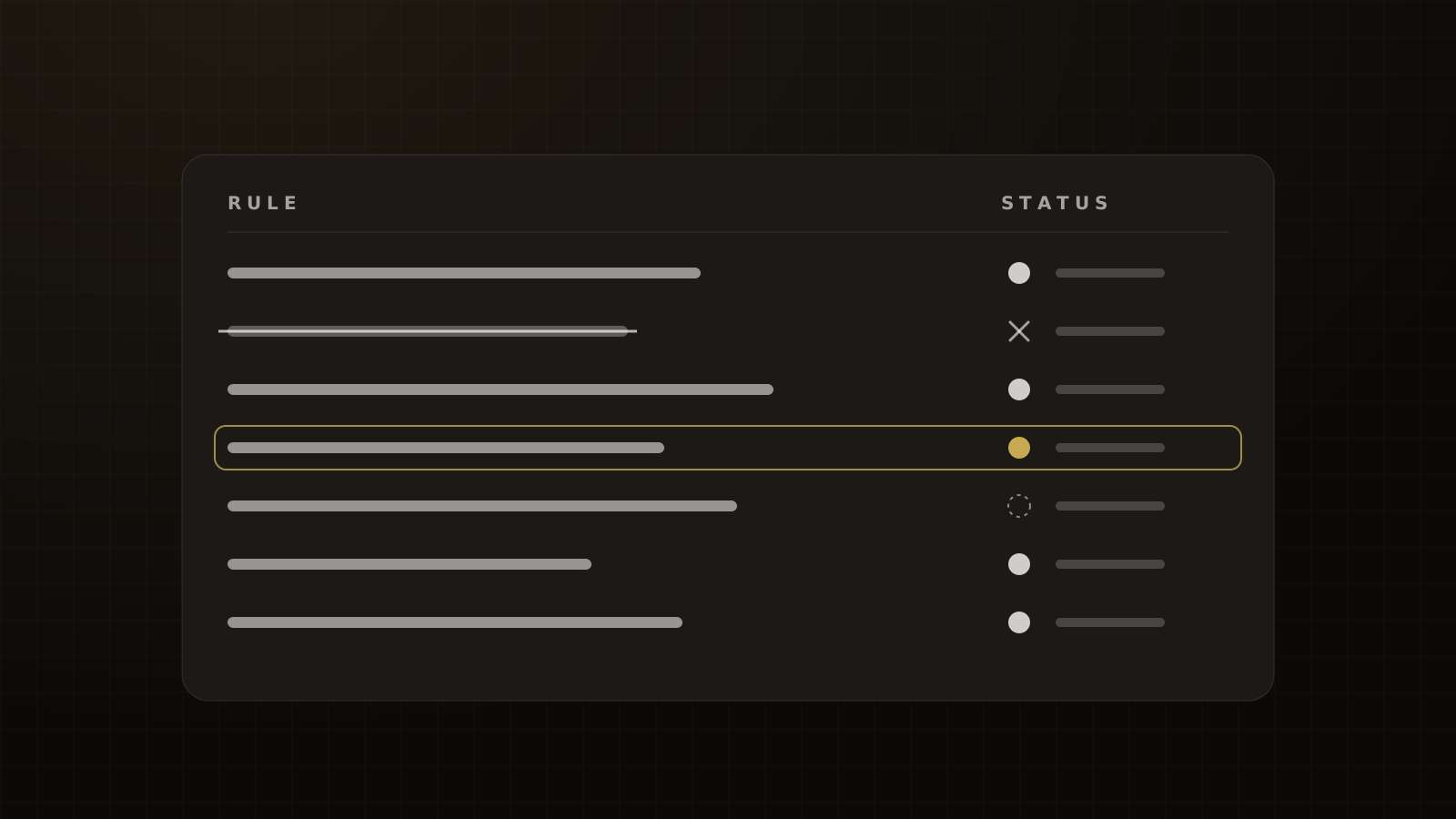
The status matrix
Rows marked "state law" are examples, not a complete list. Check every state your list covers.
| Rule | Status | Governing source |
|---|---|---|
| One-to-one consent and "logically and topically related" limits (FCC 2023 order, Part III.D) | Vacated 2025-01-24 | 11th Cir.[1] |
| One-to-one text removed from 47 CFR 64.1200(f)(9) | Done. Court mandate 2025-04-30; FCC conforming order 2025-07-14 | DA 25-621[8] |
| Prior express written consent for autodialed or prerecorded marketing (E-SIGN signatures valid; "not a condition of purchase" disclosure) | In force (2012 rule) | 47 CFR 64.1200(a)(2), (f)(9)[2] |
| Revocation by any reasonable method; stop, quit, end, revoke, opt out, cancel, unsubscribe all count | In force since 2025-04-11 | FCC 24-24; 64.1200(a)(10)[3][2] |
| Honor opt-outs within 10 business days | In force since 2025-04-11 | FCC 24-24[3] |
| "Revoke-all": an informational opt-out covers all messages | Waived to 2026-04-11, then to 2027-01-31 | DA 25-312; DA 26-12[9][4] |
| FCC 26-67: category-specific informational opt-outs; an exclusive designated opt-out method; comment sought on the 10-day window | Pending. Adopted 2026-09-30, released 2026-10-01; effective 30 days after Federal Register publication (not published as of 2026-10-04) | FCC 26-67[5] |
| National Do Not Call protections cover texts | In force | DA 25-90[10] |
| Federal quiet hours: no telephone solicitation before 8 a.m. or after 9 p.m. local time | In force. A petition on texts sent with consent is pending | 64.1200(c)(1); DA 25-216[2][11] |
| Private suits over DNC or quiet-hours texts under 47 USC 227(c)(5) | Split. 7th Cir. says texts aren't covered; other courts disagree | Steidinger[7] |
| Autodialer means a random or sequential number generator | Law since 2021 | Facebook v. Duguid[12] |
| Courts aren't bound by the FCC's TCPA interpretations | Law since 2025-06-20 | McLaughlin v. McKesson[13] |
| Statutory damages: $500 per violation, up to $1,500 if willful | Law | 47 USC 227(b)(3)[14] |
| Florida: written consent for autodialed sales texts; STOP plus 15 days before suit | State law | Fla. Stat. 501.059[15] |
| Florida: 8 a.m. to 8 p.m.; max 3 calls per 24 hours on the same subject | State law | Fla. Stat. 501.616(6)[6] |
| Oklahoma: written consent; 8 a.m. to 8 p.m.; max 3 per 24 hours | State law since 2022-11-01 | HB 3168[16] |
| Maryland: no solicitations 8 p.m. to 8 a.m.; max 3 per 24 hours | State law since 2024-01-01 (bill text) | HB 37[17] |
| Texas: consented texters need not register under Chapter 302 | State law (otherwise $200 fee and $10,000 deposit) | Texas SOS[18] |
| Virginia: STOP to a solicitation text honored for 10 years | State law | Va. Code 59.1-514[19] |
| Utah: no solicitation without prior express consent 9 p.m. to 8 a.m., Sundays or legal holidays | State law | Utah Code 13-25a-103[20] |
| Connecticut: telemarketing 9 a.m. to 8 p.m. | State law | CT DCP[21] |
Last verified 2026-10-04 for every row. 'Pending' means adopted or proposed but not yet effective.
Why this matters: TCPA litigation isn't slowing. WebRecon tracked 2,810 TCPA suits in 2025, up 0.8% on 2024.[22] In 2026, filings were up 34.3% year to date through June. Class actions were 76.4% of June filings and 61.0% of July's, so don't quote one month as "the" share.[23][24]
One-to-one: what happened and why pages still get it wrong
The FCC's 2023 order would have required consent to be given to one seller at a time, for related content only. It was due to take effect on January 27, 2025.
It never did. On January 24, 2025, the Eleventh Circuit granted the petition in Insurance Marketing Coalition v. FCC and vacated Part III.D of the order.[1] The same day, before the opinion came out, the FCC's consumer bureau issued DA 25-90 postponing the rule.[10] The court's mandate followed on April 30, and the FCC formally conformed its rules on July 14, 2025.[8]
That same-day sequence explains a lot of bad pages. Some say the rule was "postponed". The right word is vacated.
Others never updated at all, and the stale ones aren't only from 2024:
- The FCC's own one-to-one FAQ, a PDF still live on fcc.gov, says the rule "takes effect on January 27, 2025".[25]
- A National Law Review headline still says the rule is in effect from that date.[26]
- A 2026 SMS compliance guide from a major messaging platform lists one-to-one consent as a current rule.[27]
- A September 2026 guide still tells marketers to get consent under "the FCC's one-to-one consent rule".[28]
We nearly made the same mistake. An early research pass for our own guides repeated the "took effect" claim, and we caught it only by opening the court's opinion. That's why every row above carries a source and a date.
There's another reason summaries go stale. In June 2025, the Supreme Court held in McLaughlin Chiropractic v. McKesson that district courts aren't bound by the FCC's interpretations of the TCPA.[13] Courts now read the statute themselves, and they don't all read it the same way.
The clearest example is texts. In July 2026 the Seventh Circuit held in Steidinger v. Blackstone Medical Services that the TCPA's private right of action for Do Not Call violations doesn't cover texts. The court said agency enforcement under other parts of the statute is undisturbed.[7] That ruling binds Illinois, Indiana and Wisconsin. Courts elsewhere have disagreed. It isn't a license to ignore Do Not Call or quiet hours: the FCC and the states still enforce both.
Opt-outs: 10 business days, any reasonable method, and the FCC's September 2026 change
Since April 11, 2025, a person can revoke consent by any reasonable method. Replies such as stop, quit, end, revoke, opt out, cancel and unsubscribe count, and you must honor the request within a reasonable time not exceeding 10 business days.[3][2]
Ten business days is the ceiling, not the target. Your platform should process STOP the moment it arrives, and your team should watch for natural-language opt-outs such as "please stop texting me", which the automatic keyword filter can miss.
One provision was held back. Under "revoke-all", an opt-out in reply to one informational message would have covered every message you send, including unrelated ones. The FCC waived it until April 11, 2026, then extended the waiver to January 31, 2027.[9][4]
On September 30, 2026, the FCC adopted FCC 26-67, released October 1. Under it, senders may treat a revocation as applying only to the category of informational messages it responded to, and may designate an exclusive method for revoking consent. The 10-business-day limit stays, and the FCC is asking for comment on whether to shorten it and on two-way texting.[5]
It isn't in effect yet. The order says the changes become effective 30 days after Federal Register publication, which hadn't happened as of October 4, 2026.[5] Until then, plan on the current rules.
States can be stricter. Virginia requires a STOP or UNSUBSCRIBE reply to a telephone-solicitation text to be honored for at least 10 years.[19] Florida requires a recipient to reply STOP and give the sender 15 days before suing over texts.[15]
Quiet hours: federal vs state
The federal rule bars telephone solicitations before 8 a.m. or after 9 p.m. in the recipient's local time.[2] A 2025 petition asks the FCC whether that applies to texts sent with prior express written consent. The FCC sought comment in March 2025, and we found no ruling as of October 4, 2026.[11]
One district court has dismissed a quiet-hours claim where the recipient had subscribed by texting a keyword (King v. Bon Charge, D. Del., amended April 30, 2026).[29] It's one fact-specific ruling, not a safe harbor for late-night sends.
The state rules we track:
- Florida: 8 a.m. to 8 p.m. for commercial telephone solicitation, and no more than 3 calls in 24 hours on the same subject.[6]
- Oklahoma: 8 a.m. to 8 p.m., with a 3-per-24-hours limit.[16]
- Maryland: no solicitations between 8 p.m. and 8 a.m., and a 3-per-24-hours limit.[17]
- Connecticut: telemarketing between 9 a.m. and 8 p.m., the latest morning start we found.[21]
- Utah: no solicitation without prior express consent from 9 p.m. to 8 a.m., on Sundays, or on legal holidays.[20]
Whether a given event text counts as a "solicitation" or "telemarketing" under each statute is a question for counsel. The simple operating answer is to schedule every send by the recipient's time zone, inside the strictest window on your list.
What this means for event and webinar texts
Most texts an event or webinar brand sends fall into two buckets. Informational messages tell a registrant what they signed up for: the time, the link, the venue. Marketing messages promote something: a VIP upgrade, the next event, the offer.
The line between them isn't always clean. A reminder that says "doors open at 9" is informational. The same reminder with "upgrade to VIP today" is likely marketing. Counsel should classify your templates. Don't assume.
The safest setup covers both cases at the form:
- Collect written consent at registration, next to the phone field, naming your brand and the kinds of texts you'll send, with the "not a condition of purchase" disclosure.[2]
- Register the program. A2P 10DLC registration is carrier policy, separate from the TCPA, but unregistered texts don't get delivered. Our A2P 10DLC registration guide covers approval.
- Honor every opt-out immediately, across every workflow and number on the brand.
- Send inside the strictest quiet-hours window your list covers.
CTIA's carrier guidance adds its own layer: express written consent for promotional texts, and opt-ins that aren't transferable.[30] That's carrier policy, not law. Some platform rules, such as sending STOP language every 30 days, are platform guidance and not statute either. Our guide to SMS consent, registration and verification explains why those three are different jobs on the same form.
Common mistakes
- Saying one-to-one consent "took effect" or was "postponed". It was vacated.
- Treating A2P approval as consent. Registration is carrier policy. Consent is law.
- Reading Steidinger as "texts are exempt". It closes one private-suit route in one circuit.
- Planning on FCC 26-67 before it's effective. Check the Federal Register first.
- Using one quiet-hours window for every state. Use the strictest one on the list.
Want a second set of eyes on your texting program before your next launch? Book a strategy call.
Frequently asked questions
Sources
- 1.Insurance Marketing Coalition v. FCC, No. 24-10277. US Court of Appeals for the Eleventh Circuit, 2025-01-24.
- 2.47 CFR 64.1200: Delivery restrictions. eCFR via Cornell LII, current, checked 2026-10-04.
- 3.Report and Order on revoking consent (FCC 24-24). FCC, 2024-02-16.
- 4.Order extending the revoke-all waiver (DA 26-12). FCC Consumer and Governmental Affairs Bureau, 2026-01-06.
- 5.Report and Order and FNPRM on revoking consent (FCC 26-67). FCC, adopted 2026-09-30, released 2026-10-01.
- 6.Fla. Stat. 501.616: Unlawful acts and practices (calling hours and frequency). Florida Legislature, 2026 statutes.
- 7.Steidinger v. Blackstone Medical Services, No. 25-2398. US Court of Appeals for the Seventh Circuit, 2026-07-14.
- 8.Order conforming the consent rule to the one-to-one vacatur (DA 25-621). FCC Consumer and Governmental Affairs Bureau, 2025-07-14.
- 9.Order waiving the revoke-all provision (DA 25-312). FCC Consumer and Governmental Affairs Bureau, 2025-04-07.
- 10.Order postponing the one-to-one consent rule (DA 25-90). FCC Consumer and Governmental Affairs Bureau, 2025-01-24.
- 11.Public notice seeking comment on quiet hours for consented texts (DA 25-216). FCC Consumer and Governmental Affairs Bureau, 2025-03-11.
- 12.Facebook, Inc. v. Duguid, No. 19-511. US Supreme Court, 2021-04-01.
- 13.McLaughlin Chiropractic Associates v. McKesson Corp., No. 23-1226. US Supreme Court, 2025-06-20.
- 14.47 U.S.C. 227: Restrictions on use of telephone equipment. US Code via Cornell LII, current, checked 2026-10-04.
- 15.Fla. Stat. 501.059: Telephone solicitation. Florida Legislature, 2026 statutes.
- 16.Oklahoma Telephone Solicitation Act, Enrolled HB 3168. Oklahoma Legislature, 2022, effective 2022-11-01.
- 17.Stop the Spam Calls Act, HB 37 (third reader). Maryland General Assembly, 2023, effective 2024-01-01.
- 18.Telephone solicitation registration FAQs. Texas Secretary of State, living page, checked 2026-10-04.
- 19.Va. Code 59.1-514: Telephone solicitation requests. Virginia Legislative Information System, current, checked 2026-10-04.
- 20.Utah Code 13-25a-103: Telephone solicitation prohibitions. Utah Legislature, current, amended 2024.
- 21.When can telemarketers call me?. Connecticut Department of Consumer Protection, 2026-01-29.
- 22.WebRecon stats for December 2025 and year in review. WebRecon, 2026-01-30.
- 23.WebRecon stats for June 2026. WebRecon, 2026-07.
- 24.WebRecon stats for July 2026. WebRecon, 2026-08.
- 25.One-to-one consent rule FAQ (DOC-408396). FCC Consumer and Governmental Affairs Bureau, undated, pre-2025-01-24; still live 2026-10-04.
- 26.FCC TCPA one-to-one lead generator consent rule in effect January 27, 2025. National Law Review, 2024.
- 27.TCPA compliance for SMS. Infobip, 2026-04-13, checked 2026-10-04.
- 28.TCPA compliance for SMS in 2026. SignalMash, 2026-09-07, checked 2026-10-04.
- 29.King v. Bon Charge, No. 25-105 (amended memorandum opinion). US District Court for the District of Delaware, 2026-04-30.
- 30.Messaging Principles and Best Practices. CTIA, 2023-05.
Written by
Ray GillespieCo-Founder & COO
Ray runs day-to-day operations across every Victory engagement, building the systems, automations and AI-powered workflows that hold the machine together. He has overseen operations behind more than $120M in revenue.
Part of the guide: Deliverability and Compliance in 2026: Gmail, Yahoo and Microsoft Sender Rules, A2P 10DLC and the TCPA