A2P 10DLC Registration: How to Get Approved the First Time (and Why Campaigns Get Rejected)
Why A2P 10DLC campaigns get rejected, the coherence test we run before submitting, what it costs, and the caps that bite after approval.
 Oussama El AlamiCTO & Lead Developer
Published 10 min read
On this page
Key takeaways
- A2P 10DLC registration tells US carriers who is texting (the brand), why and with what consent (the campaign), and from which numbers. Twilio blocks texts from numbers that aren't on an approved campaign.[1]
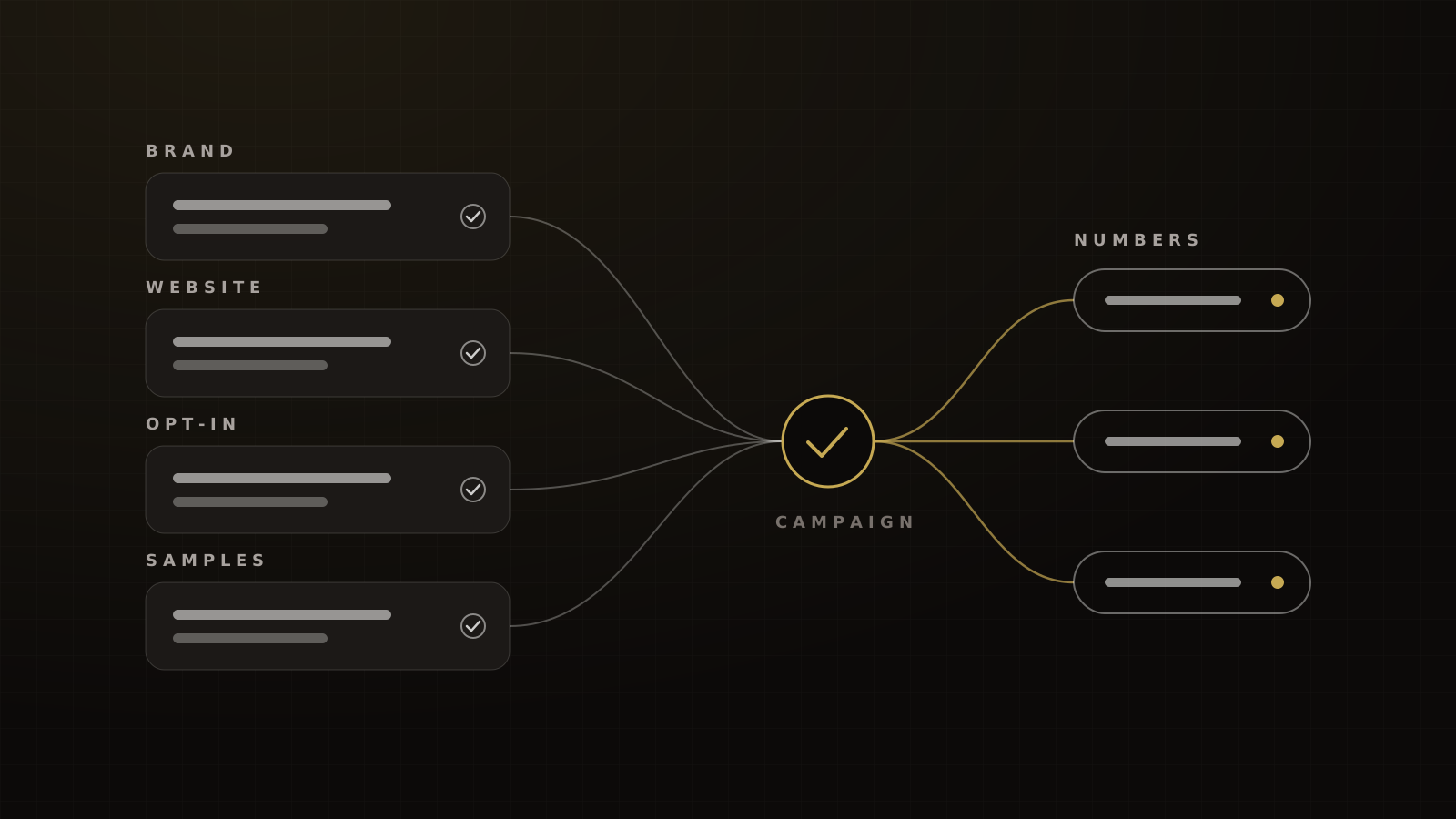
- Most rejections are one problem: the brand name, website, opt-in form, consent wording and sample messages don't describe the same sender.
- Fix and resubmit a rejected campaign. Don't delete it. On Twilio, the vetting fee is charged once per campaign.[2]
- After approval, daily caps, unattached numbers and provider switches catch more teams than the review does.
- Registration lets you send. It doesn't prove anyone consented.
- From 2027-04-29, The Campaign Registry will require Auth+ for private for-profit brands. Put a corporate-domain email on your brand contact now.[3]
Submit one coherent sender and you get approved the first time. Reviewers compare your brand name, website, opt-in form, consent wording and sample messages against each other. When they agree, campaigns go through. When one contradicts the rest, you lose days you may not have before a launch.
We register brands and campaigns for the coaching, course and event businesses we build funnels for, mostly inside HighLevel. Here is the coherence test we run before submitting, a code-by-code rejection diagnostic, and the limits that bite after approval.
What A2P 10DLC is, in one paragraph
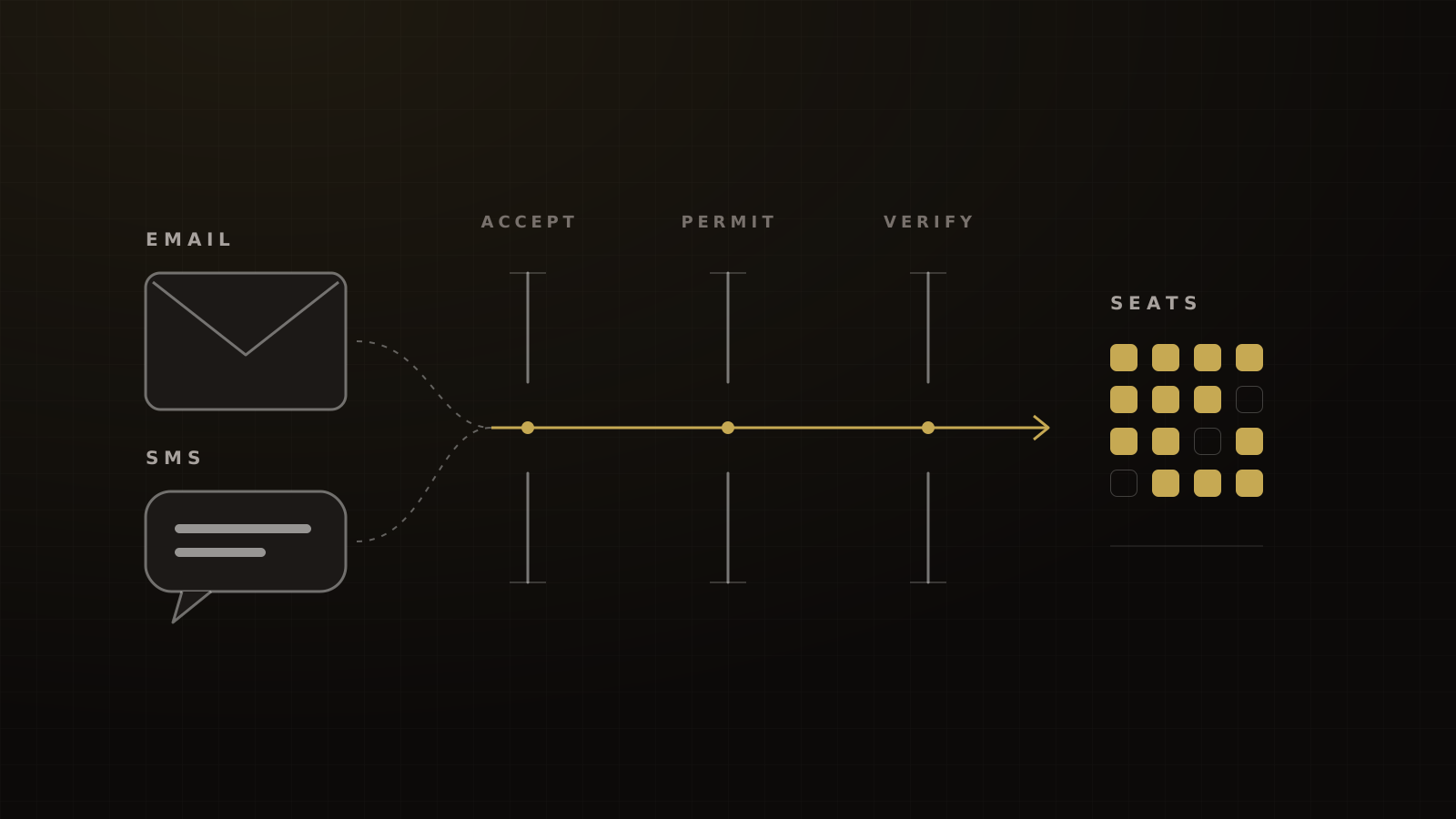
A2P 10DLC is the carrier standard for business texts sent from ordinary 10-digit numbers. Twilio describes its purpose as making long-code traffic verified and consensual.[4] You register a brand (the legal business), then a campaign (the use case, opt-in flow and sample messages), then attach your numbers to that campaign. Send from a number that isn't on an approved campaign and Twilio blocks it with error 30034.[1]
Enforcement dates vary by provider. Bandwidth says unregistered traffic has been blocked industry-wide since February 1, 2025.[5] That's Bandwidth's statement; we found no carrier notice saying so directly.
What you'll pay and how long it takes
The registration fees are small. The Campaign Registry (TCR) charges $4.50 per brand, $12.50 for Authentication+ and $41.50 for a standard vet, plus $10 a month for a Marketing or Mixed campaign or $1.50 for Low Volume Mixed, with a three-month minimum.[6] Providers may mark these up; HighLevel says it doesn't.[7]
HighLevel bundles brand, campaign and a $3 fast-track fee into one charge: $22.50 for Sole Proprietor or Low Volume Standard, $64 for High Volume Standard. Fast track promises approval within 3 business days, and resubmitting a rejected campaign costs no extra vetting fee.[8]
The per-message carrier surcharges matter more over a year:
| Carrier | Registered | Effective | Unregistered |
|---|---|---|---|
| AT&T | $0.0035 | 2026-04-01 | $0.0100 |
| T-Mobile | $0.0045 | 2026-01-19 | $0.012 |
| Verizon | $0.0050 (was $0.0045) | 2026-10-01 | $0.0100 |
Bandwidth's 2026 pass-through schedule, checked 2026-10-04. Other providers may bill differently.
Unregistered traffic costs two to three times more, when it gets through at all.[9]
In our experience, for an event business that texts registrants heavily, the HighLevel plan fee is only 25–40% of the monthly bill; usage is the rest. That's our rule of thumb, not an industry benchmark. Next to usage, registration fees are a rounding error.
Time is the real cost. Twilio says vetting can take several weeks or longer.[2] Bandwidth quotes 3 to 5 business days for the first manual review, and numbers can't be attached until the campaign is approved.[10] Register before you build the reminder sequence.
The coherence test: why campaigns get rejected
Reviewers aren't grading your copy. They're checking that every field describes the same business, doing the same thing, with the same consent. HighLevel's rejection guide (updated 2026-09-09) lists the codes we use below.[11] Bandwidth's vetting codes follow the same logic: its 601 means the campaign doesn't match the website or samples.[12]
Nobody publishes industry-wide approval rates. Figures like "80% get rejected" have no traceable source. The only numbers we found are vendor self-reports: ReadySMS says 33 of its own 47 submissions (70%) passed first time,[13] and Telgorithm claims 99% without a denominator.[14] Treat both as marketing.
Website (30919–30922)
These codes cover a site with no business information, a site that's only a form, a site behind a login, and a broken site.[11] A funnel page with a registration form and nothing else fails. Give reviewers a public page on the brand's domain with who you are, how to reach you, the opt-in form and a privacy policy.
Name and identity (30914, 30915, 30918)
These are name mismatches between the brand, the website and the messages.[11] Coaching businesses trip here: the LLC, the personal brand and the event often have three different names. Use one name reviewers can trace to the registered business, everywhere.
Opt-in and consent language (30909, 30913, 30924, 30925)
This group trips up event funnels most, because the form was built for conversions, not reviewers.
- 30909: the reviewer couldn't verify your call to action or message flow. Give them a public URL where they can see the form.
- 30913: marketing consent has to be separate from transactional consent. If you send reminders and offers, you need two checkboxes.
- 30924: the consent language is missing message frequency, opt-out instructions or the rates disclosure.
- 30925: the checkbox has to be unchecked by default.[11] Bandwidth's 803 is the same problem: a forced opt-in, where the checkbox is missing or mandatory.[12]
Behind all of these is CTIA's guidance: the call to action should make clear the program, who is sending, any fees and how to opt out. Consent collected for one campaign doesn't transfer to another, and lists that were rented, sold or shared shouldn't be texted at all.[15]
Use case and samples (30886, 30893, 30911, 30912)
Twilio rejects vague descriptions (30886) and samples that don't match the use case (30893).[2] HighLevel flags copy-pasted fields (30911) and campaigns that look like person-to-person chat (30912).[11] Copy your samples straight out of the workflow, with the brand name, the opt-out line and the kind of link you'll really send.
Links (30892)
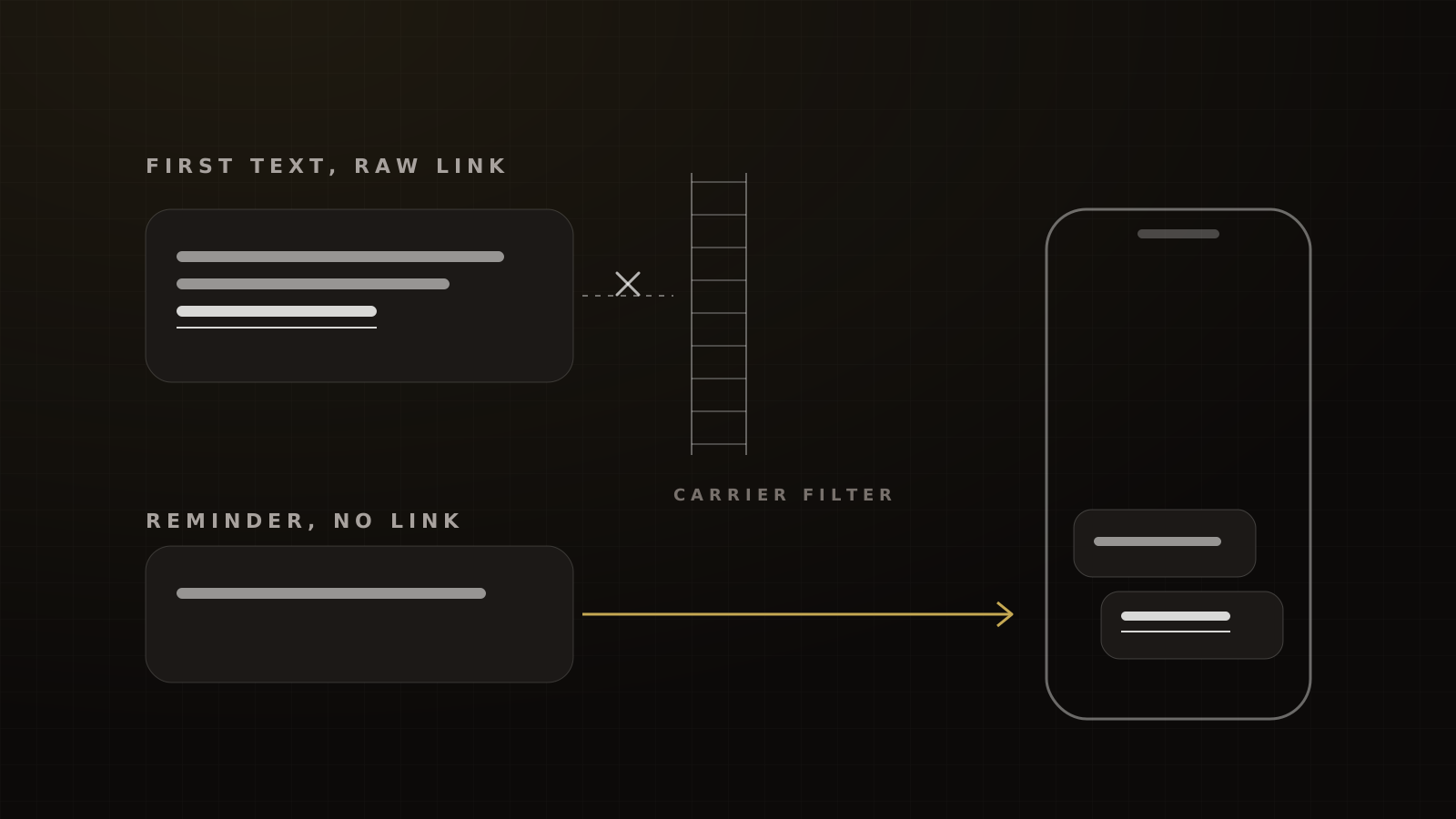
Twilio rejects public URL shorteners and accepts only dedicated, branded short domains.[2] CTIA says the same: use a shortener dedicated to your exclusive use.[15] We use branded trigger links, and our carrier-filtering post-mortem shows why.
Coherent vs conflicting: a side-by-side
An illustration built from common rejection reasons, not one client's submission:
| Field | Conflicting (rejected) | Coherent (approved) |
|---|---|---|
| Brand | Registered LLC name only | LLC name, with the event brand listed as its DBA |
| Website | A one-page registration form | Brand site with about, contact, privacy policy and the form |
| Opt-in | One pre-checked box covering everything | Two unchecked boxes: event reminders, and marketing offers |
| Consent wording | "By registering you agree to receive texts" | Program name, sender, "Msg frequency varies", "Msg & data rates may apply", "Reply STOP to opt out" |
| Use case | "Customer communication" | "Event reminders and offers to registrants who opted in on [brand site]" |
| Sample message | "Hey! Don't miss out: bit.ly/xyz" | "[Brand]: Your workshop starts Sat 10am. Details: [brand domain link]. Reply STOP to opt out." |
Hypothetical example. Example consent wording is for illustration only; have counsel review your own.
Fix and resubmit, don't delete
Edit a rejected campaign and resubmit it. Twilio says not to delete it, because the vetting fee is charged once per campaign.[2] On HighLevel, resubmitting costs no extra vetting fee.[8] The exception is Bandwidth's 601: that campaign can't be edited and has to be re-created.[12]
Some use cases can't be fixed at all. HighLevel won't resubmit campaigns for SHAFT content (sex, hate, alcohol, firearms, tobacco), cannabis, loans or gambling.[11]
Fix the mismatch everywhere it lives: the site, the form and the samples, not just the field the code names.
After approval: the limits nobody explains
Brand tiers and daily caps
HighLevel lists Low Volume Standard at up to 6,000 segments a day and High Volume Standard at up to 600,000.[7] Twilio's T-Mobile figures are tighter: 1,000 a day for Sole Proprietor and up to 2,000 for Low-Volume Standard.[4] We read HighLevel's number as all carriers combined. Plan to the lower one.
On standard brands, T-Mobile's cap follows the vetting score:
| Vetting score | Daily cap |
|---|---|
| 75–100 | 200,000 |
| 50–74 | 40,000 |
| 25–49 | 10,000 |
| 1–24 | 2,000 |
| Low Volume Mixed | 2,000 |
Per Bandwidth's T-Mobile 10DLC page, checked 2026-10-04. The cap resets at midnight Pacific; messages over it are rejected with error (4)780.
That cap is shared by every campaign under the same brand and tax ID, even across providers.[16] AT&T limits speed instead, per campaign: 4,500 messages a minute for its top classes (A and B), 2,400 for C and D, 240 for E and F, 75 for Low Volume Mixed and 15 for sole proprietors.[17]
Approval doesn't guarantee delivery either. In our experience, a registered number sending in drips, with trigger links on the brand's own domain, delivers 95% or better on reminder sends. We found no industry delivery benchmark with a disclosed method to compare it to. Sending discipline gets you that number; registration alone doesn't.
Every number goes on the campaign (and why that isn't number cycling)
Every number you send from has to be attached to the approved campaign.[18] A new number that isn't attached is unregistered, and its texts get blocked.[1] The classic miss: a fresh workflow number bought the day before an event.
Adding numbers is fine. Cycling them isn't. T-Mobile's Code of Conduct prohibits dropping numbers as they degrade to get around filtering.[19] A new number with a distinct job, attached to your campaign, is ordinary operations. Swapping numbers whenever delivery dips is evasion.
Sub-accounts and splitting sends
Because T-Mobile's cap is per brand and tax ID, splitting one business into more sub-accounts doesn't raise it.[16] A better vetting score does. Split sends only when they're genuinely separate use cases or brands, each registered.
And write it down. On one webinar day we inherited a setup where the previous operator had split warm leads and registrants across sub-accounts and never documented it. We found it minutes before go-time. A one-page map of sub-account, number, campaign and list would have prevented the scramble.
Switching providers means starting over
HighLevel says A2P registration from your own Twilio account doesn't migrate to its LC Phone system: you register again, pay again and attach each number.[18] TCR itself supports moving campaigns between providers for $0.50 each (not for sole proprietor brands), so it depends on the platforms.[6]
Our rule: never switch providers mid-promotion. If a launch is close and you're capped, send from a sub-account that's already registered and fix the plumbing after the event.
Auth+ in 2027: use a corporate-domain contact email now
TCR's Authentication+ 2.0 sends a verification email to the brand's business contact at a corporate email domain. Public companies already need it. For private for-profit and nonprofit brands it becomes optional on 2027-01-21 and required on 2027-04-29; free-email domains will get a separate path TCR hasn't disclosed.[3]
Most coaching and event brands are private for-profit. If your brand contact is a Gmail address, move it to a working inbox on your company domain now.
Registration is not consent
An approved campaign means carriers accept the flow you described. It doesn't prove any individual agreed to your texts. For autodialed marketing texts, the FCC's rule requires prior express written consent: a signed written agreement (an E-SIGN electronic signature counts) that discloses consent isn't a condition of purchase.[20]
Registration, consent and phone verification are separate layers, each with its own evidence. We break them apart in registration, consent and verification and track which rules are in force in TCPA in 2026.
Common mistakes
- Deleting a rejected campaign. You pay the vetting fee again.
- Registering the week of the launch. Vetting can take weeks.
- Buying a number and not attaching it. It's unregistered until it's on the campaign.
- Treating approval as consent. Keep consent records separately.
For how A2P fits with email authentication and list hygiene, start with our deliverability and compliance guide; our GoHighLevel guide covers the rest of the build. If you'd rather we register and audit it for you, book a strategy call.
Frequently asked questions
Sources
- 1.Error 30034: US A2P 10DLC, message from an unregistered number. Twilio Docs, living doc, checked 2026-10-04.
- 2.Troubleshooting and rectifying A2P campaigns. Twilio Docs, 2026-07-21.
- 3.Authentication+ 2.0 feature overview. The Campaign Registry, updated 2026-10-01.
- 4.A2P 10DLC overview. Twilio Docs, 2026-07-07.
- 5.10DLC FAQ. Bandwidth Support, 2026-08-13.
- 6.TCR Terms and Conditions, fee exhibit. The Campaign Registry, 2025-10-30.
- 7.A2P campaign registration: step-by-step guide and FAQs. HighLevel Help Center, 2026-09-11.
- 8.A2P 10DLC messaging fees: registration, monthly and carrier costs. HighLevel Help Center, 2026-09-24, checked 2026-10-04.
- 9.Carrier surcharges. Bandwidth Support, checked 2026-10-04.
- 10.10DLC campaign vetting and phone number provisioning process. Bandwidth Support, 2026-08-14.
- 11.A2P campaign rejections: required fixes and vetting errors. HighLevel Help Center, 2026-09-09.
- 12.DCA2 vetting rejection reasons. Bandwidth Support, 2026-03-17, checked 2026-10-04.
- 13.10DLC rejection: what actually gets approved. ReadySMS (vendor blog), undated, checked 2026-10-04.
- 14.Telgorithm's A2P 10DLC registration performance metrics 2026. Telgorithm (vendor), 2026-02-26.
- 15.Messaging Principles and Best Practices. CTIA, 2023-05.
- 16.T-Mobile 10DLC. Bandwidth Support, 2026-08-13, checked 2026-10-04.
- 17.AT&T 10DLC. Bandwidth Support, 2026-08-27, checked 2026-10-04.
- 18.Twilio ISV A2P 10DLC. HighLevel Help Center, 2026-09-01.
- 19.T-Mobile Code of Conduct, v2.2. T-Mobile, 2020-11.
- 20.47 CFR 64.1200, Delivery restrictions (prior express written consent, (f)(9)). eCFR via Cornell LII, current, checked 2026-10-04.
Written by
Oussama El AlamiCTO & Lead Developer
Oussama leads technical architecture and development at Victory, building in GoHighLevel, n8n and custom environments. He has built more than 10,000 automations across CRMs, payments and messaging.
Part of the guide: Deliverability and Compliance in 2026: Gmail, Yahoo and Microsoft Sender Rules, A2P 10DLC and the TCPA