SMS and Phone Verification Statistics 2026: Invalid Numbers, Landlines, Reassigned Numbers and Delivery Rates
Only primary-sourced numbers on landlines, reassigned numbers, error codes and SMS delivery, plus the benchmarks nobody has actually measured.
 Oussama El AlamiCTO & Lead Developer
Published 9 min read
On this page
- The short answer
- Landlines: fewer people have them than your list suggests
- Reassigned numbers: 35 million a year and an $8 safe harbor
- Invalid and fake numbers: what we know and what nobody measures
- Delivery rates: the honest table
- Reading the failure log: error codes that tell you which problem you have
- Our list-validation funnel
- Validation vs verification vs consent
- Numbers to stop repeating
Key takeaways
- Only 1.6% of US adults are landline-only, and 79.2% are wireless-only (July to December 2025).[1] Landlines on your list are a data-entry and decay problem, not a population problem.
- The FCC estimated that about 35 million numbers are disconnected and made available for reassignment each year. That figure dates from 2018.[2]
- The FCC's reassigned-numbers safe harbor costs $8 for 1,000 queries a month at the lowest tier.[3]
- No independent public benchmark exists for the US A2P delivery rate, the A2P rejection rate, or the show-rate lift from phone verification.
- In our experience, only about 40% to 45% of raw records on a list texted for years without validation end up as unique, SMS-capable numbers.
- Validation proves a number can receive texts. Verification proves the person controls it. Neither proves consent.
The short answer
About 97% of US adults have a wireless phone, and only 1.6% rely on a landline alone.[1] The FCC's last official estimate is that about 35 million numbers are disconnected and made available for reassignment each year.[2]
Your list still fills with landlines and dead numbers. People type their home or office line into forms, numbers churn, and nobody re-checks records collected years ago.
Here's what most "SMS statistics" pages won't tell you: no public, independent benchmark exists for the US A2P delivery rate, the A2P campaign rejection rate, or how much phone verification lifts show rate. A page that gives you one precise figure for any of those isn't citing data.
What does exist is a federal phone-status survey, the FCC's reassignment figure and safe harbor, carrier error codes, and list-cleaning results from operators. That's what this page compiles. Every figure carries its publisher, date and method.
Landlines: fewer people have them than your list suggests
The best source on phone ownership is the CDC's National Health Interview Survey, which asks households about their phones in person. Its latest release, published in September 2026, covers July to December 2025.[1]
Share of US adults who are landline-only, July to December 2025. 79.2% are wireless-only.
| Phone status | All adults | Adults 65+ |
|---|---|---|
| Wireless-only | 79.2% | 63.4% |
| Wireless-mostly | 12.8% | |
| Dual use | 3.2% | |
| Landline-mostly | 1.9% | |
| Landline-only | 1.6% | 3.5% |
| No phone | 1.0% |
Source: CDC NCHS, NHIS Early Release, September 2026. The 18 to 24 landline-only estimate is suppressed as unreliable, not zero.
At household level, 80.0% of homes with adults are wireless-only, 18.6% have both a landline and a cell phone, and 1.0% are landline-only.[1]
Landline-only adults ticked up from 1.4% in the July to December 2024 release to 1.6%. With only 186 landline-only adults in the sample, that's within noise. Don't call it a trend.[1]
Two things follow for event and webinar lists:
- Older audiences carry more landlines. If your seminar audience skews 65+, expect more of them, though still only 3.5% are landline-only.
- Most landlines on your list belong to people who also own a cell. Nearly one household in five still has both.[1] When the form says "phone", some people type the home number.
The wider network is enormous. CTIA counts nearly 603 million US wireless connections in 2025, about 1.8 per American, but 46% of connected devices aren't phones.[4] Americans exchanged nearly 2.2 trillion SMS and MMS messages in 2024, person-to-person and business traffic combined.[5] Neither number tells you how many texts reach a real person.
Reassigned numbers: 35 million a year and an $8 safe harbor
A reassigned number is a consent problem, not just a delivery problem. The text goes through. It just reaches someone who never agreed to hear from you.
The FCC's 2018 order creating the Reassigned Numbers Database estimated that about 35 million numbers are disconnected and made available for reassignment each year. It also set a minimum aging period of 45 days before a disconnected number can be reassigned, and required providers to report disconnections monthly.[2] That estimate is about eight years old, and no newer official figure exists. You'll see it misquoted as "35 million reassigned". The FCC said made available.
The database comes with a safe harbor. Under 47 CFR 64.1200(m), a caller isn't liable for reaching a reassigned number if it had consent and the database wrongly reported the number as not disconnected.[6] The FCC declined to extend that protection to commercial databases.[2]
It's cheap. After a 20% price cut on April 28, 2025, Tier 1 costs $0.008 a query, or $8 for 1,000 queries over one month. Tier 2 is $0.006 a query, or $60 for 10,000.[3]
Usage is growing fast, according to a secondary summary of the database administrator's 2025 annual report. It cites 6.22 billion queries in 2025, up from 3.37 billion in 2024, and 314 million "yes" responses, meaning the number was disconnected after the consent date. That's about 5% of queries. It also reports about 28 million permanent disconnects a month.[7] We couldn't open the primary report, so treat these as indicative.
Carrier churn adds context, though churn isn't reassignment, because many customers port their number. AT&T's prepaid churn was 2.89% a month in Q4 2025, against 0.98% for postpaid phones.[8] Verizon's 2025 postpaid phone churn averaged 0.92% a month.[9] Prepaid-heavy audiences decay faster.
CTIA's guidance adds a carrier-side expectation: process deactivation files regularly, for example daily, and remove deactivated numbers.[10]
Invalid and fake numbers: what we know and what nobody measures
People don't always want to give a phone number. In Baymard's research on ecommerce checkout, 14% of 1,026 US shoppers said they were reluctant to provide one, and test users admitted typing fake numbers. Baymard also found 39% of sites required a phone number without explaining why.[11] That's checkout, not event registration. It explains how fake numbers get into forms. It isn't an invalid-rate benchmark.
Consumers are broadly open to business texts. In SimpleTexting's January 2026 survey of 1,000 US consumers, 85.6% said they were opted in to texts from at least one business.[12] Opted in to some business isn't consent to yours.
What nobody has measured neutrally is the share of web-form numbers that are invalid. Precise invalid-rate figures circulate on vendor pages without a study behind them. One vendor's invalid-rate figure wasn't on its page when we opened it.
Delivery rates: the honest table
| Question | What the evidence says |
|---|---|
| Average US A2P 10DLC delivery rate | No independent public benchmark. Carriers and The Campaign Registry don't publish one, and the precise percentages on listicles cite no study. |
| A2P campaign rejection or approval rate | None published by The Campaign Registry, carriers or providers. |
| Share of web-form numbers that are invalid or landlines | No neutral study. Vendor claims only, none with a method. |
| Show-rate lift from passcode or line-type checks at opt-in | No public data. |
| Current annual reassigned numbers | Only the FCC's 2018 estimate of ~35 million made available a year.[2] |
| Filtering of texts with shortened links | One vendor figure: 1.96% filtered with third-party shorteners vs 0.07% with Twilio's own, across 63 million+ messages, period undisclosed.[13] |
| Daily send caps | Published. T-Mobile caps: 1,000 segments a day for Sole Proprietor brands, up to 2,000 for Low-Volume Standard, 2,000 to unlimited for Standard by Trust Score.[14] |
| "98% open rate" | Untraced. CTIA's 2022 FCC comments call it an estimate, citing an FCC advisory committee report.[15] SMS has no open tracking. |
'No benchmark' means we searched for a method-disclosed, independent source and found none.
On drip sends from a dedicated number on a registered campaign, with links on the brand's own domain, the target we hold is 95% or better delivery. That's our operating target, not an industry benchmark, because there isn't one to compare it with.
Why carriers filter as hard as they do: Americans reported $470 million in losses to text scams in 2024, more than five times the 2020 figure.[16] Text was the contact method in 7% of 2025 fraud reports with a loss, behind websites and apps at 31% and social media at 28%.[17] The FCC logged about 15,300 unwanted-text complaints in 2021, 18,900 in 2022, 12,000 in 2023 and 15,600 in 2024 through August 6.[18]
Reading the failure log: error codes that tell you which problem you have
Your message log already sorts failures into list problems and sender problems. Twilio's error codes are the clearest public taxonomy:
| Code | What it means | What it tells you |
|---|---|---|
| 30006 | Landline or unreachable carrier. The destination can't receive SMS; Twilio advises a lookup first and no retries.[19] | List problem |
| 30003 | Unreachable handset: off, no signal or unable to receive SMS. Repeated failures can indicate filtering.[20] | Usually list, sometimes sender |
| 30005 | Unknown handset. The number may no longer exist.[21] | List problem |
| 30007 | Message filtered as spam or unwanted by Twilio or the carrier.[22] | Sender or content problem |
| 30034 | Message from a 10DLC number not on an approved campaign.[23] | Registration problem |
After we fixed the filtering on one event send (the carrier-filtering post-mortem has the details), the failures left over were list problems: inactive or out-of-service numbers, landlines, countries the sender wasn't set up for, and app-only numbers. Those map straight onto 30003, 30005 and 30006.
Lookups can catch most of these before you send. Twilio's Line Type Intelligence returns 12 line types, including mobile, landline, fixed VoIP, non-fixed VoIP, toll-free and pager.[24] Twilio has also launched a line-status check for whether a number is active, and claims 99.1% accuracy for US numbers without publishing a method.[25]
Our list-validation funnel
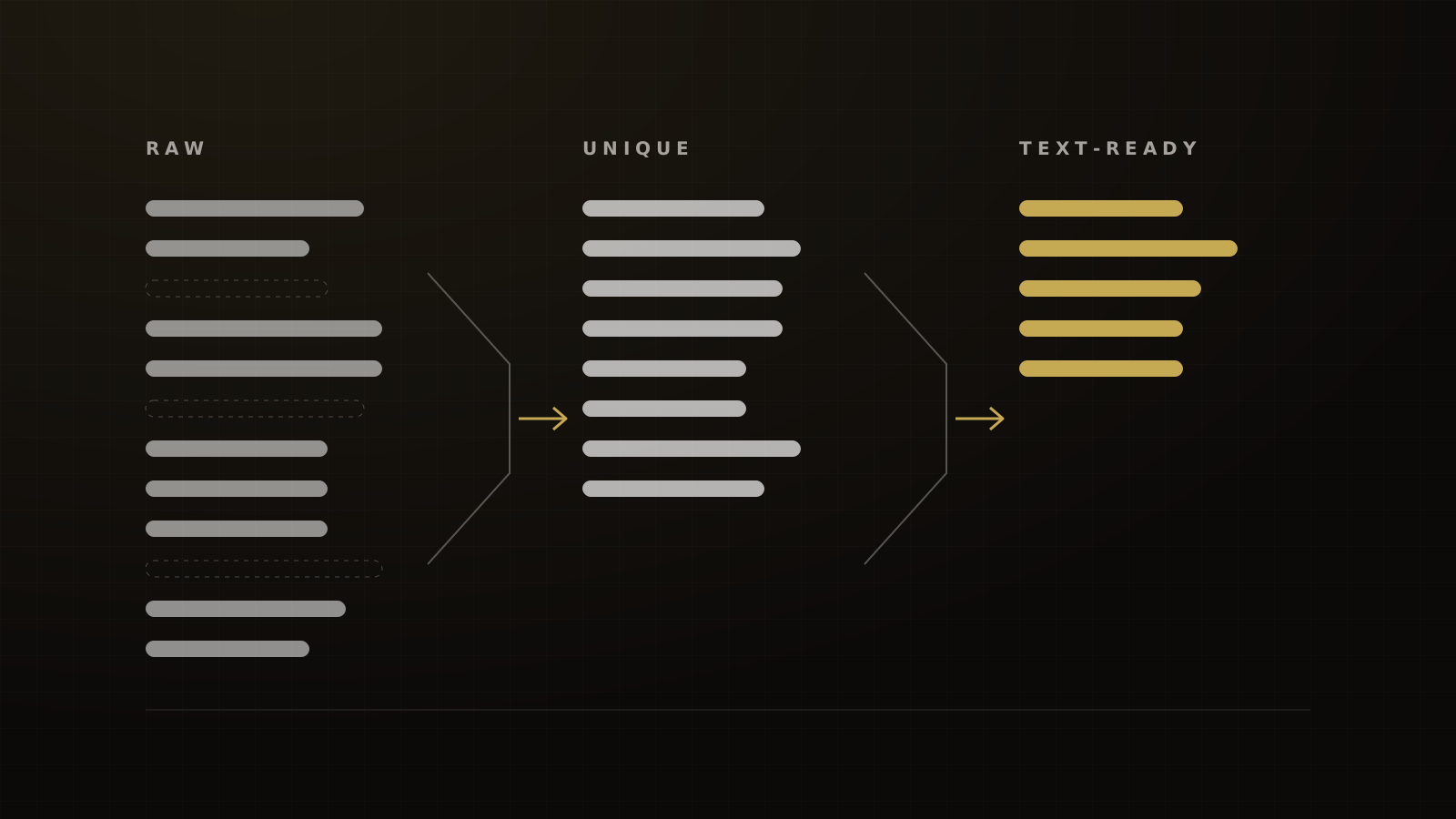
When a client has texted the same list for years without validating it, we run it through three stages before anything is sent:
- Raw records. Every contact row with a phone field, including duplicates across forms, imports and events.
- Unique numbers. After normalizing formats and deduplicating.
- SMS-ready numbers. After a line-type lookup removes landlines, invalid and unreachable numbers, and after opt-outs are suppressed.
In our experience, only about 40% to 45% of raw records survive to the last stage. No public industry figure exists to compare that with, so treat it as our rule of thumb from list cleans.
Put that next to the CDC's 1.6% landline-only figure and the gap is obvious. The population hasn't gone back to landlines. Lists decay, people type the wrong number, and duplicates pile up across every import.
Validation vs verification vs consent
These three get blurred constantly, and they answer different questions:
- Validation (a line-type or line-status lookup) tells you a number can receive texts.
- Verification (a one-time passcode at opt-in) tells you the person filling in the form controls that phone.
- Consent (the disclosure and agreement on your form) tells you that person agreed to hear from you.
A verified number with no consent is still a number you shouldn't text. Our guide to SMS consent, registration and verification covers how to capture all three on one form.
Numbers to stop repeating
- "SMS has a 98% open rate." An estimate with no traced measurement.[15]
- "35 million numbers are reassigned every year." The FCC said disconnected and made available, in 2018.[2]
- Any single "average SMS delivery rate". No independent source publishes one.
- "Phone verification proves consent." It proves control of the phone, nothing more.
Frequently asked questions
Sources
- 1.Wireless substitution: early release of estimates, July-December 2025. CDC National Center for Health Statistics, 2026-09.
- 2.Second Report and Order on the Reassigned Numbers Database (FCC 18-177). FCC, 2018-12-13.
- 3.RND subscription pricing notice. Reassigned Numbers Database, 2025-04-07.
- 4.2026 Annual Survey Highlights. CTIA, 2026-09.
- 5.2025 Annual Survey Highlights. CTIA, 2025-09.
- 6.47 CFR 64.1200: Delivery restrictions. eCFR via Cornell LII, current, checked 2026-10-04.
- 7.Regulatory report, March 2026 (summarizing the SomosGov 2025 RND annual report). Gryphon.ai, 2026.
- 8.4Q 2025 earnings release. AT&T, 2026-01.
- 9.2025 Annual Report on Form 10-K. Verizon, 2026.
- 10.Messaging Principles and Best Practices. CTIA, 2023-05.
- 11.Explain why the phone number field is required. Baymard Institute, 2020-03-16, updated 2025-07-29.
- 12.SMS Marketing Report 2026. SimpleTexting, 2026-05-26.
- 13.SMS messaging (link-shortening claim). Twilio, undated, checked 2026-10-04.
- 14.A2P 10DLC overview. Twilio Docs, 2026-07-07.
- 15.Comments of CTIA on robotext proceedings. CTIA, filed with the FCC, 2022-11-10.
- 16.Top text scams of 2024. FTC Data Spotlight, 2025-04-14.
- 17.Social media: a golden goose for scammers (Data Spotlight). FTC Data Spotlight, 2026-04.
- 18.Fact sheet: Eighth Report and Order, CG Docket 17-59. FCC, 2024-09-05.
- 19.Error 30006: Landline or unreachable carrier. Twilio Docs, living doc, checked 2026-10-04.
- 20.Error 30003: Unreachable destination handset. Twilio Docs, living doc, checked 2026-10-04.
- 21.Error 30005: Unknown destination handset. Twilio Docs, living doc, checked 2026-10-04.
- 22.Error 30007: Message filtered. Twilio Docs, living doc, checked 2026-10-04.
- 23.Error 30034: US A2P 10DLC, message from an unregistered number. Twilio Docs, living doc, checked 2026-10-04.
- 24.Lookup v2 API: Line Type Intelligence. Twilio Docs, 2026-07-24.
- 25.Lookup Line Status public beta. Twilio Blog, 2026-07-13.
Written by
Oussama El AlamiCTO & Lead Developer
Oussama leads technical architecture and development at Victory, building in GoHighLevel, n8n and custom environments. He has built more than 10,000 automations across CRMs, payments and messaging.
Part of the guide: Deliverability and Compliance in 2026: Gmail, Yahoo and Microsoft Sender Rules, A2P 10DLC and the TCPA