Before You Text 40,000 People: The SMS Pre-Flight Checklist for Event and Webinar Reminders
Ten checks to run before you text an old or imported list: line type, reassigned numbers, consent, caps, drip speed, send windows and the real cost.
 Oussama El AlamiCTO & Lead Developer
Published 10 min read
Key takeaways
- Stop before a big send and work through ten checks. Every one maps to a failure we've seen on a live event or webinar.
- Validate and dedupe first. In our experience, a list texted for years without validation keeps only about 40–45% of its raw records as unique, SMS-capable numbers.
- Validating 40,000 numbers by line type costs $320 at Twilio's list price.[1] One bad batch can stop every text on a HighLevel account until 00:00 UTC.[2]
- Count the segments in the final copy. One curly quote or emoji drops a text from 160 characters per segment to 70, which can double the bill.[3]
- Send by the recipient's clock, not yours. Florida, Oklahoma and Maryland stop at 8 p.m.[4][5][6]
- Drip the send under your daily cap, keep raw links out of the first text, and have the same message ready by email.
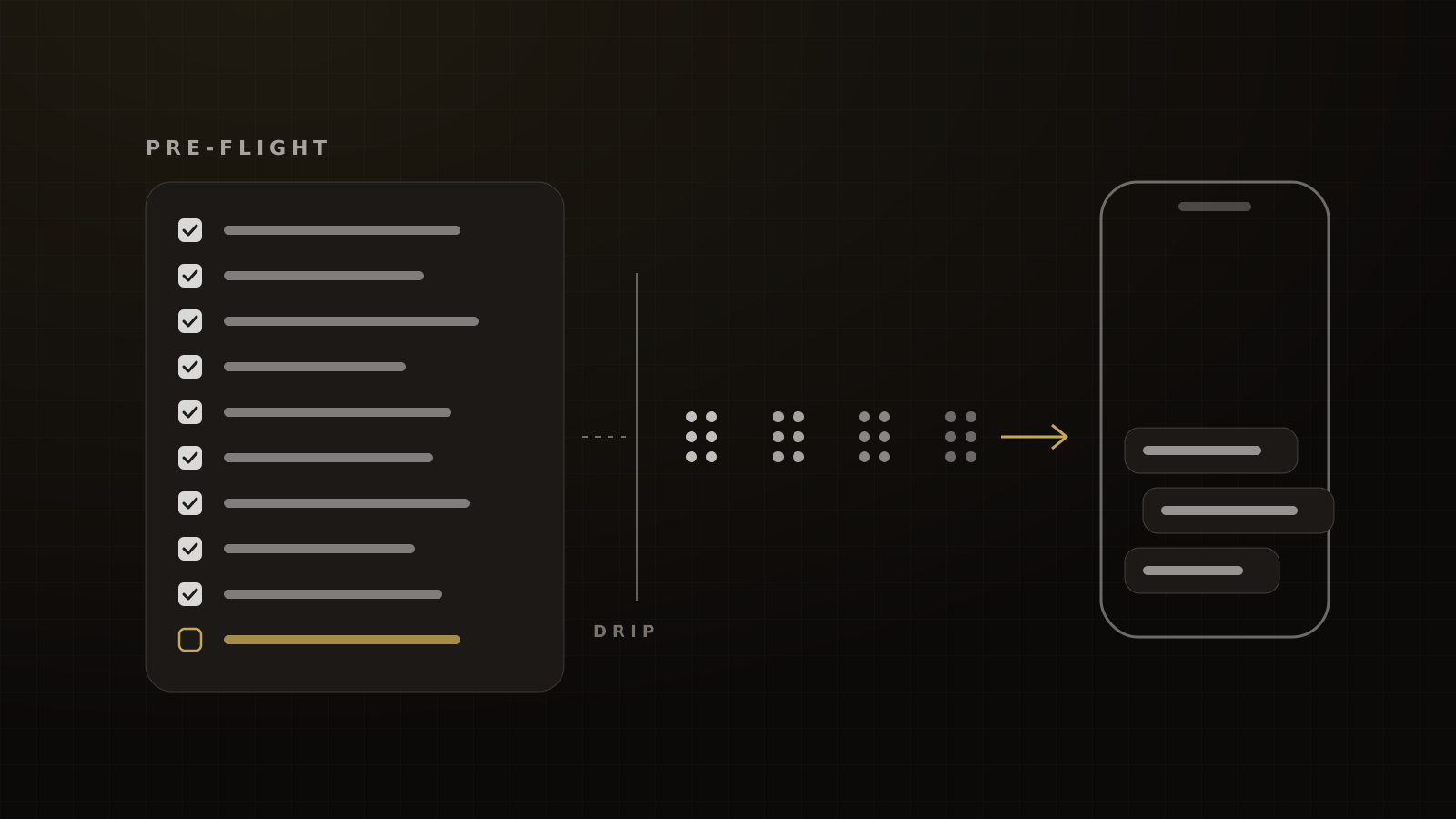
Before you text a big list, stop and work out everything that can go wrong. That pause is the checklist: validate line type, check for reassigned numbers, confirm consent, put the number on the registered campaign, seed-test, drip under your cap, respect the send window, keep raw links out of the first text, price the segments and international numbers, and line up backup email.
Each item maps to a failure we've seen. Run all ten and our target is 95% or better delivered on the send. We haven't found an industry delivery benchmark with a disclosed method to compare it to, so treat that as the number we hold ourselves to.
The pre-send pause
Big sends fail in the same few ways: dead numbers, an unregistered number, a burst that trips the account's limits, a filtered link, a send that lands at 6 a.m. Most are visible in advance if someone looks.
So before any send to an old or imported list, one person owns a 30-minute pause and works the list below. It's the cheapest step in the launch.
The 10-point pre-flight checklist
1. Validate line type
Run every number through a line-type lookup and drop landlines and invalid numbers. Twilio's Line Type Intelligence returns 12 types, from mobile and landline to fixed and non-fixed VoIP, toll-free and pager.[7] It costs $0.008 a lookup.[1] Texts to a landline fail with error 30006, and Twilio's advice is to look the number up first and not retry.[8]
Older audiences carry more landlines. In CDC survey data for the second half of 2024, 4.3% of adults 65 and over lived landline-only, against 1.4% of all adults.[9] Lists pick up landlines mostly from people typing a home or office number into a form.
Telnyx charges $0.0015 for an LRN query, but that returns carrier routing, not line type, so it isn't a like-for-like substitute.[10]
2. Dedupe and check reassigned numbers
Dedupe before you validate, so you don't pay twice for the same number. On the lists we audit, duplicates sharing one number are a big share of what disappears.
Then check for reassigned numbers on anything aged. The FCC estimated in 2018 that about 35 million US numbers are disconnected and made available for reassignment each year.[11] Its rule gives a safe harbor if you had consent and the FCC's Reassigned Numbers Database wrongly reported the number as not disconnected, and only that database qualifies.[12] Queries cost $0.008 each at Tier 1 and $0.006 at Tier 2.[13] CTIA also expects senders to process deactivation files regularly and remove those numbers.[14]
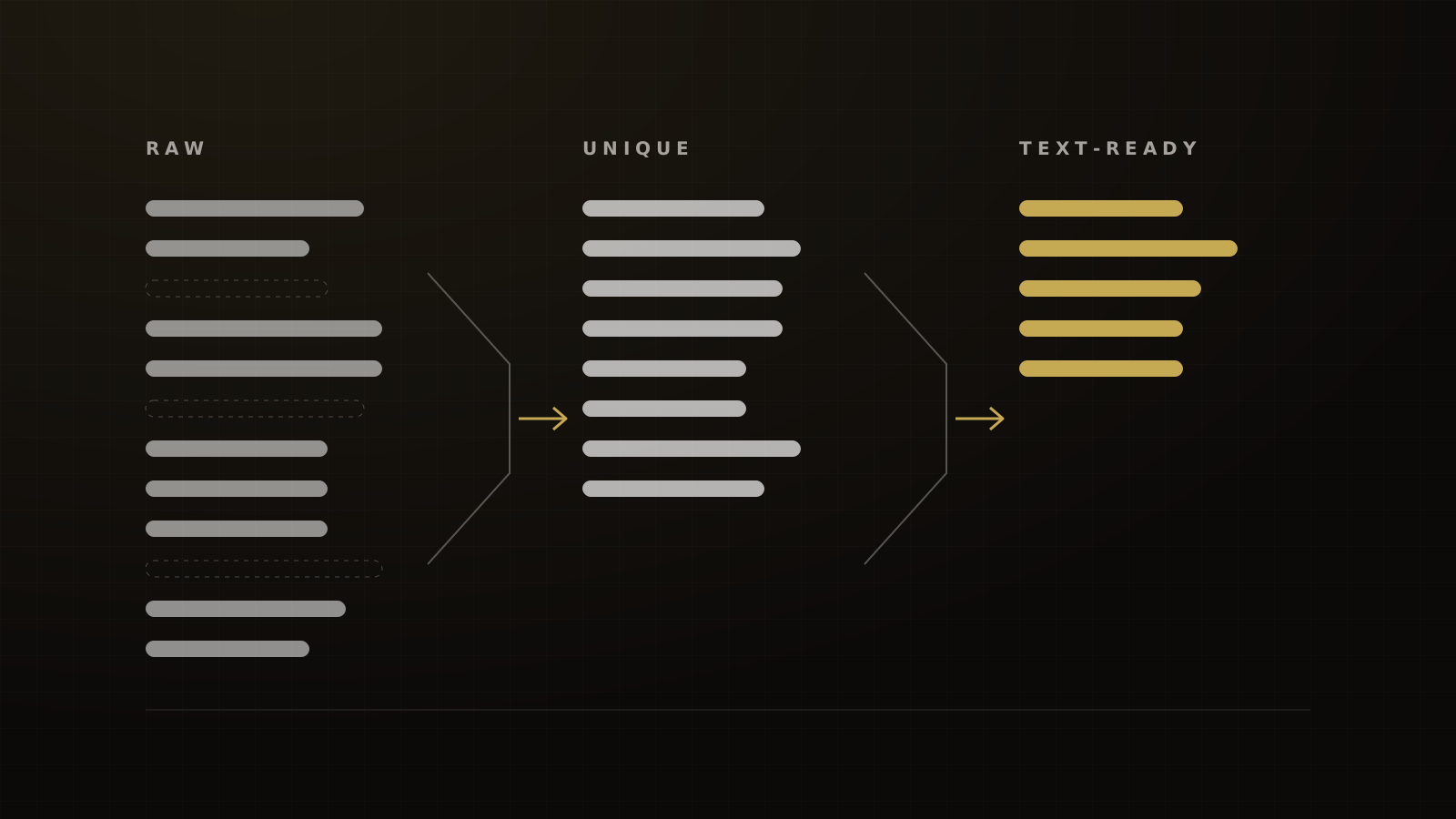
In our experience, on a list texted for years without validation, only about 40–45% of raw contact records end up as unique, SMS-capable numbers after dedupe and line-type checks. No public industry figure exists to compare it to. Our phone verification statistics collect the primary-sourced numbers that do exist.
3. Confirm where consent came from
Know the source of every number before it gets a marketing text. The FCC's rule requires prior express written consent for autodialed marketing texts: a signed agreement, where an E-SIGN electronic signature counts, that says consent isn't a condition of purchase.[12] CTIA says consent doesn't transfer between campaigns and that rented, sold or shared lists shouldn't be texted.[14] The FCC has also codified that National Do Not Call Registry protections apply to texts.[15]
Imported lists from a previous operator are where this breaks. If nobody can say how a segment opted in, don't text it. Registration, consent and verification explains what evidence to keep.
4. Put the sending number on the registered campaign
Twilio blocks US texts from 10-digit numbers that aren't on an approved A2P campaign (error 30034).[16] Every new number has to be attached to the campaign after you buy it.[17] We've seen a fresh number bought for a workflow that nobody added to the campaign.
A new number for a new job is fine. Dropping numbers as they degrade to dodge filters is number cycling, which T-Mobile's Code of Conduct prohibits.[18] Our A2P 10DLC guide covers the registration side.
5. Seed-test to your own phones, then pilot
Send the final message to your team's phones: iPhone and Android, on different carriers. On an iPhone with Screen Unknown Senders on, texts from numbers not in contacts go to a separate list with no notification, and links stay unopenable until the person marks the sender as known.[19] Your seed test shows you what a first-time recipient actually sees.
Then send a pilot batch of a few hundred and watch the logs before you release the rest. HighLevel describes a "good" error rate as 0–6% and a "good" opt-out rate as 0–1%.[2] If the pilot drifts outside either, stop and find out why.
6. Set drip throttling under your daily cap
Never blast. HighLevel's drip mode sends bulk actions in batches of 1 to 10,000, repeated every set number of minutes, hours or days, inside the hours you choose.[20] Size the batches against your cap. Twilio puts T-Mobile's cap at up to 2,000 segments a day for a Low-Volume Standard brand.[21] HighLevel lists that tier at up to 6,000 a day.[22]
On T-Mobile, the daily cap is shared by every campaign under the same brand and tax ID, even across providers. A brand vetted at 50–74 gets 40,000 a day.[23] A 40,000-segment send at that tier uses the whole day's allowance, including what your reminder workflows needed.
Get this wrong and the damage spreads. When a HighLevel account crosses its limits, outbound SMS fails until 00:00 UTC.[2] That means every workflow, not just the blast.
7. Respect the send window, in the recipient's time zone
The federal rule bars telephone solicitations before 8 a.m. or after 9 p.m. in the recipient's local time.[12] Some states are stricter:
| Rule | Earliest | Latest | Source |
|---|---|---|---|
| Federal, 47 CFR 64.1200(c)(1) | 8 a.m. | 9 p.m. | [12] |
| Florida, Fla. Stat. 501.616(6) | 8 a.m. | 8 p.m. | [4] |
| Oklahoma, 15 O.S. 775C (2022) | 8 a.m. | 8 p.m. | [5] |
| Maryland, Com. Law 14-4502(c) | 8 a.m. | 8 p.m. | [6] |
| Washington, RCW 80.36.390(8) | 8 a.m. | 8 p.m. | [24] |
Examples, not a complete list. Washington's statute refers to calls; texts there are also governed by a separate commercial electronic messages law.
Time zones are where this goes wrong. A national retailer is now facing a class action alleging marketing texts sent outside those hours, including at 5:15 a.m. local time; those are allegations, not findings.[25] Check which time zone your drip's hours run in. If it's the account's, a 9 a.m. Eastern start reaches California at 6 a.m. For a national list, the simple safe window is 8 a.m. to 8 p.m. in the recipient's time zone.
8. Keep raw links out of the first text
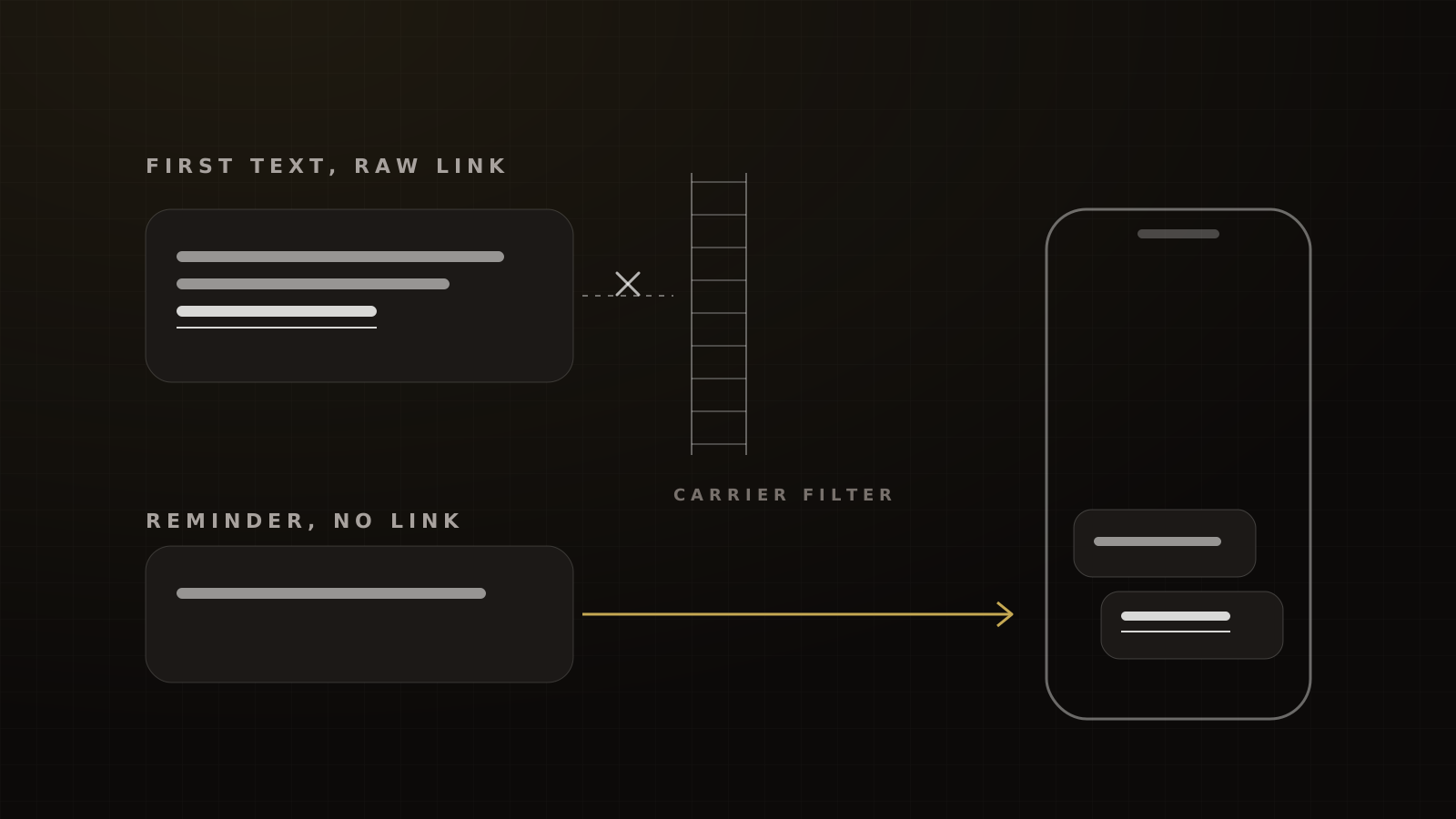
A first text from an unfamiliar number that carries a link is the message most likely to be filtered. CTIA says senders who shorten links should use a shortener dedicated to their exclusive use.[14] We use trigger links on the brand's own domain and send the link in a follow-up, not in message one. Our carrier-filtering post-mortem shows what happens when you don't.
9. Count the segments and price the international numbers
Render the final copy and count segments. A plain GSM-7 text fits 160 characters, or 153 per segment when it runs longer. One emoji, curly quote or other non-GSM character switches it to UCS-2: 70 characters, or 67 per segment.[3] A 100-character reminder with one curly apostrophe becomes two segments, and 40,000 texts become 80,000 billable segments.
Then sort the list by country code. Twilio charges $0.0083 a segment in the US.[26] A text to Egypt costs $0.3959.[27] That's about 48 times more, and nobody notices until the invoice. Other countries also have their own marketing-text laws, so check before you include them.
10. Line up backup email
Have the same message ready to go by email before the text goes out. If carriers restrict the account mid-send, you switch channels instead of losing the reminder. We've done exactly that on a ticket send that hit a carrier restriction: slowed the drip and sent the message by email so registrants still got it.
The math for a 40,000-number send
This is a worked illustration at list prices, not a client result. Your provider's rates will differ; HighLevel's LC Phone rate card isn't Twilio's.
| Line | Math | Cost |
|---|---|---|
| Line-type lookup, Twilio[1] | 40,000 × $0.008 | $320 |
| Carrier lookup, Telnyx LRN (different product)[10] | 40,000 × $0.0015 | $60 |
| Reassigned-number checks, RND at the Tier 2 rate[13] | 40,000 × $0.006 | about $240 |
| Send, one segment, Twilio base[26] | 40,000 × $0.0083 | $332 |
| Carrier fees, one segment | 40,000 × $0.0035 to $0.005 | $140 to $200 |
| Same send at two segments | double both lines | $944 to $1,064 |
| Fees on failed messages | $0.001 per failure | $10 per 10,000 |
List prices checked 2026-10-04. Carrier fees range from AT&T's $0.0035 to Verizon's $0.005 per segment.
Three things stand out. Validation costs about what one send costs. The segment count matters more than any lookup. And failed messages cost almost nothing in fees; what they cost is the account, when the failure rate trips its limits.
Validation also shrinks the send. If the list behaves like the old lists we see, 40–45% of records survive, so you pay to text roughly 16,000 to 18,000 numbers instead of 40,000.
That matters because usage is most of the bill. In our experience, on the event funnels we run, usage (email, SMS, carrier and A2P fees) runs 1.5–3x the HighLevel plan fee in launch months. That's our estimate; there's no industry benchmark for it.
Drip time. AT&T limits each campaign's speed by class: 240 messages a minute for classes E and F, up to 4,500 for A and B.[28] At 240 a minute, 40,000 segments take about 2 hours 47 minutes. Start well inside the send window.
International. At Twilio's list prices, 40,000 one-segment texts would cost $332 to Canada,[29] $2,240 to the UK[30] and $7,276 to Mexico.[31]
Opt-outs to expect. Postscript's 2026 benchmarks put ecommerce campaign unsubscribe rates between 0.33% (25th percentile) and 0.88% (75th).[32] On 40,000 delivered, that's 132 to 352 opt-outs. Klaviyo rates under 0.5% as great and 2% or more as critical.[33] Neither is an event list, so use them as rough bands for your pilot gate.
The SMS pre-flight checklist
- Validate line type; drop landlines and invalid numbers
- Dedupe; check reassigned numbers on aged lists
- Confirm the consent source for every segment
- Sending number attached to the registered A2P campaign
- Seed-test to your own phones, then pilot a small batch
- Drip under the daily cap, inside your carrier throughput
- Send window set in the recipient's time zone
- No raw link in the first text; trigger links on your domain
- Segments counted; international numbers priced
- Backup email ready
For how SMS fits with email authentication, A2P and consent, start with our deliverability and compliance guide. If you want a second pair of eyes before a big launch, book a strategy call.
Frequently asked questions
Sources
- 1.Lookup pricing. Twilio, living page, checked 2026-10-04.
- 2.Best practices for SMS deliverability and avoiding SMS restrictions. HighLevel Help Center, 2026-09-04.
- 3.SMS character limit (glossary). Twilio Docs, checked 2026-10-04.
- 4.Fla. Stat. 501.616(6), Unlawful acts and practices (calling hours). Florida Legislature, 2026 statutes.
- 5.Oklahoma Telephone Solicitation Act, Enrolled HB 3168. Oklahoma Legislature, 2022, effective 2022-11-01.
- 6.Md. Code, Commercial Law 14-4502 (Stop the Spam Calls Act). Maryland General Assembly, current, effective 2024-01-01.
- 7.Lookup v2 API: Line Type Intelligence. Twilio Docs, 2026-07-24.
- 8.Error 30006: Landline or unreachable carrier. Twilio Docs, living doc, checked 2026-10-04.
- 9.Wireless substitution: early release of estimates from the NHIS, July–December 2024. CDC National Center for Health Statistics, 2025-06.
- 10.Your number lookup guide. Telnyx Support, 2026-09-29, checked 2026-10-04.
- 11.Second Report and Order (FCC 18-177), Reassigned Numbers Database. Federal Communications Commission, 2018-12-13.
- 12.47 CFR 64.1200, Delivery restrictions (sections (c)(1), (f)(9) and (m)). eCFR via Cornell LII, current, checked 2026-10-04.
- 13.RND subscription pricing notice. Reassigned Numbers Database Administrator, 2025-04-07.
- 14.Messaging Principles and Best Practices. CTIA, 2023-05.
- 15.Order DA 25-90 (footnote 4: National DNC Registry protections apply to texts). Federal Communications Commission, 2025-01-24.
- 16.Error 30034: US A2P 10DLC, message from an unregistered number. Twilio Docs, living doc, checked 2026-10-04.
- 17.Twilio ISV A2P 10DLC. HighLevel Help Center, 2026-09-01.
- 18.T-Mobile Code of Conduct, v2.2. T-Mobile, 2020-11.
- 19.Screen and filter texts on iPhone. Apple Support, iPhone User Guide, living doc, checked 2026-10-04.
- 20.New drip mode architecture for bulk actions. HighLevel Help Center, 2025-10-14.
- 21.A2P 10DLC overview. Twilio Docs, 2026-07-07.
- 22.A2P campaign registration: step-by-step guide and FAQs. HighLevel Help Center, 2026-09-11.
- 23.T-Mobile 10DLC. Bandwidth Support, 2026-08-13, checked 2026-10-04.
- 24.RCW 80.36.390, Telephone solicitation. Washington State Legislature, current, checked 2026-10-04.
- 25.Victoria's Secret PINK class action claims company sent text messages at impermissible times. Top Class Actions, 2026-07-03.
- 26.SMS pricing: United States. Twilio, living page, checked 2026-10-04.
- 27.SMS pricing: Egypt. Twilio, living page, checked 2026-10-04.
- 28.AT&T 10DLC. Bandwidth Support, 2026-08-27, checked 2026-10-04.
- 29.SMS pricing: Canada. Twilio, living page, checked 2026-10-04.
- 30.SMS pricing: United Kingdom. Twilio, living page, checked 2026-10-04.
- 31.SMS pricing: Mexico. Twilio, living page, checked 2026-10-04.
- 32.2026 SMS benchmarks. Postscript, 2026.
- 33.SMS unsubscribe-rate bands (help article). Klaviyo Help Center, 2026-08-10, checked 2026-10-04.
Written by
Oussama El AlamiCTO & Lead Developer
Oussama leads technical architecture and development at Victory, building in GoHighLevel, n8n and custom environments. He has built more than 10,000 automations across CRMs, payments and messaging.
Part of the guide: Deliverability and Compliance in 2026: Gmail, Yahoo and Microsoft Sender Rules, A2P 10DLC and the TCPA