AI in Marketing Statistics 2026: Adoption, ROI and Agent Use From Primary Surveys
Every figure with its publisher, sample and fieldwork dates, split into self-reported, measured and forecast. Use is near-universal. Scaled impact isn't.
 Ray GillespieCo-Founder & COO
Published 9 min read
On this page
Key takeaways
- AI use in marketing is near-universal: 75% of marketers have adopted it (Salesforce) and 86.4% of teams use it somewhere (HubSpot).[1][2]
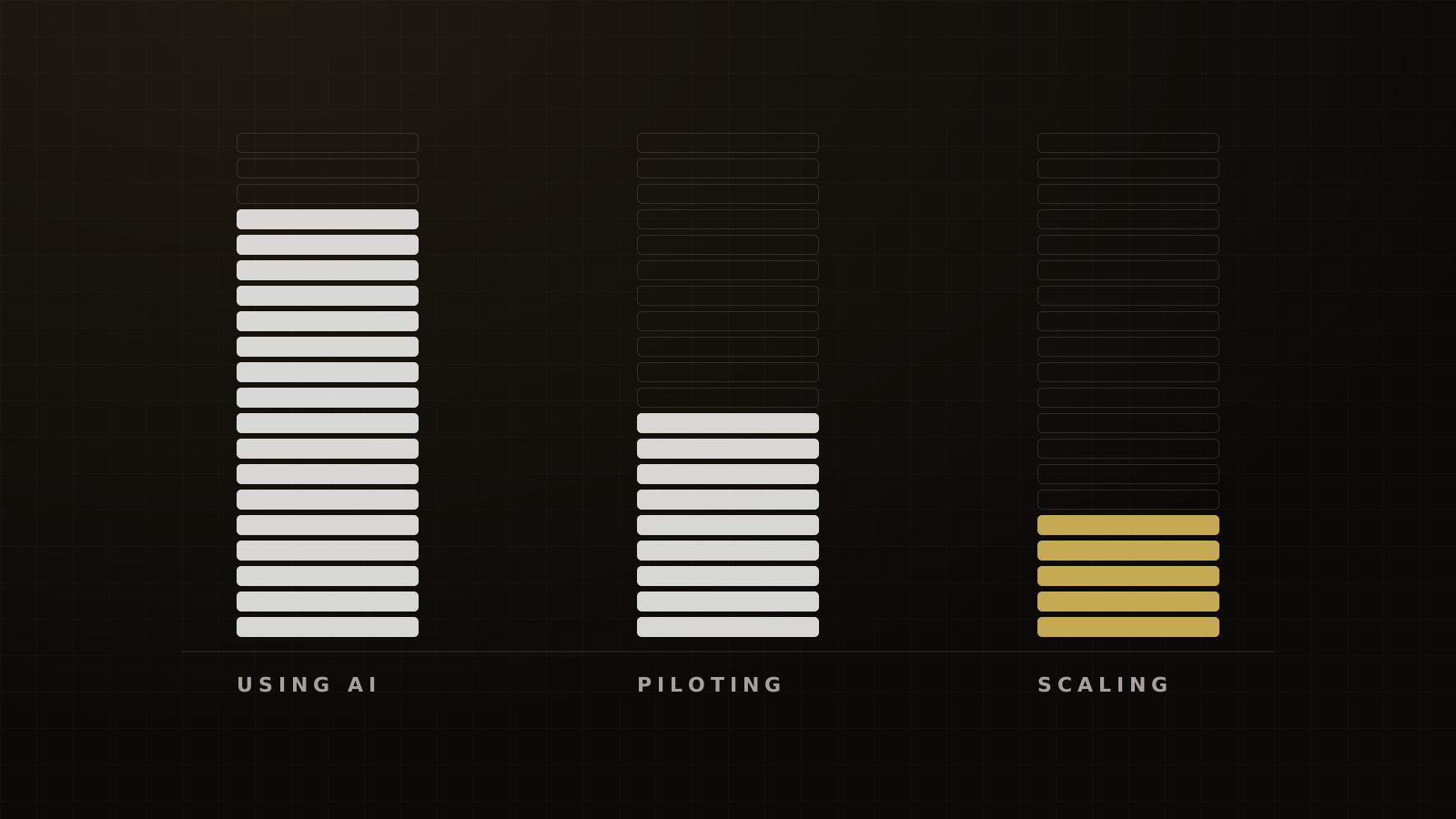
- Scaled impact isn't. Only 25% of organisations have reached the scaling phase,[3] and 39% attribute any EBIT impact to AI.[4]
- Agents are earlier still: 23% of organisations are scaling an agent somewhere, and no more than 10% in any single function.[4]
- Almost every ROI figure is self-reported. The few randomised experiments measure output, clicks and opens, not ROI.
- Read every number with its sample, fieldwork dates, vendor and denominator. This page lists all four.
AI use in marketing is near-universal. Scaled impact isn't. That's the one-line read of every credible survey published in the last 18 months, and it's the line to take into a budget meeting.
The roundups that rank for this topic mix vendor claims, forecasts and surveys with no dates or samples. Below, every figure carries its publisher, sample and fieldwork dates, and says whether it's self-reported, measured or a forecast. We opened every source ourselves and dropped what we couldn't trace.
The five numbers that matter
| Figure | What it measures | Source, sample, fieldwork | Type |
|---|---|---|---|
| 75% | Marketers who have adopted AI | Salesforce, 4,450 marketing decision-makers, Oct 8 to Nov 17, 2025[1] | S |
| 25% | Organisations in the scaling phase (47% still piloting) | SmarterX, 2,100+ professionals, Feb to Apr 2026[3] | S |
| 39% | Organisations attributing any EBIT impact to AI | McKinsey, 1,993 respondents, Jun 25 to Jul 29, 2025[4] | S |
| ≤10% | Organisations scaling agents in any single function | McKinsey, same survey[4] | S |
| 13% | Organisations with all four AI governance foundations | SmarterX, same survey[3] | S |
Type: S = self-reported survey. SmarterX and McKinsey are cross-functional, not marketing-only.
How to read these statistics
Three checks before you quote anything.
Self-reported, measured or forecast? Nearly everything below is a survey answer. "We see a clear ROI" is a belief, not a measurement. Forecasts are labelled as forecasts.
Who was asked? Vendors that sell AI publish most of these surveys. Salesforce sells agents. SAS sells marketing AI. That doesn't make the numbers wrong. It means the question wording deserves a look.
What's the denominator? This is the error roundups make most. The Census Bureau found 18% of US firms use AI in a business function, but 52% of those adopters use it in sales and marketing.[5] Quote "52% of firms use AI in marketing" and you're off by a factor of about five. Microsoft's 2026 Work Trend Index surveyed 20,000 workers who already use AI, and counts an agent as active after one use in a rolling 28 days.[6] Both are useful. Neither is a marketing adoption rate.
Adoption: almost everyone uses AI
| Figure | Source, sample, fieldwork |
|---|---|
| 75% of marketers have adopted AI | Salesforce, 4,450 marketing decision-makers, Oct to Nov 2025[1] |
| 86.4% of teams use AI in at least some areas | HubSpot, 1,500+ B2B and B2C marketers, fieldwork not stated[2] |
| 95% of B2B marketers' organisations use AI apps | CMI, 1,015 B2B marketers, Jun 24 to Aug 14, 2025[7] |
| 88% of organisations use AI regularly in at least one function | McKinsey, 1,993 respondents in 105 nations, Jun to Jul 2025[4] |
| Nearly 90% of marketers have used generative AI at work; 71% weekly | AMA with Lightricks, 1,000+ marketers, Sep 2024[8] |
All self-reported. AMA fieldwork is about two years old.
Now the reality check. The Census Bureau's nationally representative survey put current AI use at 19.8% of US businesses as of May 3, 2026, and 39.7% in the Information sector.[9] The marketer surveys sample people who answer marketing surveys. The economy-wide rate is far lower.
Piloting vs scaling
Using AI and running on it are different stages. SmarterX's 2026 survey found 47% of organisations still piloting, 25% scaling and 28% at the understanding stage.[3] People are ahead of their companies: 53% of respondents were personally at the integration or transformation stage.[3]
Marketing leaders say the same. In Gartner's 2026 CMO Spend Survey (401 CMOs, Jan to Mar 2026, mostly $1B+ firms), 30% reported mature AI readiness, while 70% called AI leadership a critical 2026 goal.[10] CMI's B2B sample rated itself 20% exploratory and 48% developing.[7]
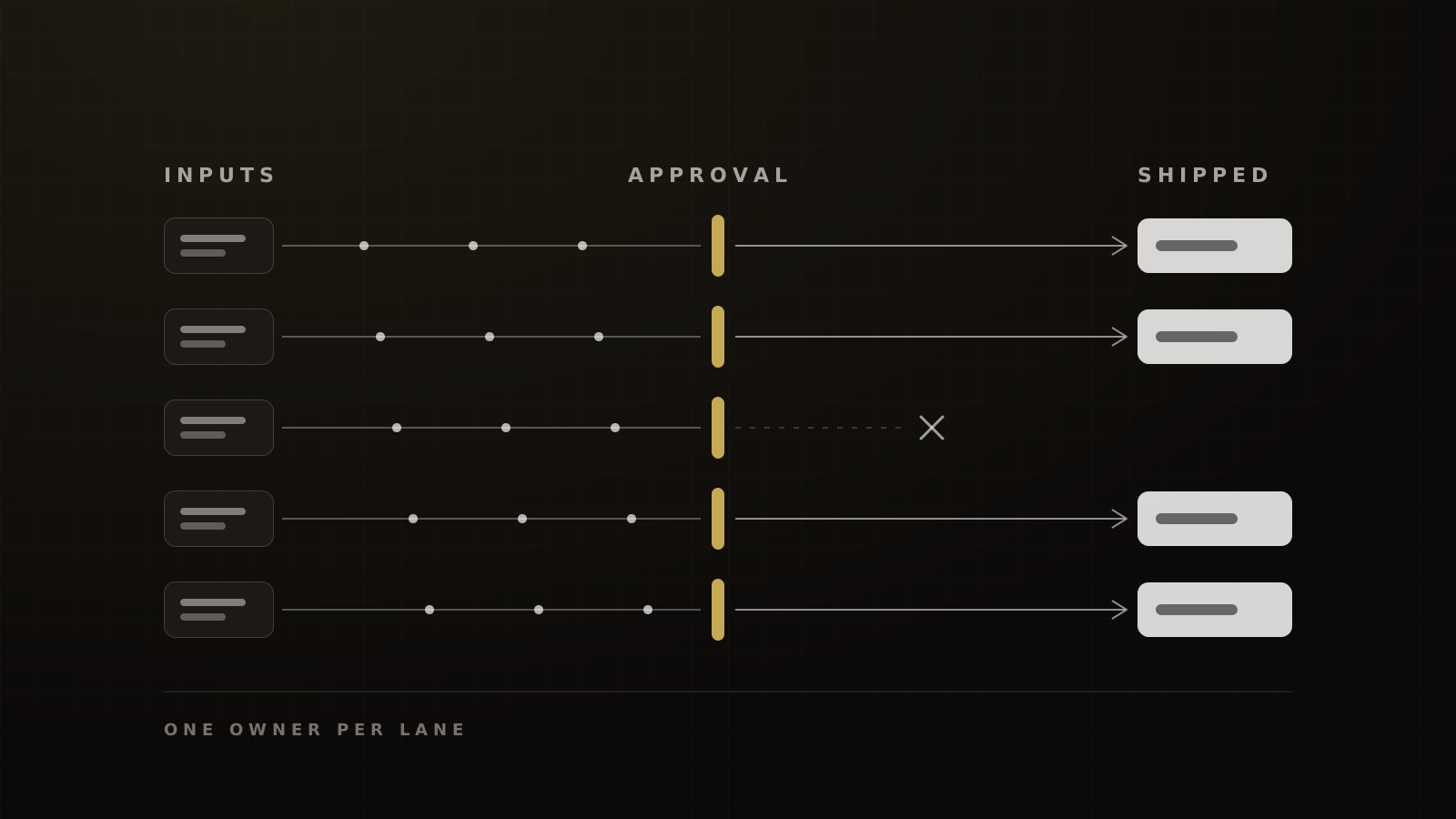
What separates the scalers isn't the tool. McKinsey's high performers, about 6% of respondents, were nearly three times as likely to have redesigned individual workflows, and more often defined when outputs need human validation.[4] That's the case for writing SOPs with approval points, which is how we build it in our AI marketing operations guide.
ROI: what's self-reported and what isn't
Self-reported
| Figure | Source, sample, fieldwork |
|---|---|
| 93% of CMOs and 83% of marketing teams "report a clear ROI" from genAI | SAS / Coleman Parkes, 300 decision-makers, Jun to Jul 2025[11] |
| ROI shows up as time efficiency (49%), cost efficiency (40%), capacity (27%) | Gartner, 402 CMOs, Feb to Mar 2025[12] |
| 39% attribute any EBIT impact to AI; most of them under 5% | McKinsey, 1,993 respondents, Jun to Jul 2025[4] |
| 39% of AI content users say content performance improved; 34% no change | CMI, B2B subgroup, Jun to Aug 2025[7] |
| About a third of teams save 10 to 14 hours a week; a third 15+ | HubSpot, 1,500+ marketers[2] |
| 15.3% of marketing budget goes to AI initiatives | Gartner, 401 CMOs, Jan to Mar 2026[10] |
None of these surveys publishes an ROI formula.
Notice where the value shows up. Gartner's CMOs name time and cost first. That fits Hormozi's value equation: AI mostly attacks the bottom of it, time delay and effort, rather than raising the dream outcome. It also explains the agency line in the same survey: 22% of CMOs said genAI cut their reliance on external agencies for creativity and strategy, and 39% planned to cut agency budgets.[12]
Measured
Randomised experiments are rarer, and they measure narrower things:
- Output. In an MIT experiment with 2,234 participants and 11,024 ads, human-AI teams produced 50% more ads per worker, with higher text quality and lower image quality.[13]
- Clicks. With 21,328 customers of one retailer, AI-personalised video ads lifted click-through by 9.4 percentage points over personalised image ads.[14] Engagement, not sales.
- Opens. In a 50-arm email test to 5.1 million recipients, the best AI-refined creative beat the best human one by 45.1% on open rate.[15] Best against best, not an average lift.
- Conversions. A Hong Kong Baptist University field experiment with 150+ video ads found AI ads won attention but converted less often. It publishes no effect sizes.[16]
- Productivity. The best-known measured study is from customer support, not marketing: an AI assistant raised issues resolved per hour by 14%, and by 34% for novices, among 5,179 agents.[17] It's from 2023.
The honest summary: we found no measured, generalisable ROI percentage for generative AI in marketing. Anyone quoting one is quoting a survey or a vendor.
Vendor claims: traceable, but vendor-run or self-reported
- ActiveCampaign: marketers save 13 hours a week and about $5,000 a month. Talker Research online survey of 1,000 US marketers and owners, May 21 to Jun 12, 2025, self-reported.[18]
- Google AI Max for Search: typically 14% more conversions at similar CPA or ROAS. Google internal data, no design disclosed.[19]
- Meta GEM: up to 5% more conversions in a one-week randomised Reels test; Advantage+ Sales averaging 22% higher ROAS.[20]
- LinkedIn Accelerate: "up to" 42% lower cost per action, from 67 of LinkedIn's own A/B tests.[21] "Up to" is the best case.
- HubSpot State of AI: "transformative" adopters, 6% of respondents, are 4x more likely to hit revenue goals. Self-rated maturity and correlation; the full report is gated.[22]
- The "80% of marketers use AI" line in roundups is HubSpot's 80% for content creation, shortened.[23]
Agents: experimenting, rarely scaled
Watch the verbs. "Building, deploying or developing" isn't "deployed".
| Figure | Source, sample, fieldwork |
|---|---|
| 23% scaling an agent in at least one function; 39% experimenting; ≤10% scaling in any one function | McKinsey, 1,993 respondents, Jun to Jul 2025[4] |
| 62% building, deploying or developing agents (53% the prior quarter) | KPMG, 314 US leaders at $1B+ firms, Jul 24 to Aug 25, 2026[24] |
| 42% tested or deployed agents; 15% scaled multi-agent systems | Deloitte, 501 US leaders at organisations already piloting, Apr to Jun 2026[25] |
| 30% say agents are integrated into workflows (13% a year earlier) | BCG, about 12,000 workers, dates not stated[26] |
| Six in ten exploring agentic AI | Capgemini, 1,505 executives at $1B+ firms, Nov 2025[27] |
| 28% of B2B marketers experimenting with agents; 3% say they're core | CMI, 1,015 B2B marketers, Jun to Aug 2025[7] |
| Half of US agencies use agentic AI for marketing execution | Forrester with the 4As, sample not disclosed[28] |
All cross-functional. No 2026 survey we found measures agent deployment inside marketing functions specifically.
One forecast belongs next to these: Gartner predicts over 40% of agentic AI projects will be cancelled by the end of 2027, over cost, unclear value or weak risk controls.[29] That's a prediction, not a measurement.
Usage data points the same way. In Anthropic's sample of 1 million API transcripts from August 2025, 4.7% involved creating marketing materials.[30] That's telemetry from one vendor, not a survey. How we test agents before trusting them is in what autonomous agents can and can't do.
What holds teams back
Skills and structure, not tools. In SmarterX's 2026 survey, the top barriers were lack of education and training (38%) and lack of awareness or understanding (35%).[3] On its report page, 32% said no AI training exists, 48% have a generative AI policy, and 51% want to learn to use agents, which is interest, not use.[31] Only 13% had a roadmap, a council, a genAI policy and an ethics policy all in place.[3]
Data is the other gap. Salesforce found complete marketer access to service data at 58%, sales data at 56% and commerce data at 51%.[1] An agent can't act on data it can't see.
Consumers: what buyers accept
The strongest consumer sample is Gallup's: 3,270 US adults on a probability panel, May 4 to 11, 2026. 75% accept disclosed AI for brainstorming and early drafts, and 62% reject AI-created people or voices even when disclosed.[32]
Ad executives misread this. In IAB's survey, 45% of Gen Z and Millennial consumers felt positive about AI ads, while 82% of executives thought they did.[33] Use AI behind the scenes freely. Be careful putting synthetic people in front of buyers.
Automation is already the plumbing
Adoption surveys miss the automation that's already running. HighLevel, the CRM we build on, reported 120 billion workflow actions executed on its platform in 2024.[34] In December 2025 alone, its AI answered more than 1 million calls and sent more than 12 million messages for customers.[35] Both are vendor-reported. They show that marketing automation is mature infrastructure, which is where most AI value lands first.
Methodology
We included a figure only if we could open the original page or report and match the number, sample and dates on 2026-10-04. Figures we could only check in a PDF download, a gated report or a search summary were left out, including several widely repeated market-size forecasts. Where two surveys disagree, both appear with their samples. For how we turn these numbers into a working plan, read how we use Claude for marketing operations and our scaling roadmap, or book a strategy call.
Frequently asked questions
Sources
- 1.State of Marketing, 10th edition. Salesforce, 2026-02-19.
- 2.2026 State of Marketing (marketing industry trends report). HubSpot, 2026-04-10 (updated).
- 3.2026 State of AI for Business: executive summary. SmarterX / Marketing AI Institute, 2026-05-18.
- 4.The state of AI in 2025: Agents, innovation, and transformation. McKinsey, 2025-11-05.
- 5.AI use in US businesses: BTOS AI supplement (CES-WP-26-25). US Census Bureau, Center for Economic Studies, 2026-04.
- 6.Work Trend Index 2026: agents, human agency and the opportunity for every organization. Microsoft WorkLab, 2026 (fieldwork Feb 18 to Apr 7, 2026).
- 7.B2B Content and Marketing Trends 2026. Content Marketing Institute / MarketingProfs, 2025-10-08.
- 8.Generative AI takes off with marketers. American Marketing Association with Lightricks, 2024-12-12.
- 9.AI use among businesses. US Census Bureau, 2026-05-26.
- 10.Gartner 2026 CMO Spend Survey finds CMOs allocate 15.3% of marketing budgets to AI. Gartner (via Business Wire), 2026-05-11.
- 11.New study: GenAI hype is over as 93% of CMOs see strong ROI (Marketers and AI: Navigating New Depths). SAS / Coleman Parkes, 2025-09-26.
- 12.Gartner 2025 CMO Spend Survey reveals marketing budgets have flatlined at 7% of company revenue. Gartner, 2025-05-12.
- 13.Randomised experiment on human-AI teams producing ads (arXiv 2503.18238, v3). Ju and Aral, MIT, 2026-02-05 (v3).
- 14.AI-personalised video ads: randomised field experiment (Marketing Science 2025, research brief). Kapoor and Kumar, MIT IDE, 2025-07.
- 15.AI-refined creative in a 50-arm adaptive email field experiment (arXiv 2607.23696). arXiv preprint, 2026-07.
- 16.Attention without conversion: AI-generated versus human-created video ads. Li and Li, Hong Kong Baptist University, 2026-06-12.
- 17.Generative AI at Work (NBER Working Paper 31161). Brynjolfsson, Li and Raymond, NBER, 2023-04 (rev. 2023-11).
- 18.13 hours back each week. ActiveCampaign (survey by Talker Research), 2026-04-15.
- 19.AI Max for Search campaigns. Google, 2025-05-06.
- 20.Cannes Lions 2025: a nova era da IA generativa para anunciantes e agências. Meta Newsroom (Brazil), 2025-06-17.
- 21.LinkedIn Accelerate. LinkedIn, 2025.
- 22.State of AI 2026. HubSpot, 2026.
- 23.State of Marketing 2026. HubSpot, 2026.
- 24.Q3 2026 AI Pulse. KPMG, 2026-09-24.
- 25.Deloitte survey examines AI readiness and agentic AI success. Deloitte, 2026-08-12.
- 26.AI at Work 2026: why strategy matters more than tools. BCG, 2026-06-02.
- 27.In a shift from AI hype to AI realism, organizations are increasing their AI investments. Capgemini Research Institute, 2026-01-16.
- 28.Nine in 10 US marketing agencies use AI to cut costs at the expense of creativity. Forrester with the 4As, 2026-06-24.
- 29.Gartner predicts over 40% of agentic AI projects will be canceled by end of 2027. Gartner, 2025-06-25.
- 30.Anthropic Economic Index: September 2025 report. Anthropic, 2025-09-15.
- 31.2026 State of AI for Business (report page). SmarterX, 2026.
- 32.Americans aren't sold on businesses using AI in advertising (Bentley-Gallup Business in Society). Gallup / Bentley University, 2026-08-19.
- 33.The AI Ad Gap Widens. IAB and Sonata Insights, 2026-01.
- 34.HighLevel 2024 recap. HighLevel, 2025-01-09.
- 35.How HighLevel customers built real momentum in 2025. HighLevel, 2026-03-02.
Written by
Ray GillespieCo-Founder & COO
Ray runs day-to-day operations across every Victory engagement, building the systems, automations and AI-powered workflows that hold the machine together. He has overseen operations behind more than $120M in revenue.
Part of the guide: AI Marketing Operations: How a Modern Agency Runs Funnels with Claude, Agents and Automation