How Far Out Should You Promote an Event? The Short-Runway Promo Calendar and Reminder Schedule
Run paid ads close to the date, start warm email and SMS earlier, and stack reminders on the day itself. The promo calendar and cadence we run.
 Ray GillespieCo-Founder & COO
Published 9 min read
On this page
Key takeaways
- Separate the ad runway from the warm-list runway. Ads run close to the date. Email and SMS to people who already know you can start earlier.
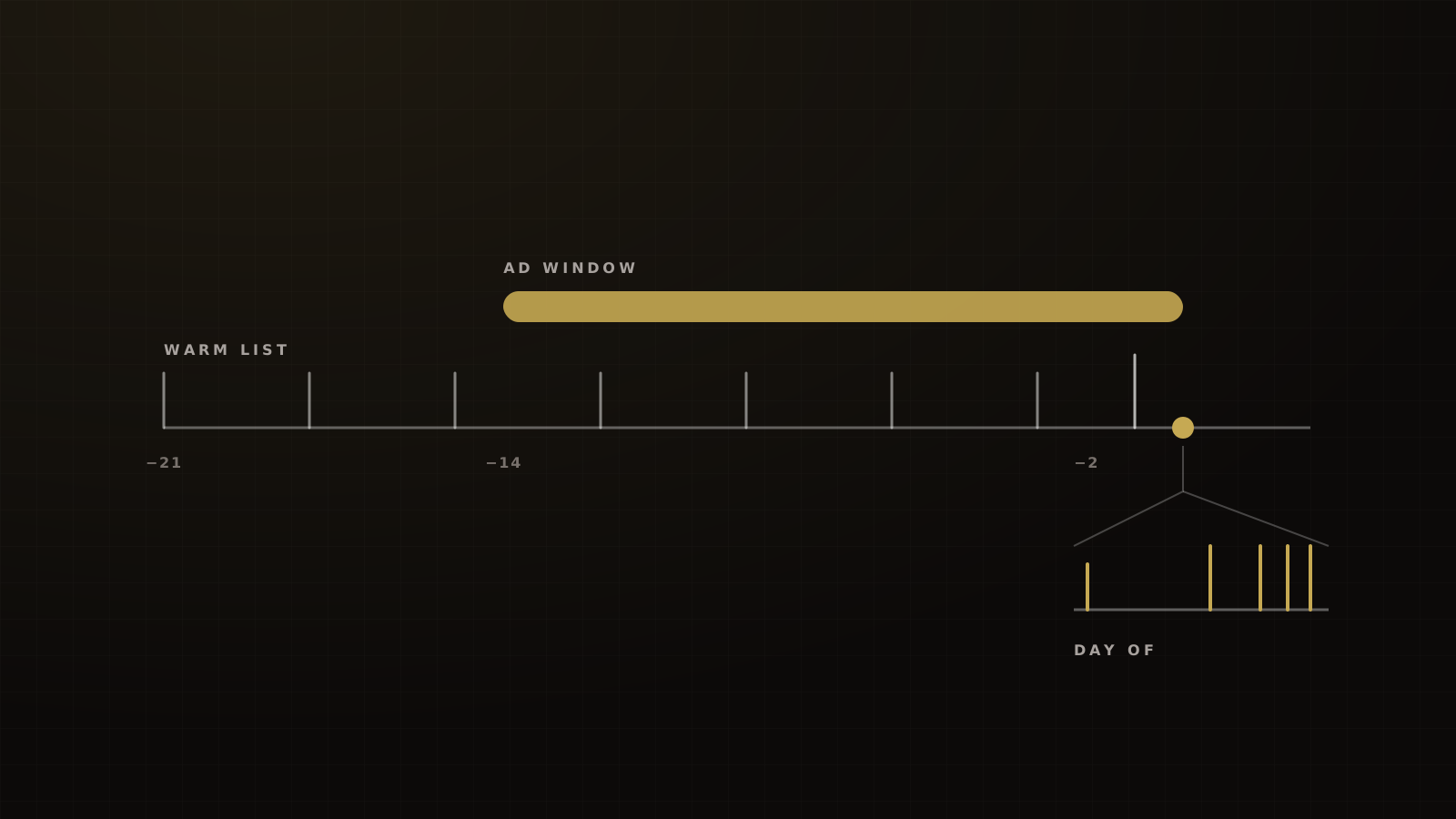
- Our defaults: 10 to 14 days of paid ads for a free in-person event, warm email and SMS from about 21 days out, and webinar ads only in the 2 days before.
- 49.6% of webinar registrations land in the final week and 15.3% on the day.[1] Inside the same event, late registrants attend almost as reliably as early ones.[2]
- Put most reminders on the day itself: morning, one hour, ten minutes, "we're live" and a late-join text.
- More texts aren't the fix. An extra text on top of working reminders changed nothing in a controlled test.[3]
For a free event filled from paid traffic, run the ads in a short window close to the date. Let warm email and SMS start earlier. Then stack the reminders on the day itself.
The logic is simple. People register late whatever you do, and late registrants turn out to be no flakier than early ones. Meanwhile, every extra day between sign-up and the event is a day to forget, double-book or lose interest. A short runway costs you almost nothing in show rate and keeps intent fresh.
On a weekly evening webinar, we run ads only in the 2 days before. Running ads two weeks out raises cost per registration and lowers the show rate.
What the usual advice says, and why it's built for conferences
Search "how far in advance to promote an event" and you get rules of thumb: LinkedIn suggests 2 to 3 weeks for short virtual events, 3 to 4 weeks for webinars, 4 to 6 weeks or more for large events, and paid promotion 2 to 4 weeks out. It cites no data.[4]
Those windows make sense for a conference. People need to book travel, clear a workday and get approval. They make much less sense for a free evening webinar or a one-day local event, where the decision takes a minute and so does the forgetting.
The reminder advice is just as generic: two or three reminders, a week out, a day out and an hour out. Almost nobody separates invitations to new people from reminders to people who already registered. They're different jobs.
Why a short runway works
Most people register late. Livestorm's 2026 data shows 49.6% of webinar registrations land in the final week and 15.3% on the day of the session.[1] Across 4.35 million registrations, only 16.4% came three or more weeks early. 26.2% came 2 to 6 days before, and 8.2% the day before.[1]
It isn't just webinars. Maritz found 43% of conference-goers register within the four weeks before the event.[5]
The more important finding is that late registrants aren't worse. PheedLoop matched 216,282 registrations to check-ins across 467 live events. Within the same event, early and late registrants attended at almost the same rate: a median gap of 0.6 points across 374 events. PheedLoop's conclusion is that early-registration deadlines cut registrations without raising show rates.[2]
So a short window doesn't buy you flakier people. It buys you the same people, closer to the moment they act.
That's what sits behind our best webinar numbers. On a weekly evening webinar program, with ads running only in the 2 days before each session, our current best cost per registration is $4 to $5, against a historical best of $8 to $10. That program returns 4x to 7x ROAS week over week. A free one-day event that shows 35% to 45% of registrants in our experience depends on the same two things: a short promo window and a tight reminder cadence.
The counterpoint: Zoom's 13-day finding
Zoom's 2026 analysis found the top 1,000 webinars by attendance had a 13-day median promotion window, against 9 days for the rest.[6] That looks like an argument for longer windows.
Read it carefully. It ranks webinars by attendance count, not show rate. Bigger programs with bigger lists promote longer and get more attendees. That doesn't show a longer window raises the share of registrants who show up.
A longer window does make sense in three cases: when people must travel, when the ticket is paid and the decision takes longer, and when you're promoting to a warm list. On the funnels we run, free webinars to a warm or house list show 40% to 50% live, against 25% to 35% for cold paid traffic. Warm audiences forget less, so they can hear about it earlier.
The promo calendar
| When | Free in-person event | Free evening webinar |
|---|---|---|
| Day −21 | Warm email and SMS to past attendees and the house list | Not yet |
| Day −14 to −10 | Paid ads start | Not yet |
| Days −7 to −2 | Ads continue; warm-list reminders; VIP upgrade push | Warm-list invite |
| Day −2 | Ads continue | Paid ads start |
| Every registration | Confirmation page, Wallet pass, confirmation email and text | Confirmation page, calendar add, confirmation email and text |
| Day −1 | Reminder with address, parking and agenda | Reminder with time and join link |
| Day of | Day-of cadence (below) | Day-of cadence (below) |
Our defaults for free events filled from paid traffic. Adjust the warm-list window to how often your list hears from you.
Russell Brunson's Soap Opera Sequence is a good model for the warm-list window: a short run of story-driven emails that build a relationship before the ask. Hormozi teaches a Whisper-Tease-Shout cadence for launches, quiet hints, then a tease, then the full announcement, and is open that he doesn't know where it came from. Jason Fladlien's promo cycle packs about eight emails into a week, with two on the event day. All three fit inside the warm-list window. None of them needs the paid ads to start early.
Our event budget calculator turns the ad window into a daily spend once you know the registrations you need.
The day-of cadence
Most reminders should land on the day itself, because that's when the conflicts happen. In a Zoom survey of 1,000 attendees, 68% of webinar no-shows blamed a scheduling conflict, and 30% said a last-minute reminder makes them more likely to attend live.[6]
Our run of show for the day:
- Morning: "Today at 7 p.m." with the time zone, the address or join link, and one line on what they'll get.
- About one hour out: time to leave, or time to set a reminder.
- About ten minutes out: the join link or the door to use.
- "We're live": for webinars, at start time.
- Late-join text: for webinars, about 15 minutes in, for people who meant to come and got caught up.
The best controlled evidence for a last-minute nudge comes from a cluster randomized trial: a text 5 minutes before an in-person conference raised attendance from 44.4% to 49.5%, about 4 points after adjustment.[7] It's a small effect, in a medical-training setting, but it points the right way.
WebinarGeek reports that reminders sent within 24 hours (but more than an hour before) align with 46% attendance, against 39% for a one-hour reminder alone. It doesn't publish a sample.[8] Nobody has tested 1 hour against 15 minutes against "we're live" in a clean experiment. Treat this cadence as our run of show, not a proven optimum.
For in-person events, the Wallet pass adds a channel. Google Wallet event tickets can send reminder notifications on the day of the event.[9] Our Wallet tickets guide covers the setup.
Measure clicks and joins, not opens. SMS has no open event. Klaviyo's US benchmarks treat an 8.9% to 14.5% SMS click rate as "good" for ecommerce campaigns, which makes a rough sanity check for reminder links.[10]
How many reminders is too many
The research says more of the same stops helping quickly.
- In a 2021 Sister District test, every registrant got automated email and text reminders. One extra personal text added nothing: 56.16% attended against 55.78%.[3]
- In a 2024 randomized trial with 15,551 patients, one text lifted clinic attendance from 74.8% to 76.6%, and a three-text cascade reached 78.2%. The cascade's edge over a single text was borderline (p=0.05), and its third text came after the appointment.[11]
- A healthcare meta-analysis found multiple notifications beat a single one.[12]
- Penn Medicine's 2024 trial of 59,994 patients found that adding an automated call to SMS reminders cut no-shows from 11.3% to 9.6%.[13]
Those are clinical settings, not events. The direction is still useful: a second channel helps more than a fourth text. That's why our cadence mixes email, SMS and the Wallet pass instead of stacking texts. If people aren't showing, check whether the reminders are arriving at all before you add more.
Rules for texting reminders
A few rules we follow regardless:
- Send in the registrant's time zone, inside quiet hours, and keep promotional content out of pure reminders.
- Use a registered A2P 10DLC number and put links on your own domain. Our target is 95% or more of reminder texts delivered.
- Keep the first text link-free, and drip bulk sends instead of blasting a list.
The rules behind those are in our email and SMS deliverability guide.
Email reminders that land
Gmail requires bulk senders to authenticate with SPF, DKIM and DMARC, offer one-click unsubscribe and keep the spam rate below 0.30%, aiming below 0.10%.[18] Yahoo requires unsubscribes to be honored within 2 days.[19] CAN-SPAM requires honoring opt-outs within 10 business days and a valid postal address.[20] On the domains we manage, we keep the Gmail spam rate under 0.1%.
The short-runway reminder checklist
- Warm email and SMS to the house list from about day −21 (in-person) or the week of (webinar)
- Paid ads from day −14 to −10 for in-person events, day −2 for webinars
- Confirmation page with date, time zone, address or link, agenda and a way to text you
- Wallet pass or calendar add on the confirmation page and in the confirmation email and text
- Day-before reminder with the practical details
- Day-of: morning, about 1 hour, about 10 minutes, "we're live" and a late-join text
- Every text inside quiet hours, in the registrant's time zone, from a registered number
- Links on your own domain; no link in the first text
- Seed-test big email sends; spam rate under 0.1%
- Count clicks and joins, not opens
The calendar is one part of the show-rate system. For the rest, from the confirmation page to the sale, read our event marketing guide.
Frequently asked questions
Sources
- 1.Webinar Benchmark Report 2026. Livestorm, 2026-09-01.
- 2.Event Data Lab #09: late registrants aren't flakier, their events are different. PheedLoop, 2026-09-10.
- 3.You don't have to tell me twice: additional text message reminders for confirming volunteer attendance. Sister District Project (now States Win), 2021-05-18.
- 4.The ultimate guide to planning your event promotions. LinkedIn Marketing Blog, 2025-05-06.
- 5.Registration Insights Report. Maritz, 2024.
- 6.How to promote a webinar: your pre-event strategy guide. Zoom, 2026-08-19.
- 7.Are text pages an effective nudge to increase attendance at internal medicine morning report conferences? A cluster randomized controlled trial. Ganatra, Reese & Breu, Federal Practitioner, 2023-10.
- 8.How many reminder emails should you send before a webinar?. WebinarGeek, 2026-07-06.
- 9.Event tickets overview. Google for Developers, current 2026, checked 2026-10-04.
- 10.Campaign SMS and MMS benchmarks. Klaviyo Help Center, 2025-10-28 (updated).
- 11.Text messaging to improve retention in hypertension care in Bangladesh. Jubayer et al., Journal of Human Hypertension, 2024-08-24.
- 12.Using digital notifications to improve attendance in clinic: systematic review and meta-analysis. Robotham et al., BMJ Open, 2016-10-24.
- 13.Automated calls added to SMS reminders reduce missed appointments among high-risk patients. Penn Medicine Nudge Unit / PAIR Center, 2026-05-20.
- 14.47 CFR 64.1200: delivery restrictions. eCFR (FCC rule), current as of 2026-09-01.
- 15.Florida Statutes 501.616: unlawful acts and practices (telephone solicitation). Florida Legislature, current 2026.
- 16.Maryland Commercial Law 14-4502: telephone solicitations. Maryland General Assembly, current 2026.
- 17.The 1-to-1 consent rule is no more. Nelson Mullins, 2025-01-29.
- 18.Email sender guidelines. Google Workspace Admin Help, effective 2024-02-01.
- 19.Sender best practices. Yahoo Sender Hub, effective 2024-02.
- 20.CAN-SPAM Act: a compliance guide for business. Federal Trade Commission, 2023-08, edited 2024-01.
Written by
Ray GillespieCo-Founder & COO
Ray runs day-to-day operations across every Victory engagement, building the systems, automations and AI-powered workflows that hold the machine together. He has overseen operations behind more than $120M in revenue.
Part of the guide: Event Marketing for Coaches and Experts: Fill the Room, Raise Show Rates and Monetize Free Events