Retainer vs % of Ad Spend vs Rev Share: How Growth Agencies Charge and What Each Model Rewards
Every agency fee model pays for a behavior. What retainers, % of ad spend, rev share and pay-per-result reward, and how to structure a pilot you can trust.
 Devin AlexanderCo-Founder & CEO
Published 10 min read

On this page
- Why pay an agency fee instead of putting it all into ads
- The five models in plain English, and what each one rewards
- What the surveys say about how agencies really charge
- Results-based pricing needs control and equal-value results
- How to structure a pilot both sides can trust
- Questions to ask every proposal
- How we run this at Victory
Key takeaways
- Every fee model pays for a behavior. A retainer pays for capacity and attention. Percent of ad spend pays for managing more spend. Revenue share pays for attributed sales. Pay-per-result pays for whatever the contract calls a result.
- Most agencies mix models. In a 2026 survey of 165 agency leaders, 60% used retainers and 18% used performance-based pricing.[1]
- Results-based pricing only works when the agency controls what drives the result and every result is worth roughly the same.
- When neither is true, start with a short paid pilot with written success criteria, a system of record and a decision date.
- "Just put the fee into ads" buys more exposure for your current system, not a better one.
Every agency fee model pays for a behavior. A retainer pays for capacity and attention. A percentage of ad spend pays for managing more spend. Revenue share pays for attributed sales. Pay-per-result pays for whatever the contract defines as a result.
So the useful question isn't "which model is cheapest?" It's "which behavior do I want to pay for, and who controls the thing being measured?"
Results-based pricing only works when the agency controls what drives the result and every result is worth about the same. When that isn't true, a short paid pilot with written success criteria is the fairer way to start. "How do you charge?" is the question we hear most on sales calls, so here is how we'd read any proposal, including ours.
Why pay an agency fee instead of putting it all into ads
Ad spend buys distribution. It sends more people into the system you already have. If that system converts well, more spend is the right move and you may not need an agency at all.
The fee pays for something else: changes to the system. A better offer, a page that converts, reminders that get people to show, a CRM that follows up, a sales process that closes. We work from first click to closed deal because the constraint is often outside the ads.
Agencies also aren't high-margin businesses. Promethean Research found US digital agencies have averaged a 15% net margin since 2015.[2] Most of a fee pays for people's time. The question is whether that time is spent on the part of your funnel that is actually broken.
The five models in plain English, and what each one rewards
Monthly retainer
A fixed monthly fee for a defined scope. It rewards capacity, responsiveness and continuity: the same team learning your business month after month.
The risk is drift. Scope gets vague, reporting gets thin, and the senior people from the pitch quietly hand the account to someone junior. Hormozi describes this pattern in $100M Leads and argues you should use an agency to learn a channel, with a purpose and a deadline, then bring it in-house. That advice is worth taking seriously, especially from the buyer's side.
Percent of ad spend
The fee scales with your media budget. It rewards managing more spend, which lines up with your interests only when more spend is profitable.
It also creates a quiet conflict: the agency earns more by recommending a bigger budget. At the large-advertiser end, the ANA and K2 Intelligence investigation in 2016 found 59 of 117 media-buying sources reported direct experience of non-transparent practices, including rebates of 1.67% to about 20% of spend.[3] That was big media agencies, ten years ago, and not a prevalence rate. The lesson still holds: if the fee rises with spend, insist on seeing the spend.
Revenue share
The agency takes a percentage of revenue it helped produce. It rewards attributed sales, which sounds perfectly aligned until you define "revenue."
Revenue is not profit. A front end can show a strong return on ad spend and still lose money once refunds, delivery and the back end are counted. We judge front ends on the cost to acquire a back-end customer, not on front-end ROAS. On the self-liquidating front ends we run, our target is 0.8 to 1.2x at scale; there's no public industry benchmark for that, and it's our working rule.
A revenue-share contract needs written answers to four questions: gross or net of refunds and chargebacks, which customers count (new only, or existing ones who buy again), which attribution window, and which system decides. Disputes matter here. Visa classes a US merchant as "excessive" at a 1.5% fraud-and-dispute ratio (with 1,500 or more such cases a month) from April 2026.[4] Our own target on event sales with a next-day kickoff is under 0.5% of transactions. Either way, net them out in the definition.
Pay per lead, appointment or result
A fee per lead, booked call, signed case or sale. It rewards whatever counts as a result, and nothing else.
If "result" means a lead, expect cheap leads. If it means a booked call, expect calls that don't show. The model is only as good as the definition, and only fair if the agency controls the steps between the click and the result.
Paid pilot
A short engagement with a fixed fee, a narrow scope and a decision date. It rewards proving the fit. Both sides learn whether the system works before anyone commits to a long relationship.
| Model | What it rewards | Ask this |
|---|---|---|
| Retainer | Capacity and attention | Who exactly works on my account, and what is the scope? |
| Percent of spend | Managing more spend | Can I see every dollar of spend and every fee? |
| Revenue share | Attributed sales | Gross or net? New customers only? Which system decides? |
| Per result | Whatever counts as a result | Who controls each step between the click and the result? |
| Paid pilot | Proving fit | What result means continue, and what means stop? |
Qualitative only. We don't publish rates, and there is no reliable 'industry standard' rate to quote.
What the surveys say about how agencies really charge
The surveys overlap and don't add up to one pie chart, because most agencies run several models at once.
In Promethean Research's 2026 survey of 165 agency leaders, 62% priced project work, 60% used retainers, 39% billed time and materials, 21% used value-based pricing and 18% used performance-based pricing.[1] In SparkToro's survey, 85% of agencies said they primarily work with clients on a retainer basis rather than one-off projects, and 31% keep clients more than three years.[5]
Promethean also found 45% of marketing agencies prefer retainers, and that value-based pricing underperformed standard models in 2025.[6] An older Sprout Social report (2022, 228 agencies) found two-thirds offer more than one contract type, and 12% had month-to-month as their average client contract length.[7]
The picture: retainers dominate, models are blended, and pure performance pricing is a minority.
Results-based pricing needs control and equal-value results
Hormozi classes performance and revenue-share deals as implied guarantees in $100M Offers: the agency only wins if you win. That's a strong promise. It's only an honest one when two conditions hold.
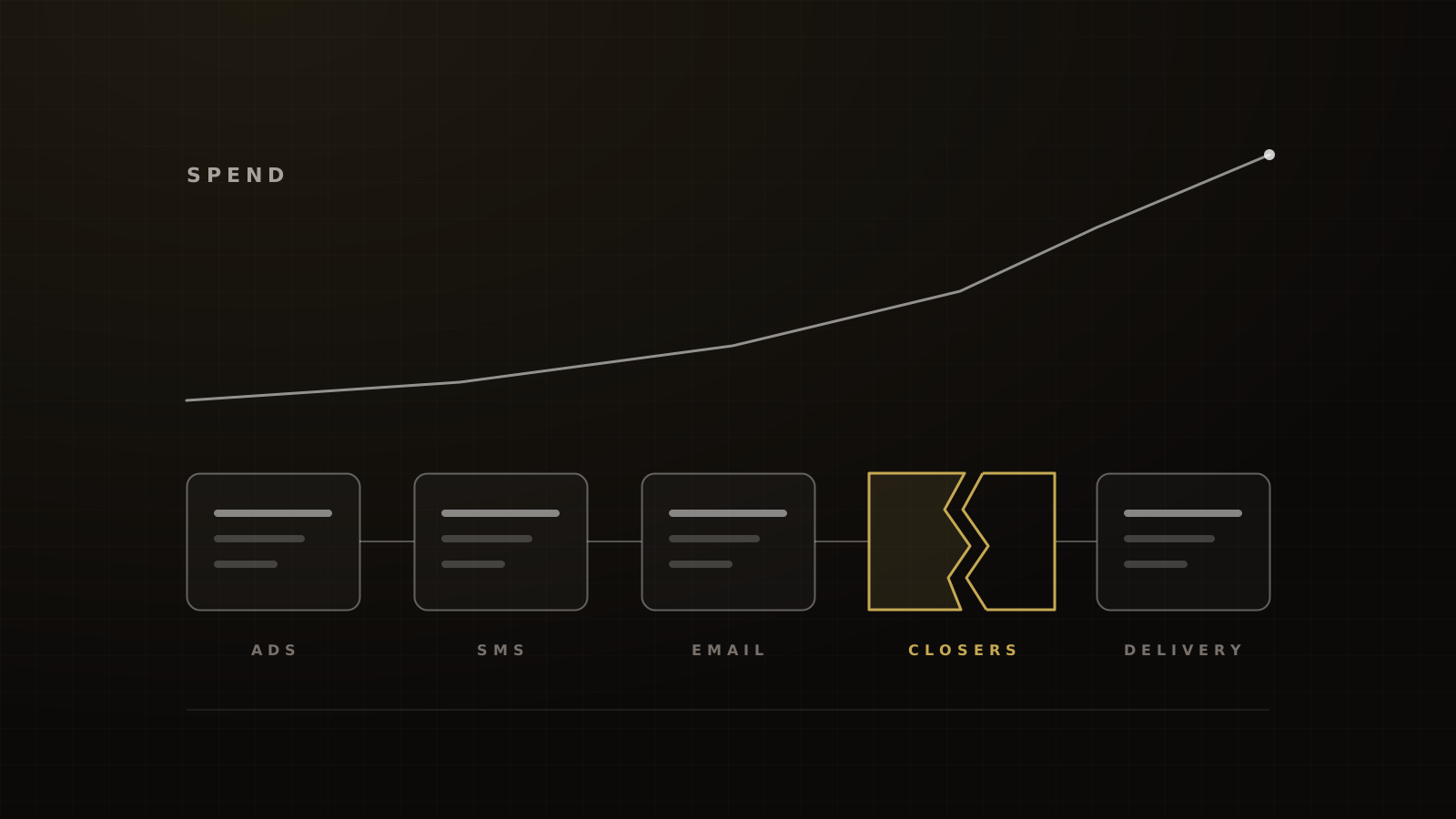
Who controls each stage of your funnel
Map the funnel and write a name next to each stage.
| Stage | Usually owned by | What decides it |
|---|---|---|
| Ads and creative | Agency | Offer, hooks, targeting, budget |
| Landing page and checkout | Agency or client | Copy, speed, friction |
| Speed to lead | Client's team, unless outsourced | Time to first dial |
| Sales calls | Client's closers, unless outsourced | Show rate, close rate |
| Financing and fulfillment | Client | Approval rates, refunds |
If the client's team owns the right-hand stages, a per-result deal asks the agency to carry risk it can't manage.
Speed to lead is a good test. On the funnels we run, our standard is a median time to first dial under an hour during staffed hours, with every lead dialed within 24 hours. In InsideSales' 2014 audit, the median first call among companies that called back at all came after 3 hours and 8 minutes.[8] Show rate is another. We hold booked high-ticket calls to an 82% to 88% show rate; RevenueHero's B2B average no-show is 15.9%.[9]
If the client's team owns those stages, paying the agency per case or per close makes the agency carry risk it can't manage. It will protect itself the only way it can: by chasing cheap results.
When one result is worth 100x another
Flat per-result deals assume every result is worth about the same. Often they aren't.
Take a hypothetical law firm paying an agency a flat fee per signed case. Most cases are worth around $2,000 to the firm. One in fifty is worth $200,000. The agency is paid the same for both, so the firm captures almost all the upside of the big case and the agency is paid for volume. Over time, the agency has every reason to optimize for whatever signs fastest, and the firm has every reason to resent the fee on small cases.
We've walked away from a flat per-result deal for exactly this reason, after one result turned out to be worth far more than the others.
The evidence for performance pay is thin
Among large advertisers, the ANA found 41% used performance incentives with their agencies in 2022, down from 48% in 2016 and 61% in 2013. Most said they didn't know whether the incentives improved agency performance.[10] That's big-brand data, but it's the best public evidence there is, and it doesn't make the case that tying fees to results reliably produces better results.
How to structure a pilot both sides can trust
"Can we test you first?" comes up on almost as many calls. The answer should be yes, with structure. A pilot without written criteria ends in an argument about what happened.
Pilot protocol
- Baseline. Record current opt-in, show, close and cash-collected numbers before anything changes. Start with an audit, so both sides agree what's broken.
- Scope. One offer, one channel, one funnel. Write down what's in and what's out.
- Definitions. What counts as a lead, a qualified lead, a booked call, a sale. Gross or net of refunds.
- System of record. One CRM or dashboard both sides can see. No reconciling two spreadsheets at the end.
- Ownership. Who runs each funnel stage during the pilot, including speed to lead and sales calls.
- Dispute window. How long either side has to challenge a number, and how it gets settled.
- Decision date. The day you decide to continue, change or stop, and the result that triggers each.
- Edge cases. Walk through the odd ones before you start: a refund after the pilot ends, a lead who buys three months later, an existing customer who comes through an ad.
Hormozi's advice to give an agency engagement a purpose and a deadline applies here. A pilot is that idea in contract form.
Questions to ask every proposal
- What does this model reward, and is that the behavior I want?
- Which funnel stages do you own, and which do I?
- How are results defined, measured and netted for refunds?
- Who works on my account week to week?
- Who owns the ad accounts, pixels, pages and CRM data if we part ways?
- What does the first 30 to 60 days look like, and what result means we stop?
How we run this at Victory
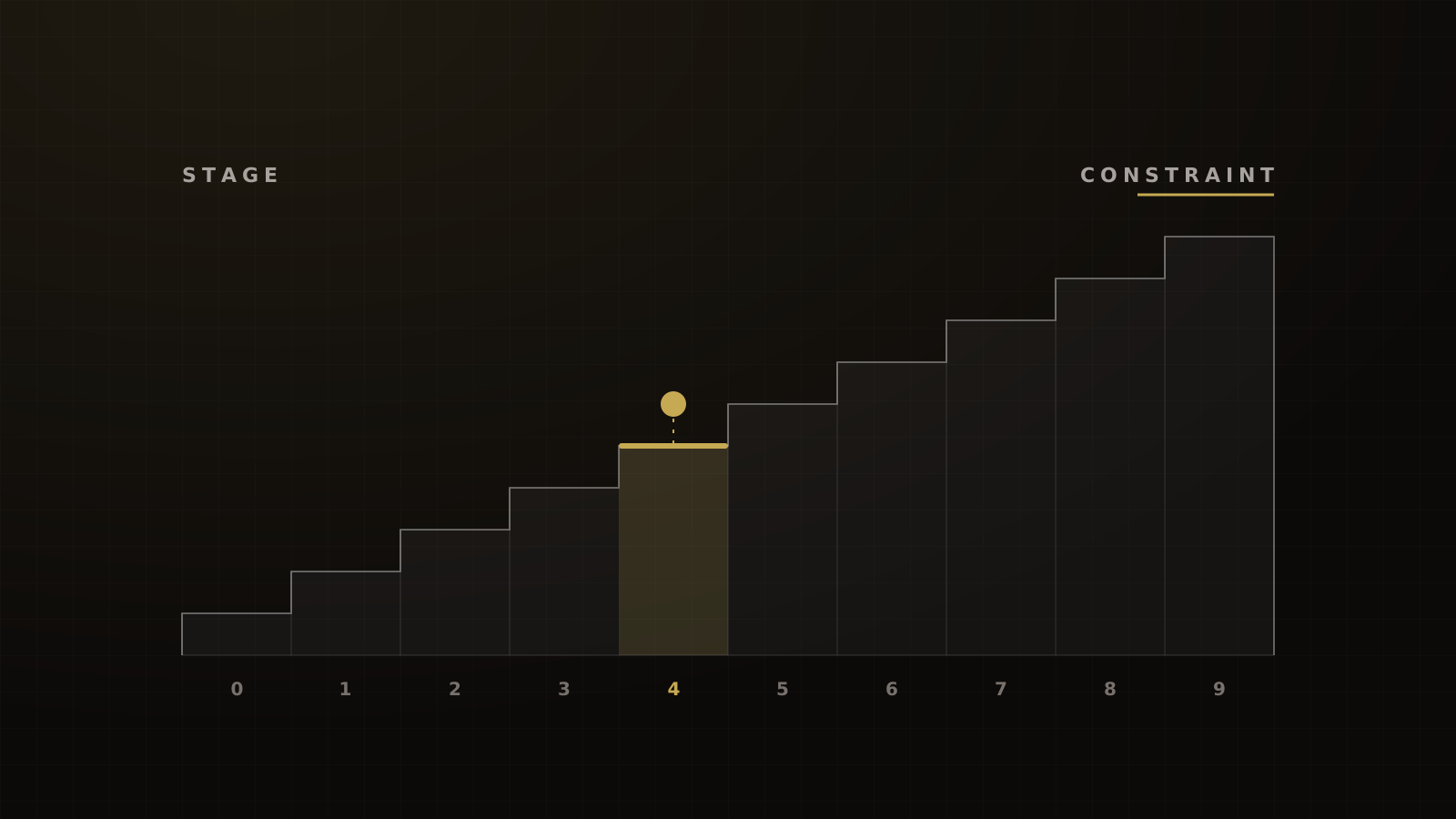
If you're weighing proposals, the bigger question is what your constraint is. Our scaling roadmap shows how to find it, and what breaks at $1M, $3M and $10M shows what tends to fail when spend goes up. Agencies that deliver more than the scope earn the next month; we cover how to do that profitably in the business case for over-delivering. Our acceleration session case shows why refund terms belong in any revenue definition. Or book a strategy call and we'll pressure-test your proposals with you.
Frequently asked questions
Sources
- 1.Client retention strategies for agencies. Promethean Research, 2026-07-03.
- 2.2024 Digital Agency Industry Report. Promethean Research, 2024-08.
- 3.Media Transparency Initiative (ANA / K2 Intelligence report). ANA / K2 Intelligence, 2016-06.
- 4.Visa Acquirer Monitoring Program (VAMP) fact sheet. Visa, 2025 (thresholds effective 2025-06-01).
- 5.Where agency revenue is heading: fewer big retainers, more mid-market retainers and longer engagements. SparkToro, 2026-01.
- 6.Pricing models follow agency archetypes. Promethean Research, 2026-03-31.
- 7.2022 Agency Pricing & Packaging Report. Sprout Social, 2022.
- 8.Annual 2014 Lead Response Report. InsideSales.com (XANT), 2014.
- 9.Ways to reduce no-show rates in sales calls. RevenueHero, 2025-08-18.
- 10.Trends in Agency Compensation. ANA, 2022-12-13.
- 11.Air AI and its owners will be banned from marketing business opportunities to settle FTC charges. Federal Trade Commission, 2026-03-24.
Written by
Devin AlexanderCo-Founder & CEO
Devin architects Victory's revenue systems: team structure, comp plans, scripts and the accountability frameworks that make sales floors predictable. He has generated more than $150M in sales and trained more than 250 closers.
Part of the guide: The 7-to-8-Figure Scaling Roadmap for Coaching, Info and Service Businesses