Which Scaling Stage Is Your Business In? A Diagnostic Checklist for Finding Your One Constraint
Count heads, not dollars, to find your scaling stage. Then run six yes/no checks to name the one constraint to fix first, and what to read next for each.
 Ray GillespieCo-Founder & COO
Published 9 min read
On this page
Key takeaways
- Count your team, not your revenue. Acquisition.com's Scaling Roadmap places a business in one of ten stages by headcount.[1]
- Then run six yes/no checks in order: demand, conversion, founder-led sales, delivery, retention and cash timing.
- The first check that fails is your constraint. Fix that one, and nothing else, then re-run the checklist in 30 days.
- Buying a stage-9 fix for a stage-3 problem is how founders lose a year.
- The checklist below maps each failed check to the specific fix and the article that covers it.
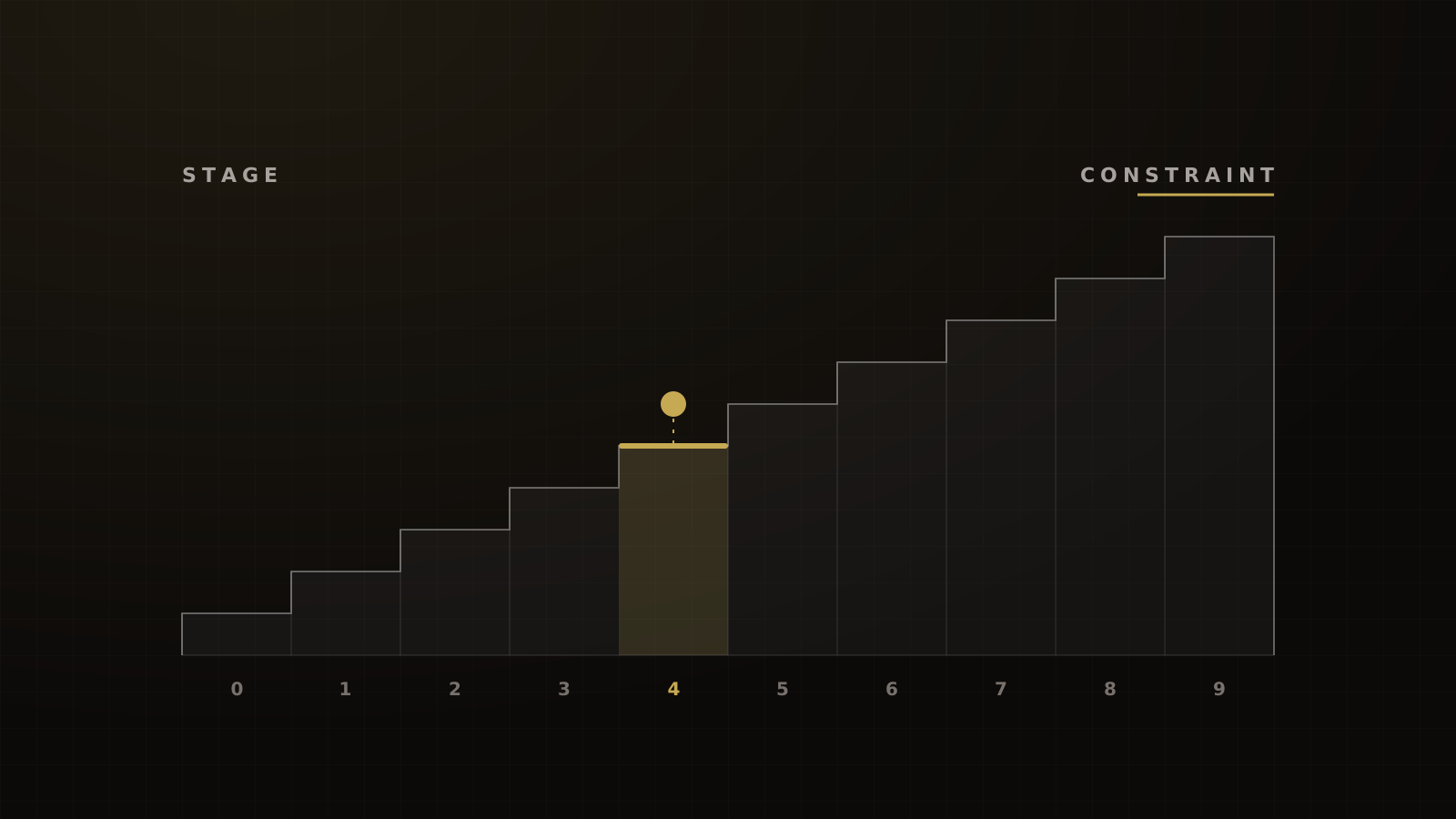
Count your team, not your revenue. Acquisition.com's $100M Scaling Roadmap places a business in one of ten stages by headcount, and each stage tends to have one main constraint.[1]
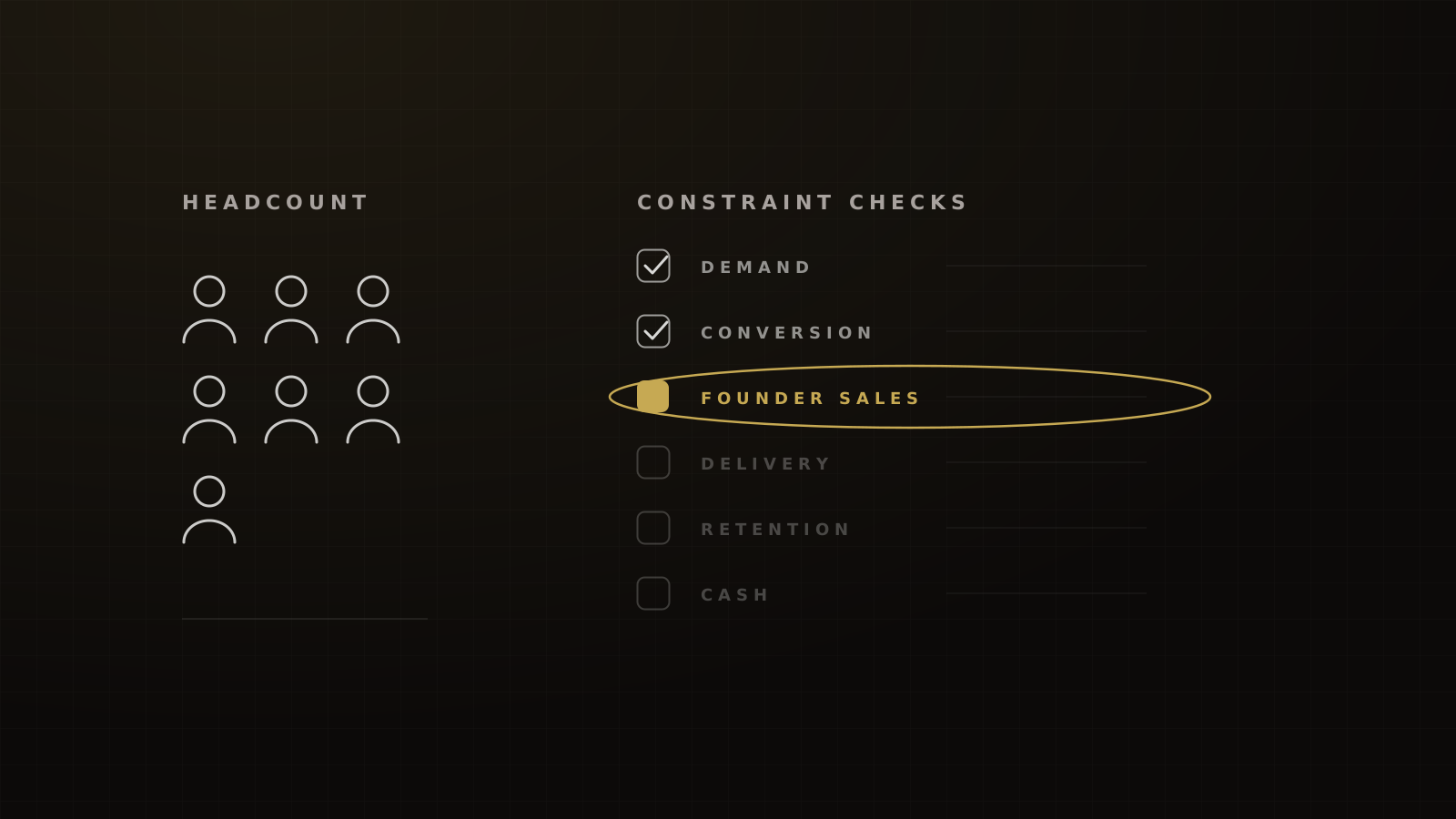
Then run six yes/no checks: demand, conversion, founder-led sales, delivery, retention and cash timing. Fix the first one that fails. Leave the rest alone until you've re-tested.
That's the whole method. The rest of this page is the checklist, the numbers we use to answer each question, and where to go next for each fix.
Why stage before strategy
Most founders don't lack ideas. They have too many. Every podcast, peer and vendor offers a fix, and most of those fixes are right for someone, just not at your size.
Acquisition.com frames its roadmap as a way to "solve the biggest constraint in your business at your size."[2] A nine-person business and a ninety-person business have different problems. Knowing your stage filters out most of the advice before you waste money on it.
The six checks then pick the one problem worth solving now. In the Fed's 2026 survey of US employer firms, 57% named reaching customers as a challenge, 46% named hiring and keeping staff, and 50% reported uneven cash flow.[3] Most businesses feel several at once. You can only fix one at a time well.
Step 1: find your stage (count heads, not dollars)
Count everyone who does the work every week, including full-time contractors. Then find your row. Stage names and bands are Acquisition.com's; the descriptions are ours.
| Stage | People | You're here if |
|---|---|---|
| 0 Improvise | 0 to 1 | Nobody is using it yet |
| 1 Monetize | 0 to 1 | People use it, but nobody has paid |
| 2 Advertise | 0 to 1 | You've sold, but new customers arrive unevenly |
| 3 Stabilize | 1 to 4 | Demand exists and you can't do it all yourself |
| 4 Prioritize | 5 to 9 | You serve too many kinds of customer |
| 5 Productize | 10 to 19 | You need more revenue from each customer |
| 6 Optimize | 20 to 49 | Things work, but inefficiently |
| 7 Categorize | 50 to 99 | Every system is overloaded |
| 8 Specialize | 100 to 249 | Nobody can know everything any more |
| 9 Capitalize | 250 to 500 | The next growth source isn't obvious |
Bands from Acquisition.com. The first three stages share the same 0 to 1 band, so solo founders should place themselves by what they've proven: someone using it, a first sale, then repeatable acquisition.
Most businesses are small by this measure. Among US employer firms in 2022, 63.0% had fewer than 5 employees, 16.2% had 5 to 9, 10.3% had 10 to 19 and 6.7% had 20 to 49 (our calculation from Census counts).[4] In our experience, most $1M to $3M coaching businesses sit in stage 3 or 4, and $3M to $10M service firms in stages 4 to 6. Revenue per head varies, so trust the headcount.
Step 2: run the six constraint checks
Answer each check with your own numbers, by offer and by channel. Run them in order, because a failure early in the list hides the ones after it. Our rule of thumb for each threshold is noted; where there's a public benchmark, it's beside ours.
Check 1: demand
- Do qualified leads arrive every week, not just during launches?
- Can you raise spend without cost per lead jumping?
- Do you have more than one channel producing leads?
- Is the ad account stable, not cycling in and out of learning?
The metric: cost per lead and volume by channel. On curiosity-led event opt-ins, our target cost per lead on cold Meta traffic is $15 to $25. LocaliQ's 2026 benchmark puts the all-industry average for Facebook lead campaigns at $27.39.[5] Meta ad sets need about 50 results a week to leave learning, so budgets too small to reach that stay unstable.[6]
If no: demand is your constraint. Start with paid ads for coaches and the demand section of our scaling roadmap.
Check 2: conversion
- Does your opt-in page convert at least 15% of cold Meta traffic?
- Do at least 35% of free one-day event registrants show up?
- Do at least 82% of booked sales calls show?
- Do your reminder texts and emails actually deliver?
The metric: opt-in, show and close rate. On the funnels we run, cold Meta traffic to a generic opt-in page converts at 15% to 22%; Unbounce's 2024 data puts Facebook-referred visitors at 13%.[7] A free one-day in-person event run well shows 35% to 45% of registrants. Booked high-ticket calls held within about three days show 82% to 88%; RevenueHero's B2B average no-show is 15.9%.[8] Check SMS volume against carrier caps too: T-Mobile limits daily texts per brand by trust score.[9]
If no: conversion is your constraint. Read what breaks at $1M, $3M and $10M and our guide to event show rates.
Check 3: founder-led sales
- Could revenue hold steady if the founder took two weeks off?
- Is the sales process written down well enough for someone else to run it?
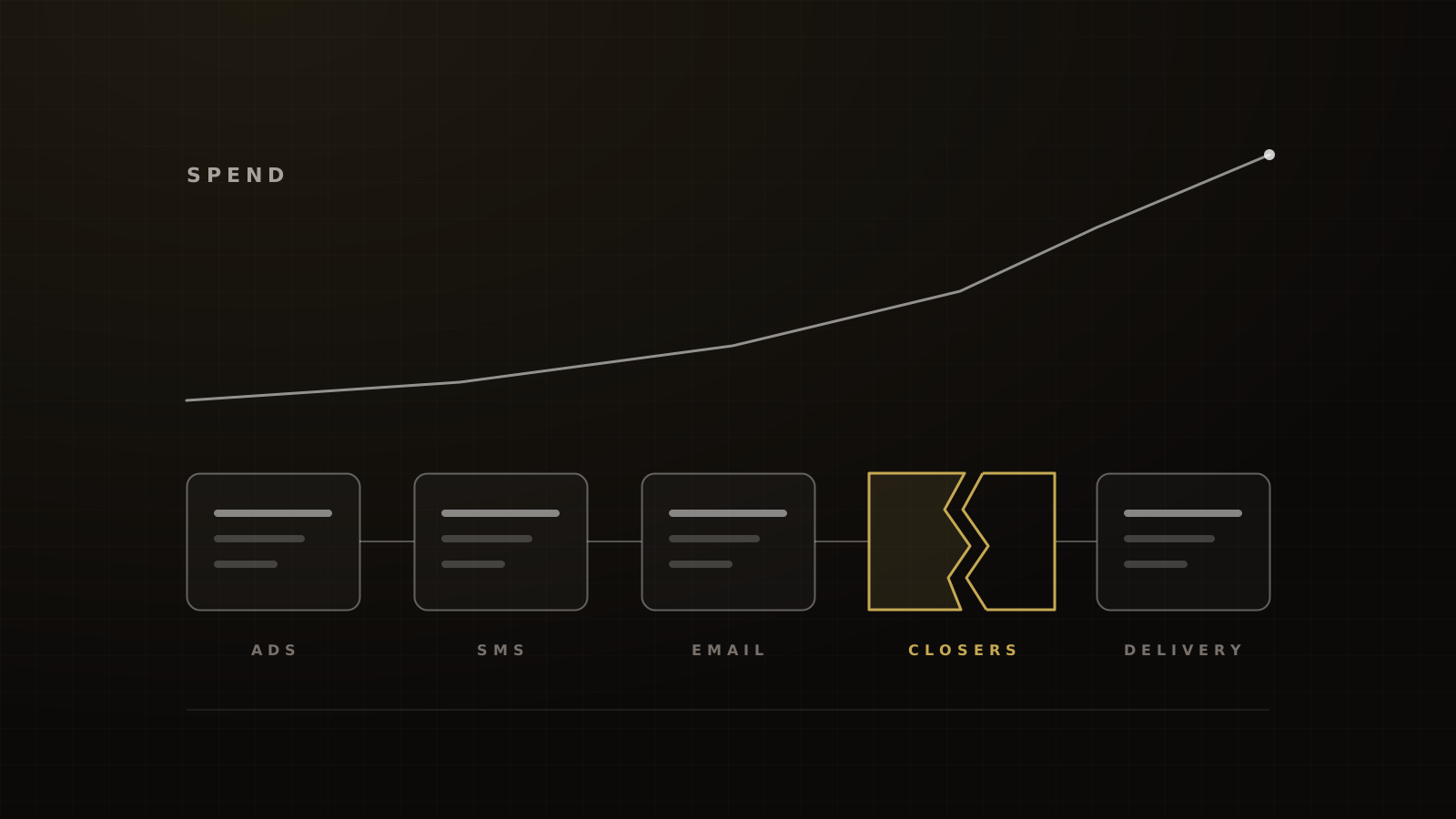
- Are closers' calendars below 75% to 80% of available slots?
- Are fewer than 20% of new leads still uncalled after 24 hours?
The metric: share of revenue closed by the founder, calendar fill and uncalled leads. Founder-led sales is common: SparkToro found 70% of agencies have no full-time sales staff.[10] It's a constraint only when the calendar is full and demand and conversion pass. Our rule is to add a setter at 75% to 80% fill with more than about 20% of leads uncalled after a day. When a closer takes over, our target is for a trained closer to reach 70% to 90% of the founder's close rate by day 60; there's no industry benchmark for that.
If no: founder-led sales is your constraint. Start with our guide to building a high-ticket sales team.
Check 4: delivery capacity
- Can new clients start within a week of buying?
- Is your delivery team below full utilization?
- Is rework and redo time falling, not rising?
- Do new clients reach a first win on schedule?
The metric: onboarding wait, utilization and time to first win. SPI Research's 2026 benchmark, via Deltek, found professional-services utilization fell to 66.4% in 2025, against the 75% SPI treats as optimal.[11] Teams near full utilization have no room for new sales.
If no: delivery is your constraint. Read the business case for over-delivering, which shows how to cut costly extras before you hire.
Check 5: retention
- Do most buyers finish the program?
- Do at least half of enrolled participants attend live calls?
- Are refunds and chargebacks falling, not rising?
- Do you track voluntary churn and failed payments separately?
The metric: completion, attendance, refunds and churn. Our target for live-call attendance in a paid challenge is above 50% of enrolled participants; in Circle's 2024 creator benchmark, 59% of top-tier creators saw event attendance above 50%, against 33% of others.[12] For paid 4 to 8 week cohorts we build, we target 50% to 60% completion; paid verified edX learners completed at 46% in 2017 to 2018.[13] Recurly splits voluntary and involuntary churn for a reason: the fixes differ.[14]
If no: retention is your constraint. Read how to build an online community and our course completion and retention statistics.
Check 6: cash timing
- Does gross profit collected in a customer's first 30 days cover the full cost of acquiring them, with room to spare?
- Can you fund next month's ad spend and payroll from cash already collected?
- Is your dispute ratio well under processor thresholds?
- Do you run a rolling 13-week cash view?
The metric: 30-day cash multiple and dispute ratio. Our target before raising spend is 30-day gross profit of at least 1.5x fully loaded acquisition cost. The well-known 3:1 lifetime value to acquisition cost ratio is David Skok's SaaS rule of thumb, not a coaching benchmark.[15] On event sales with a next-day kickoff, we target a dispute ratio under 0.5% of transactions; Visa classes a US merchant as "excessive" at 1.5% (with 1,500 or more cases a month) from April 2026.[16]
If no: cash timing is your constraint. Read LTV:CAC and 30-day cash.
Step 3: fix one thing, then re-run the checklist
This is Goldratt's Theory of Constraints applied to a service business. TOCICO teaches it as a loop that starts with defining the goal and the metric, then finding the constraint, getting the most from it, lining everything else up behind it, raising its capacity, and starting again.[17]
In practice:
- Pick the first failed check. Write down the one number you're moving.
- Change one variable at a time. As Devin puts it, "it's a scientific method." Two changes at once and you won't know which worked.
- Give it 30 days, or long enough to get a readable sample.
- Re-run all six checks. The constraint has probably moved.
Hormozi's More, Better, New in $100M Leads follows the same logic: do more of what works until it breaks, then fix the broken step, and only then try something new.
Common misdiagnoses
- A stage-9 fix for a stage-3 problem. An enterprise CRM migration, a COO or a brand campaign won't help a founder who is still the only closer.
- Hiring a closer for a demand problem. If calendars have open slots, the closer has nothing to close.
- Buying traffic for a conversion problem. If the page converts 1% to 2%, more clicks buy more bounces.
- Buying software for a people problem. A new tool won't fix a process nobody has written down.
- Reading blended numbers. One strong offer can hide a losing one. Run the checks per offer and per channel.
In our audits, the first constraint is more often conversion than lead volume. Founders arrive asking for more leads; the numbers point at the page, the show rate or the close rate.
Get the checklist
Copy this into a doc and answer it with your last 30 days of numbers. Stop at the first "no."
The one-constraint diagnostic
- Stage: I counted everyone doing the work weekly, and I know my stage.
- Demand: qualified leads arrive weekly, from more than one channel, at a stable cost per lead.
- Conversion: opt-in at least 15% on cold traffic, event show at least 35%, booked-call show at least 82%, reminders delivering.
- Founder-led sales: revenue holds without the founder on calls; calendars under 75% to 80%; under 20% of leads uncalled after 24 hours.
- Delivery: clients start within a week, the team has slack, first wins land on schedule.
- Retention: most buyers finish, live calls are at least half full, refunds and disputes are falling.
- Cash timing: 30-day gross profit is at least 1.5x fully loaded acquisition cost, and next month is funded from cash collected.
- Next step: my first "no" is the constraint. I'm fixing only that, and re-running this list in 30 days.
If you'd rather have someone run the checks with you, book a strategy call. You'll leave with your constraint named and a prioritized plan.
Frequently asked questions
Sources
- 1.The $100M Scaling Roadmap: stages by headcount. Acquisition.com, accessed 2026-10-04.
- 2.Scaling Roadmap (product page). Acquisition.com, accessed 2026-10-04.
- 3.2026 Report on Employer Firms: Findings from the 2025 Small Business Credit Survey. Federal Reserve Banks, 2026-03-03.
- 4.2022 SUSB annual data tables, detailed employment sizes. US Census Bureau, 2022 data (released 2025).
- 5.Facebook advertising benchmarks. LocaliQ / WordStream, 2026-09-23.
- 6.About the learning phase. Meta Business Help Center, accessed 2026-10-04.
- 7.Conversion Benchmark Report. Unbounce, 2024-08-29.
- 8.Ways to reduce no-show rates in sales calls. RevenueHero, 2025-08-18.
- 9.T-Mobile daily message limits for long code messaging with A2P 10DLC. Twilio Help Center, accessed 2026-10-04.
- 10.Digital agency new business is still a concern, referrals still rule for lead gen. SparkToro, 2026-02-17.
- 11.Professional services benchmarks (summarizing SPI Research's 2026 PS Maturity Benchmark). Deltek, 2026-07-30.
- 12.2024 Community Benchmark Report: Creators. Circle, 2024.
- 13.Study offers data to show MOOCs didn't achieve their goals (reporting Reich and Ruipérez-Valiente, Science). Inside Higher Ed, 2019-01-16.
- 14.Subscriber benchmarks. Recurly Docs, accessed 2026-10-04.
- 15.Startup Killer: the cost of customer acquisition. David Skok, For Entrepreneurs, c. 2009.
- 16.Visa Acquirer Monitoring Program (VAMP) fact sheet. Visa, 2025 (thresholds effective 2025-06-01).
- 17.Introduction to the Theory of Constraints. TOCICO, accessed 2026-10-04.
Written by
Ray GillespieCo-Founder & COO
Ray runs day-to-day operations across every Victory engagement, building the systems, automations and AI-powered workflows that hold the machine together. He has overseen operations behind more than $120M in revenue.
Part of the guide: The 7-to-8-Figure Scaling Roadmap for Coaching, Info and Service Businesses