Why Your Business Is Stuck at 7 Figures: What Breaks at $1M, $3M and $10M (and How to Stress-Test It First)
Seven-figure businesses stall when the systems behind the ads break. What fails at $1M, $3M and $10M, and the one-week stress test to run first.
 Ray GillespieCo-Founder & COO
Published 9 min read
On this page
Key takeaways
- Most seven-figure businesses don't stall for lack of leads. They stall because the systems behind the ads break when spend goes up.
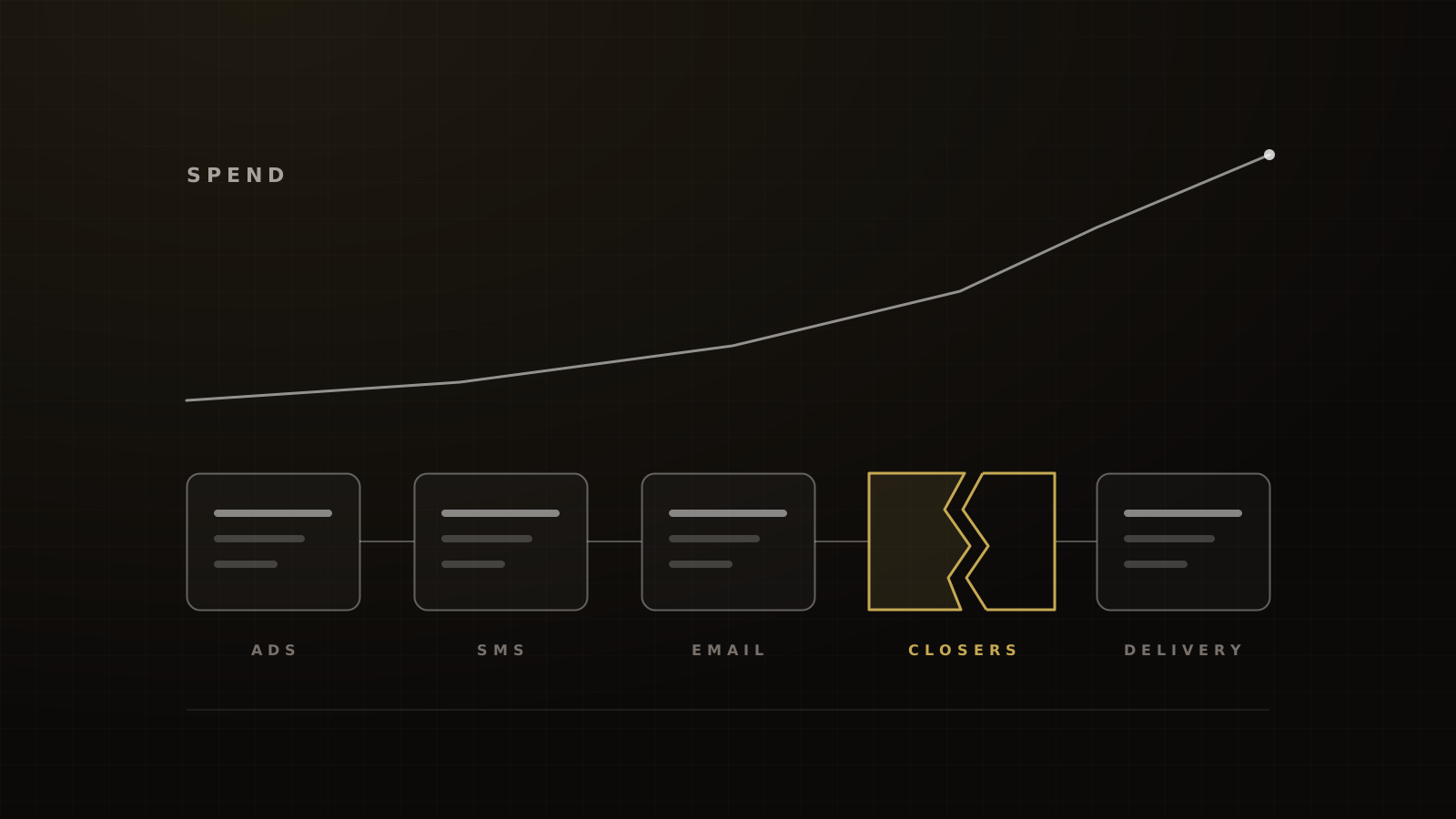
- Five systems fail first: the ad account, SMS reminders, email reminders, closer capacity and fulfillment. Each has a platform rule or a capacity limit you can check in advance.
- Meta ad sets leave learning after about 50 results in a week, and big budget jumps can send them back.[1][2]
- T-Mobile caps daily texts per brand by trust score, shared across every platform you text from.[3]
- Run a one-week stress test at the planned daily spend before you scale. If you already spent big and didn't make it back, scale down to profitable and rebuild from capacity.
Most seven-figure businesses don't stall for lack of leads. They stall because the systems behind the ads break when spend goes up.
Ad costs rise while Meta relearns. Reminder texts hit carrier caps. Email starts landing in spam. Closers' calendars overflow. Fulfillment slips and refunds follow. Each one quietly lowers the return on every extra dollar.
The fix is to break those systems on purpose, at a small budget, before the money goes in. Here is what tends to break at each size, the five systems to test, and the one-week stress test we run.
You're not stuck for lack of leads
Founders name demand first. In the Federal Reserve's 2026 survey of US employer firms, 57% said reaching customers and growing sales was an operational challenge.[4] It's the number one answer.
It's also the easiest diagnosis to get wrong. When a client tells us "the ads aren't working," we often find a page converting 1% to 2% of clicks, or a reminder sequence that stopped sending, or calls booked two weeks out that never show. The leads arrived. The system dropped them.
The stakes are real because the climb is steep. In 2022, about 30.2% of US employer firms had receipts of $1M or more, and about 4.5% had $10M or more (our calculation from Census counts).[5] Most of the businesses that reach the first number don't reach the second.
What breaks at $1M, $3M and $10M
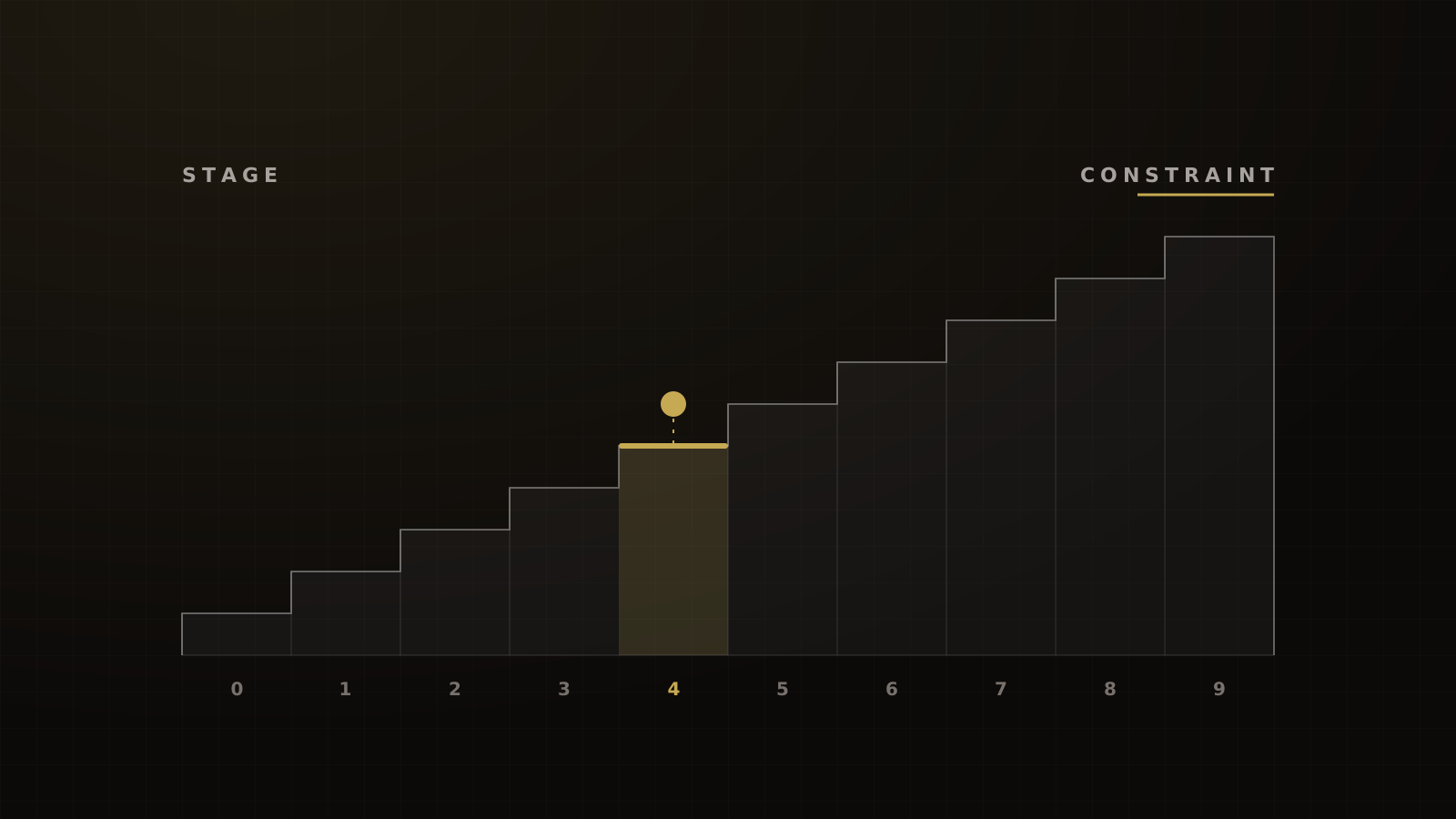
The revenue bands below are illustrative. Headcount is the better ruler, so we map each band to the stages in Acquisition.com's $100M Scaling Roadmap.[6] Our scaling roadmap covers the full map.
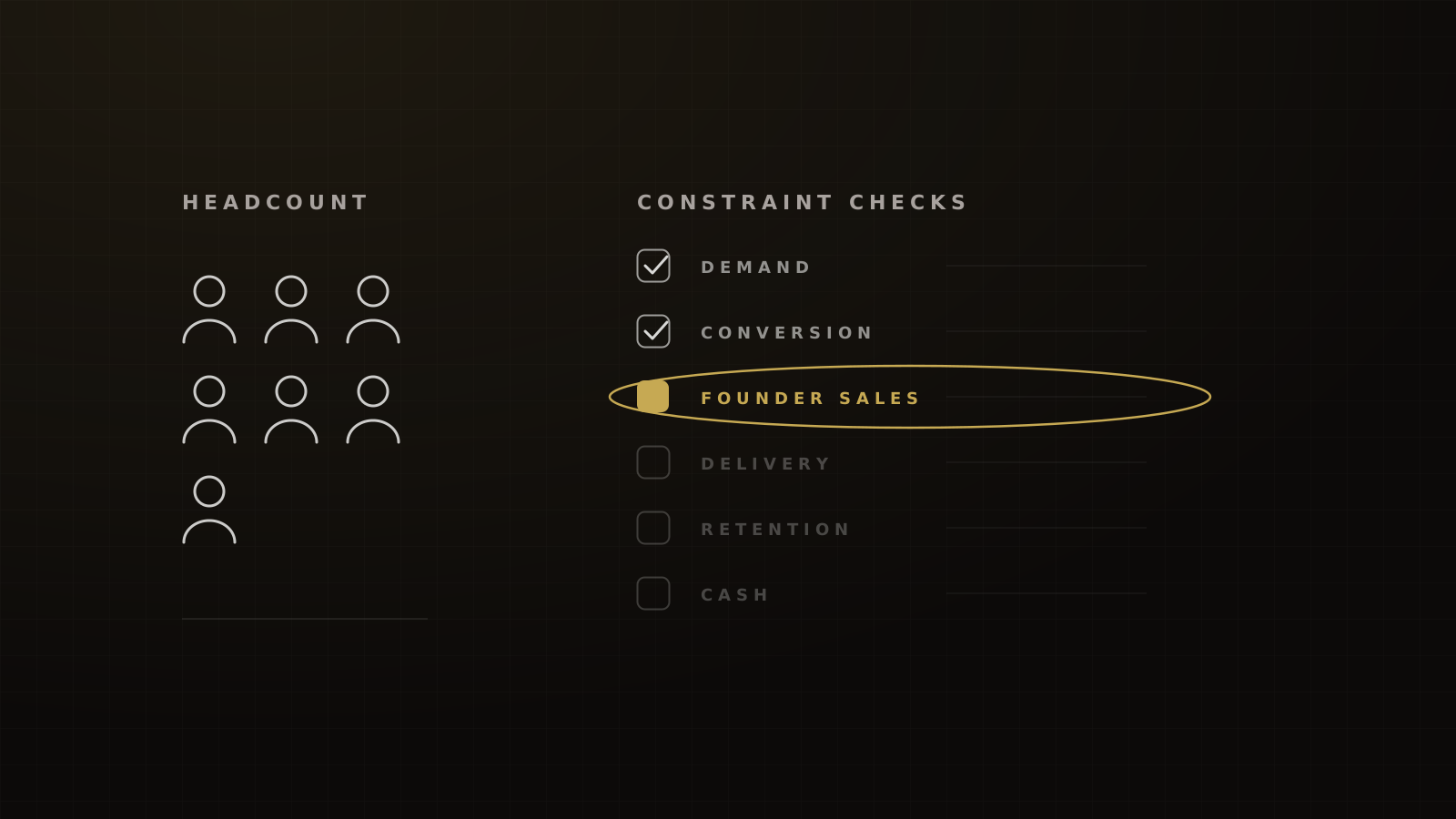
Around $1M: the founder is the sales team and the CRM (stages 3 to 4)
At this size the founder closes most deals, remembers most follow-ups and holds the process in their head. Lead tracking lives in a mix of a CRM, a spreadsheet and a phone.
What breaks: follow-up. When leads double, the founder can't call them all, and nothing else does. Leads go cold in the gap between the form and the first call.
Around $3M: reminders, deliverability and closer capacity (stages 4 to 5)
Now there's a small team and real volume. Reminder texts and emails go out by the thousand. A few closers share a calendar.
What breaks: the messaging and the calendar. A reminder blast trips a carrier limit or a spam filter, and show rate falls for reasons nobody sees in the ad account. Closers fill every slot, so follow-up stops. Our rule is to add a setter only when closers' calendars are at 75% to 80% and more than about 20% of new leads are still uncalled after 24 hours.
Around $10M: ad-account stability, handoffs and cash timing (stages 5 to 6)
Spend is large enough that every budget change moves results. Several teams touch each lead. Launches commit cash weeks before it comes back.
What breaks: stability and timing. A budget jump resets learning across campaigns. Handoffs between marketing, setters, closers and onboarding drop context. And booked revenue runs ahead of cash. JPMorganChase Institute puts the median small business's cash buffer at 17.6 days of outflows in 2025.[7] One slow-collecting launch can eat that.
The five systems that fail when spend goes up
The systems that support the ad spend, they get stressed and they break.
1. The ad account
Meta ad sets exit the learning phase after about 50 results in the week after the last significant edit. While learning, performance is less stable and cost per result is usually higher.[1]
Budget changes count as edits depending on size. Meta's own example: $100 to $101 a day is unlikely to reset learning, while $100 to $1,000 may.[2] Meta gives no percentage threshold, so we raise budgets in steps and let each one settle.
The market is also moving against you. Triple Whale's data on 40,000+ brands shows median Meta CPM up 13.24% year over year to $15.06.[8] Metricool's 2026 report has Meta cost per lead up 14% to $6.00 worldwide.[9] One useful exception: e-learning and online courses was the only Triple Whale category where CPM fell, by 6.61%.[8]
Timing can break a funnel as easily as budget. On a weekly evening webinar we run, ads go live only in the two days before each session, and our best cost per registration there is $4 to $5. When ads ran two weeks out instead, cost per registration rose and show rate fell. More time in market made it worse.
2. SMS reminders
US carriers cap texts. T-Mobile limits daily A2P 10DLC messages per brand (per EIN) by trust score, from 2,000 a day at the lowest score to 200,000 at the highest, and 1,000 a day for sole proprietors. The cap is shared across every platform texting for that EIN. Messages over it fail until midnight Pacific.[3]
Throughput is set per campaign and shared across its numbers, so adding phone numbers doesn't add capacity.[10] A reminder that worked at 2,000 registrants can fail outright at 20,000.
Lists also decay. In our experience, on lists texted for years without validation, only about 40% to 45% of raw contact records end up as unique, SMS-capable numbers after dedupe and line-type checks. After we fix sending (paced drips, trigger links on the brand's own domain, a registered number), delivery comes back to 95% or better. Our SMS carrier-filtering post-mortem shows the fix.
3. Email reminders
Bulk-sender rules kick in at volume. Gmail requires senders of 5,000+ messages a day to use SPF, DKIM and DMARC, offer one-click unsubscribe, and keep spam rates below 0.3%, aiming for under 0.1%.[11] Yahoo adds honoring unsubscribes within 2 days.[12] Outlook.com has required SPF, DKIM and DMARC for 5,000+ a day since May 5, 2025, with failing mail sent to junk or rejected.[13]
Even senders who test lose mail. Validity's 2026 benchmark puts global inbox placement at 87.2%.[14] On domains we manage after remediation, we target 90%+ inbox placement on seed tests and keep Gmail user-reported spam under 0.1%.
4. Closer capacity
Closers run out of time before they run out of leads. Salesforce's 2026 State of Sales found sellers spend 40% of their time selling.[15]
Our working assumption is that one full-time closer holds 4 to 6 high-ticket calls a day at 80% fill. We cap calendars at 75% to 80% so there's room for follow-up. Push past that and the calls still happen, but the second and third touches don't.
Speed suffers too. The 2007 Lead Response Management study found the odds of qualifying a web lead were 21 times higher when it was called within 5 minutes rather than 30.[16] That's qualification, not sales, and it's old. The direction is why our standard is a median first dial under an hour during staffed hours, with every lead dialed within 24.
5. Fulfillment
When sales jump, onboarding queues grow. New clients wait for a kickoff, the first win slips, and refunds and chargebacks follow. The cheapest fix we know is starting fulfillment the day after the sale; the play is in our acceleration session case.
The pre-scale stress test (run it in a week)
Hormozi's More, Better, New sequence in $100M Leads puts it plainly: "So you do more and more… until it breaks. Then, you make it better." The stress test makes the break happen at a small budget instead of a big one.
Run it for 7 days at the planned daily spend on a capped audience, or until the campaign has about 50 optimization events, Meta's learning-phase exit.[1]
Pre-scale stress test
- Ad account. Run at the target daily budget for 7 days or about 50 optimization events. Log cost per result daily and note any learning resets.
- CRM load. Push test leads through every form, tag and workflow at target volume. Check that routing, tags and notifications still fire.
- SMS. Send the reminder sequence to target volume in paced batches. Check delivery by error code. Compare planned daily volume with your T-Mobile cap.
- Email. Seed-test the reminder emails. Confirm SPF, DKIM and DMARC pass and one-click unsubscribe works.
- Closer capacity. Project booked calls at target spend. If calendars pass 75% to 80%, add capacity or cap spend.
- Speed to lead. Measure median time to first dial during the test. If it's over an hour, fix staffing before scaling.
- Fulfillment slots. Count onboarding slots for the sales you're projecting. Book kickoffs before you sell them.
- Cash runway. Model platform usage, ad spend and refunds against cash collected. On the event funnels we run, messaging and platform usage runs 1.5 to 3 times the HighLevel plan fee in launch months.
If something breaks, that's the test working. Fix it, then run the test again before you add spend. Our scaling stage diagnostic helps you decide which break to fix first.
Spent big and didn't make it back? The revenue-first rebuild
This is one of the most common calls we take. A launch spent heavily, booked a lot, and collected less than it cost.
Don't keep spending to find out why. Rebuild from the back end forward:
- Scale down to profitable. Cut spend to the last level where cash collected beat acquisition cost. Then scale back up from there, in steps.
- Start from capacity. How many calls can your closers take at 75% to 80% of their calendars? How many clients can delivery onboard this month? That's your ceiling.
- Work backwards to spend. Divide capacity by pessimistic show and close rates to get the leads you need, then the budget to buy them. Use your worst recent week, not your best.
- Judge the front end on the back end. Our target for a self-liquidating front end at scale is 0.8 to 1.2x return on ad spend, judged on what it costs to acquire a back-end customer.
- Gate every increase on 30-day cash. We raise spend only when gross profit collected in the first 30 days is at least 1.5x fully loaded acquisition cost. That's a target we hold, not a guarantee. The math is in our guide to LTV:CAC and 30-day cash.
How we run this at Victory
If you're paying an agency to scale, check that its fee model rewards the back end too; we compare the options in how growth agencies charge. For the ad side, start with our guide to paid ads for coaches. Want us to find your break before the budget does? Run the free Revenue Leak Diagnostic, or book a strategy call.
Frequently asked questions
Sources
- 1.About the learning phase. Meta Business Help Center, accessed 2026-10-04.
- 2.Significant edits and the learning phase. Meta Business Help Center, accessed 2026-10-04.
- 3.T-Mobile daily message limits for long code messaging with A2P 10DLC. Twilio Help Center, accessed 2026-10-04.
- 4.2026 Report on Employer Firms: Findings from the 2025 Small Business Credit Survey. Federal Reserve Banks, 2026-03-03.
- 5.2022 SUSB annual data tables by enterprise receipts size. US Census Bureau, 2022 data (released 2025).
- 6.The $100M Scaling Roadmap: stages by headcount. Acquisition.com, accessed 2026-10-04.
- 7.San Francisco small business snapshot (national median cash buffer days). JPMorganChase Institute, 2026-05-28.
- 8.Facebook ad benchmarks by industry. Triple Whale, 2026-08-17 (updated).
- 9.Metricool 2026 Social Ads Report (press release). Metricool, 2026-09-21.
- 10.Message throughput (MPS) and trust scores for A2P 10DLC in the US. Twilio Help Center, accessed 2026-10-04.
- 11.Email sender guidelines. Google Workspace Admin Help, 2024-02-01 (effective).
- 12.Sender best practices. Yahoo Sender Hub, 2024-02 (effective).
- 13.Strengthening the email ecosystem: Outlook's new requirements for high-volume senders. Microsoft Defender for Office 365 Blog, 2025-04-02 (updated 2025-04-29).
- 14.2026 Email Deliverability Benchmark Report. Validity, 2026-03.
- 15.State of Sales report, 7th edition. Salesforce, 2026-02-03.
- 16.Lead Response Management Study. James Oldroyd (MIT) and InsideSales.com, 2007.
Written by
Ray GillespieCo-Founder & COO
Ray runs day-to-day operations across every Victory engagement, building the systems, automations and AI-powered workflows that hold the machine together. He has overseen operations behind more than $120M in revenue.
Part of the guide: The 7-to-8-Figure Scaling Roadmap for Coaching, Info and Service Businesses