The Acceleration Session: How a Next-Day Kickoff Cut Refunds and Buyer's Remorse After a Live Event
Buyer's remorse grows in the gap between paying and getting a result. How a live-event company closed it with a buyers-only kickoff the next day.
 Devin AlexanderCo-Founder & CEO
Published 9 min read
On this page
Key takeaways
- Refunds and buyer's remorse start in the gap between paying and getting a result. The fix is timing, not policy wording.
- A live-event company closed that gap with a buyers-only "acceleration" session the day after the event. The team says refunds and chargebacks almost disappeared.
- It works because the first days decide engagement, and because paying doesn't make people show up.[1][2]
- Broadcasting the session to registrants who missed the event turns the same day into a second sales window.
- Measure dispute ratios against the card-network lines. Visa's US merchant line is 1.5% from April 2026, but acquirers are flagged at 0.5%.[3]
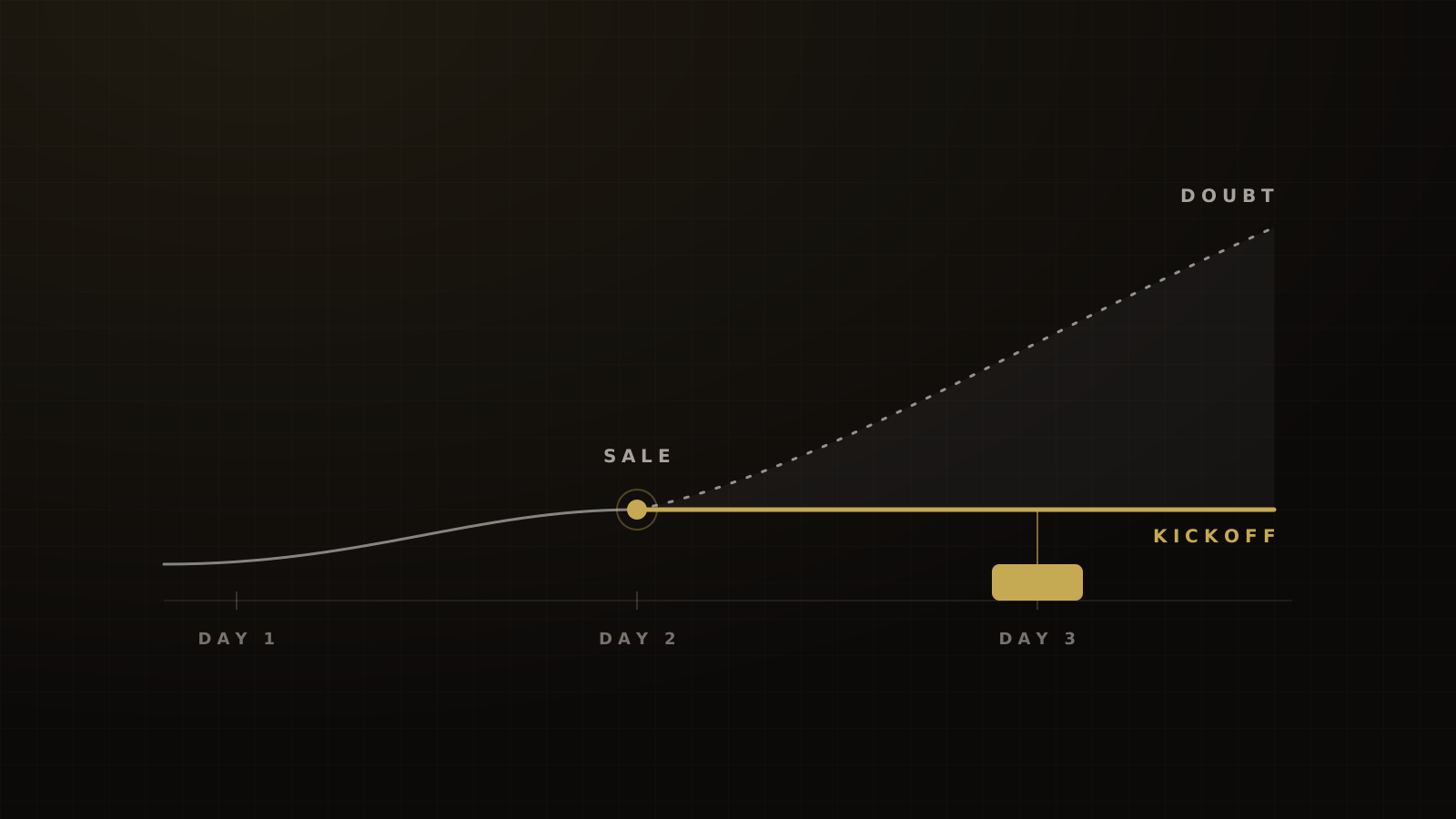
Buyer's remorse grows in the gap between paying and getting a result. The longer a new buyer waits for something to happen, the more time they have to doubt the decision.
A live-event company closed that gap. It added a buyers-only session the day after the event, so fulfillment started within 24 hours of the sale. The team says refunds and chargebacks almost disappeared.
It also broadcast the same session to people who registered but didn't come, which turned the day after the event into a second sales window. Here's the structure, why it works and what to measure.
The problem: refunds start in the gap after the sale
Most refund advice is about policy: clearer terms, better checkout copy, a recognizable statement descriptor. Those matter. But they treat the refund as a paperwork problem.
On high-ticket event sales, the refund usually starts on the drive home. The buyer made a big decision in a room full of energy. Then the energy is gone, the card statement arrives, and the program hasn't started yet. Nothing has happened to prove the decision was right.
That gap is where we put the work. Fill it with a result, and the doubt has nothing to grow in.
The case: a live-event company adds a next-day kickoff
The company ran a three-day rhythm:
- Friday: a webinar that fed registrations into the event.
- Saturday: the live event, with the main offer presented from stage.
- Sunday: a new "acceleration" session, for buyers only, the morning after the sale.
The point of the change was simple: every buyer in a working session within 24 hours of paying, before doubt had time to set in.
Completely eliminated pretty much all of the churn and the chargebacks.
Ray put it the same way from the operations side: the Sunday session "completely wipes out any buyer's remorse."
That's the team's read, not a published dataset. We haven't released the before-and-after refund rates, and we won't put a number on it until we can show it by purchase cohort.
Why it works
Fulfillment starts while commitment is highest
Alex Hormozi's value equation says perceived value rises as the time before a buyer sees a result shrinks. His case for fast wins in $100M Offers is the same idea applied to delivery: give buyers something that works early, because a quick win does more for retention than a big promise later.
The next-day session is that fast win on a fixed schedule. It runs while the buyer still remembers exactly why they bought.
The first days decide engagement
The research on online courses points the same way. In Katy Jordan's study of 221 MOOCs, the first two weeks were critical for engagement, and longer courses lost more people.[1] In product data, Amplitude found that 69% of the top performers on day-seven activation were also top performers on three-month retention.[4] That's digital products and correlation, not refunds. The pattern still holds: early activity predicts who stays.
Commitment matters, too. In Coursera's first paid Signature Track class, 74% of paying students finished, against 9% of everyone else.[5] Buyers come in committed. The job is to use that commitment before it fades.
Paying isn't using
A purchase doesn't guarantee attendance. In DellaVigna and Malmendier's study of 7,752 gym members, people on flat monthly contracts of more than $70 went 4.3 times a month, paying more than $17 a visit when a $10 pass existed.[2] They paid for the version of themselves who would go.
Your buyers do the same. The acceleration session gets them in the room on day one, before the version of themselves who doesn't go takes over.
Prevention beats recovery
Fixing a bad experience after the fact helps less than it seems. A meta-analysis of service recovery studies found that a good recovery raises satisfaction, but has no significant effect on repurchase intent or word of mouth.[6] A refund call you handle well still costs you the customer. It's cheaper not to need it.
The run of show
Framework
The next-day acceleration session
- Before buyers leave the event. Every buyer gets the kickoff time, the access link and a named contact, in writing, before they go home.
- That evening. A welcome text and email from a real person, plus a call. On the funnels we run, the first dial to a new buyer happens in under an hour during staffed hours, and every buyer is reached within 24 hours.
- The next morning, 90 minutes to three hours. A live, buyers-only session hosted by the founder or lead coach. No selling.
- One concrete first win. Pick the task that makes the program feel real fastest: a plan built, a first asset shipped, a first number measured. Everyone leaves with it done.
- The roadmap. Show what happens in weeks one to four, when the next calls are and who to contact.
- The no-show broadcast. Send the session, or a cut of it, to registrants who missed the event, with the offer and a firm deadline.
Victory's run of show for post-event onboarding. Fast-win principle credited to Alex Hormozi's value equation in $100M Offers.
A few rules we hold to:
- Keep it buyers-only. The room should feel like the start of the program, not a second pitch.
- Make the win concrete. "Get clear on your goals" isn't a win. A finished first draft is.
- Chase the absentees. Buyers who miss the kickoff are the refund risk. Our target for rebooking sales-call no-shows is 30–40% within 48 hours, and we hold missed kickoffs to the same standard.
The second sales window
The broadcast to no-shows isn't an afterthought. In our experience, 30–50% of a webinar's sales close after the live session, during the replay and follow-up window. There's no industry benchmark for that; it's our rule of thumb. A next-day session gives registrants who missed the event a reason to watch, and a real deadline to act on.
If the event sold a paid VIP tier, the VIP group is usually the warmest audience in the follow-up too. Our event marketing and show-rate guide covers how we fill the room in the first place.
What to measure
Track these by purchase cohort, from the first event you run with a kickoff:
The post-event scorecard
- Refund rate. Refunds divided by sales, at 7, 14 and 30 days.
- Dispute ratio. Chargebacks divided by transactions, monthly, against your processor's thresholds.
- Kickoff attendance. Buyers who attended the session divided by buyers.
- First-win completion. Buyers who finished the day-one task.
- Time to first contact. Minutes from purchase to the first call.
- No-show conversion. Purchases from the broadcast divided by registrants who missed the event.
The dispute ratio is the one that can shut down your payments. Visa's monitoring program flags US merchants as "Excessive" at a fraud and dispute ratio of 1.5% from 1 April 2026, down from 2.2%, with at least 1,500 monthly fraud and dispute cases. It flags acquirer portfolios at 0.5% and 0.7%, which is why processors police merchants well below the merchant line.[3] Stripe's documentation of Mastercard's program puts its first excessive tier at 100 to 299 chargebacks and a 1.5%–2.99% chargeback rate in a month.[7]
Our target on event sales with a next-day kickoff is a dispute ratio under 0.5% of transactions, the acquirer line, not the merchant one.
For context, Sift's network chargeback rate rose from 0.21% to 0.26% between Q3 2024 and Q3 2025.[8] Teachable reported 0.18%–0.20% for creators on its native payments in 2021.[9] Neither is a coaching benchmark, and no method-disclosed coaching refund rate exists that we could find.
Fix the paperwork too. In Chargebacks911's survey of 1,200+ US and UK cardholders, 39.49% said confusing statement descriptions often made charges hard to recognize, and 48.28% had gone straight to their bank to dispute.[10] Make your descriptor match the brand name buyers saw on stage, and put a support contact on every receipt.
Two numbers to stop repeating. Industry tables listing "education 4.79%" as an average chargeback rate give no sample, period or source.[11] And "75% of chargebacks are friendly fraud" has no Visa original we could find. Visa itself says friendly fraud is about 20% of fraudulent disputes, up to 30% for high-volume online merchants.[12]
Refunds, guarantees and the rules
Hormozi's approach to guarantees fits the kickoff well: make a guarantee conditional on actions the buyer controls, such as attending the session and finishing the first week's work. It protects buyers who do the work, and it tells everyone on day one what doing the work means.
Choose your payment partners with disputes in mind too. A processor or financing partner that sides with the buyer by default on every chargeback will cost you more than its fees suggest. Ask how they handle disputes before you sign.
Where this fits
The acceleration session is over-delivery placed where it pays back fastest. For how to design extras that stay profitable, see the business case for over-delivering. For why refunds hit cash harder than booked revenue suggests, see LTV:CAC and 30-day cash. If you're comparing how agencies get paid for work like this, our breakdown of growth agency pricing models explains what each model rewards. And for the wider plan, start with the scaling roadmap.
If your events sell well and then leak refunds, book a strategy call and we'll map your first 24 hours with you.
Frequently asked questions
Sources
- 1.Massive open online course completion rates revisited: assessment, length and attrition. Katy Jordan, International Review of Research in Open and Distributed Learning 16(3), 2015-06-19.
- 2.Paying not to go to the gym. DellaVigna and Malmendier, American Economic Review 96(3), 2006-05.
- 3.Visa Acquirer Monitoring Program (VAMP) fact sheet. Visa, 2025.
- 4.The 7% retention rule explained. Amplitude, 2025-09-30.
- 5.Retention and intention in massive open online courses: in depth. Koller, Ng, Do and Chen, EDUCAUSE Review, 2013-06-03.
- 6.Service recovery paradox: a meta-analysis. de Matos, Henrique and Rossi, Journal of Service Research 10(1), 2007-08.
- 7.Dispute and fraud card monitoring programs. Stripe Documentation, accessed 2026-10-04.
- 8.New Q3 2025 data available in Sift's Fraud Industry Benchmarking Resource. Sift, 2025-10.
- 9.Chargeback and risk detection on Teachable. Teachable, 2021-04-16.
- 10.Cardholder Dispute Index. Chargebacks911, 2025.
- 11.Chargeback rates by industry. PayCompass, 2026-04-21.
- 12.Friendly fraud explained: prevention and solutions. Visa, accessed 2026-10-04 (undated).
- 13.FTC sues to stop Air AI from using deceptive claims about business growth, earnings potential, and refund guarantees. Federal Trade Commission, 2025-08-25.
- 14.Air AI and its owners will be banned from marketing business opportunities to settle FTC charges. Federal Trade Commission, 2026-03-24.
- 15.FTC proposes rule changes and new rule to deter deceptive earnings claims by multilevel marketers and money-making opportunity sellers. Federal Trade Commission, 2025-01-13.
- 16.Federal Trade Commission announces bipartisan rule banning junk ticket and hotel fees. Federal Trade Commission, 2024-12-17.
- 17.Click-to-cancel just got cancelled: Eighth Circuit vacates entirety of FTC's Negative Option Rule. Cooley LLP, 2025-07-11.
- 18.Clicking all the right boxes: FTC moves to revive 'Click-to-Cancel' rule following Eighth Circuit vacatur. Crowell & Moring, 2026.
Written by
Devin AlexanderCo-Founder & CEO
Devin architects Victory's revenue systems: team structure, comp plans, scripts and the accountability frameworks that make sales floors predictable. He has generated more than $150M in sales and trained more than 250 closers.
Part of the guide: The 7-to-8-Figure Scaling Roadmap for Coaching, Info and Service Businesses