How to Build an Online Community for Your Business: The Free Nucleus That Feeds Your Paid Offers
Build two spaces: a free community that costs none of your time and a paid room where results happen. Challenges, ascension paths and what to measure.
 Ray GillespieCo-Founder & COO
Published 10 min read
On this page
Key takeaways
- Build two spaces, not one: a free community that costs none of the founder's time, and a separate paid room where support and accountability live.
- The best creator communities charge. In Circle's 2024 benchmark, 93% of its top-tier creator communities require a purchase, and all of them run events.[1]
- Paying changes behavior. Paid verified edX learners completed at 46%, against 3.13% of all participants.[2]
- Hard monthly challenges, with live calls at the start, middle and end, are what keep a community active. Easy ones get ignored.
- Measure the free-to-paid ascension rate by monthly cohort, inside your CRM. Nobody has published an independent benchmark for it, so your own number is the one that counts.
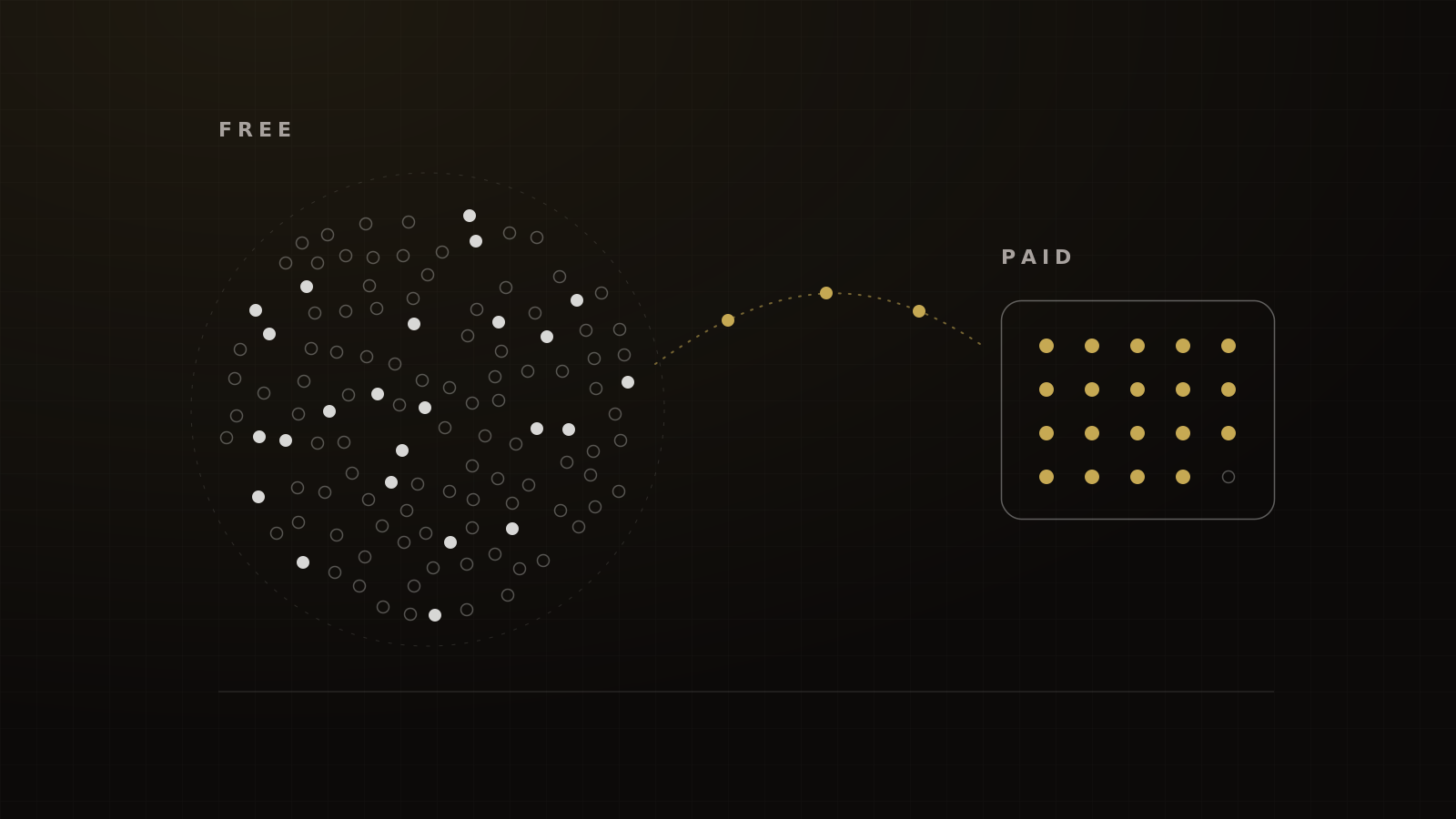
Build two spaces, not one. A free community that costs none of your own time exists to create buyers. A separate paid space is where the real support happens.
Then run hard monthly challenges with live calls at the start, middle and end. Give every member one clear next step up the ladder. And track how many free members ascend, because that number is the whole point.
One caveat up front: the evidence that communities produce buyers is thin, and most of it comes from vendors. So measure your own.
A community is a lead engine, or it's a feed you moderate
Most community advice treats the community as the product: pick a platform, write guidelines, post, moderate. Without a plan for what members buy next, that's a second job.
We treat a business community as a lead engine. Its job is to turn followers into buyers and buyers into repeat buyers. If you can't say how many members moved up to a paid offer last month, you have a feed, not an engine.
There is some independent evidence that communities move spending. A Marketing Science study of one multichannel retailer found that participation in the retailer's own online community accounted for almost 20% of members' spending after they joined. Members who posted drove more of it than lurkers.[3] It's an 11-year-old retail study of spending, not conversion, but it's the best non-vendor evidence we've found.
The counter-evidence matters just as much. Five experiments and two meta-analyses covering more than 14,000 people found that "liking" a brand on Facebook doesn't, by itself, raise purchasing.[4] A join is not a buyer. Participation is what counts, and participation has to be designed.
The two-space model: free nucleus, paid room
Run two spaces with two different promises.
The free community is the nucleus: people taste the method, meet each other and watch members win. The paid space is where support happens: live calls, feedback, accountability and peers at the same stage.
Keep them separate. In a shared room, free members get the paid experience for nothing and paying members wonder what they paid for.
This matches what the top creators do. In Circle's 2024 creator benchmark, 93% of its top-tier communities require a purchase, every one of them runs events, and 76% have 500 or fewer members.[1] Circle's 2025 survey of more than 1,200 builders found 54% already use paid memberships.[5] That's adoption, not proof of conversion. The pattern is still clear: the communities that work are small, paid and active.
The free tier: costs none of your time
The free tier has one rule: none of the founder's time. No live calls, no founder DMs, no "quick question" threads that turn into free coaching.
None of your time, no live calls.
Fill it with assets that already exist: recorded trainings, last month's kickoff, member wins and a pinned post on what the paid space includes. Lean is normal. In the Circle benchmark, half of top-tier creators spend nothing on member acquisition, and nearly 3 in 5 creators have no full-time help.[1]
Someone still has to own replies. Across roughly 1,500 association communities on Higher Logic, about 59% of posts got no reply.[6] An unanswered post in a free community is an advert for leaving. Give a moderator a daily reply window and a simple script for pointing good questions toward the paid offer.
The paid space: support, accountability, results
The paid space is where members get you or your coaches: live calls, hot seats, reviews of their work. It's also where you over-deliver on purpose, with extras priced to stay profitable. Our piece on the business case for over-delivering covers how to do that without giving away margin.
Keep free members out. Don't post paid-call replays in the free feed, and don't let free members into paid threads "to see what it's like." Show them outcomes instead: member wins, short clips and the calendar of what paid members get this month.
Why the paid space should cost something
A price changes behavior. In the MIT and Harvard edX data published in Science in 2019, only 3.13% of all participants completed their course in 2017–18. Learners who paid for the verified track completed at 46%.[2] Same courses, different commitment.
People who choose to pay were more motivated to start with. That's the point: a price filters for the people who'll do the work, and their results feed the free community.
On the paid 4–8 week instructor-led cohorts we build, our target is 50–60% completion, against that 46% for paid verified edX learners. Our course completion and community retention statistics break down the wider evidence, including which popular numbers to stop repeating.
Our default is a one-time or cohort price, not an open-ended subscription. A subscription can work if the renewal terms are clean.
Hard monthly challenges: the engagement engine
The best way we've found to keep a community active is a hard monthly challenge. Pick 7, 10 or 14 days. Give it one measurable outcome. Hold live calls at the start, the middle and the end.
Make it hard. As Ray puts it, the trouble starts "when it is too easy. Then you get bored." Real daily work gives members something to post, and free members read those posts.
The three calls each have a job:
- Kickoff. Set the outcome, teach the first task and get everyone to post their starting point.
- Midpoint. Hot-seat the people who are stuck and call out the members who are ahead.
- Wrap-up. Celebrate the finishers, share results and present the next step.
Events are where communities grow. More than 40% of community builders in Circle's 2024 survey said hosting events was a significant driver of member acquisition.[9] Attendance also separates the best communities: 59% of Circle's top-tier creators report event attendance above 50%, against 33% of everyone else.[1] In our experience, a well-run paid community challenge holds live-call attendance above 50% of enrolled participants. That's the target we hold.
The structure helps people finish, too. In a 2026 Center for Creative Leadership paper, leaders in a social cohort with a live kickoff, discussion boards, a moderator and a wrap-up completed 7.41 more lessons than a self-paced group, after adjusting for motivation and support.[10] The sample was small and not randomized, so read it as a direction, not a benchmark.
Don't expect everyone to talk. Jakob Nielsen's 90-9-1 rule from 2006 says most members lurk and a few create most of the content.[11] It's a heuristic, not a measurement. When researchers placed 520 recruited people into six private Reddit discussion communities for four weeks, 331 of them commented at least once.[12] Structure gets more people talking than the old rule suggests, so give every challenge day a prompt that asks for a short post.
Build the ascension path
Every member should know the one next step. Not a menu of five offers. One rung.
For a free member, the next rung is usually the paid challenge or the paid community. For a paid member, it's the high-ticket program, the mastermind or the live event. Map it before you launch, the same way you'd map any offer ladder.
Two of Russell Brunson's ideas fit here. His Attractive Character is the leader whose story, flaws and opinions give people a reason to follow. His mass movement pairs that leader with a cause and a new opportunity. A community is where both live day to day: the founder's story in the kickoff call, the cause in the challenge, the opportunity in the next rung.
Alex Hormozi's hook, retain and reward pattern from $100M Leads points the same way: give real value, consistently, until people ask how to work with you. The free nucleus is that pattern running every day. Consumption is what sells the next step. Members who've done the work and got a result are the ones who buy.
The nucleus also makes launches cheaper, because warm audiences behave differently from cold traffic. In our experience, a free live webinar promoted to a warm house list shows 40–50% of registrants, against 25–35% for cold paid traffic. On the funnels we run, 25–35% of warm email and SMS visitors to a registration page sign up. A community is a warm list you talk to every day.
Measure the conversion
The monthly community scorecard
- Free-to-paid ascension rate, by cohort. Of the members who joined free in a given month, how many bought within 30, 60 and 90 days.
- Challenge completion. Finishers divided by enrolled.
- Live-call attendance. Attendees divided by enrolled, for each of the three calls.
- Renewal or repeat purchase in the paid space.
- Reply coverage. The share of free-community posts that get a reply within a day.
Use a cohort denominator. "4,000 members and 80 paying" mixes people who joined years ago with people who joined yesterday. A monthly cohort shows whether the engine is improving.
Connect it to the CRM. In CMX's 2025 survey of 589 community professionals, teams with community data in their CRM were over twice as likely to rate their impact "extremely successful."[13] It's self-rated and mostly B2B, but the logic holds: if activity isn't on the contact record, you can't see who ascended.
Don't wait for referrals. The same CMX report found the share of communities seeing members evangelize or refer fell from 59% to 52%.[13] Ask for them in the wrap-up call, with a specific invite link.
Most teams can't measure this yet. In CMX's 2026 report, as reported by Bettermode, only 17.2% of community professionals could confidently quantify community's business value, though 84% said it had a positive impact.[14]
Picking a platform (it matters less than the effort)
Platform choice gets the most attention and matters least. As Ray says, a community gives back "however much love you pour into it." A well-run community on a basic tool beats a neglected one on the best.
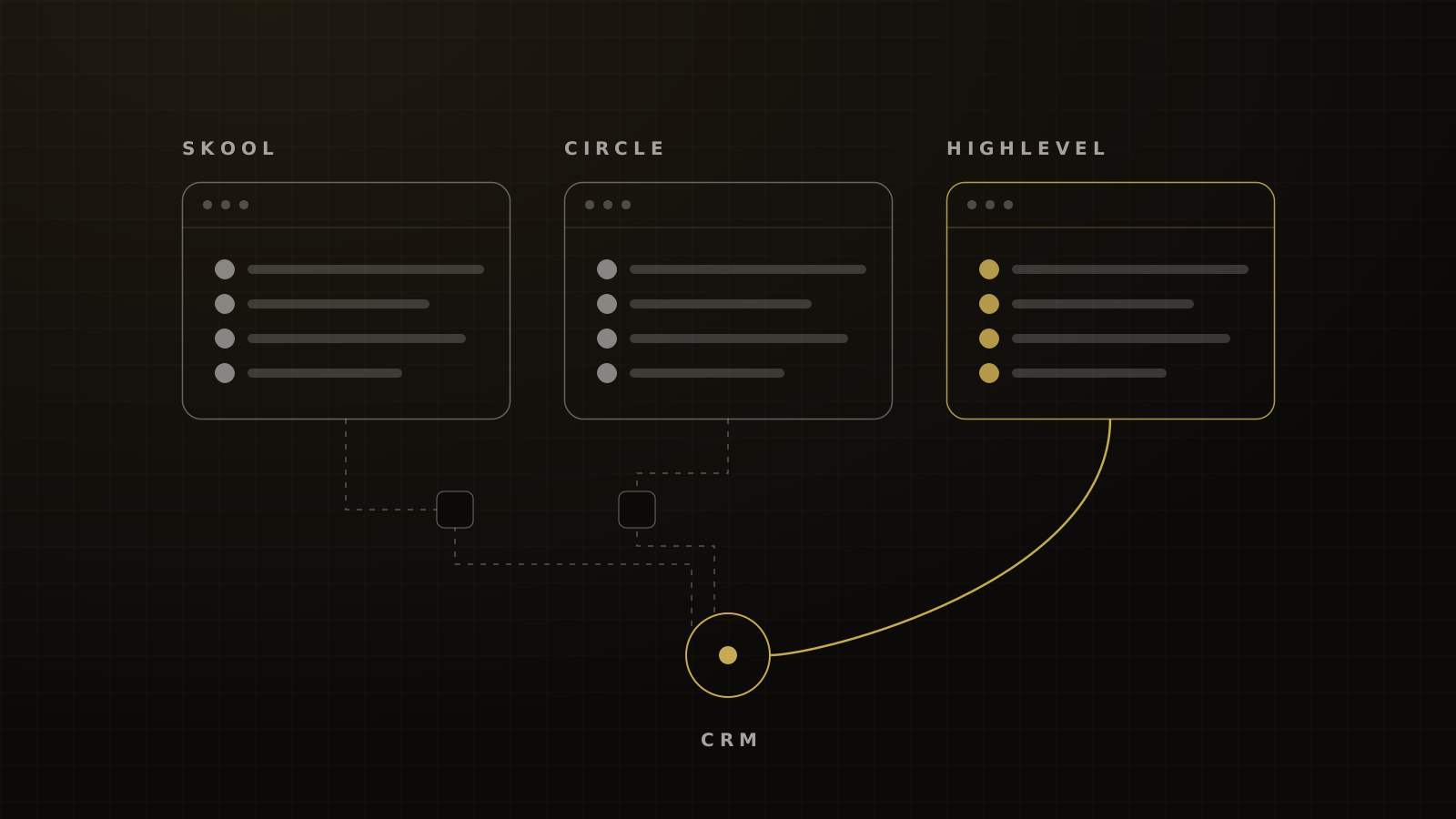
What does matter: whether members use one login for the course and the community, whether payments are built in, and whether activity flows back to your CRM. We compare the main options on exactly those terms in Skool vs Circle vs GoHighLevel.
What we know and don't yet
Nearly all community data comes from platform vendors surveying their own customers. Circle's 2026 trends report, built on 750+ builders and product data from more than 20,000 communities, publishes no free-to-paid conversion rate.[15] We haven't found an independent study linking a community to coaching-business lifetime value. The free-to-paid percentages that circulate online trace back to SaaS freemium data or forum posts.
Our own proof is thin, too, until client cohort data is in. Treat the two-space model as a design we'd defend, not a benchmark, and measure your own ascension rate from the first cohort.
For where community fits in the wider growth plan, see the 7-to-8-figure scaling roadmap. If you want help designing the ladder from free member to high-ticket buyer, book a strategy call.
Frequently asked questions
Sources
- 1.2024 Community Benchmark Report: Creators. Circle, 2024.
- 2.Study offers data to show MOOCs didn't achieve their goals. Inside Higher Ed, reporting Reich and Ruipérez-Valiente, Science, 2019-01-16.
- 3.Double-digit growth for firms that create own online communities. INFORMS, reporting Manchanda, Packard and Pattabhiramaiah, Marketing Science, 2015-05-04.
- 4.Does 'liking' lead to loving? The impact of joining a brand's social network on marketing outcomes. John, Emrich, Gupta and Norton, Journal of Marketing Research, 2017-02.
- 5.2025 Community Trends Report. Circle, 2025.
- 6.2025 Association Community Benchmark Report. Higher Logic, 2025-09-23.
- 7.Opinion in No. 24-3137, petitions for review of the FTC's amended Negative Option Rule. US Court of Appeals for the Eighth Circuit, 2025-07-08.
- 8.Attorney General Bonta issues consumer alert on California's automatic renewal law. California Attorney General, 2025-09-04.
- 9.7 types of virtual events that boost member engagement. Circle Blog, 2024-03-29.
- 10.Format, motivation and support predict persistence in virtual leadership development. Center for Creative Leadership, 2026-03.
- 11.Participation inequality: the 90-9-1 rule for social features. Nielsen Norman Group (Jakob Nielsen), 2006-10-08.
- 12.Disentangling participation in online political discussions with a collective field experiment. Oswald, Schulz and Lorenz-Spreen, Science Advances, 2025-12-10.
- 13.2025 Community Industry Trends Report. CMX, 2025.
- 14.Community management statistics for 2026 (citing the CMX Community Industry Report 2026). Bettermode, 2026-08.
- 15.2026 Community Trends Report. Circle, 2026.
Written by
Ray GillespieCo-Founder & COO
Ray runs day-to-day operations across every Victory engagement, building the systems, automations and AI-powered workflows that hold the machine together. He has overseen operations behind more than $120M in revenue.
Part of the guide: The 7-to-8-Figure Scaling Roadmap for Coaching, Info and Service Businesses