Skool vs Circle vs GoHighLevel Communities for Coaching Businesses
A non-vendor comparison of Skool, Circle and GoHighLevel Communities on login, discovery, payments and CRM data, with dated fees and a worked example.
 Oussama El AlamiCTO & Lead Developer
Published 10 min read
On this page
Key takeaways
- Choose on fit with your funnel, not features. We judge every platform on four revenue tests: one login with courses, discovery, who processes payments, and whether member data reaches your CRM.
- Skool is the simplest and the only one with a built-in discovery marketplace. But Skool is the merchant on your sales, its email broadcast has no segmentation, and data reaches your CRM through Zapier.[1][2][3]
- Circle is the most flexible and brandable: from $89 a month billed annually, plus a 2% transaction fee on its entry plan. Branded apps are on Circle Plus only.[4]
- GoHighLevel Communities share one login with your courses and billing, and live inside the CRM. Discovery is the weak spot.[5]
- Our bias, stated up front: Victory runs on GoHighLevel. The effort you put into the community still matters more than the platform.
Pick the platform that fits your funnel, not the one with the longest feature list.
Skool is the simplest and has a built-in audience, but it keeps payments and member data on its own rails. Circle is the most flexible and the easiest to brand. GoHighLevel Communities shares one login with your courses and sits inside the CRM, so upsells and follow-up run without extra plumbing.
All three can host a community that makes money. The bigger factor is how hard you work it.
The short answer (and our bias)
We build client funnels on GoHighLevel, and our own CRM is GoHighLevel. So read this with that in mind. We'd still pick Skool or Circle for some funnels, and we'll say which.
Our default for a coaching business already on GoHighLevel is its Communities feature. The reason is one login. A member who finishes a course and sees the community, the next offer and their billing in the same portal has fewer reasons to stall. In our experience, moving a coaching business onto GoHighLevel retires 3 to 5 tools: typically email, SMS, the scheduler, forms and a pipeline tool. That's our rule of thumb, not an industry figure.
We'd pick Skool for a founder starting from zero who wants a built-in audience and no setup. We'd pick Circle for a brand that wants its own look, more structure and, at the top tier, its own app.
Most comparison pages are written by a platform or an affiliate, and several carry stale fees. One ranking page says Skool Pro has no platform fee under $899. Skool's own payments FAQ says 2.9% plus 30 cents.[6][1] Every price below is from the official pages as of October 2026. Check them again before you buy.
Judge platforms on four revenue tests
Features are table stakes. These four tests decide whether the community makes money.
Framework
The four revenue tests for a community platform
- One login with courses. Can a member move from a lesson to the community to the next offer without signing in again? Every extra login is friction at the moment you want them to buy.
- Discovery. Does the platform send you new members, or does every member come from your own marketing?
- Payments. Whose merchant account takes the money, and what's the fee at your price point?
- Data back to the CRM. Do joins, posts, purchases and cancellations land on the contact record, so you can segment and follow up?
Victory's evaluation checklist for coaching and course businesses.
The fourth test is the one most comparisons skip. In CMX's 2025 survey of 589 community professionals, teams with community data connected to their CRM were over twice as likely to rate their impact "extremely successful."[7] It's a self-rated, mostly B2B sample, but it matches what we see: if you can't see community activity next to purchases, you can't sell the next step on time.
Skool
Skool's strength is simplicity. Two plans, both with unlimited members, courses, videos and live calls: Hobby at $9 a month and Pro at $99.[8] There's a 14-day free trial. You get a community feed, a classroom with progress tracking, a calendar with reminder emails, and gamification where reaching a level can open a course.[2]
Discovery is the reason many coaches choose it. Skool Discovery ranks groups on member growth, engagement and retention, with a human reviewing boosts and penalties. Groups must meet minimum member, post and activity thresholds to appear.[9] If you switch on Growth Boost, Skool shows your group in Discovery and in off-site ads, and takes a 30% commission on the members it brings.[9]
What groups charge varies widely. One third-party snapshot of 1,000 groups in Discovery on 7 September 2026 found a median monthly price of $39 among the 768 that showed one.[10] That's one day's trending list, not a census.
The trade-offs are all about revenue plumbing:
- Skool is the merchant. Payments run on Skool's merchant account, with weekly payouts through Stripe Express. Pro charges 2.9% plus 30 cents per transaction up to $899 and 3.9% plus 30 cents above $900. Hobby charges 10% plus 30 cents.[1]
- Email is a broadcast. Skool's one-click email goes to the whole group, with no segmenting by lists or tags.[2]
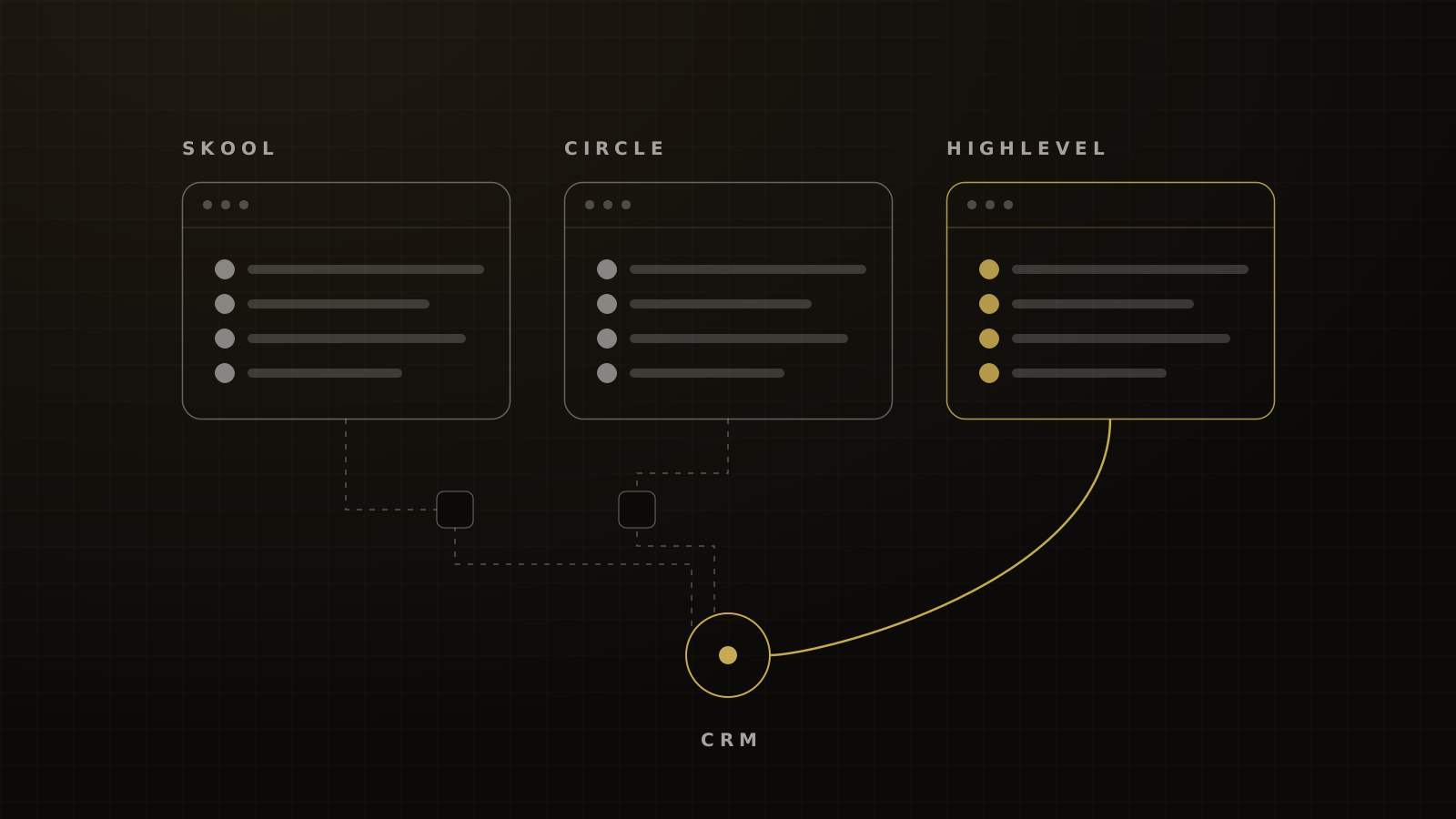
- CRM data goes through Zapier. Skool's own Zapier page lists sending paid members' name and email to your CRM as a use case.[3] It works, but it's a connector to maintain, not a native sync.
- The leaderboard rewards subscriptions. The Skool Games leaderboard ranks groups by monthly recurring revenue growth. One-time course sales don't count, and refunds reduce it.[11] That's a fine game. It's not a reason to change a cohort offer into a subscription.
One more caution: Skool publishes no platform-wide member totals. The "170,000 communities" and "25 million users" figures that circulate trace to no first-party source.[12]
Circle
Circle is the most flexible of the three, and the easiest to make look like your brand. On annual billing, Professional is $89 a month with a 2% transaction fee, Business is $199 with 1%, Scale is $419 with 1%, and Circle Plus is custom-priced with 0.5%.[4] An email hub is available as an add-on.
Two things to check before you commit. Branded mobile apps are only on Circle Plus, so the lower plans use Circle's own app.[4] And the transaction fee sits on top of whatever your payment processor charges.
Circle has no public marketplace like Skool Discovery, so every member comes from your own marketing. Its help center wasn't readable when we checked, so confirm in a trial exactly how member data reaches your CRM. If that path is a weekly CSV export, the fourth test fails.
GoHighLevel Communities
GoHighLevel's pricing starts at $97 a month for Starter, then $297 for Unlimited and $497 for Agency Pro. Communities and courses are included on every plan.[13]
Communities sit inside Client Portal, under Memberships, next to your courses. Course-access and payment emails are set in the same place, and community notifications send from the sub-account's own email service.[14] HighLevel's Unified Client Portal gives members one login and one navigation across their dashboard, courses, communities, billing and shared files.[5]
That's the first revenue test passed outright. The fourth one too: community posts, comments, join-request rejections and event registrations can all trigger workflows.[15] A member who comments on the module-three thread can get a tag, a text from a coach or an upgrade offer without a connector in between.
The weak spots are real:
- No discovery. There's no public directory sending you members. You bring all of them.
- Gamification is preset. You can rename levels, but the number of levels (up to 9) and the point structure are fixed. One like is one point.[16]
- The app isn't yours yet. Members use HighLevel's shared app, Kollab by LeadConnector. Branded apps on the new native codebase are planned, not released.[17]
- The plan fee isn't the whole bill. In our experience, for an event business that texts heavily, the plan fee is only 25–40% of the monthly HighLevel bill. Messaging and other usage make up the rest. That's our rule of thumb; budget for it.
Setup takes more work than Skool, too. Our GoHighLevel guide covers the build. If you sell from live events, the same portal is where a next-day kickoff for new buyers lives; our acceleration session case shows why that matters for refunds.
Where Kajabi fits
People searching "Skool vs Kajabi" are usually weighing an all-in-one course platform against a community-first one. Kajabi Basic is $179 a month on monthly billing ($143 billed annually) and includes one community. Kajabi Payments in the US costs 2.9% plus 30 cents per transaction on Basic, falling to 2.7% plus 30 cents on Pro.[18] You can export all contacts to a CSV from the Contacts screen.[19] That's every contact, not a list of current paying community members, so plan the data handoff before you migrate.
The comparison table
| Skool | Circle | GoHighLevel | |
|---|---|---|---|
| Entry price | $9/mo Hobby, $99/mo Pro | $89/mo Professional (annual) | $97/mo Starter |
| Platform fee on sales | 10% + 30¢ (Hobby); 2.9% + 30¢ to $899, 3.9% + 30¢ above (Pro) | 2% Professional; 1% Business and Scale; 0.5% Plus | Your processor's fees |
| Who's the merchant | Skool | Your processor | Your processor |
| Discovery | Yes, ranked directory; 30% on Growth Boost members | No | No |
| One login with courses | Yes, inside Skool | Yes, inside Circle | Yes, across courses, community and billing |
| One-click broadcast, no segments | Email hub add-on | Full CRM email and SMS | |
| Data back to CRM | Via Zapier | Confirm in trial | Native, with workflow triggers |
| Branded app | No | Circle Plus only | Planned |
Prices and fees from each platform's official pricing and help pages, accessed 2026-10-04. Circle prices are for annual billing. Re-check before you buy.
What the fees cost at your price (illustration)
Fees look small until you multiply them. Here's a hypothetical community at $49 a month with 200 paying members, about $9,800 a month in sales. The membership numbers are made up; the fees are the published ones.
- Skool Hobby: $9 plan plus 10% and 30 cents on each of 200 payments, about $1,049 a month.
- Skool Pro: $99 plan plus 2.9% and 30 cents per payment, about $443 a month.
- Circle Professional: $89 plan plus a 2% fee of $196, about $285 a month, before your processor's fees.
- GoHighLevel Starter: the $97 plan, plus your processor's fees and any messaging usage.
Two lessons. Skool Hobby only makes sense while the group is small: at $49 a month, Pro becomes cheaper at about 26 paying members. And Skool charges its fee as the merchant, while Circle's 2% and GoHighLevel's plan fee sit on top of your own processor's fees. Compare totals, not headline rates.
The platform matters less than the effort
Ray says a community gives back "however much love you pour into it." The data on what top communities do backs him up, and none of it is about software.
In Circle's 2024 creator benchmark, 93% of its top-tier communities require a purchase, all of them run events, and 76% have 500 or fewer members.[20] In a 2026 Hivebrite and Wonderly survey of 186 community professionals, 76.9% said events are the biggest driver of meaningful participation.[21] That's an opinion survey, not proof of cause, but the direction is consistent.
Attendance is the number that separates them. 59% of Circle's top-tier creators report event attendance above 50%, against 33% of others.[20] On the paid community challenges we run, our target is live-call attendance above 50% of enrolled participants, on whatever platform the client uses.
How to get there, from the free tier to hard monthly challenges, is in our guide to building an online community that feeds your paid offers. For what completion and retention data says about paid versus free members, see our course completion and community retention statistics.
How we'd choose for your funnel
- Starting from zero, no funnel yet, want a built-in audience: Skool Pro.
- Established brand, want your own look and more structure: Circle, and Circle Plus if a branded app matters.
- Courses, payments and follow-up already in GoHighLevel: GoHighLevel Communities. Keep one login and one contact record.
Whichever you pick, the community is one rung in a larger plan. See where it fits in our 7-to-8-figure scaling roadmap, or book a strategy call and we'll map the platform to your funnel.
Frequently asked questions
Sources
- 1.Payments FAQs. Skool Help Center, accessed 2026-10-04.
- 2.Features. Skool, accessed 2026-10-04.
- 3.Zapier integration. Skool Help Center, accessed 2026-10-04.
- 4.Pricing. Circle, accessed 2026-10-04.
- 5.Unified Client Portal experience. HighLevel Support Portal, 2026-08-08.
- 6.Skool vs Circle. Ruzuku, 2026-03-26.
- 7.2025 Community Industry Trends Report. CMX, 2025.
- 8.Pricing. Skool, accessed 2026-10-04.
- 9.Discovery FAQs. Skool Help Center, accessed 2026-10-04.
- 10.Skool community cost. Skoolfiles, 2026-09-07.
- 11.Skool Games leaderboard FAQ. Skool Help Center, accessed 2026-10-04.
- 12.Skool platform review. Skoolmakers, accessed 2026-10-04.
- 13.Pricing. HighLevel, accessed 2026-10-04.
- 14.How to set up, customize and manage your communities. HighLevel Support Portal, 2026-09-17.
- 15.Communities workflow triggers for posts, comments, requests and events. HighLevel Support Portal, accessed 2026-10-04.
- 16.Gamification in Communities: points, badges and leaderboards. HighLevel Support Portal, accessed 2026-10-04.
- 17.GoKollab mobile app Beta v2: native iOS and Android experience. HighLevel Support Portal, 2026-08-09.
- 18.Pricing. Kajabi, accessed 2026-10-04.
- 19.How Kajabi helps you with privacy regulations. Kajabi Help Center, accessed 2026-10-04.
- 20.2024 Community Benchmark Report: Creators. Circle, 2024.
- 21.Community Growth & Benchmark Report 2026. Hivebrite and Wonderly, 2026-07-16.
Written by
Oussama El AlamiCTO & Lead Developer
Oussama leads technical architecture and development at Victory, building in GoHighLevel, n8n and custom environments. He has built more than 10,000 automations across CRMs, payments and messaging.
Part of the guide: The 7-to-8-Figure Scaling Roadmap for Coaching, Info and Service Businesses