GoHighLevel Workflows vs n8n: Which Layer Should Own Your Marketing Automation?
GHL owns the contact record. n8n owns the bridges between systems. The layer rule we build on, plus the retries, dedupe and alerts tutorials skip.
 Oussama El AlamiCTO & Lead Developer
Published 9 min read
On this page
Key takeaways
- Use a layer rule. GoHighLevel owns anything that lives on the contact record. n8n owns the bridges between systems.
- GoHighLevel's outbound Webhook action documents no retry behaviour.[1] n8n has per-node retries and error workflows.[2] So retries, dedupe and alerts belong on the n8n side.
- Every bridge needs four things tutorials skip: a retry rule, a dedupe key, an alert that reaches a named person, and a saved record of failed runs.
- Name one credential owner and one patch owner. n8n had two critical vulnerabilities in the last year.
- The automation layers are the cheap part of the bill. Messaging usage is what moves it.
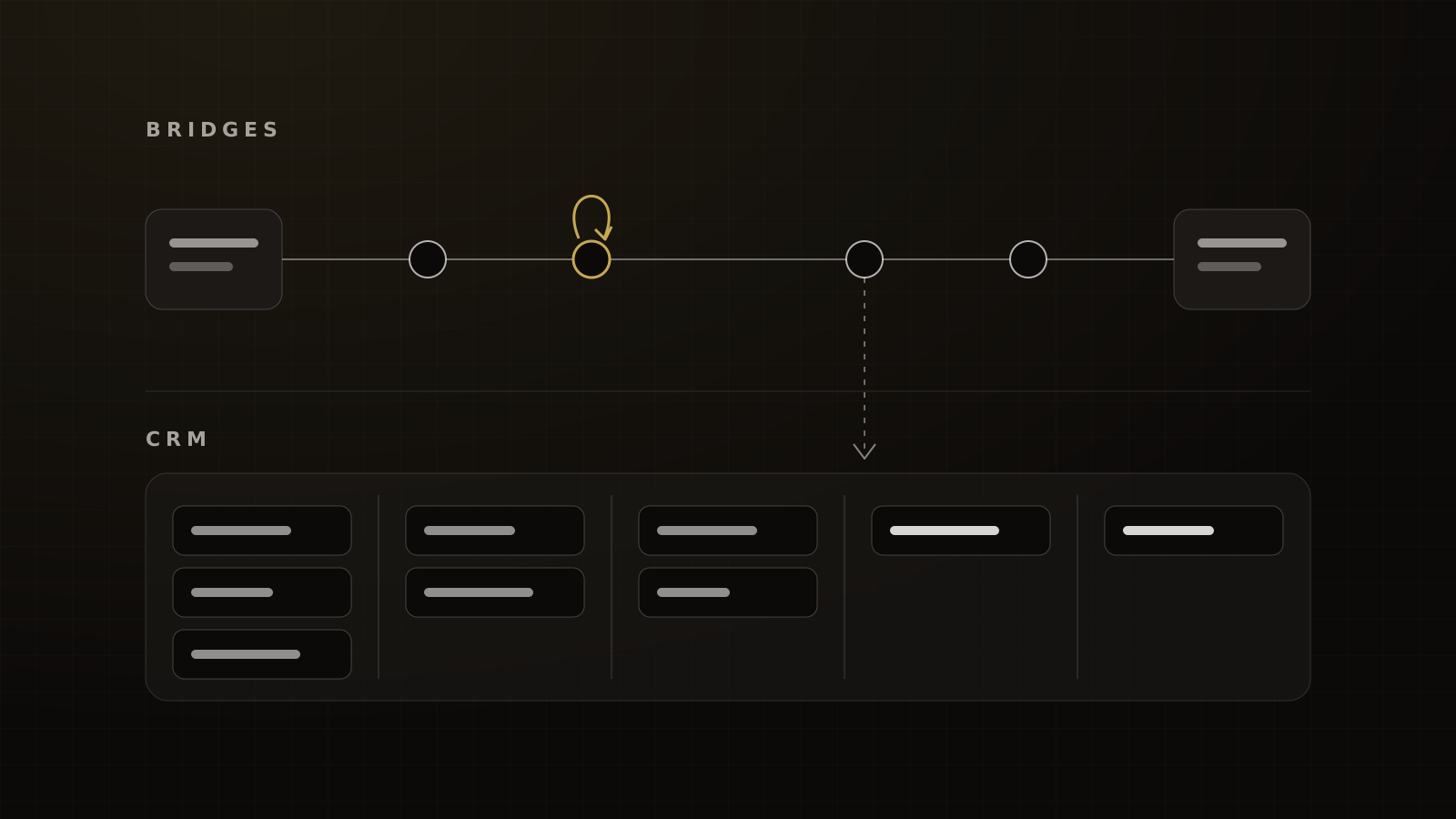
Use both, in different layers. GoHighLevel owns anything that lives on the contact record: nurture, pipeline stages, reminders and the triggers that move a contact from one stage to the next. n8n owns the bridges between systems: webinar attendance into the CRM, call outcomes into attribution, an AI SDR that calls three APIs in a row.
The split isn't about which tool is better. It's about where failures show up and who sees them. A GHL workflow that fails shows on the contact. An outbound webhook that fails can disappear without a trace. So the bridge layer carries the retries, the dedupe and the alerts.
The layer rule in one table
| Job | Owner | Why |
|---|---|---|
| Lead nurture by email and SMS | GoHighLevel | Lives on the contact; consent and A2P registration sit here |
| Pipeline stages and stage-based triggers | GoHighLevel | The sales team works from the pipeline |
| Event and webinar reminders | GoHighLevel | Same number, same domain, same opt-out history |
| Webinar attendance into the CRM | n8n | Pulls from another platform, then writes to GHL |
| Call outcomes into attribution | n8n | Two outside systems, neither is the CRM |
| AI SDR (research, draft, log, route) | n8n | Several APIs in sequence, each can fail |
| Anything that must retry or alert on failure | n8n | GHL's outbound webhook documents no retry |
Our build rule for coaching, course and event businesses on GoHighLevel.
What GoHighLevel should own
Most of a funnel's automation belongs in GoHighLevel. In our experience, a day-one coaching or event build has 12 to 20 workflows, and the sub-account goes live in 5 to 7 business days. We haven't found an industry benchmark for either; they're our build standards. How we set up the sub-account itself is in our GoHighLevel guide.
Trigger on stages, not on time. A "wait three days, then send" sequence keeps firing after the contact has booked, bought or asked to stop. A stage-based trigger fires when the contact's state changes. We design stages using Hormozi's five lead stages (uncontacted, contacted, engaged, qualified, sold), so every workflow has a clear entry and exit.
Branch on behaviour. Russell Brunson's Perfect Webinar funnel branches follow-up on what the registrant did: stayed to the end, left early or didn't show, and it stops when they buy. That logic belongs on the contact, in GHL.
Keep reminders in GHL. The reminder has to go from the registered number, on the brand's own domain, with the contact's opt-out history attached. After we fixed a filtering problem with drip sends and own-domain trigger links, reminder delivery came back at 95% or better. That story is in why our event reminder texts got carrier-filtered.
Watch the premium meter. GHL's premium triggers and actions, including inbound and custom webhooks, bill per execution: 100 free for the lifetime of each sub-account, then $0.01 each, or $10 for 10,000, $25 for 30,000 and $50 for 65,000. Standard actions don't count, and unused executions don't roll over.[3]
GHL's own AI now builds workflows too. HighLevel reports 125 billion workflow executions across about 1 million locations in 2025, and more than 140,000 workflows built with its AI Workflow Builder.[4] Its help page is blunt about the limit: "AI cannot test workflows. Perform manual tests."[5] Needing an AI step isn't, by itself, a reason to move a job to n8n.
What n8n should own
n8n earns its place where a job crosses systems. We run three kinds of bridge most often.
1. Webinar attendance into the CRM. The webinar platform knows who attended and for how long. GHL needs that on the contact to fire the right follow-up. n8n pulls the attendance, matches each person, and posts to a GHL Inbound Webhook trigger. That trigger takes JSON only and needs an email or phone number to create a contact.[6] Send both whenever you have them.
2. Call outcomes into attribution. The disposition a closer logs is the signal the attribution tool needs to credit the right ad. n8n moves it from the CRM to the attribution platform, so ad decisions run on outcomes, not on lead counts.
3. An AI SDR. Research the lead, draft a first message, log it to the CRM, route hot leads to a person. Anthropic draws a useful line here: workflows orchestrate models and tools through predefined code paths, while agents direct their own process.[7] A scripted AI SDR is a workflow, and that's a feature. It does the same steps every time, so you can test it. The bridge protects our speed-to-lead target: a median first dial under an hour in staffed hours, and every lead dialled within 24 hours. The industry comparisons are in our speed-to-lead research.
Bridges are most of the work in any stack. MuleSoft's 2026 survey of 1,050 IT leaders found only 27% of apps connected on average, with 36% of IT time going to custom integrations.[8]
Failure handling the tutorials skip
Every template gallery shows the happy path. Production is the other path.
Retries
In n8n, each node has a Retry On Fail setting and an On Error setting: stop the workflow, continue, or continue through an error output you can route.[2] Use retries on every outside API call. Be careful with Always Output Data, which n8n warns can create infinite loops on IF nodes.[2]
GoHighLevel's Webhook action page documents the method and fields but says nothing about retries.[1] Assume a failed outbound call from GHL is lost. For anything that matters, have n8n reconcile on a schedule as well as listen.
Error workflows and who gets paged
Each n8n workflow can name an error workflow that starts with an Error Trigger node. One error workflow can serve many workflows, and its payload includes the execution ID and URL, the error message and the last node that ran.[9] Ours posts to a Slack channel with the workflow's named owner tagged. An alert nobody owns is a log entry.
Dedupe and idempotency
Webhooks can arrive twice and out of order. Stripe's docs say so plainly and recommend tracking event IDs.[10] Stripe also prunes idempotency keys after at least 24 hours.[11] That's Stripe, not GHL, but the pattern carries over: store the event ID you processed, and before creating a contact, search GHL by email and phone.
Rate limits and backoff
The HighLevel API allows 100 requests per 10 seconds and 200,000 per day, per app per location or company, and returns remaining-quota headers.[12] Batch writes, read those headers, and back off before you hit the wall.
Timeouts and saved failures
Per workflow, n8n lets you save failed production executions, set a timeout and redact production execution data.[13] Save every failed run, so you can replay it. Redact anything with lead data in it; our AI data-safety checklist covers what counts.
Before a bridge goes to production
- Retry On Fail set on every outside API call
- An error workflow named, alerting a named owner
- A dedupe key stored and checked before any create
- Contact match on email and phone before creating in GHL
- Rate-limit headers read; writes batched
- Failed executions saved; lead data redacted
- A scheduled reconcile for any job GHL triggers outbound
Credentials and ownership
Credentials. n8n credentials live in a personal space or a project. OAuth credentials can be fixed, the same for every run, or end-user, each user's own, on Enterprise. You can restrict which domains a credential may be sent to.[14] Use project-scoped credentials per client, and set allowed domains on every one.
License. n8n's Sustainable Use License isn't an OSI open-source license. It lets an agency build and run client automations on its own instance and charge for setup and maintenance, as long as clients can't create or edit workflows there. Letting clients build on your hosted n8n isn't allowed.[15] Most comparison pages just call it "open source."
Patching. Self-hosting means someone owns updates. CVE-2026-21858 was a critical flaw allowing unauthenticated file access through webhooks and forms, fixed in version 1.121.0.[16] CVE-2025-68613 was a critical remote-code-execution flaw through workflow expressions.[17] Name a patch owner, and limit who can edit workflows.
Ownership. The client owns the accounts. The agency owns the runbook: what each bridge does, who's paged, how to replay a failure. Production automations are built by developers, not vibe-coded by whoever had a free afternoon. Internal tools nobody can maintain are the most expensive automation there is.
Cost: where each layer bills you
| n8n | GoHighLevel workflows | |
|---|---|---|
| Unit | One full workflow run, however many steps | One premium trigger or action run |
| Entry | Community Edition free self-hosted; Cloud Starter €20/mo for 2,500 executions | 100 free per sub-account, lifetime |
| Next tiers | Pro €50/mo for 10,000; Business €667/mo for 40,000 (self-hosted) | $0.01 each, or $10 / 10K, $25 / 30K, $50 / 65K |
List prices at the time of writing. n8n prices are in euros; re-check both before you budget.
Sources: n8n pricing,[18] HighLevel premium executions.[3]
Neither line is where the money goes. On the event funnels we run, total usage (email, SMS, carrier fees and A2P) runs 1.5 to 3 times the plan fee in launch months, and the plan fee ends up at 25% to 40% of a texting event business's monthly HighLevel bill. Both are our own working figures; we haven't found an industry benchmark. Spend the effort on message volume, not on shaving workflow runs.
Zapier? When it's fine
Zapier is fine for low-volume, single-step jobs where a missed run costs nothing: a form to a spreadsheet, a new sale to a Slack channel. Once a job needs retries, dedupe, branching or an AI step that touches lead data, build it in n8n. n8n now reports 1.7 million monthly active builders,[19] so finding help isn't the obstacle it was.
Want to see how we build it in your account? Book a strategy call.
Frequently asked questions
Sources
- 1.Workflow action: Webhook. HighLevel Support Portal, 2025-12-11.
- 2.Work with nodes (node settings). n8n Docs, viewed 2026-10-04.
- 3.Workflows Pro plan: new pricing tiers (premium executions). HighLevel Support Portal, 2025-09-04.
- 4.HighLevel 2025: a year in review. HighLevel, 2026-01-15.
- 5.Workflow AI Builder. HighLevel Support Portal, 2026-08-28 (modified).
- 6.How to use the Inbound Webhook workflow premium trigger. HighLevel Support Portal, 2026-09-16.
- 7.Building effective agents. Anthropic, 2024-12-19.
- 8.Connectivity Benchmark Report 2026. MuleSoft (Salesforce), 2026-02-05.
- 9.Handle errors gracefully (error workflows). n8n Docs, viewed 2026-10-04.
- 10.Receive Stripe events in your webhook endpoint. Stripe Docs, viewed 2026-10-04.
- 11.Idempotent requests. Stripe API Reference, viewed 2026-10-04.
- 12.Rate limits. HighLevel Marketplace Developer Portal, viewed 2026-10-04.
- 13.Configure workflow settings. n8n Docs, viewed 2026-10-04.
- 14.Create and edit credentials. n8n Docs, viewed 2026-10-04.
- 15.Sustainable Use License FAQ. n8n Docs, viewed 2026-10-04.
- 16.Security advisory GHSA-v4pr-fm98-w9pg (CVE-2026-21858). n8n (GitHub), 2026-01-07.
- 17.Security advisory GHSA-v98v-ff95-f3cp (CVE-2025-68613). n8n (GitHub), 2025-12-19.
- 18.n8n pricing. n8n, viewed 2026-10-04.
- 19.n8n and SAP. n8n, 2026-05-12.
Written by
Oussama El AlamiCTO & Lead Developer
Oussama leads technical architecture and development at Victory, building in GoHighLevel, n8n and custom environments. He has built more than 10,000 automations across CRMs, payments and messaging.
Part of the guide: AI Marketing Operations: How a Modern Agency Runs Funnels with Claude, Agents and Automation