Order Bumps vs Upsells: Take Rates, AOV Lift and Where Each One Goes
A bump sits on the order form; an upsell comes after payment. We traced the popular take-rate stats to their origins, and give the placement rules we use.
 Ray GillespieCo-Founder & COO
Published 9 min read
On this page
Key takeaways
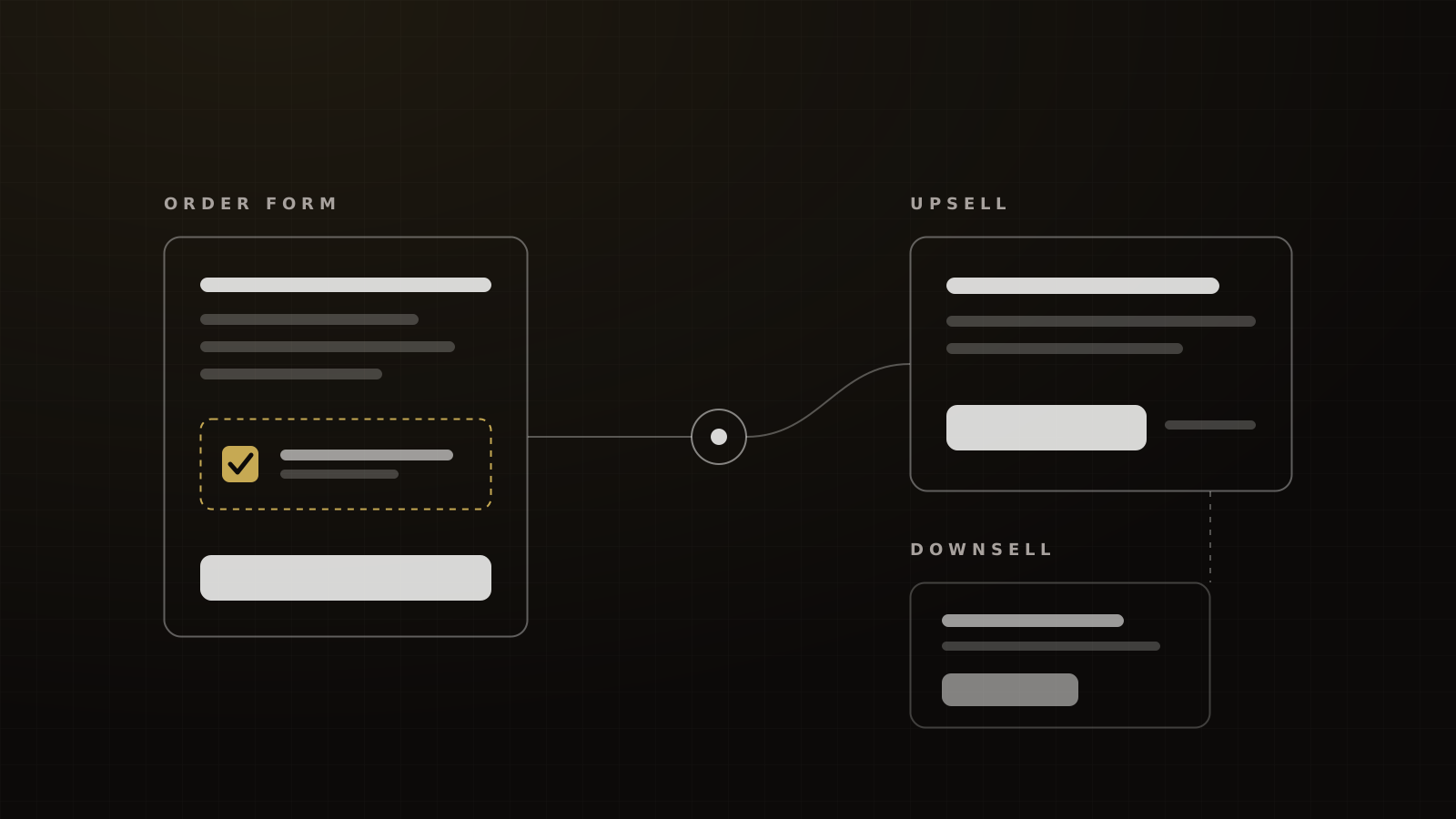
- An order bump is a checkbox on the order form, charged with the main purchase. An upsell is a separate one-click offer after payment. A downsell appears only after a no.
- Most take-rate numbers online are vendor marketing. SamCart says bumps convert at 30% to 40% on one page[1] and 35% to 40% on another.[2]
- ClickFunnels' famous 38% describes one offer in Russell Brunson's own funnel, in 2015.[3]
- SamCart's "68%" is an increase in order value, not an upsell take rate.[2]
- The rule we use: bump on the form, upsell after payment, downsell after a no, one offer per page. Measure each against the buyers who actually saw it.
An order bump goes on the order form and is charged with the main product. An upsell goes on its own page after payment and charges the saved card in one click. A downsell is the smaller offer shown to people who decline the upsell.
The confusing part isn't the definitions. It's the numbers. Most "average take rates" trace back to a vendor page with no method, or to one offer in one funnel. Here's where each popular figure comes from, what the traceable data says, and the placement rules we build with.
Bump vs upsell vs downsell
Russell Brunson popularized these as funnel building blocks, alongside the tripwire, which he credits to Ryan Deiss and Perry Belcher.
| Order bump | One-click upsell | Downsell | |
|---|---|---|---|
| Where it appears | On the order form, above the pay button | Its own page, right after payment | Its own page, after a no to the upsell |
| When it's charged | With the main purchase | Separately, on the saved card | Separately, on the saved card |
| What it should be | A small add-on that makes the main product easier or faster to use | The next logical step: more help, more speed, more done for them | A smaller version of the upsell or a payment plan |
| Price vs main product | At or below it | Often several times it | Below the upsell |
Price guidance is our rule of thumb, not a published benchmark.
The bump is an impulse add-on at the moment of highest intent. The upsell is a second, bigger decision made after the first one is done. They do different jobs, so they get judged differently.
The take-rate numbers, traced
Order bumps
SamCart says order bumps convert at 30% to 40% on average, across more than $7 billion in processed transactions.[1] Another SamCart page, updated the same week, says 35% to 40%.[2] Neither discloses a period, a denominator or a method.
Kajabi says bumps convert at 20% to 40% on average, also with no method.[4]
ClickFunnels' 38% comes from a 2015 post by Brunson saying roughly 38% of the people who saw one specific bump took it, on his own two-step order form.[3] It's one offer, not a benchmark. In DotCom Secrets Brunson says bumps can reach about 40%, which is his own figure.
Focus Digital reports a 37.8% average bump rate across 1,847 businesses.[5] Its stated study window ends in July, yet the same page reports Black Friday and Cyber Monday rates. Treat it with caution.
"40% to 60%" shows up on many funnel blogs. We couldn't find any original source.
One-click upsells
SamCart's 68% is the average increase in order value from adding one upsell.[2] A $47 order growing to $79 is a 68% AOV lift, whatever share of buyers took the upsell. It isn't a take rate.
ThriveCart says upsells convert at 4% to 10%, with no source given.[6]
Zipify, an ecommerce upsell app, says its merchants average a 16.2% take rate on post-purchase offers, while under-optimized stores sit around 4%.[7] That's physical products on Shopify, not coaching.
You'll also see "10% to 15% OTO conversion" and "upsells drive 10% to 30% of revenue (Forrester)". We found no original for the first, and the second isn't in Forrester's public summary.
The cases that report both
The most useful public numbers are single funnels that report both rates. They're vendor-selected, so they skew high.
| Front end | Bump take | Upsell take |
|---|---|---|
| $47 product, $47 bump, $497 upsell | 56% | 6.87% |
| $48 digital product, two upsells | 24% | 8% each |
| $47 workout plan, $17 bump, $197 coaching upsell | 43% | 11% |
| Creator business, several products | 20% | about 25% |
Single vendor-published cases. No buyer counts or periods disclosed.
Sources, in order: SamCart, which calls the 56% "unusually high";[2] ThriveCart;[8] SamCart;[9] and a SamCart customer story.[10]
What we can actually say
Public digital-product bump rates run from about 20% to 56%. Upsell rates run from about 7% to 25%. Neither range is a benchmark.
In our experience, a one-click upsell on a sub-$100 coaching front end takes 8% to 12%. For comparison, Rokt Aftersell measured 6.96% for its best post-purchase placement across 17 million Shopify sessions,[11] and the SamCart seller above reports 6.87%.
Get the denominator right
Kajabi defines bump conversion as checkout sessions where at least one bump was accepted, divided by sessions where a bump was shown, and it reports upsell revenue after refunds.[12] Use that definition.
An upsell rate is a share of buyers, not visitors. On the funnels we run, cold traffic buys a $7 to $47 sales page at 3% to 6%. So 1,000 visitors make perhaps 40 buyers, and a 10% upsell is 4 sales. A high upsell rate on a page few people reach is still a small number.
Placement rules backed by data
Put the offer right before the final click. Across 17 million Shopify sessions, the same offer converted at 6.96% just before "Complete Order" and as low as 0.18% in the worst placement. One offer converted at 2.55%, several at 1.67%.[11]
Before payment beats after. Growth Suite's 66 million offer impressions show 12% acceptance in the cart, 9% at checkout and 6% post-purchase.[13] That's why the bump lives on the order form.
Show the bump price and the new total. Baymard's average of 50 studies puts cart abandonment at 70.22%, and "extra costs too high" is the top reason given.[14] In a drip-pricing experiment, 24.5% of people who saw optional add-on fees late made the costlier choice, against 7.8% who saw them upfront.[15]
Make "no thanks" easy. In Baymard's testing, 66% of users forced through a separate cross-sell step at Amazon showed extreme frustration.[16]
Placement rules
- Bump on the order form, unchecked, with its price and the new total visible.
- One upsell per page, straight after payment.
- Downsell only after a no to the upsell.
- A plain "no thanks" link on every post-purchase page.
- Delivery of the main product never waits on a post-purchase decision.
How many upsells?
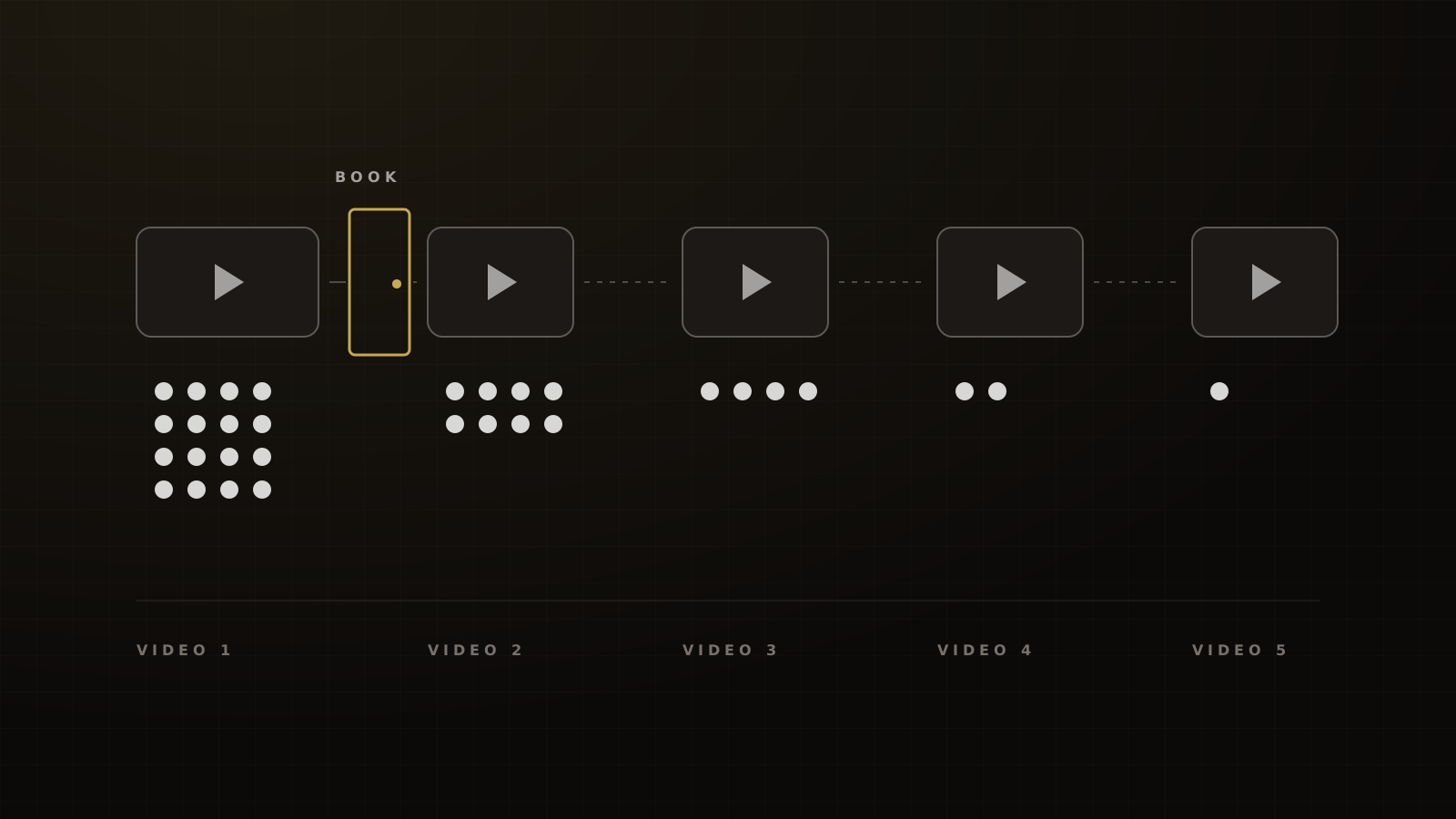
Fewer than you think. Growth Suite's fatigue curve across 20 million sessions shows acceptance of 5% on the first offer, 8% on the second, 6% on the third and 1% on the fourth.[13] It's observational, but the cliff is clear.
A 1.6-million-shopper field experiment found the same shape in recommendation sets: purchases rise, then fall as more products are shown, and up to 64% of the drop comes from fewer people clicking at all.[17] Shopify caps buyers at three accepted post-purchase offers per checkout,[18] which is a ceiling, not a target.
Alex Hormozi's offer stacking makes the operating point: add one step at a time, starting with whichever adds the most money for the least complexity. We start with one bump and one upsell, add a downsell, and only then test a second upsell.
Effect on refunds, chargebacks and buyer quality
Nobody publishes how bumps and upsells change refunds, disputes or lifetime value against a holdout. Every source we found measures the sale, not what happens after it.
What's known is the cost side. Each separate upsell charge pays Stripe's fixed 30-cent fee, original fees aren't returned on refunds, and a dispute costs $15.[19] Chargebacks911's 2026 merchant survey puts the average chargeback rate at 0.57%.[20] Visa's US Excessive Merchant threshold dropped to 150 basis points (1.5%) in April 2026.[21] Our target on the event sales we run is a dispute ratio under 0.5%.
Hormozi argues, from his own businesses, that buying the upsell is one of the best predictors of who stays. Test that on your own data. Track refund and dispute rates per component and per buyer cohort, not just for the funnel as a whole.
The free-registration bump
This is the play most guides miss. For webinars, we keep registration free and show a low-priced paid upgrade (VIP access, the replay, a workbook) right after sign-up. Oussama, our CTO, put it simply: there's no friction, because they already signed up.
In our experience, 5% to 12% of free registrants take it, and it recovers about 40% to 50% of the webinar's ad spend. Don't compare that with SamCart's 30% to 40%: theirs is a share of paying buyers, ours is a share of free registrants.
It sits inside a weekly evening webinar program where ads run only in the two days before. Our best cost per registration there is $4 to $5, against a historical best of $8 to $10, and the program returns 4x to 7x ad spend week over week. The bump softens the ad bill. The webinar's sales do the rest. Our webinar funnel guide covers the full build.
Events work the same way. One public case put a $20 post-event bump on a $59 conference ticket, and around half of buyers added it.[22] We run paid VIP tiers so their ticket revenue covers their own ads.
Building it in GHL and Stripe
In HighLevel, a form order bump needs a main product, and a form can carry only one recurring product.[23] PayPal can't sell a bump when the main product is recurring.[24]
HighLevel's one-click Order Upsell reuses the payment token from the form purchase. It works in V2 funnels only, and every step must stay on the same domain.[25]
On Stripe, before you save or charge a saved card you must state how it will be used, collect explicit consent and keep a record. Off-session charges request exemptions from strong customer authentication but can fail.[26] A properly saved card makes later unattended charges merchant-initiated, which needs that up-front agreement.[27]
Bumps and upsells only work inside a low-ticket funnel that leads somewhere. For how they fit the rest of the ladder, see our offer architecture guide and the self-liquidating offer funnel. If you'd rather we find where your checkout leaks, run the free diagnostic above or book a strategy call.
Frequently asked questions
Sources
- 1.The complete guide to order bumps. SamCart, 2026-03-30 (updated).
- 2.How to increase average order value. SamCart, 2026-04-02 (updated).
- 3.Order form bump. ClickFunnels blog (Russell Brunson), 2015-04-15, updated 2026-09-01.
- 4.Digital product upsells and bundles. Kajabi, 2026-04-22.
- 5.Average upsell conversion rate: 2026 report. Focus Digital, 2026-08-21.
- 6.Upsell solutions for course creators. ThriveCart, 2026-07-28 (updated).
- 7.How to upsell in 2026. Zipify, 2026-06-18, updated 2026-07-21.
- 8.Kelli Mitchell case study. ThriveCart, 2026-08-18, updated 2026-09-25.
- 9.8 upsell strategies that increased AOV by 68%. SamCart, 2026-03-06.
- 10.Annie Fuller customer story. SamCart, 2024-10-03, updated 2026-01-17.
- 11.2026 High Trust Revenue Report. Rokt Aftersell, 2026.
- 12.View offer stats. Kajabi Help Center, living doc, checked 2026-10-04.
- 13.Shopify upsell and cross-sell guide. Growth Suite, 2026 (data Jan-Jun 2026).
- 14.Cart abandonment rate statistics. Baymard Institute, 2025-09-22 (updated).
- 15.Drip pricing and add-on fees (Study 1a). Santana, Dallas & Morwitz, Marketing Science 39(1), 2020.
- 16.Cross-sell step benchmark. Baymard Institute, undated, checked 2026-10-04.
- 17.Choice overload in product recommendations (field experiment). Long, Sun, Dai, Zhang & Zhang, Manufacturing & Service Operations Management 27(1), 2025-02.
- 18.About product offers. Shopify Dev Docs, living doc, checked 2026-10-04.
- 19.Pricing. Stripe, undated, checked 2026-10-04.
- 20.2026 Chargeback Field Report. Chargebacks911, 2026-06-30.
- 21.Visa Acquirer Monitoring Program fact sheet. Visa, 2025.
- 22.Chris Huntley case study. ThriveCart, 2026-02-17.
- 23.Forms: how to set up and use order bumps. HighLevel Support Portal, 2025-07-24 (updated).
- 24.Selling products on order forms with available payment providers. HighLevel Support Portal, living doc, checked 2026-10-04.
- 25.How to use Order Upsell in forms. HighLevel Support Portal, 2026-04-28 (updated).
- 26.Save a payment method during payment. Stripe Docs, living doc, checked 2026-10-04.
- 27.Setup Intents. Stripe Docs, living doc, checked 2026-10-04.
- 28.Directive 2011/83/EU on consumer rights, Article 22. EUR-Lex, Official Journal of the EU, 2011-11-22.
- 29.Bringing dark patterns to light. Federal Trade Commission, 2022-09.
Written by
Ray GillespieCo-Founder & COO
Ray runs day-to-day operations across every Victory engagement, building the systems, automations and AI-powered workflows that hold the machine together. He has overseen operations behind more than $120M in revenue.
Part of the guide: Offer Architecture: Value Ladders, Grand Slam Offers and Self-Liquidating Front Ends