The Webinar Funnel Playbook: Live, Automated and Hybrid Webinars That Sell (2026)
How to build a webinar funnel that sells: pick the destination, the format, the pages, the ad window and the follow-up, with benchmarks you can trust.
 Ray GillespieCo-Founder & COO
Published 17 min read
On this page
- What a webinar funnel is
- Pick the destination first: call, checkout or live event
- Live, automated and hybrid: definitions that matter
- The pages and the build
- Traffic and timing: why we buy ads only in the last two days
- Show rate is a system
- The pitch
- The behavior-based follow-up map
- Benchmarks without the denominator games
- Frequency: pitch reps beat one big event
- See how we build it
Key takeaways
- Pick the destination first: a booked call, a checkout or a live event. Each one needs its own pitch, follow-up owner and success metric.
- Run it live first. Automate only the version that already converts, and automate honestly: no simulated chat, no countdowns that reset.
- We buy ads only in the two days before each session. Registrants decide late anyway: 49.6% of webinar registrations land in the final week.[1]
- Show rate is a system: the confirmation page, the reminder cadence, deliverability and a single date.
- No public dataset publishes an attendee-to-buyer rate for $1K–$10K coaching webinars. Measure your own on fixed denominators.
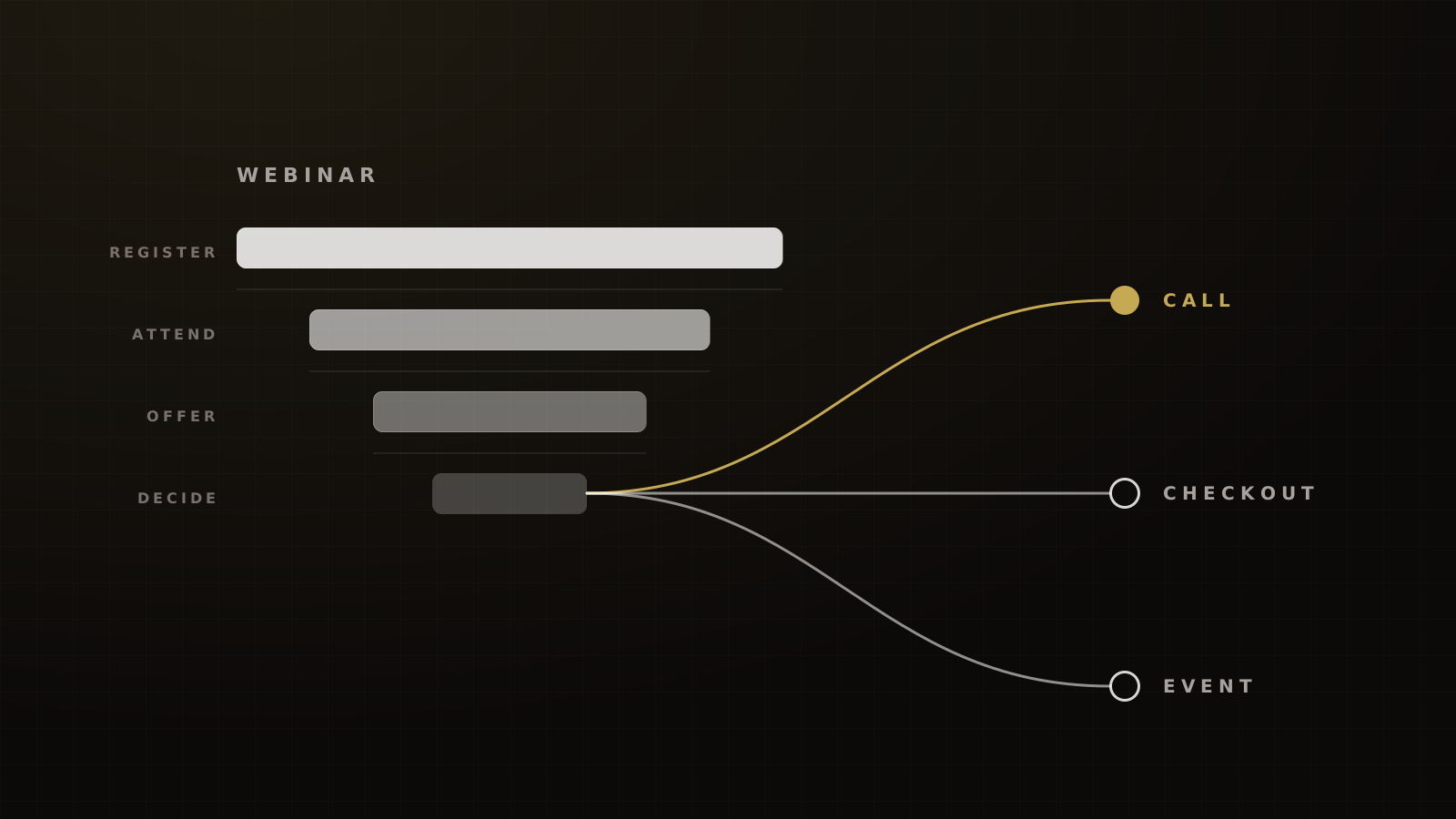
A webinar funnel is the path from an ad to a registration, to a presentation, to one specific sale: a booked call, a checkout or a seat at a live event. Pick that destination before anything else. It decides the pitch, the follow-up, who on your team owns the buyer, and the number you judge the webinar by.
Most webinar funnels get built the other way round. Pages first, then slides, and the question of what the webinar is supposed to produce gets answered after the first session flops.
We run webinars as a weekly sales engine. On our current best program, a weekly evening webinar with ads running only in the two days before each session, leads cost $4–5 and the program returns 4–7x ROAS week over week. The closest public yardstick, the median Meta lead-campaign cost for Education & Instruction, is $28.22.[2]
This playbook covers how that funnel is built, from the destination down to the follow-up map, and which public benchmarks you can and can't trust along the way.
What a webinar funnel is
Strip away the software and every webinar funnel has the same parts:
- Traffic: paid ads, your email and SMS list, partners.
- A registration page that sells the session, not the product.
- A confirmation page that locks in the date and fires your tracking.
- Reminders by email and text between sign-up and start time.
- The room: live, automated or hybrid.
- The offer, with one or more doors to buy.
- Follow-up sorted by what each person did.
The parts are easy. The order you decide them in is where funnels go wrong. Here is the order we use.
Framework
The webinar build order
- Destination. Call, checkout or live event. Everything downstream depends on it.
- Offer. Price, deliverables, bonuses, deadline. A great room can't save a weak offer.
- Format. Live first. Hybrid or automated only once a version has won.
- Pages. Registration, confirmation, room, replay and offer. Tracking on every step.
- Ad window. Short, close to the session, budgeted backwards from buyers.
- Show system. Confirmation page, reminder cadence, deliverability, one date.
- Pitch and doors. Pay now, financing with a person, more info with a closer.
- Follow-up map. By behavior, with buyers suppressed first.
Victory's build sequence. Offer-first thinking credited to Jason Fladlien; the four-page funnel is his; the Stack is Russell Brunson's, which he credits to Armand Morin.
Pick the destination first: call, checkout or live event
The destination is the sale the webinar exists to make. There are three common ones, and they behave differently enough that you shouldn't run one playbook for all three.
Webinar to booked call
Use this for high-ticket offers, or any offer where the buyer needs a diagnosis before they can say yes. The pitch sells the conversation, not the product. The closer sells the product.
Measure held calls, not bookings. A booked call that never happens is a cost, not a result. In our experience, calls booked no more than about three days out are held 82–88% of the time. RevenueHero's average no-show for B2B sales meetings is 15.9%, which is roughly the same band.[3] The longer the booking window, the more people forget why they booked.
Speed matters as much as the calendar. Our target is a first dial in under an hour during staffed hours, with every new lead dialed within 24 hours. The best-known audit of lead response, from 2014 and now old, found a median of 3 hours 8 minutes to a first call.[4]
Webinar to checkout
Use this when the buyer can decide alone: a clear deliverable, a price they don't need to talk through, and a real deadline.
Measure buyers on two denominators. Buyers divided by people who saw the offer tells you whether the pitch works. Buyers divided by registrants tells you whether the funnel pays. A pitch can be strong while the funnel loses money, because too few registrants reached the offer.
Webinar to live event
Use this when the real sale happens in a room. The webinar sells a seat, free or VIP, at a one-day event, and the high-ticket offer is made from stage.
Measure people at the event, not event sign-ups. The webinar's job is to put qualified buyers in seats, and seats are where the money is made. We cover that side in our guide to event marketing and show rates, and the ticket economics in free vs paid event tickets.
| Destination | Best for | Main CTA | Primary metric | Follow-up owner |
|---|---|---|---|---|
| Booked call | High-ticket offers, or offers that need a diagnosis | Apply or book a call | Held calls and closes per registrant | Closers |
| Checkout | Offers people can buy alone | Buy now, with a real deadline | Buyers per offer viewer and per registrant | Email and SMS, then a closer for high-intent non-buyers |
| Live event | Offers sold from stage | Claim a seat, free or VIP | Event attendees, then stage sales | Event team and reminder system |
Victory's operating model. Pick one destination per webinar; mixing them splits the pitch.
Live, automated and hybrid: definitions that matter
The format words get used loosely, and the loose use causes real mistakes. Here is what each one means and when it fits.
Live
A real presenter, in real time, with a real chat. Live is where you learn. Every session tells you where people leave, which objections come up, which bonus gets a reaction and how many buy at the price. That's why our best numbers come from a live weekly program.
Automated (evergreen)
Demio's definitions are the clearest we've found. An automated webinar is pre-recorded and scheduled for a specific date and time, and the host can join the chat live. An on-demand webinar can be watched any time after registering.[5]
Automated sessions lose people faster. In Demio's 2023 data, 29% of automated-webinar viewers dropped off in the first third of the session, against 26% for on-demand and 24% for live.[5]
Automation has one rule we don't bend: be honest about what it is. No simulated chat, no fake attendee counts, no countdown that resets for each viewer. The FTC's dark-patterns report names "baseless countdown timers" and false activity messages as deceptive designs.[6]
Hybrid
"Hybrid" means three different things depending on who's talking. Systeme.io uses it for a recording played at a scheduled time with a host answering in chat.[7] Zoom calls that same setup "simulive": hosts can use chat and Q&A during playback, but can't appear on live video.[8] The events industry uses "hybrid" for in-person plus virtual.
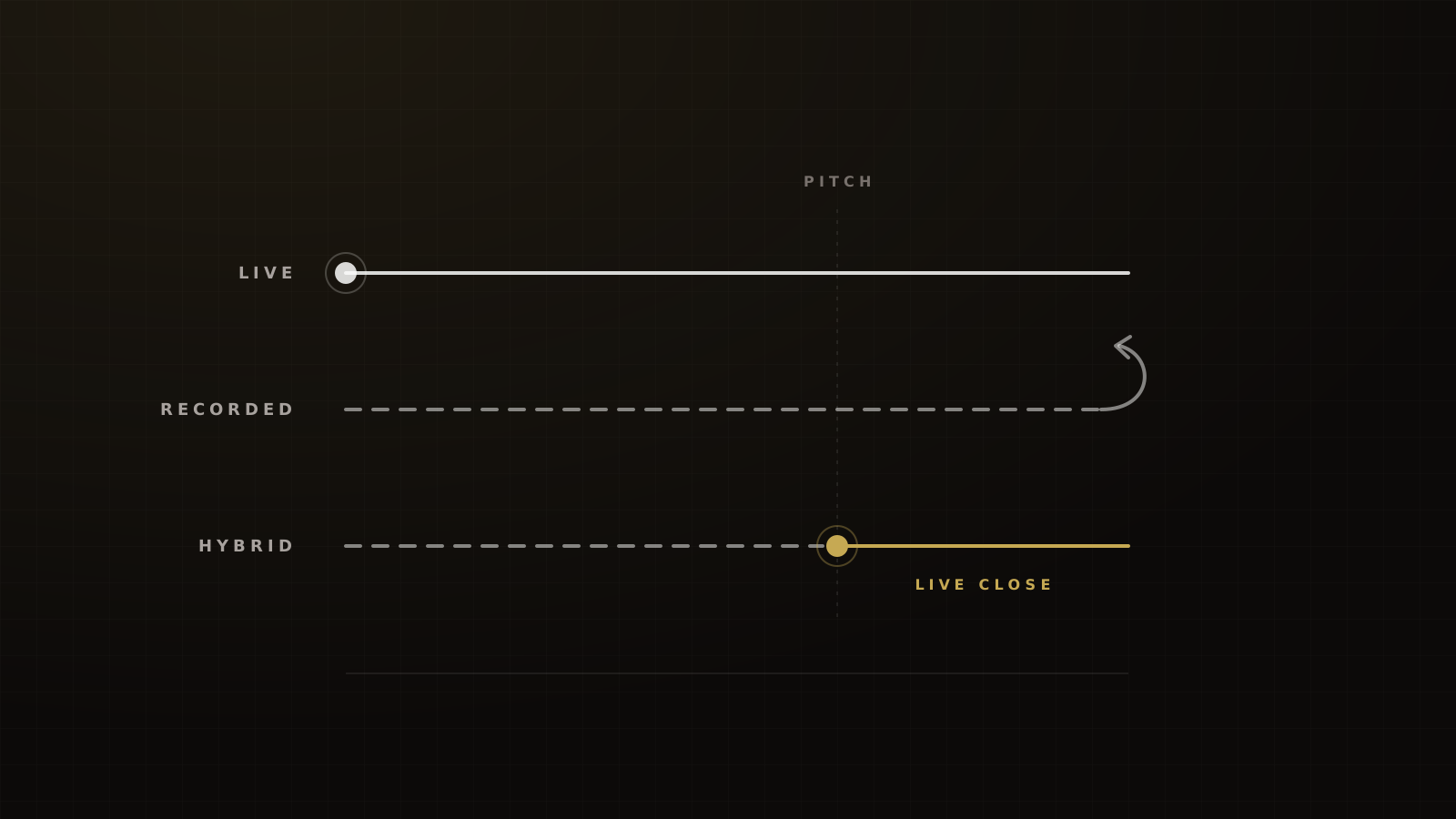
Our definition is narrower and more useful for selling: recorded teaching, then a real person live for the Q&A and the close. The teaching is consistent every time. The part that earns the money, handling objections and walking people through the doors, stays human. On higher-priced offers that difference is large, because the close is where a person adds the most.
Run live first, then automate the winner
Jason Fladlien's view is that automated webinars need the call to action earlier and less teaching, so they suit narrower offers at lower prices. We agree, and we add a sequencing rule: run live until a version clearly wins, then automate that version, not the one you hoped would win. Our full comparison is in live vs evergreen vs hybrid webinars.
The pages and the build
Fladlien's four-page webinar funnel is still the right skeleton: a registration page, a thank-you page, a sales page and a replay page. We build it with one change, a paid step after registration, and tracking on every page.
Registration page. Write it like an invitation to an event, not a product page. Lead with news if there is any. Fladlien argues for keeping a little friction, because sign-ups that take no thought show up less. In our experience, a free webinar registration page converts 22–30% of cold Meta visitors. GetResponse's landing pages that promote a webinar converted 22.3% of visitors, against 10.76% for all its landing pages, in 2023 data.[9]
Confirmation page. Keep it, even when you're cutting steps. It does two jobs. It fires your registration event, and it locks in commitment: the date and time in the registrant's timezone, add to calendar, what they'll get, and a prompt to text you first so your reminders don't arrive from an unknown number. Fire Meta's CompleteRegistration standard event here, on the actual completion; Meta defines it as submitting information in exchange for a service.[10] Fewer steps in total also means cleaner pixel data.
The paid step after registration. Keep registration free. On the next step, offer a low-priced VIP seat, replay access or a workbook. There's no friction, because they've already said yes. In our experience, 5–12% of free registrants take it, and it recovers roughly 40–50% of the webinar's ad spend. Don't compare that with vendor bump rates: SamCart's 30–40% take rate is measured among people already paying at checkout, a different denominator.[11] The full model is in the webinar order bump guide.
The room. Whatever platform you use, one rule matters more than the software: one date. If registrants can see next week's session, they'll wait for it.
Replay and offer page. The replay expires with the offer, on a real deadline. The offer page carries only what's needed to buy: deliverables, proof, guarantee, payment options.
If you build in HighLevel, our step-by-step is in how to build a webinar funnel in GoHighLevel, including the pipeline stages and workflows behind each page.
Traffic and timing: why we buy ads only in the last two days
This is the part of our program that surprises people most. We run paid ads only in the two days before each session, at a few thousand dollars a day. When we ran ads two weeks out, cost per lead went up and show rate went down.
The reason is that registrants decide late anyway. In Livestorm's 2025 data, 49.6% of registrations came in the final seven days and 15.3% on the day itself. Only 16.4% came three or more weeks early.[1] That's a distribution of sign-up dates, not a test of promotion length. But it matches what we see: people who register two weeks out put it on the calendar and forget it. So we buy the traffic when people are deciding.
What the short window did to cost per lead
For years, our best webinar cost per lead was $8–10. With the two-day window on a weekly evening session, it's now $4–5, the lowest we've seen.
For context, WordStream's 2025 median cost per lead for Meta Leads-objective campaigns was $27.66 across all industries and $28.22 for Education & Instruction, from 726 campaigns between April 2024 and June 2025.[2] LocaliQ's 2026 figure for Education & Instruction is $26.31, with no published method.[12] Neither is a webinar-registration benchmark, but they're the closest public yardstick.
On a working webinar ad, we typically see a cold Meta link CTR of 1.8–2.5%. LocaliQ's 2026 average for Education & Instruction lead campaigns is 1.74%.[12]
Budget backwards from buyers
Don't set a webinar budget by picking a daily spend. Start from the buyers you need and work back.
| Step | Input | Result |
|---|---|---|
| Buyers needed | 20 | 20 |
| Live attendees needed | 8% of attendees buy | 250 attendees |
| Registrants needed | 30% of registrants attend live | 834 registrants |
| Ad budget | $15 per registration | about $12,500 |
Every input here is hypothetical. Swap in your own buyer rate, show rate and cost per registration.
A first cold-traffic test usually comes in at $12–20 per registration in our experience, well before the program is tuned. That's why your first webinar should be cheap on purpose: a baseline test on your own list plus a small daily budget, not a launch. Run your own numbers in the webinar funnel calculator.
Day and time
Most public day-of-week data is B2B and daytime. Goldcast's best attendance rates in 2025 fell on its smallest days: Monday averaged 47.2% on 106 registrants, Thursday 38.7% on 486.[13] Livestorm's best day was Tuesday, at 51.7%.[1]
We found no credible public data on evening webinars for business owners or consumers. We run evenings for those audiences because that's when they're free. Treat your slot as a test, and compare sessions with similar registrant counts.
Show rate is a system
Paid traffic buys registrations. It doesn't buy attendance. Everything between sign-up and start time decides show rate: the confirmation page, the reminder cadence, whether the reminders actually deliver, and whether there's one date or several.
That show rate, it's all systems for webinar. It's how we communicate with the person from when they register to when the event happens.
Reminders. In Demio's 2023 data, webinars that used its email notifications had 35% live attendance, against 9% for webinars that didn't.[5] It's correlational, since some webinars "without" may have sent reminders from another tool. The direction is still clear.
What good looks like on cold traffic. In our experience, a cold-traffic, single-date evening webinar shows 25–35% of registrants live. The closest public proxy for small coaching businesses is Demio's: 20% for Education Services and 22% for hosts with under $1M in revenue, against 41–48% for larger companies, in 2023 data.[5]
Why platform averages look higher. On a warm or house list, we see 40–50% live. That's the band most platform reports sit in: Goldcast 40% for 2025 and Livestorm 47.7%.[13][1] Those datasets are mostly B2B and mostly house-list registrants. If you're buying cold traffic, don't hold yourself to them.
Deliverability is attendance. A reminder text that gets filtered is a registrant you paid for and lost. After we rebuilt our SMS setup (drip sends, trigger links on the brand's own domain, a registered number), reminder delivery came back above 95%. The full post-mortem is in why our event reminder texts got carrier-filtered. On email, we keep Gmail's user-reported spam rate under 0.1% on the domains we manage. Google's ceiling is 0.3%.[14]
One date. Urgency dies when people can see another session. Run one date, hide future ones, and give no-shows a replay with a real deadline instead.
The pitch
The pitch is where most webinars lose the room. Two structures are worth learning, and both deserve credit.
Fladlien's 14 steps in four blocks. An opening that earns attention and makes the problem felt. A content block that delivers the one belief shift that makes buying obvious. A short bridge from agreement to readiness. Then the pitch, which presents the deal and keeps going, objection by objection, for as long as people are still buying. He builds the offer first and writes the opening last.
Brunson's Perfect Webinar and the Stack. One core belief attacked from several angles, then a running summary of everything included that grows with each item before the price is revealed. Brunson credits the Stack to Armand Morin.
The structure underneath matters less than what most pitches get wrong: a single "buy now" button for a room full of people at different stages of ready. We give three doors.
- Pay now for people who've decided.
- Financing with a person for people who want it but need to talk through the money.
- More info with a closer for people who need a conversation first.
On $1K–$10K offers, 40–60% of webinar sales come through the more-info door in our experience. There's no industry benchmark for that. The nearest public signal is ON24's report that in-webinar meeting bookings tripled in 2024, in B2B.[15] The room design, timing and staffing for all three doors are in our webinar pitch structure guide.
The behavior-based follow-up map
A webinar's sales don't stop when the session ends. In our experience, 30–50% of a webinar's sales close after the live session, in the replay and follow-up window. There's no industry benchmark for that share. The only public case with real numbers is a 2019 course launch on Amy Porterfield's podcast: 58% of 35 sales of a $597 course came after the live webinars ended.[18] It's one self-reported launch, below $1K, so treat it as a story, not a benchmark.
Replays are a big part of that window. ON24 says 45% of its 2024 attendees watched on-demand, rising to 52% in 2025.[15][19] Goldcast found that 10.61% of live attendees went back and watched the replay.[13] Every one of those figures uses a different denominator, which is why one "replay email to everyone" is the wrong follow-up.
Segment by what people did, not by whether they registered.
| Priority | Segment | Signal | What they get | Owner |
|---|---|---|---|---|
| 1 | Buyer | Order completed | Onboarding, and removal from every sales message | Fulfillment |
| 2 | Checkout abandoner | Started checkout, no order | A fast personal text or call | Closer |
| 3 | Offer-page visitor | Clicked the offer, no checkout | Objection-handling emails, and a call on high-ticket offers | Closer and email |
| 4 | Attendee, no purchase | Stayed through the pitch | The close replayed, the bonuses, the real deadline | Email and SMS |
| 5 | Replay viewer | Watched a set share of the replay | The pitch segment, then the deadline | Email and SMS |
| 6 | No-show | Registered, didn't attend | The replay, with the same deadline | Email and SMS |
Victory's segmentation. When someone fits two rows, the higher row wins.
Three rules hold the map together:
- Suppress buyers first. Nothing kills trust faster than a "last chance" email to someone who bought yesterday.
- Highest intent wins. If someone watched the replay and abandoned checkout, they're a checkout abandoner.
- One sequence at a time. Overlapping sequences double the sends and halve the trust.
Within each segment, Brunson's ordering is a good default: lead with stories, then the logical case, then real urgency for the people who need a deadline. Fladlien's rule for the replay is that it expires with the offer. The full email and text sequences are in the webinar follow-up sequence.
Benchmarks without the denominator games
Webinar benchmarks are mostly attendance numbers, and most of them hide which denominator they used. Read them carefully before you judge your own webinar against them.
Goldcast's headline webinar attendance rate for 2024, against its own average attendees divided by average registrants (51 ÷ 238)
Goldcast's 2026 report repeats the pattern. It headlines 40% attendance for 2025. Its average registrants and attendees (251 and 102) give 40.6%, but its platform totals (2,220,718 attendees from 6.8 million registrants) give 32.7%.[13] Same report, two answers, depending on whether you average per webinar or across everyone.
Three more traps:
- "Total" isn't live. ON24 reports 60% registrant-to-attendee conversion for 2025 and labels it "total", which includes on-demand viewers.[19] It's not a live show rate.
- Two numbers on one page. Livestorm reports a 47.7% live show-up rate for 2025, and the same page also gives 51.3% as the average show-up rate without reconciling the two.[1]
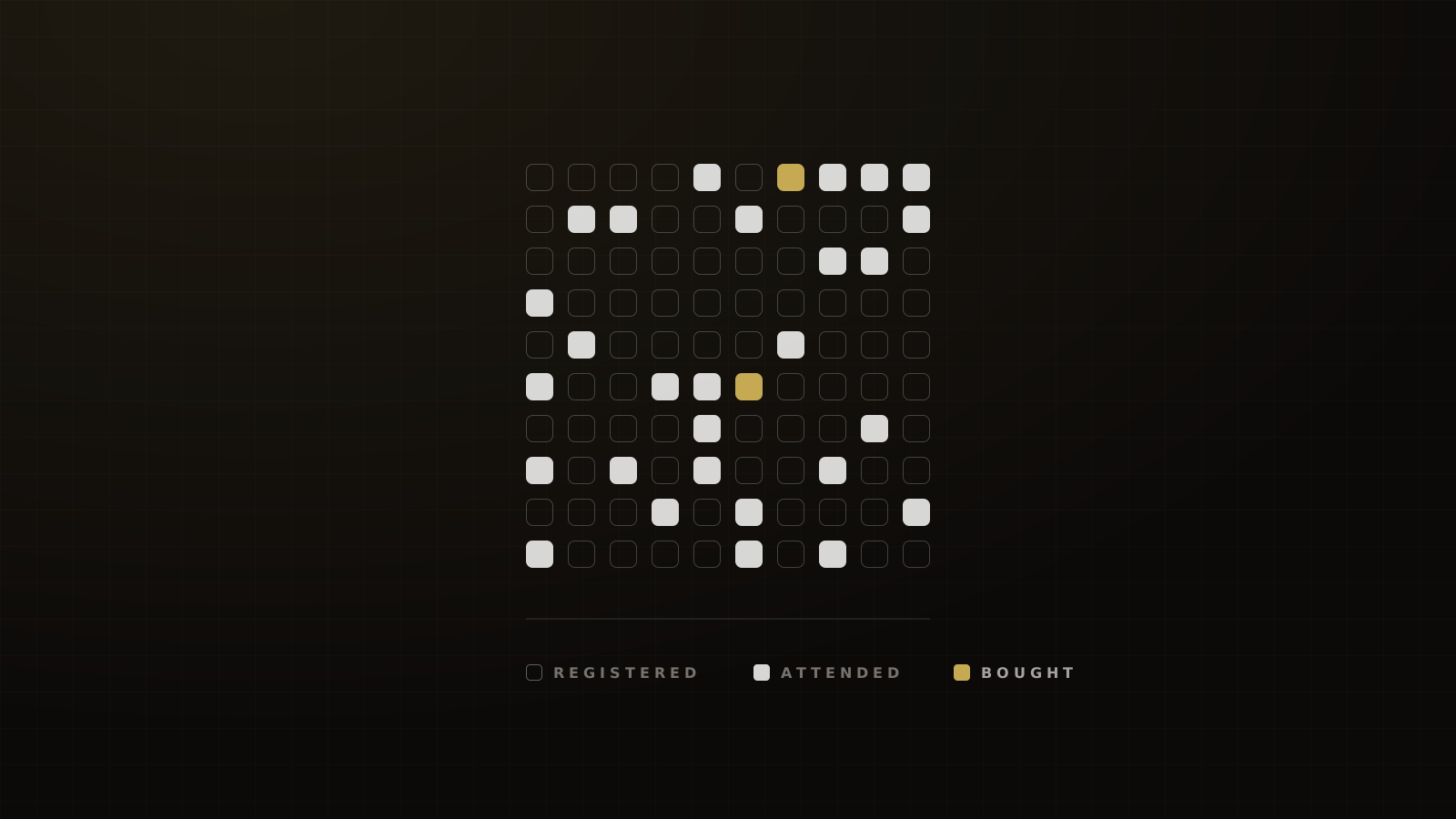
- Small rooms post bigger percentages. Goldcast's highest-attendance days are its smallest-audience days. A 60% show on 80 registrants isn't better than 35% on 900.
The number nobody publishes
None of the major platform reports (ON24, Goldcast, Livestorm, Demio) publishes an attendee-to-buyer rate for $1K–$10K coaching or course webinars. The ranges you'll see elsewhere usually have no sample behind them. EasyWebinar's guide, for example, gives 3–8% registrant-to-sale with no dataset.[21]
The operator figures that exist are self-reported. Russell Brunson has said a typical webinar shows about 25% of registrants, that 5% of attendees buying is a good webinar, and 10% is one that can scale.[22] Those are his claims, not benchmarks.
Our rule of thumb on $1K–$10K offers: 6–10% of live attendees buying is good. At 1–3%, something is broken, and the first suspect is the offer, not the room. A bigger audience doesn't fix a weak offer.
A myth to retire
"73% of B2B marketers say webinars are the best way to generate quality leads" comes from a 2017 XANT survey of 678 sales and marketing leaders. In that chart, webinars actually ranked second, at 73%, behind small executive events at 77%.[23] It's nine years old and usually misquoted.
The full side-by-side, with every platform on the same denominator, is in webinar conversion rate benchmarks.
Frequency: pitch reps beat one big event
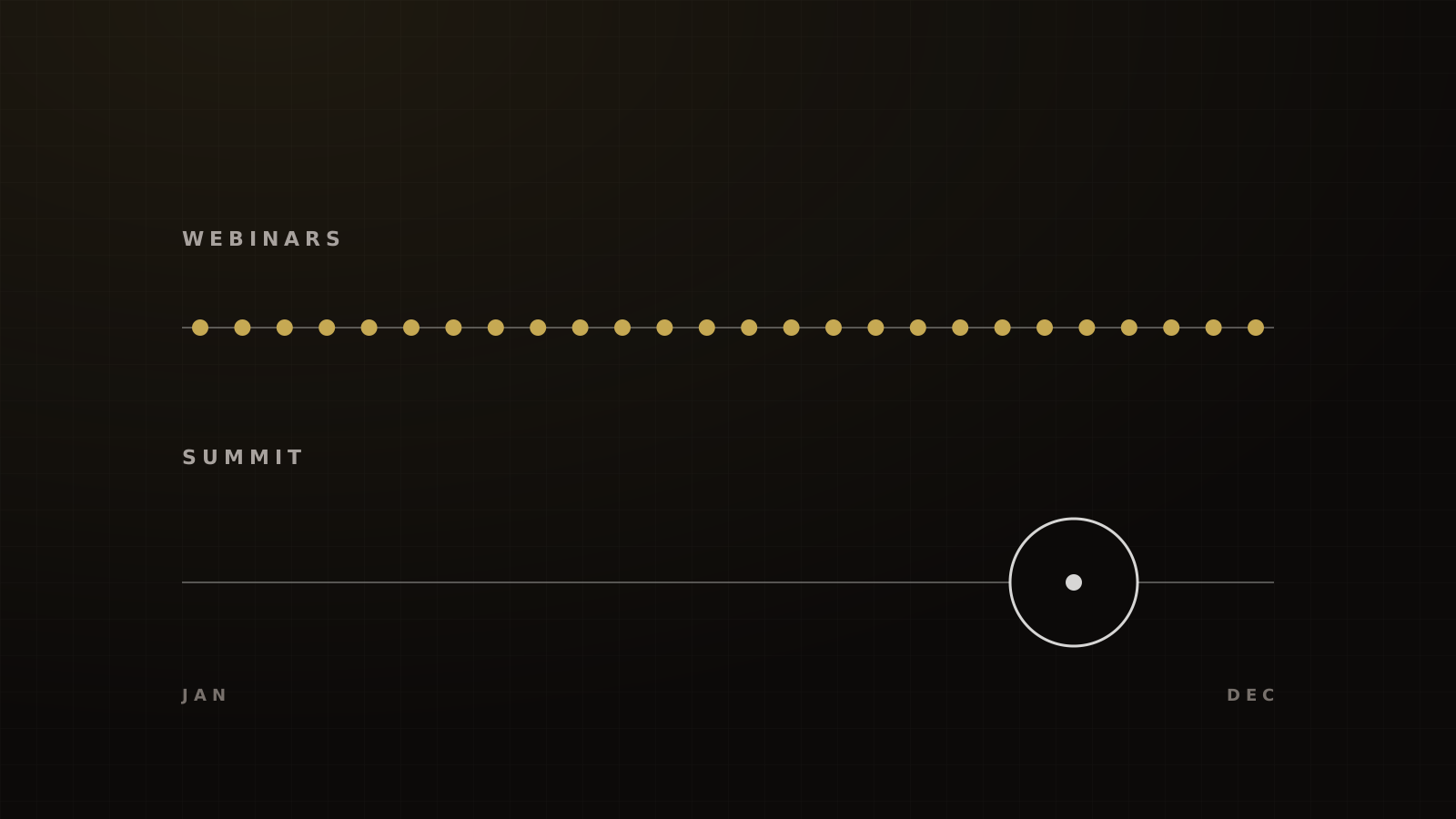
A summit gives you one pitch after spending heavily to fill it. If the pitch is off, you find out once, at the most expensive moment.
A webinar every two weeks gives you two pitches a month. Each one tells you something: where people left, which objection came up, which bonus landed. The pitch gets better on a schedule, revenue arrives steadily, and the audience you'll need for a big event builds along the way.
That's why we run frequent small webinars before one big event. Whichever offer converts best in the small sessions is the one that runs on the big stage. The longer argument is in webinars vs virtual summits.
See how we build it
The funnel above is the one we run every week: one destination, a live-first format, a short ad window, a show-rate system, three doors at the close and a follow-up map sorted by behavior. If you want it built and run for your offer, book a strategy call and we'll walk through how we'd set it up for you.
Frequently asked questions
Sources
- 1.Webinar Benchmark Report 2026. Livestorm, 2026-09-01.
- 2.Facebook Ads Benchmarks 2025. WordStream by LocaliQ, 2025, modified 2026-09-14.
- 3.Ways to reduce no-show rates in sales calls. RevenueHero, 2025-08-18.
- 4.Annual 2014 Lead Response Report. InsideSales.com (XANT), 2014.
- 5.Webinar Statistics 2024. Banzai (Demio), 2024-01.
- 6.Bringing Dark Patterns to Light (staff report). Federal Trade Commission, 2022-09.
- 7.Webinar funnel guide. Systeme.io, 2026-06 (updated).
- 8.Hosting a webinar with pre-recorded content. Zoom Support, living doc, checked 2026-10-04.
- 9.Email Marketing Benchmarks (2024 edition). GetResponse, 2024.
- 10.Specifications for Meta Pixel standard events. Meta Business Help Center, living doc, checked 2026-10-04.
- 11.The complete guide to order bumps. SamCart, 2026-03-30.
- 12.Facebook Advertising Benchmarks 2026. LocaliQ, 2026-09-23.
- 13.B2B Webinar Benchmark Report 2026. Goldcast, 2026.
- 14.Email sender guidelines. Google Workspace Admin Help, living doc, checked 2026-10-04.
- 15.Key takeaways from the 2025 Webinar Benchmarks Report. ON24, 2025-02-20.
- 16.How to spot and avoid business coaching scams. FTC Consumer Advice, 2026-04-24.
- 17.FTC proposes rule changes and new rule to deter deceptive earnings claims. Federal Trade Commission, 2025-01-13.
- 18.Online Marketing Made Easy, episode 292 (transcript). Amy Porterfield, 2019-12-05.
- 19.Webinar guide (citing the 2026 Webinar Benchmarks Report). ON24, 2026, page undated.
- 20.B2B Webinar Benchmark Report 2025. Goldcast, 2025.
- 21.Webinar funnel guide. EasyWebinar, 2026-05-04.
- 22.The playbook to a high converting webinar (Perfect Webinar). ClickFunnels blog (Russell Brunson), 2016-01-18, updated 2026-03-19.
- 23.Optimal Lead Generation Methods. XANT (InsideSales.com), 2017.
Written by
Ray GillespieCo-Founder & COO
Ray runs day-to-day operations across every Victory engagement, building the systems, automations and AI-powered workflows that hold the machine together. He has overseen operations behind more than $120M in revenue.