Webinar Pitch Structure: How to Transition to the Offer and Close (Pay Now, Financing and More-Info Rooms)
Don't end a webinar with one buy button. Give three doors (pay now, financing, more info with a closer) and control the room so nothing competes.
 Devin AlexanderCo-Founder & CEO
Published 10 min read

On this page
- Why pitches fail at the offer, not the content
- The structure underneath: pick one and credit it
- The transition: from teaching to the offer
- Three doors: pay now, financing, more info
- Timing: drop the form early, keep closing late
- Control the room
- What to say about results without breaking FTC rules
- Book a strategy call
Key takeaways
- Don't end a webinar with one "buy now" button. Give three doors matched to how ready people are: pay now, financing with a person, and more info with a closer.
- On $1K–$10K offers, 40–60% of webinar sales come through the more-info door in our experience.
- The room shrinks while you pitch: live viewers watch about 74% of a webinar on average.[1] Get the form on screen early, then keep closing.
- Control the room: one date, no future sessions visible, a managed chat, and someone who owns the run of show.
- Real deadlines, real testimonials and no implied typical results. The FTC has rules for every one of those.
Don't end a webinar with one "buy now" button. Give three doors matched to how ready people are: pay now, financing with a person, and more info with a closer. Then control the room so nothing competes with them: one date, no future sessions visible, a managed chat, and the form dropped into chat before the energy fades.
The pitch structure underneath can be Jason Fladlien's or Russell Brunson's. Both work, and both deserve credit. The CTA design and the room control are what most pitches lose, so that's what this framework is about.
Why pitches fail at the offer, not the content
Most webinars that don't sell lose people at the offer, for two reasons.
The offer wasn't built first. Fladlien's rule is to get the offer right before anything else, because a great presentation can't rescue a weak one. When we see 1–3% of live attendees buying on a $1K–$10K offer, the offer is the first suspect. Our rule of thumb is that 6–10% is what good looks like on those offers. Brunson has said 5% of attendees buying is a good webinar, which is his claim, not a benchmark.[2]
The room shrinks while you talk. Goldcast's live viewers watch about 74% of a webinar on average, so roughly a quarter miss the end.[1] Livestorm's average viewer stays 26 minutes of a 68-minute session.[3] In Demio's data, more than half of viewers leave before 90% of the session.[4] If your only call to action arrives at minute 80, most of the people who might have bought are gone.
The structure underneath: pick one and credit it
Fladlien's 14 steps
Fladlien's structure runs in four blocks: an opening that earns attention and makes the problem felt; a content block that delivers the one belief shift that makes buying obvious; a short bridge from agreement to readiness; and the pitch. Three of his ideas matter most at the close.
- Bonuses last, and longest. He gets from the product to the price quickly, then spends far longer on the bonuses than on the core offer.
- Risk and objections. He treats a guarantee as one tool among several, and puts more weight on handling objections, one by one.
- Close long. He expects most people to say no at first, and treats that as where the real selling starts. He keeps pitching for as long as people are still buying.
Brunson's Stack
Brunson's Perfect Webinar attacks one core belief from several angles, then transitions to the offer and builds the Stack: a running summary of everything included, shown again after each new item, until the value far outweighs the price. Brunson credits the Stack to Armand Morin. He also teaches trial closes, small questions the audience says yes to throughout the presentation, which he credits to Ted Thomas.
Use either one, in your own words. Don't mix halves of both.
The transition: from teaching to the offer
Keep the transition short and ask permission.
Summarize what they've learned. Name the gap between knowing it and doing it. Then ask whether they'd like to see how you can help them close that gap. A clear yes in chat from the room gives you the right to pitch, and it tells you who's interested before the price appears.
Three doors: pay now, financing, more info
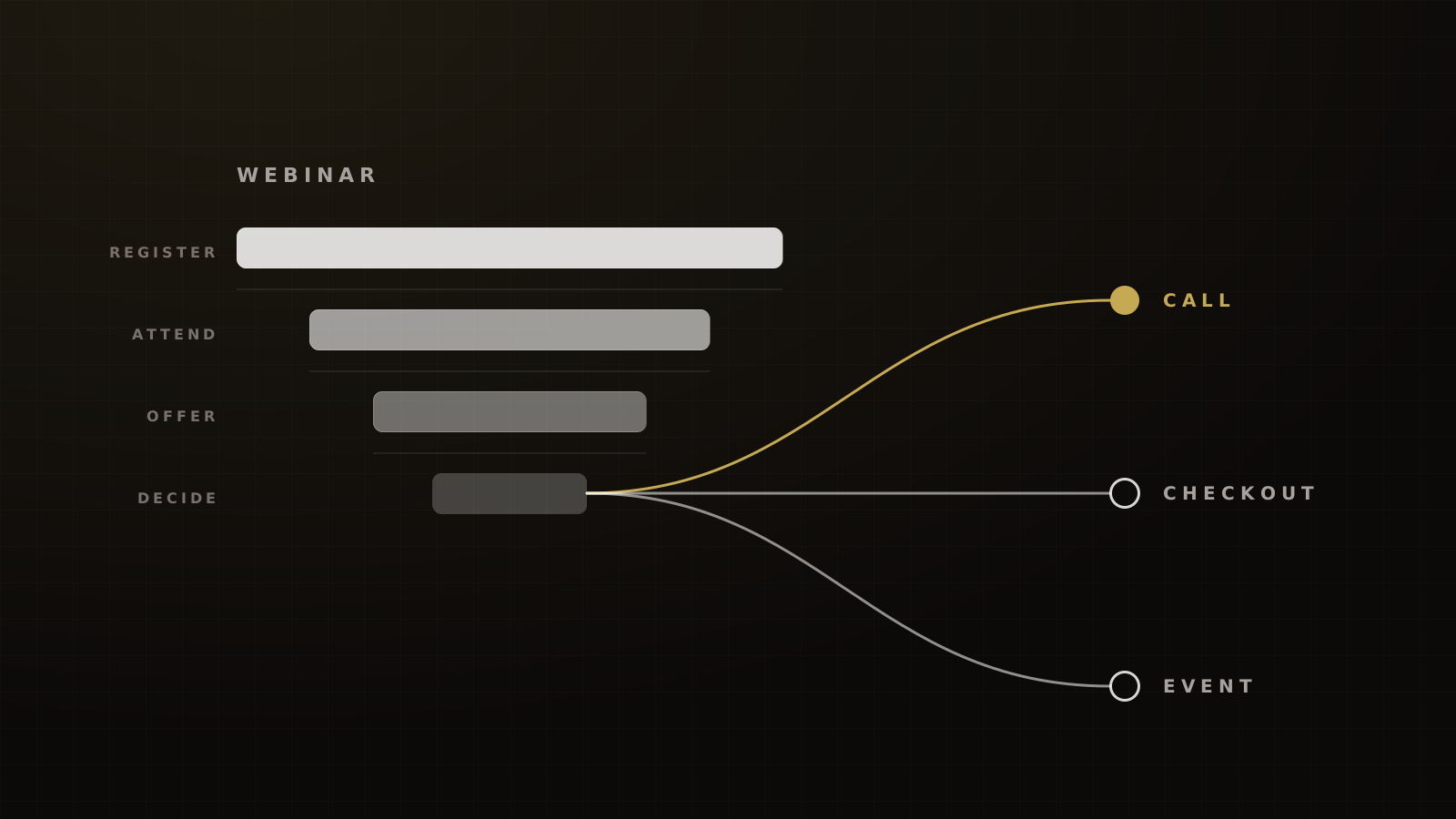
A webinar room holds people at three stages of ready. One button serves only the first group. Three doors serve all of them.
Framework
The three-door close
- Pay now. For people who've decided. One click to checkout, a real deadline, payment options shown side by side.
- Financing with a person. For people who want it but need to talk through the money. A short form, then a person who walks them through terms.
- More info with a closer. For people who need a conversation first. A form dropped into chat, then a closer in a staffed room or on a call within days.
Victory's CTA design for webinar offers. Pitch structure underneath credited to Jason Fladlien or Russell Brunson.
Pay now
Make it the shortest path in the funnel: one click from the webinar to a checkout that already knows who they are. Show the payment options side by side, so the decision is how to buy rather than whether. Fladlien frames price this way too: anchor high, talk about investing, and show the plans next to each other without making the plan look like a bad deal.
The deadline has to be real. If the bonuses end at midnight, they end at midnight.
Financing with a person
On higher-priced offers, a financing option brings in buyers who'd otherwise leave. Stripe's A/B tests across more than 150,000 checkout sessions found that showing a buy-now-pay-later option raised revenue by up to 14%. Orders of $500–$1,500 saw the largest conversion gain, and over two-thirds of the BNPL volume was net-new sales.[5] That's a checkout test, not a webinar one, but it's the best causal data there is.
We put a person on this door anyway. In the Federal Reserve's 2025 survey, 16% of US adults used buy-now-pay-later, and 26% of users paid late at least once.[6] A person makes sure the buyer understands the terms and can carry the payments. That protects them, and it protects your refund and chargeback rates.
More info with a closer
This is the door most pitches leave out, and on high-ticket offers it's often the biggest. On $1K–$10K offers, 40–60% of webinar sales come through the more-info door in our experience. There's no industry benchmark for that. The nearest public signal is B2B: ON24 reported that meeting bookings during webinars tripled in 2024 and live chat with sales rose 51%.[7]
Rooms lead to the highest conversions.
The platform catch. Zoom webinar breakout rooms need a Zoom Events or Webinars Plus licence.[8] On a standard licence, run the more-info room as a separate Zoom Meeting link, or send people to a calendar.
If it's a calendar, keep it short. In our experience, calls booked no more than about three days out are held 82–88% of the time. RevenueHero's average no-show for B2B sales meetings is 15.9%.[9] Booking should be instant: Chili Piper found that 66.7% of qualified demo-form submissions booked a meeting when scheduling was immediate.[10]
Call fast. Our target is a first dial in under an hour during staffed hours, with every form submission dialed within 24 hours. The best-known lead-response audit, from 2014, found a median of 3 hours 8 minutes to a first call.[11]
Staff for it. Our working assumption is that one full-time closer holds 4–6 high-ticket calls a day at 80% calendar fill. Count the forms you expect from a session and staff the next three days to match. When calls no-show, we aim to rebook 30–40% of them within 48 hours. That's our target; there's no industry benchmark for it. How we structure the closers themselves is in building a high-ticket sales team.
| Door | Who it's for | Where the link goes | Who staffs it |
|---|---|---|---|
| Pay now | People who've decided | One-click checkout with plans side by side | Nobody live; support on standby |
| Financing with a person | Want it, need to talk through the money | Short form, then a call or chat | A closer or finance specialist |
| More info with a closer | Need a conversation first | Form in chat, then a staffed room or a calendar with the next three days open | Closers |
Victory's operating model. Staffing depends on offer price and session size.
Timing: drop the form early, keep closing late
Two pieces of good advice seem to conflict. Goldcast's data says to land the CTA in the first two-thirds, because a quarter of live viewers leave before the end.[1] Fladlien says close long, because most of the money comes after the first no.
Do both. Put the offer and the form on screen while most of the room is still there. Drop the form into chat as soon as the offer is up, and pin it. Then keep closing: take objections one at a time, re-show the Stack, remind people of the deadline. Everyone who's ready can act early. Everyone who isn't hears the objection handling that might get them there.
The close also doesn't end with the session. In our experience, 30–50% of a webinar's sales close after the live session, in the replay and follow-up window. The one public case with real numbers is a 2019 course launch: 58% of 35 sales came after the live webinars ended.[12] It's a single, self-reported launch, so treat it as a story. Carry the same three doors into the webinar follow-up sequence.
Control the room
Even a strong pitch dies if the room fights it.
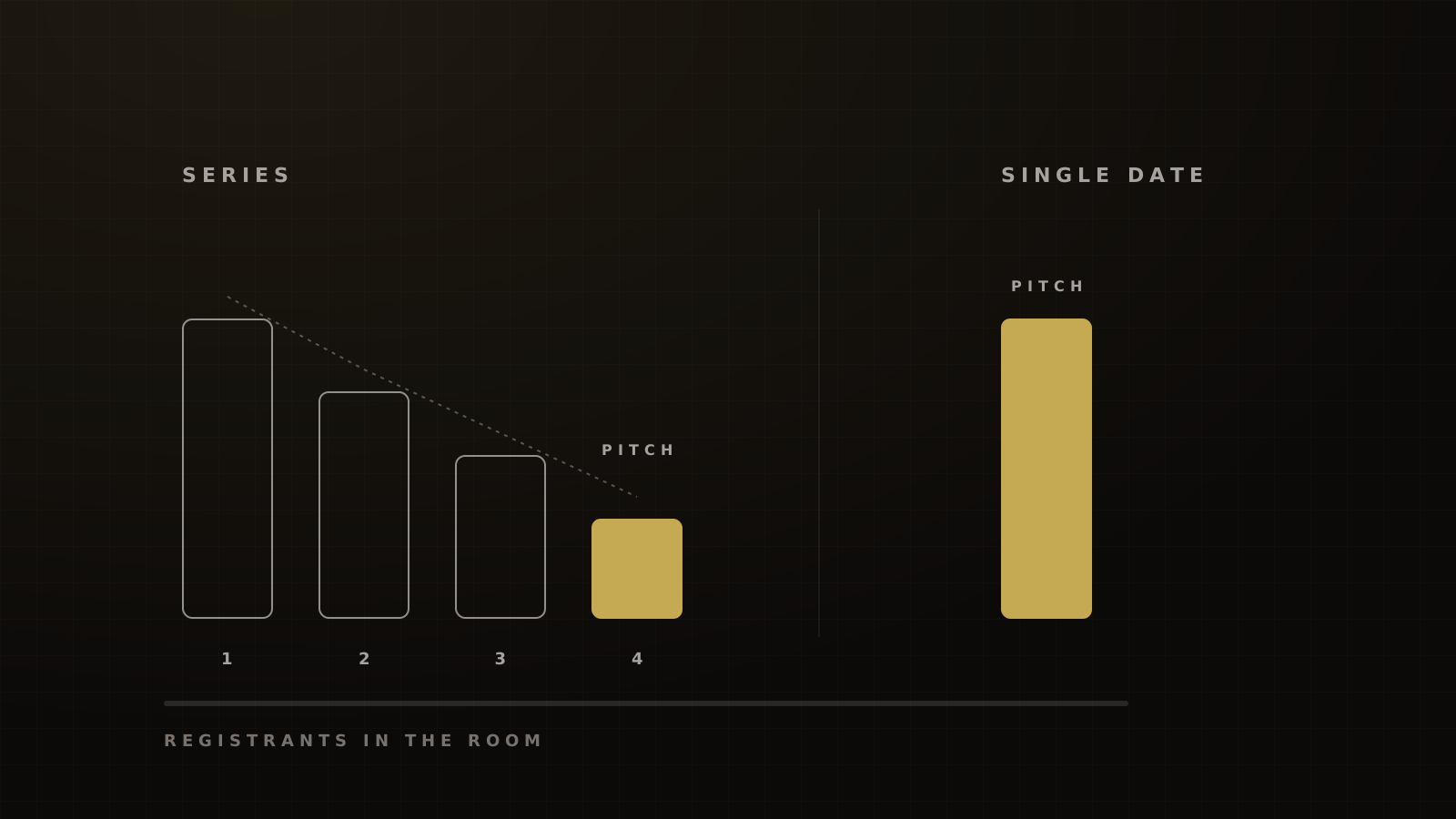
One date, no future sessions visible. If people can see another session next week, there's no reason to decide tonight. Hide future dates on the page and in the emails.
Manage the chat. Chat was used in 62.3% of Goldcast's 2025 webinars, while CTA clicks occurred in only 17.8%.[1] Chat is where the room's energy goes, so point it at the offer. In one post-mortem, the call to action got drowned out by attendees swapping LinkedIn profiles in chat. A moderator should answer questions, pin the form and steer side conversations away.
Own the run of show. On one client-run webinar, the session opened with an AI avatar and the chat was switched off, with no input from the team responsible for the results. If you're judged on sales, you need a say in the content and the pitch.
Use the format the offer needs. High-trust offers convert better one-to-many: a webinar puts the founder's conviction in front of hundreds at once, and the closer picks up from there.
What to say about results without breaking FTC rules
The close is where claims get made, so it's where the rules bite.
- Testimonials must be real. The FTC's 2024 Consumer Reviews and Testimonials Rule bans fake or false testimonials and fake social-media indicators, such as an inflated "people watching" count.[13]
- Atypical results need context. Under the FTC's Endorsement Guides, if a testimonial shows results people don't generally get, you have to make clear what they generally can expect.[14]
- Scarcity must be real. The FTC names baseless countdown timers and false limited-time messages as dark patterns.[15]
- Income claims are an enforcement priority. The FTC's 2026 coaching-scam alert flags guaranteed income and glowing success stories.[16] In 2024 it banned the owners of Automators AI from the business-opportunity industry over unfounded passive-income claims.[17]
Book a strategy call
The pitch is one part of the webinar funnel playbook. To judge whether yours is working, use the denominators in webinar conversion rate benchmarks, and if you're weighing one big event against frequent smaller ones, see webinars vs virtual summits. If you want us to rebuild your close with three doors and a staffed room, book a strategy call.
Frequently asked questions
Sources
- 1.B2B Webinar Benchmark Report 2026. Goldcast, 2026.
- 2.The playbook to a high converting webinar (Perfect Webinar). ClickFunnels blog (Russell Brunson), 2016-01-18, updated 2026-03-19.
- 3.Webinar Benchmark Report 2026. Livestorm, 2026-09-01.
- 4.Webinar Statistics 2024. Banzai (Demio), 2024-01.
- 5.Testing the impact of buy now, pay later. Stripe, 2024-06-18.
- 6.Consumer & Community Context (August 2026). Federal Reserve, 2026-08.
- 7.Key takeaways from the 2025 Webinar Benchmarks Report. ON24, 2025-02-20.
- 8.Using breakout rooms in webinars. Zoom Support, living doc, checked 2026-10-04.
- 9.Ways to reduce no-show rates in sales calls. RevenueHero, 2025-08-18.
- 10.Form Conversion Rate Benchmark Report. Chili Piper, 2025-02-18.
- 11.Annual 2014 Lead Response Report. InsideSales.com (XANT), 2014.
- 12.Online Marketing Made Easy, episode 292 (transcript). Amy Porterfield, 2019-12-05.
- 13.Consumer Reviews and Testimonials Rule: Questions and Answers. Federal Trade Commission, 2024-11.
- 14.FTC's Endorsement Guides: What People Are Asking. Federal Trade Commission, 2017-09-07, modified 2025-07-15.
- 15.Bringing Dark Patterns to Light (staff report). Federal Trade Commission, 2022-09.
- 16.How to spot and avoid business coaching scams. FTC Consumer Advice, 2026-04-24.
- 17.FTC action leads to ban for owners of Automators AI e-commerce money-making scheme. Federal Trade Commission, 2024-02-27.
- 18.FTC proposes rule changes and new rule to deter deceptive earnings claims. Federal Trade Commission, 2025-01-13.
- 19.Buy Now, Pay Later (BNPL) products. Consumer Financial Protection Bureau, page modified 2025-07-01.
Written by
Devin AlexanderCo-Founder & CEO
Devin architects Victory's revenue systems: team structure, comp plans, scripts and the accountability frameworks that make sales floors predictable. He has generated more than $150M in sales and trained more than 250 closers.
Part of the guide: The Webinar Funnel Playbook: Live, Automated and Hybrid Webinars That Sell (2026)