Free Webinar Registration With a Paid Order Bump: How to Offset Ad Spend
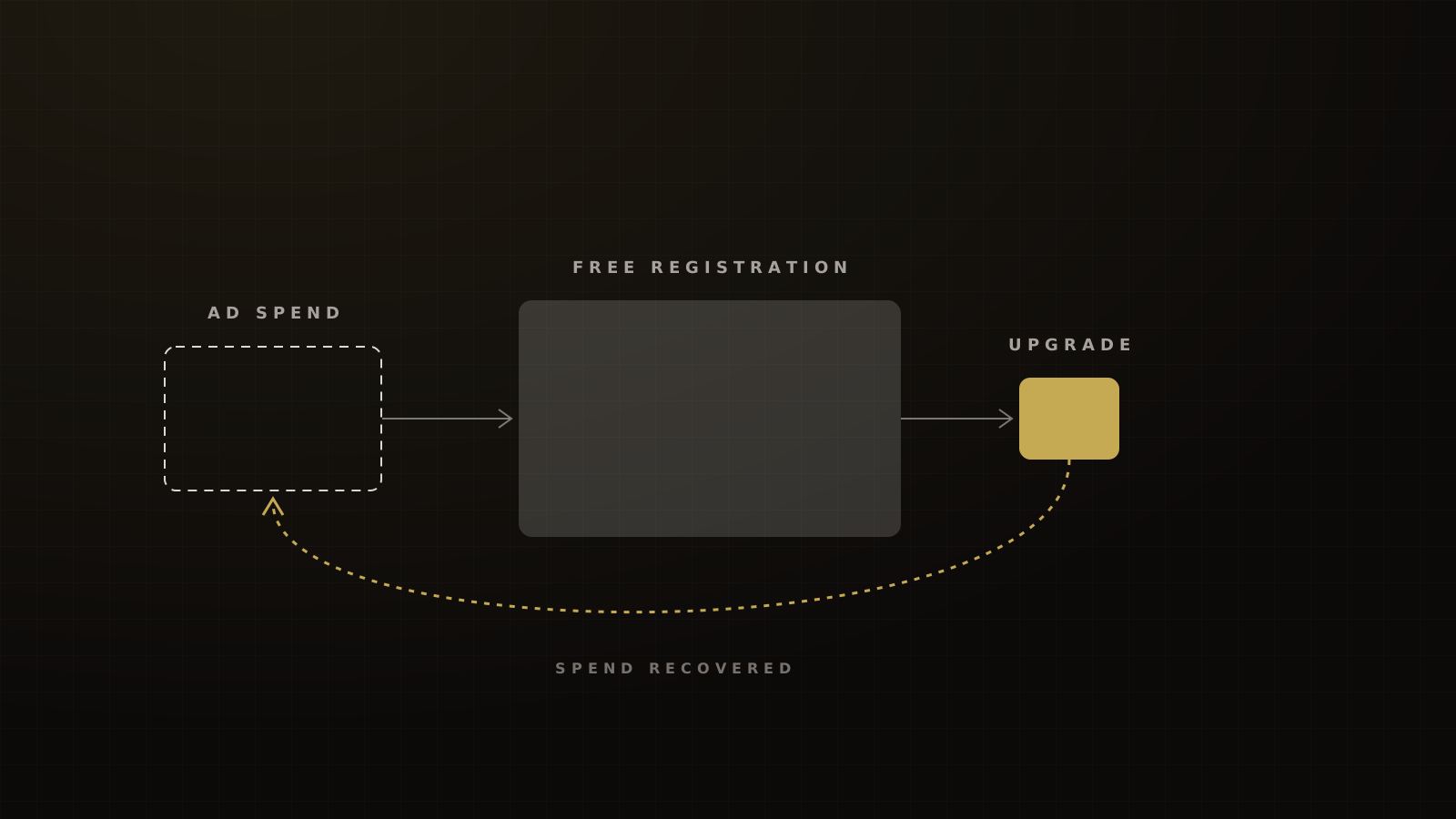
Keep webinar registration free and sell a small paid upgrade right after sign-up. Where the paywall goes, how much ad spend it recovers, how to build it.
 Ray GillespieCo-Founder & COO
Published 7 min read
On this page
Key takeaways
- Keep registration free. Put the paywall one step later, as a small paid upgrade right after sign-up, when the person has already said yes.
- On the funnels we run, 5% to 12% of free registrants take that upgrade, and it recovers roughly 40% to 50% of the webinar's ad spend.
- Don't plan with SamCart's 30% to 40% bump rate. It's measured on paying buyers at checkout, not free registrants.[1]
- Share of spend recovered = take rate × upgrade price ÷ cost per registration. The lower your cost per registration, the more a small upgrade matters.
- In GoHighLevel, a free form can't carry a bump.[2] The paid offer goes on the confirmation step.
Keep webinar registration free and sell something small on the very next step. A VIP seat, replay access or a workbook, offered the moment someone registers, adds no friction to the sign-up itself. They've already said yes.
A few of them buying it claws back a real share of the ad spend. And the people who pay have more reason to show up. Here is where the paywall goes, how much it can recover, and how we build it.
A note on terms. Strictly, an order bump is a checkbox add-on to a product someone is already buying. A paid offer after a free sign-up is closer to what Russell Brunson calls a tripwire, an idea he credits to Ryan Deiss and Perry Belcher. Most people search for "webinar order bump", so we use that name here.
Free vs paid registration: why we don't pick one
A paid registration buys commitment and costs volume. A free one buys volume and costs commitment. We want both, so we split them across two steps.
The volume side is easy to see. GetResponse found landing pages promoting a webinar converted 22.3% of visitors in 2023 data.[3] On cold Meta traffic, our webinar registration pages convert 22% to 30%. Put a price on that page and you shrink the top of the funnel before anyone has seen the pitch.
The commitment side is real too, though the best evidence is from in-person events. PheedLoop's 2026 data on more than 1,070 events found a median no-show of about 28% for free events and about 17% for paid.[4] That compares different events, not different people at the same event, so read it as a direction.
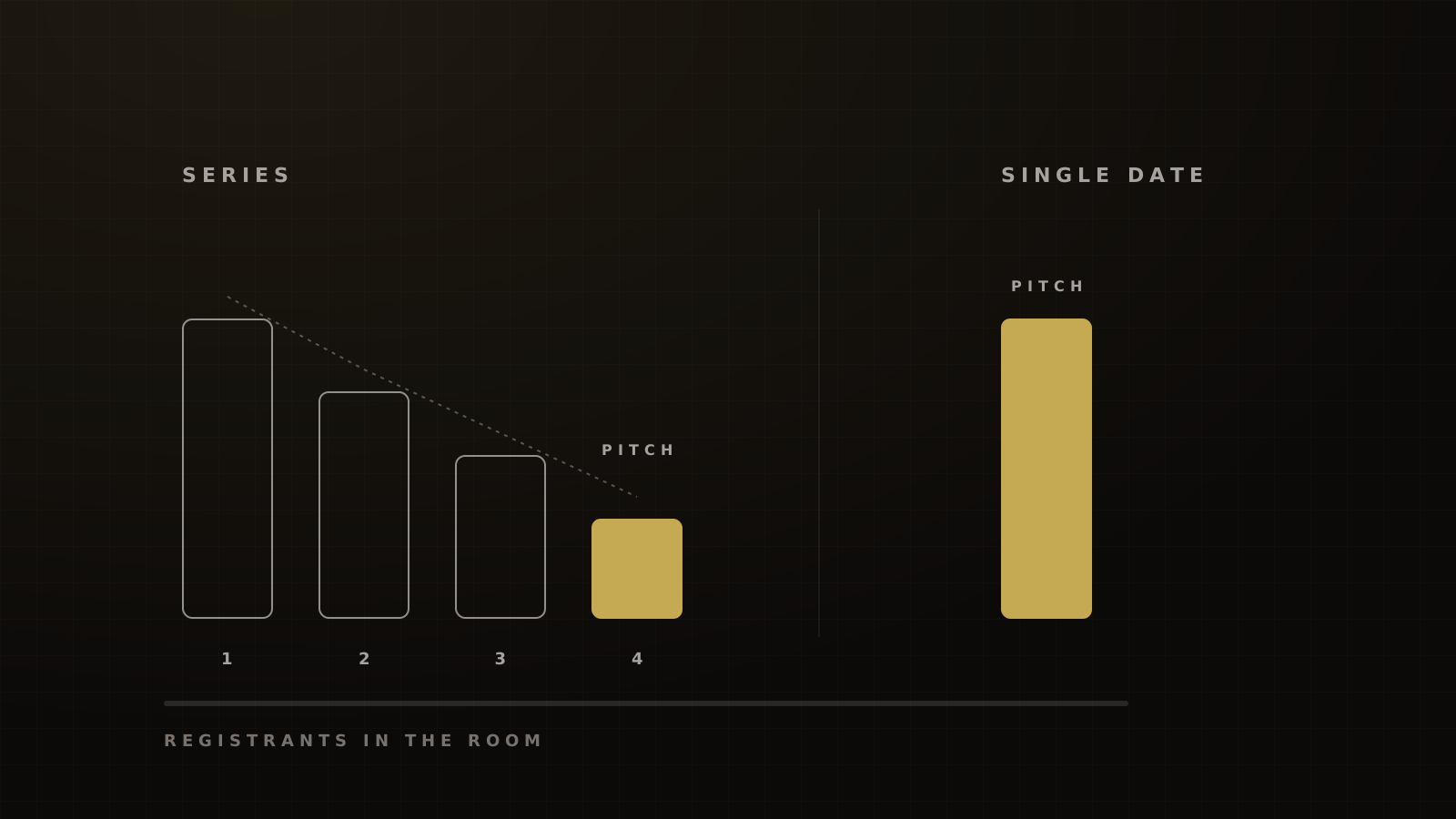
Jason Fladlien argues for a little friction at registration, because sign-ups that are too easy hurt show rate. A paid step after registration is a way to add that friction for the people who want it, without forcing it on everyone.
Where the paywall goes
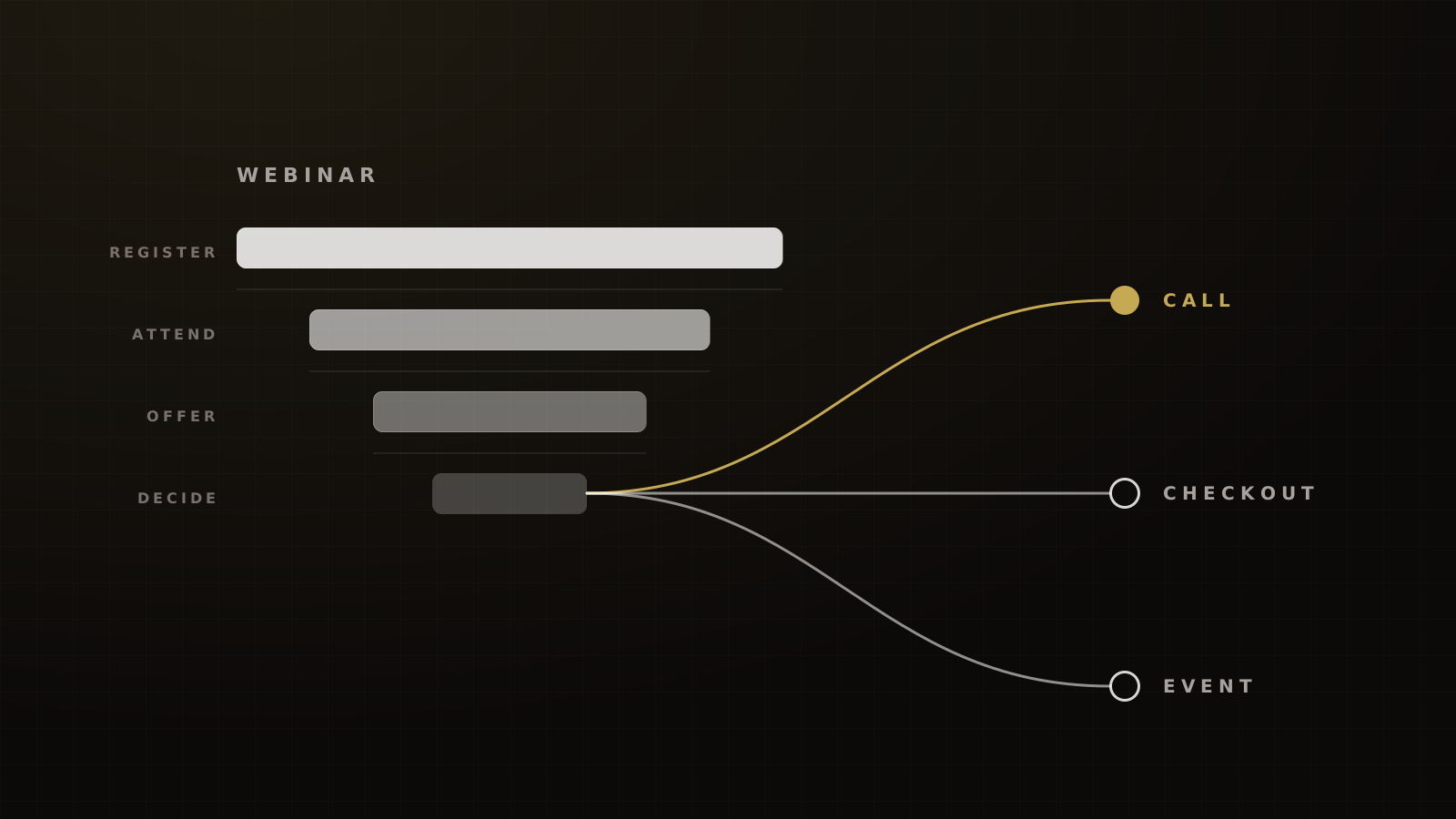
The upgrade goes on the confirmation step, the page people land on straight after registering. Brunson's weekly webinar model puts a small self-liquidating offer on the thank-you page for the same reason: it's the moment of highest intent before the webinar.
What to sell:
- Replay access. Simple to deliver and easy to value. If it's the paid item, don't also send the replay free to everyone.
- A workbook or implementation guide that follows the webinar.
- Priority Q&A or a short VIP session after the main webinar.
- A VIP seat, for hybrid or in-person versions.
Price it against the core offer, not the free webinar. SamCart suggests pricing a bump at 20% to 40% of the main product,[1] but the main product here is free, so that rule doesn't translate. Keep the upgrade low enough to be an easy yes and clearly separate from what you'll pitch live. If it overlaps the main offer, it cannibalizes it.
If you add a second step after the upgrade, a one-click upsell on a sub-$100 front end is taken by 8% to 12% of buyers on the funnels we run.
The math: how much spend can a bump recover?
One formula does the work:
Share of ad spend recovered = take rate × upgrade price ÷ cost per registration
And its mirror: break-even take rate = cost per registration ÷ upgrade price.
Here is an illustration, not a client result. 1,000 registrations, and 8% of them buy a $27 upgrade. That's 80 × $27 = $2,160.
| $5 per registration | $28 per registration | |
|---|---|---|
| Ad spend | $5,000 | $28,000 |
| Upgrade revenue | $2,160 | $2,160 |
| Share of spend recovered | 43% | About 8% |
Hypothetical. 1,000 registrations, 8% take rate, $27 upgrade, before processing fees and refunds.
The upgrade earns the same in both columns. What changes is the cost of the traffic. $5 is close to our current best: our weekly evening webinar buys registrations at $4 to $5, with ads only in the two days before each session. $28 is roughly the public yardstick: WordStream's 2025 median cost per lead for Meta Leads campaigns in Education and Instruction was $28.22.[5] At that price, a small upgrade is a rounding error.
The break-even math tells the same story. At $5 per registration and a $37 upgrade, you'd need 13.5% of registrants buying to cover the whole ad bill. At a 7% take, you recover about 52% before fees.
That matches what we see. On the funnels we run, 5% to 12% of free registrants take the upgrade, and it recovers roughly 40% to 50% of the webinar's ad spend, a front-end ROAS of about 0.4 to 0.5. No public benchmark exists for this.
Share of free registrants who bought a VIP pass at one free three-day creator summit (621 of 8,018)
The closest public reports, all self-reported summit cases, fall in the same band. One 2026 creator summit sold VIP to 7.7% of free registrants; at the same event, a $9 checkout bump was taken by 14.8% of the people already buying VIP.[6] That shows both denominators side by side. The same host reported a 5.57% upgrade rate at a 2025 summit, without defining the denominator.[7] A 2020 summit with a 20-minute post-signup tripwire saw 8.75% of 4,000 registrants buy something eventually.[8]
Keep the buyer-stage numbers separate. SamCart's 30% to 40% bump rate[1] and Zipify's 16.2% post-purchase upsell rate[9] both come from people with a card already out.
One more check. A full self-liquidating front end is a different target: we aim for 0.8x to 1.2x front-end ROAS at scale, judged on back-end acquisition cost. A webinar upgrade at 0.4 to 0.5 isn't that. It's a cost offset, and the webinar still has to sell. To run your own numbers, use our webinar funnel calculator.
What it does to show rate and the pitch
Our working assumption is that upgraders show up more. The mechanism is plausible: in a classic field experiment, theatre season-ticket buyers who paid full price used more tickets early in the season than buyers given a discount, though the gap faded later.[10] The counterweight is just as well known: gym members on flat monthly contracts attended too little to justify them.[11] Paying doesn't make people show up by itself.
So measure it. For free-only registrants on cold traffic, we plan on 25% to 35% attending live. Demio's 2023 data puts hosts under $1M in revenue at 22%.[12] Our paid in-person VIP tickets show 85% to 90%, but that's a bigger purchase and a different format. Compare upgraders against free-only registrants on the same webinar before you claim a lift.
Upgraders matter for the pitch, too. They've bought from you once. Brief your closers on who they are, and make sure the VIP promise is visible on the day. For how to run the close itself, see our webinar pitch structure.
Building it in GoHighLevel
Three platform details shape the build.
- A free form can't carry a bump. HighLevel's order bumps work on forms with a Sell Product element, and bump products won't appear unless a main product is present.[2] So the registration form stays free and the paid offer goes on the next page, as an order form on the confirmation step.
- It isn't one-click. HighLevel's form upsell charges the original payment token.[14] A free registrant has no token, so the upgrade needs card entry. Keep that form short.
- Track the two steps separately. Fire Meta's CompleteRegistration event on the free sign-up[15] and a Purchase event on the upgrade. Meta recommends running the Conversions API alongside the Pixel and dedupes events that share an event ID and name.[16] Clean events let you see the take rate and the spend recovered in the ad account, not just in a spreadsheet.
We walk through the full page and workflow setup in how to build a webinar funnel in GoHighLevel.
The upgrade is one rung on a longer ladder. Our offer architecture guide covers the rest, and the webinar funnel playbook shows where each step sits. Want to see how we'd build it on your funnel? Book a strategy call.
Frequently asked questions
Sources
- 1.The Complete Guide to Order Bumps. SamCart, 2026-03-30.
- 2.Forms: how to set up and use order bumps. HighLevel Help Center, undated, checked 2026-10-04.
- 3.Email Marketing Benchmarks (2024 edition). GetResponse, 2024.
- 4.Event Data Lab #05: no-show rates by ticket type and event size. PheedLoop, 2026-04-29.
- 5.Facebook Ads Benchmarks 2025. WordStream by LocaliQ, 2025, modified 2026-09-14.
- 6.Free virtual summit revenue numbers. Destini Copp, 2026-07-28.
- 7.Virtual summit case study: 17,958 attendees, $39K revenue. Destini Copp, 2025-09-30.
- 8.Behind the scenes of my $32,000 virtual summit (May 2020 launch debrief). Eden Fried, 2020-11-02.
- 9.Why are my upsells not performing?. Zipify, 2026-09-23 (updated).
- 10.The Psychology of Sunk Cost. Arkes & Blumer, Organizational Behavior and Human Decision Processes 35, 1985.
- 11.Paying Not to Go to the Gym. DellaVigna & Malmendier, American Economic Review 96(3), 2006-06.
- 12.Webinar Statistics 2024. Banzai (Demio), 2024-01.
- 13.Bringing Dark Patterns to Light (staff report). Federal Trade Commission, 2022-09.
- 14.How to use order upsell in forms. HighLevel Help Center, 2026-04-28 (modified).
- 15.Specifications for Meta Pixel standard events. Meta Business Help Center, living doc, checked 2026-10-04.
- 16.Handling duplicate Pixel and Conversions API events. Meta for Developers, living doc, checked 2026-10-04.
Written by
Ray GillespieCo-Founder & COO
Ray runs day-to-day operations across every Victory engagement, building the systems, automations and AI-powered workflows that hold the machine together. He has overseen operations behind more than $120M in revenue.
Part of the guide: The Webinar Funnel Playbook: Live, Automated and Hybrid Webinars That Sell (2026)