Why Your Multi-Part Webinar Series Is Killing Show Rate (Post-Mortem)
A coach swapped monthly single-date webinars for a weekly multi-part series and lost the room. Why it happens, why B2B data looks different, what to run.
 Ray GillespieCo-Founder & COO
Published 8 min read
On this page
Key takeaways
- For free, cold-traffic webinars that sell, every extra session you ask of a registrant is another chance to lose them. One date beats a series.
- The pitch usually lands in the last session, which holds the fewest of your original registrants. In one public four-session series, only 17% of registrants attended all four.[1]
- B2B data showing series "win" measures each episode on its own, mostly for branded shows with warm audiences.[2] Both findings can be true.
- Visible future dates kill urgency. If people know there's another session, they skip this one.
- Multi-session formats work with firepower: a large warm list, a strong lineup or a paid ticket.
- Weekly single-date webinars are not a series. That's the format we run.
Run one date. A free webinar on cold traffic that asks people to come back three or four times loses them at every step, and the session with the offer ends up with the fewest people in it.
We saw it play out with a coach who switched from monthly single-date webinars to a weekly multi-part series. Registrations fell. Attendance fell faster. Here is what happened, why it happens, and what to run instead.
What happened
The coach had a working format: one free webinar a month, one date, one pitch at the end. Registrations were healthy and a solid share of them showed up live.
To build more momentum, they moved to a weekly series: one registration, several parts, a week apart.
Fewer people registered for the series than for the single dates. Of those who did, a much smaller share attended. The format change cost them at both steps.
For context, our planning range for a free single-date evening webinar on cold traffic is 25% to 35% of registrants attending live. Demio's 2023 data puts Education Services webinars at 20% and hosts under $1M in revenue at 22%.[3]
100% of the time, we're going to get a better conversion running to a single date.
Why the series lost
Every extra session is a new decision to skip
Registering is one decision. Every later session is another one, made on a different day, with a different calendar and less of the original interest.
Public data on how fast cohorts thin out is sparse, and none of it covers free coaching webinars. What exists points one way:
- A free three-day virtual scientific symposium drew 58% of registrants on day one, 45% on day two and 31% on day three.[4]
- One agency's dataset of 412 B2B webinars reports average attendance drops of 47% from session one to two, 38% from two to three and 29% from three to four.[5] It doesn't publish series counts, so treat it as a lead, not a benchmark.
- Outside webinars, clinic no-shows rise with lead time: 8% for appointments booked 0 to 3 days out and 22% at 28 to 30 days.[6] Later sessions sit further from the moment someone said yes.
Decline isn't automatic. In a four-session medical series, the second session drew more people than the first, partly because 286 people registered late.[1] But the cohort still thinned.
The in-person version of this is starker. In our experience, a free one-day event shows 35% to 45% of registrants. A free three-day event gets 10% to 15% of unique registrants to attend even one day. No one publishes a multi-day attendance curve for free cold-traffic events, which is why we track our own.
Visible future dates kill urgency
If registrants can see next week's session, this week's becomes optional. As Ray put it on a client call: "if they think there's a future one, it's less urgency."
A single date carries its own deadline. Show up, or miss it. A series hands people a built-in excuse at every step. We hide future dates on single-date webinars for the same reason. Hiding them is fine; claiming "this is the only time" when it isn't is not. Jason Fladlien's rule applies: scarcity needs a true reason.
The pitch lands on the smallest audience
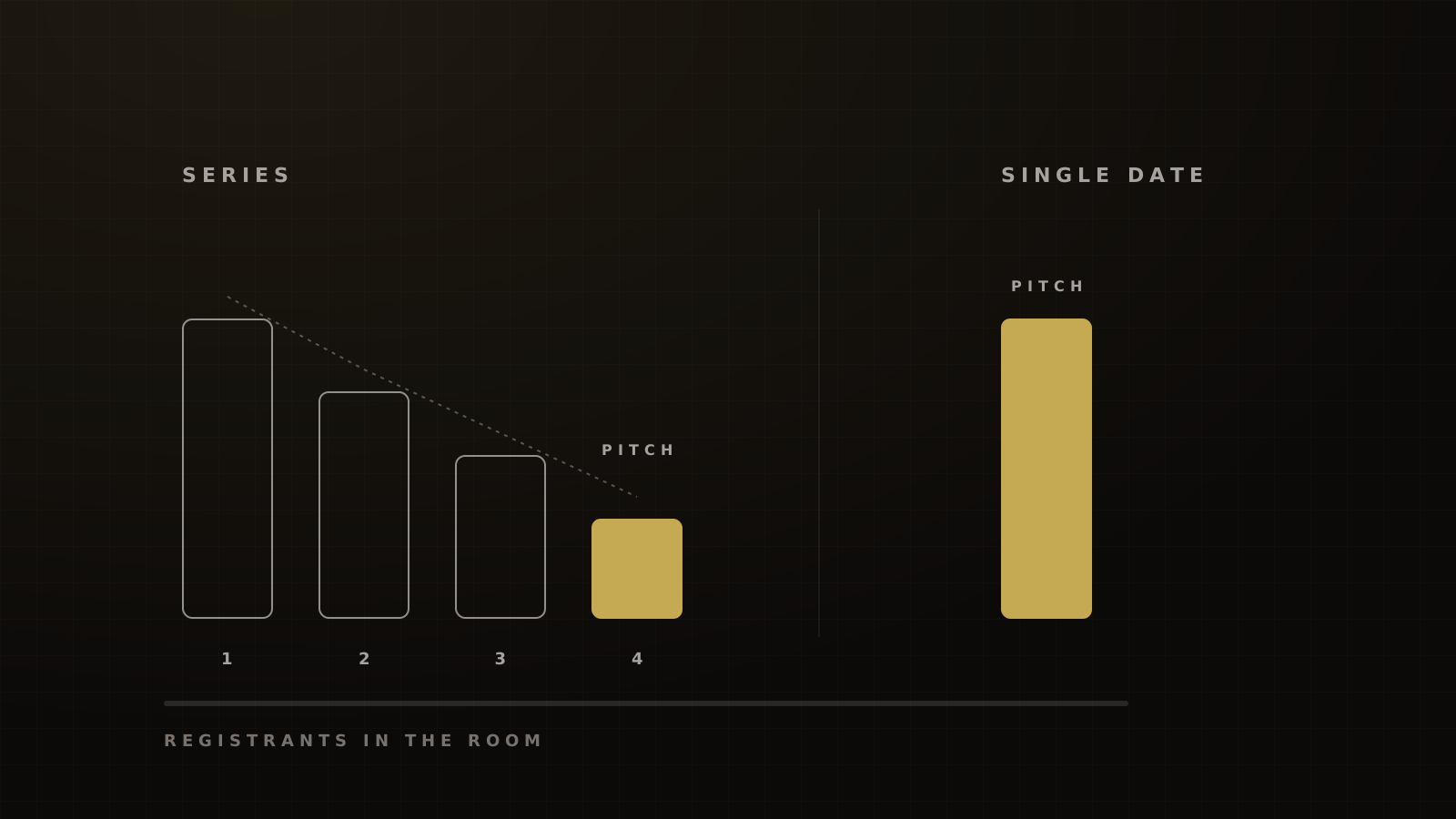
This is the part per-episode reports hide. In most coaching series, the offer comes at the end. So the pitch is delivered to whoever survived every earlier session.
Run the numbers with an illustration. Say 30% of registrants attend part one, and each later part keeps 70% of the previous one. By part four, the pitch session holds about 10% of the people who registered (30% × 70% × 70% × 70%). A single date at 30% puts three times as many registrants in front of the offer.
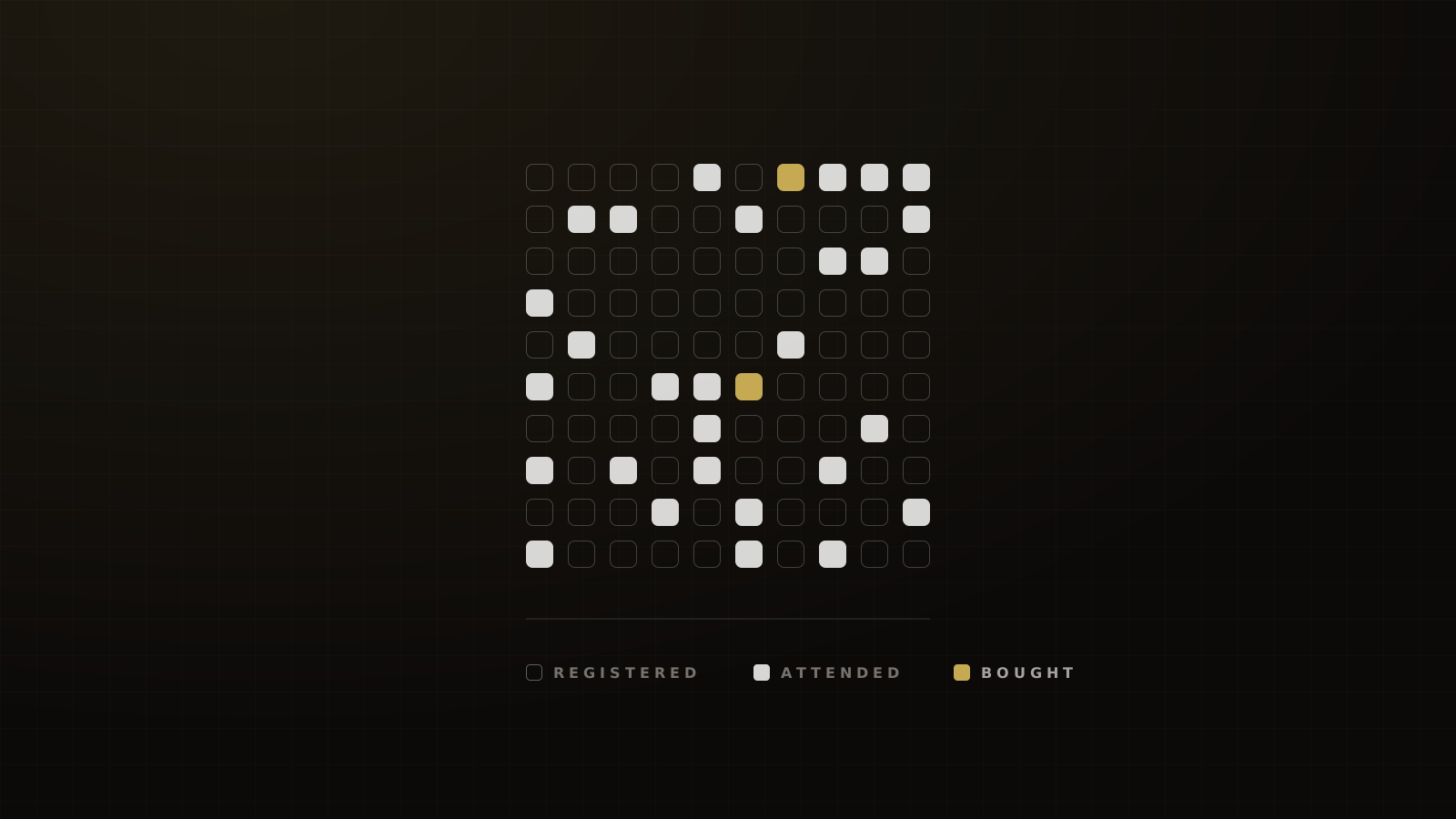
Share of registrants who attended all four sessions of a four-part webinar series with one registration (207 of 1,214)
The real case is in the same direction. In that physician series, 80.7% of registrants came at least once, but only 207 of 1,214 attended all four sessions, and the last session drew 37.3% of registrants.[1] That was a warm professional audience with no pitch. Cold traffic to a free coaching series has less reason to come back.
Attention also runs out inside each session. Livestorm's 2025 data shows an average watch time of 26 minutes on 68-minute webinars,[7] and Demio found 24% of live viewers drop off in the first third.[3] A series multiplies that cost by the number of parts.
"But B2B data says series win": why both are true
The counterpoint deserves a fair hearing. Goldcast's 2025 data shows webinars with "series" in the title averaging 42.1% attendance against a 40.1% overall benchmark. 31.2% of its webinars were part of a series, with a median of 4 episodes.[2] Its 2024 data showed series programs at 38% against 33%, and series titles drawing about 30% more registrants.[8]
Three things explain the gap.
- Per episode, not per cohort. Goldcast counts each episode as its own webinar. That tells you the average episode's attendance rate, not how many of the original registrants reach the last one.
- Small rooms post high rates. In Goldcast's 2025 data, Monday webinars averaged 106 registrants and 47.2% attendance, while Thursday averaged 486 registrants and 38.7%.[2] A series whose later episodes shrink can look healthy in percentage terms.
- Different audience. A branded B2B series is a show for people who already know the brand, often registering from a house list. On warm lists we see 40% to 50% live attendance ourselves. A free series on cold Meta traffic is a funnel for strangers.
So the B2B data is right about branded content programs. It just doesn't answer the question a coach is asking.
When a series or multi-day format does work
Multi-session formats work when the audience has a reason to keep coming back. In our experience, that takes firepower:
- A large warm list. People who already trust you return. At one three-day scientific conference, 74% of active users joined all three days.[9]
- A strong lineup. A summit with names people came to see gives each day its own reason to show up.
- A paid ticket. Money changes commitment. PheedLoop's 2026 data on more than 1,070 in-person events found a median no-show of about 28% for free events against about 17% for paid.[10] Our paid VIP tickets in the $100 to $297 range show 85% to 90%. In paid community challenges we build, our target is live-call attendance above 50% of enrolled participants.
Alex Hormozi's three-day virtual summit structure pitches at the end of day two and again on day three, and he argues the more time people spend with you, the more they spend. That holds when they show up. With a free ticket and cold traffic, the time commitment is what stops them showing up.
If you do run a series, ask each registrant to plan when and where they'll attend. In one randomised trial, if-then attendance plans raised the share completing all five group sessions from 11% to 35%.[11] That's a clinical setting, not a webinar, but the mechanism carries.
What to run instead
Run the same single-date webinar every week. Each week is its own event: one registration, one session, one pitch. Our best program is a weekly evening webinar with ads only in the two days before it, and it buys registrations at $4 to $5. Weekly frequency isn't the trap. Asking one registrant to attend several parts is.
Keep each session tight enough to hold the room through the pitch. For live in-person events we cap a free day at about five hours of content as a house rule; for webinars, the same instinct applies at a smaller scale. For when to automate a winner, see live vs evergreen webinars.
The same logic scales up. A big summit is the ultimate series, and we'd rather run small webinars before one big summit. For the in-person side of show rate, see our event marketing and show rates guide, and for the full build, the webinar funnel playbook.
Seeing attendance fall after a format change? Book a strategy call and we'll audit the funnel with you.
Frequently asked questions
Sources
- 1.Medical webinar series case study. Onomi, undated (2026 edition).
- 2.B2B Webinar Benchmark Report 2026. Goldcast, 2026.
- 3.Webinar Statistics 2024. Banzai (Demio), 2024-01.
- 4.Ten Steps to Organize a Virtual Scientific Symposium. Global Challenges (via PMC), 2022-06-26.
- 5.Webinar Marketing Statistics 2026: 412-Webinar Benchmark Study. Visionary Marketing, 2026-04.
- 6.Appointment no-shows by scheduling lead time, Family Medicine 45(9). DuMontier et al., Family Medicine, 2013-10.
- 7.Webinar Benchmark Report 2026. Livestorm, 2026-09-01.
- 8.B2B Webinar Benchmark Report 2025. Goldcast, 2025.
- 9.Three-day scientific conference participation analysis (PMC9451137). Frontiers in Communication (via PMC), 2022-08-18.
- 10.Event Data Lab #05: no-show rates by ticket type and event size. PheedLoop, 2026-04-29.
- 11.Implementation-intentions randomised trial on group-session attendance (accepted manuscript). Avishai et al., Journal of Consulting and Clinical Psychology, 2018.
Written by
Ray GillespieCo-Founder & COO
Ray runs day-to-day operations across every Victory engagement, building the systems, automations and AI-powered workflows that hold the machine together. He has overseen operations behind more than $120M in revenue.
Part of the guide: The Webinar Funnel Playbook: Live, Automated and Hybrid Webinars That Sell (2026)