Live vs Evergreen vs Hybrid Webinars: Which Converts Better for Your Offer?
Run it live first, then automate only the version that already won, and automate honestly. What the data shows, when hybrid wins and the FTC risks.
 Ray GillespieCo-Founder & COO
Published 9 min read
On this page
Key takeaways
- Run it live first. Live sessions show you which pitch, offer and price actually convert.
- Automate only the version that already won, and keep checking it against the live baseline.
- Nobody publishes live-versus-automated sales data on the same offer. The public data is engagement only.
- Automated sessions lose viewers faster: 29% drop off in the first third, against 24% for live.[1]
- Hybrid, recorded teaching with a live close, is the middle option for offers too expensive to sell with no human.
- Automate honestly: no simulated chat, no fake attendee counts, no countdown that resets.
Run it live first. Live sessions tell you which pitch, which offer and which price convert. Then automate only the version that already won, and do it honestly: no simulated chat, no fake attendee counts and no countdown that resets.
Use hybrid when the economics need a person. That means a recorded presentation, then a real host live for the Q&A and the close. It's the middle option for offers too expensive for a fully automated sale.
Here's how we decide between the three, what the data does and doesn't say, and how to automate without misleading anyone.
Three formats, defined
The words get used loosely, so pin them down before you choose.
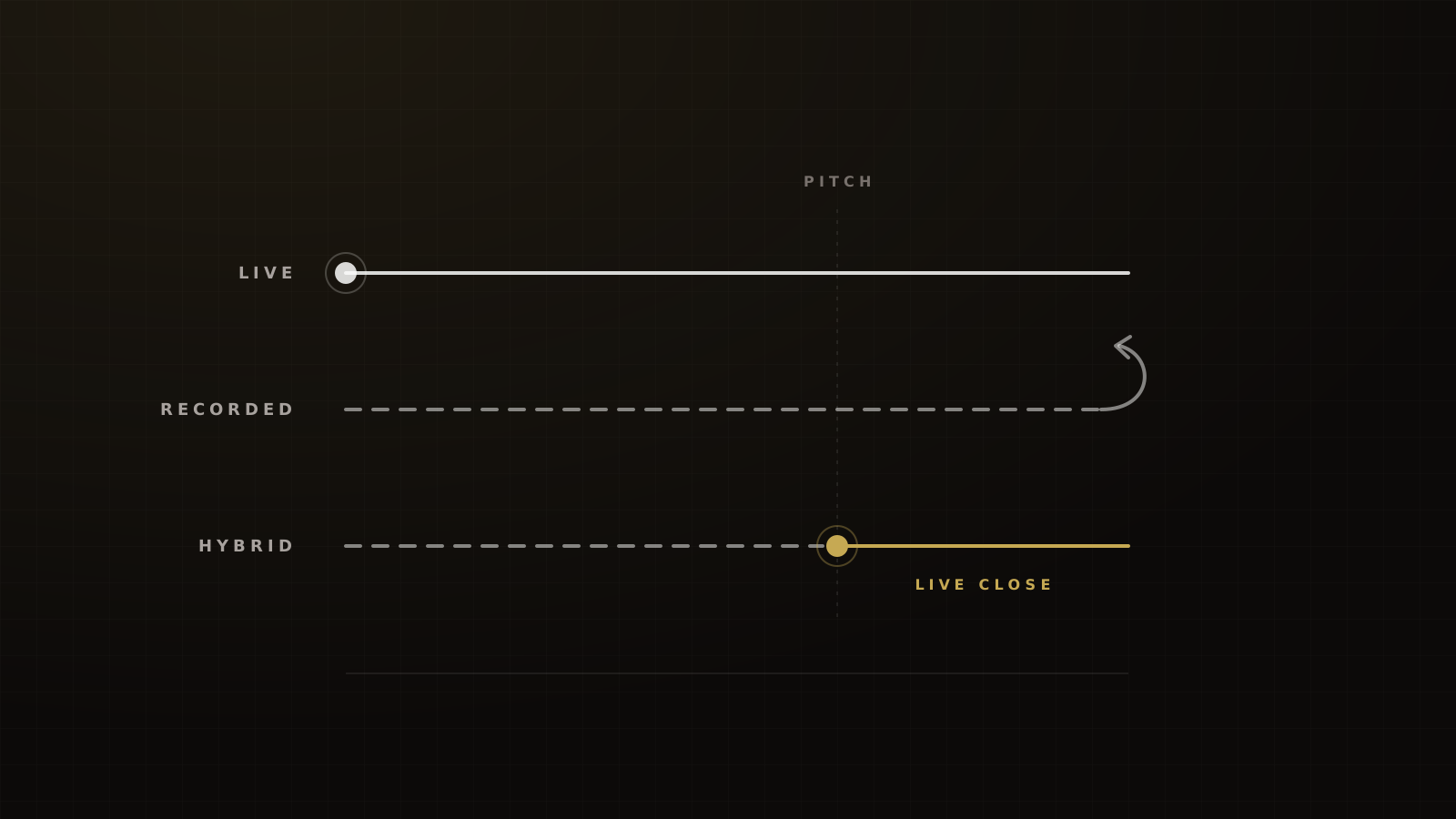
Live. A real presenter, in real time, with a real chat. Every session teaches you something about the pitch.
Automated (evergreen). Demio's definitions separate two kinds. An automated webinar is pre-recorded and scheduled for a specific date and time, and the host can join the chat live. An on-demand webinar can be watched any time after registering.[1]
Hybrid. Systeme.io uses "hybrid" for a recording played at a scheduled time with a host answering in chat.[2] Zoom calls that setup "simulive": hosts can use chat and Q&A during playback but can't appear on live video.[3] The events industry uses "hybrid" for in-person plus virtual.
Our definition is narrower: recorded teaching, then a real person live for the Q&A and the close. The teaching is the same every time. The close, where objections get handled and people get walked through the payment options, stays human.
| Format | Who's live | Best for | Main risk |
|---|---|---|---|
| Live | Presenter and closers | Finding the winning pitch, offer and price | Presenter time every session |
| Automated or on-demand | Nobody, or a host in chat | Proven, narrower offers at lower prices | Pretending it's live; decay goes unnoticed |
| Hybrid (our definition) | A closer for Q&A and the pitch | Higher-priced offers with a proven presentation | Staffing the close every session |
Victory's working definitions. Platform labels vary; check what your software actually does.
What the data says, and doesn't
The public data on formats is about attention, not sales.
Automated loses people early. In Demio's 2023 data, 29% of automated-webinar viewers dropped off in the first third, against 26% for on-demand and 24% for live.[1]
People who choose on-demand pay closer attention. Demio's focus rate was 74.2% for live and 86.3% for on-demand.[1] Goldcast's 2025 completion rates show the same pattern: 91% on-demand against 74% live.[4] Self-selected viewers finish more.
Automation is growing. Pre-recorded webinars rose to 21.5% of Goldcast's webinars in 2025, from 18.8%.[4] Demio customers ran 27 on-demand webinars for every 9 live ones on average in 2023.[1]
Replays are a large share of viewing. ON24 says 45% of its 2024 attendees watched on-demand, and 52% in 2025.[5][6] It also says making recordings available by default can raise total views by up to 80%, which is a ceiling, not an average.[5]
What nobody has measured
No public dataset compares live and automated sales conversion for the same offer. The closest things are operator anecdotes, and every one compares something slightly different.
- Amy Porterfield has said her whole live launch converts about 9%, against 5–6% for an evergreen product, and a guest reported 10–11% against about 5%.[7] Those compare different products and whole launches, not one webinar live versus recorded.
- Evergreen can beat live on show-up. One course creator reported 42% show-up on evergreen against 28% on her live webinars.[8] A vendor case reports 53.8% for automated against 49.5% for live.[9] A B2B demo moved from 40–50% attendance live to 80–90% automated.[10] Instant access drives these. None is a sales comparison.
Watch for one misquote in particular. TwentyThree's 63% "conversion" for live and 19% for on-demand often get repeated as buyer rates.[11] TwentyThree's own help docs define webinar conversion as registrations divided by registration-page views.[12]
Why we run live first
Our best webinar numbers come from a live program. On a weekly evening webinar with ads only in the two days before each session, leads cost $4–5 and the program returns 4–7x ROAS week over week. That isn't proof that live beats evergreen in general. It's proof that live is where the pitch got good.
Live sessions are pitch reps. Each one shows you where people leave, which objection comes up in chat, which bonus gets a reaction and how the room responds to the price. Change one thing, run it again next week, and you know whether it helped. A recording can't tell you any of that. It only replays the version you had.
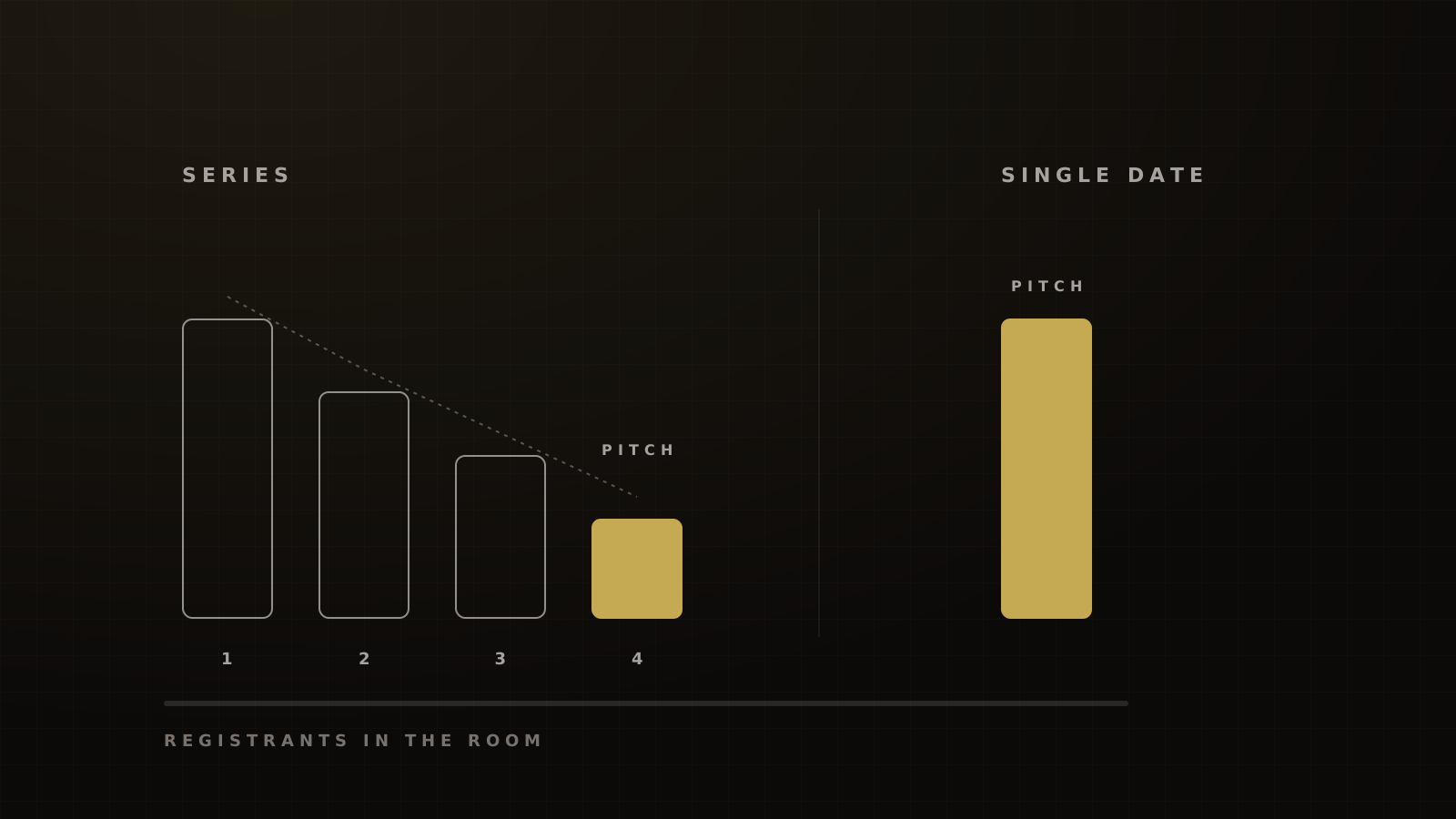
It also gives you a baseline to beat. On cold traffic to a single-date evening webinar, we see 25–35% of registrants attend live. The closest public proxy, Demio's Education Services figure, is 20%.[1] On a warm list we see 40–50%, close to Goldcast's 40% and Livestorm's 47.7%.[4][13] An automated version has to hold those numbers, or beat them, on the same audience.
Russell Brunson makes the same case from his own experience: he says his ClickFunnels webinar ran live nearly 70 times before it was automated.[14]
When to automate, and when hybrid is the better answer
Automate when the live version has cleared the bar for several sessions in a row, not once. On $1K–$10K offers, our bar is 6–10% of live attendees buying. At 1–3%, the offer or the pitch isn't ready, and automating it just repeats the problem at scale.
There's a second signal that a recording is ready to sell. In our experience, 30–50% of a webinar's sales close after the live session, in the replay and follow-up window. If your replay is already selling, the recording works without you.
Then match the format to the price.
- Fully automated fits narrower, lower-priced offers. Jason Fladlien's view is that automated webinars need the call to action earlier and less teaching than live ones, which is why he reserves them for simpler offers at lower prices.
- Hybrid fits higher-priced offers. On $1K–$10K offers, 40–60% of webinar sales come through the "more info with a closer" door in our experience. Remove the human and you remove that door. Hybrid keeps the teaching consistent and the close staffed.
- Live stays the lab. Even with an evergreen version running, a live session every so often keeps testing new angles.
Fladlien also warns that every webinar decays. Audiences get used to the message. Check the automated version against its live baseline every week, and go back to live when it slips.
Ready to automate when
- The live version hit your buyer-rate bar on several sessions in a row.
- The replay already sells during the follow-up window.
- You know which minute the pitch starts and where viewers drop off.
- The offer is simple enough to buy without a conversation, or you've staffed a live close.
- You have a real deadline you can enforce per registrant.
Automate honestly
A recorded webinar is fine. Pretending it's live is the problem. We once worked with a coach who refused to run a "fake live" replay, and they were right: trust is part of the conversion, and fake liveness is also where the legal risk sits.
What we never do on an evergreen webinar:
- Simulated chat or questions typed by a script.
- Fake attendee counts such as "1,243 people watching".
- Countdowns that reset for each viewer, or deadlines that don't actually end.
- Fake capacity such as "only 75 seats left" on a recording.
Each one maps to something regulators have named. The FTC's dark-patterns report lists baseless countdown timers, false limited-time messages and false activity messages.[15] The FTC's 2024 rule on reviews and testimonials bans fake testimonials and fake social-media indicators.[16]
The FTC's 2023 complaint against Lurn is the closest case to this exact format. It alleges that prerecorded course-pitch webinars were replayed for months while claiming limited capacity.[17] Those are allegations, settled by order, not a ruling that recordings are illegal. In a separate case, a court found that the "limited spots" claimed for a real-estate coaching program were misleading.[18]
UK readers face the same rule. The CMA's guidance on the DMCC Act uses a countdown that restarts as its example of a banned false time limit.[19] In 2026, Emma Sleep agreed to change misleading countdown timers in a court-endorsed settlement.[20] That's e-commerce, not webinars, but it shows timers get enforced.
What to do instead: say it's a recording, keep a real person reachable for questions, and give each registrant a deadline that actually ends. Real deadlines also keep working over time, because people learn whether yours are real.
Building it in GoHighLevel
HighLevel supports both live and on-demand webinars, and its webinar funnels generate the registration, confirmation and broadcast pages.[23] Recurring webinars can run daily, weekly or monthly, or on "No Fixed Time", where the broadcast plays immediately. One series can't mix live and on-demand sessions.[24]
For follow-up, HighLevel's Video Tracking workflow trigger fires when a viewer passes a watched-percentage threshold, such as 50%.[25] That's how you separate people who reached the pitch from people who left early. The full build is in how to build a webinar funnel in GoHighLevel, and the sequences by segment are in the webinar follow-up sequence.
The bottom line
Live finds the winner. Automation scales it. Hybrid keeps a person on the close when the price needs one. The order matters more than the format: automate a webinar before it has won live and you've built a machine that repeats a weak pitch every day.
For where this fits in the full funnel, see the webinar funnel playbook, and for how to judge each version's numbers, webinar conversion rate benchmarks. If you want help deciding which format your offer is ready for, book a strategy call.
Frequently asked questions
Sources
- 1.Webinar Statistics 2024. Banzai (Demio), 2024-01.
- 2.Webinar funnel guide. Systeme.io, 2026-06 (updated).
- 3.Hosting a webinar with pre-recorded content. Zoom Support, living doc, checked 2026-10-04.
- 4.B2B Webinar Benchmark Report 2026. Goldcast, 2026.
- 5.Key takeaways from the 2025 Webinar Benchmarks Report. ON24, 2025-02-20.
- 6.Webinar guide (citing the 2026 Webinar Benchmarks Report). ON24, 2026, page undated.
- 7.Online Marketing Made Easy, episode 490 (transcript). Amy Porterfield, 2022-08-18.
- 8.Online Marketing Made Easy, episode 486 (transcript). Amy Porterfield, 2022-08-04.
- 9.Case study: Carla Biesinger, course creator. EasyWebinar, undated, covers 2022 to 2025.
- 10.Customer story: The Receptionist. eWebinar, 2026-04-08.
- 11.State of Webinars 2026. TwentyThree, 2026.
- 12.Webinars: understand key analytics and attendance data. TwentyThree Help Center, 2018-10-08.
- 13.Webinar Benchmark Report 2026. Livestorm, 2026-09-01.
- 14.The playbook to a high converting webinar (Perfect Webinar). ClickFunnels blog (Russell Brunson), 2016-01-18, updated 2026-03-19.
- 15.Bringing Dark Patterns to Light (staff report). Federal Trade Commission, 2022-09.
- 16.Consumer Reviews and Testimonials Rule: Questions and Answers. Federal Trade Commission, 2024-11.
- 17.Complaint, FTC v. Lurn, Inc.. Federal Trade Commission, 2023-09-27.
- 18.FTC suit leads to judgment against principals and celebrity endorsers of a real estate investment scheme. Federal Trade Commission, 2023-05-22.
- 19.Unfair commercial practices (CMA207). UK Competition and Markets Authority, 2025-11-18 (updated).
- 20.Court endorses CMA action as Emma Sleep agrees to change sales practices. UK Competition and Markets Authority, 2026-05-28.
- 21.How to spot and avoid business coaching scams. FTC Consumer Advice, 2026-04-24.
- 22.FTC seeks public comment in response to advance notice of proposed rulemaking regarding negative option. Federal Trade Commission, 2026-03-11.
- 23.Complete guide to creating webinars in HighLevel. HighLevel Help Center, living doc, checked 2026-10-04.
- 24.Recurring webinar settings. HighLevel Help Center, 2026-01-20 (modified).
- 25.Webinar video analytics. HighLevel Help Center, living doc, checked 2026-10-04.
Written by
Ray GillespieCo-Founder & COO
Ray runs day-to-day operations across every Victory engagement, building the systems, automations and AI-powered workflows that hold the machine together. He has overseen operations behind more than $120M in revenue.
Part of the guide: The Webinar Funnel Playbook: Live, Automated and Hybrid Webinars That Sell (2026)