The Webinar Follow-Up Sequence: Emails and Texts for Attendees, No-Shows, Replay Viewers and Buyers
One replay email to everyone wastes the best days of the funnel. The six follow-up segments we run, in priority order, and who gets a call instead.
 Ray GillespieCo-Founder & COO
Published 10 min read
On this page
Key takeaways
- Split webinar follow-up by what each person did: buyers, checkout abandoners, offer-page visitors, attendee non-buyers, replay viewers and no-shows.
- No-shows are usually the biggest group. Livestorm's 2025 average was 92 no-shows against 83 live attendees per webinar.[1]
- When someone fits several segments, the warmest one wins. The top three get a person, not just another email.
- On the funnels we run, 30% to 50% of a webinar's sales close after the live session. The follow-up is where those sales come from.
- The replay expires when the offer does, on a real deadline.
- None of it works if it lands in spam. Fix the sender rules and the SMS setup before you write a single follow-up.
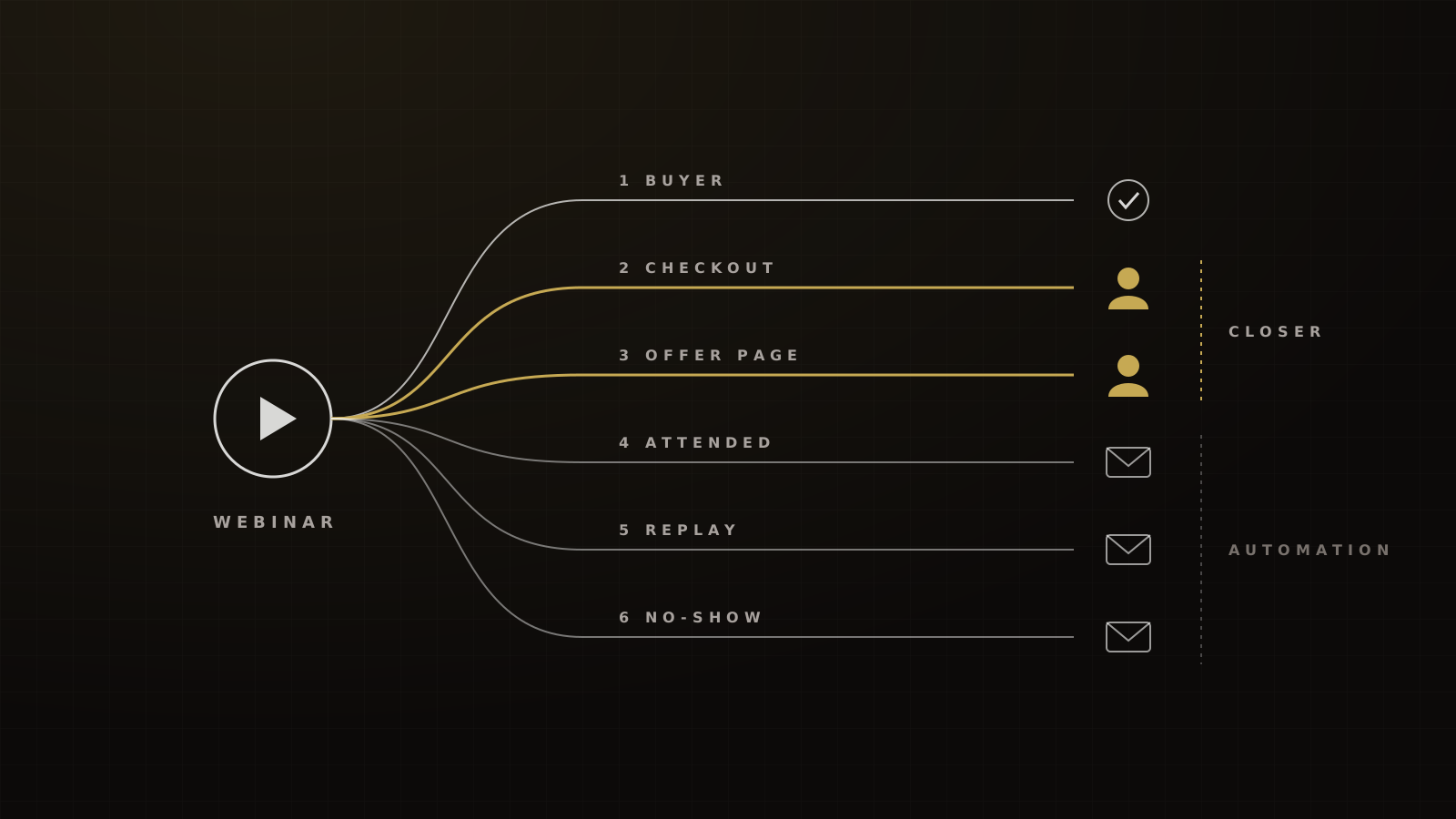
Send six follow-up sequences, not one. Each segment did something different on webinar day, so each one needs a different next message: the buyer, the person who started checkout, the person who looked at the offer, the attendee who left without buying, the replay viewer and the no-show.
The usual setup is one "here's the replay" email to the whole list. It treats someone who clicked "buy" the same as someone who never opened the room.
Here is the segment map we build, the order it runs in, and who gets a phone call instead of an email.
Why one replay email fails
Start with the math. Livestorm's 2025 data, across 33,786 webinar sessions, averaged 175 registrants, 83 live attendees and 92 no-shows per webinar.[1] The no-shows are the largest single group you have, and they haven't heard the pitch.
Many will still watch. ON24 reported that 45% of its 2024 attendees watched on-demand.[2] Goldcast's B2B data is thinner: 10.61% of live attendees rewatched and 2.62% of registrants watched only on-demand.[3] That gap is a platform and denominator difference. Either way, some of your buyers meet the offer after the live session ends.
Average no-shows per webinar, against 83 live attendees, across 33,786 Livestorm sessions in 2025
In our experience, 30% to 50% of a webinar's sales close after the live session, through the replay and the follow-up window. There's no industry benchmark for this. The nearest public reference is a single 2019 course launch, discussed on Amy Porterfield's podcast, that made 58% of its sales after the live webinars ended, including 6 sales from a 105-person "can't attend" list.[4] One launch at $597 isn't a benchmark. It shows the shape.
The six segments and their priority order
Every registrant lands in exactly one segment. When someone fits several, the warmest wins:
Buyer > checkout abandoner > offer-page visitor > attendee non-buyer > replay viewer > no-show
A buyer who missed the live session is a buyer. An attendee who started checkout is an abandoner. Without the order, people get three sequences at once.
| Segment | How it's tagged | First message | Channel | Owner |
|---|---|---|---|---|
| Buyer | Payment received | Welcome and next-day session details | Email + SMS | Fulfillment |
| Checkout abandoner | Reached the order form, no payment | A personal check-in | Call or text from a person | Closer |
| Offer-page visitor | Clicked through to the offer, no checkout | "Questions about the program?" | Call, then email | Closer |
| Attendee non-buyer | Attended = yes, no click | Recap and the main objection | Automation | |
| Replay viewer | Watched 50%+ of the replay | The offer, framed for a viewer | Email + SMS | Automation, then closer |
| No-show | Attended = no | Replay invitation | Email + SMS | Automation |
Triggers are described generically. In HighLevel, attendance comes from the webinar platform or an imported attendee report, and watch depth from the Video Tracking trigger.
HighLevel's webinar analytics include a Video Tracking workflow trigger with a watched-percentage threshold, such as 50% watched.[5] Zoom's attendee report marks whether each registrant attended.[6] Those two signals do most of the tagging. We build the rest in the GoHighLevel webinar funnel itself.
Attendee non-buyers
These people saw the pitch and didn't act. They don't need the replay pushed at them. They need the reason they hesitated answered.
We order the sequence the way Russell Brunson describes follow-up funnels, a sequence he credits to Mike Litman and Dan Kennedy: emotion first, then logic, then urgency. One email tells a story from someone like them. The next lays out the case: what's included, what it costs against the alternative, the guarantee. The last gives the real deadline.
Each email answers one objection, pulled from the live chat and the sales calls. If your pitch has a financing or "more info" path, as in our webinar pitch structure, repeat it here. Some non-buyers only saw a pay-now button.
A note on a number you'll see quoted: the "58% follow-up email open rate" comes from ActiveCampaign's own 2022 webinar, where the thank-you email was opened by 58%, the confirmation by 72% and the reminder by 69%.[7] It's one company's emails, and Apple Mail Privacy Protection inflates opens. Don't plan around it.
No-shows
No-shows get the replay invitation first. Then they get a short hold before the offer.
The hold matters. A no-show who receives "the cart closes Friday" before they've seen a minute of the content gets a pitch with no context. We give them a day or two to watch, then start the offer sequence. Treat the length as a setting to test.
Two alternatives work alongside the replay. Jason Fladlien prefers an encore session over a replay for automated webinars, and a second live time gives no-shows a reason to show up. The other is our favorite: broadcast the buyers' next-day session. We run a "kickoff" session for new buyers the day after the pitch. Streaming it to no-shows gives them a second sales window, with proof in the room. When we've done this, 8% to 12% of those no-shows have bought. No public comparison exists for this figure.
Replay viewers and offer-page visitors
Watch depth tells you who's interested. Someone who watched 50% or more of the replay has given you most of an hour. Someone who stopped at four minutes hasn't. We set the HighLevel Video Tracking trigger at 50%[5] and send the deeper watchers the offer sequence, framed for people who've seen the content. Shallow watchers stay in the no-show track.
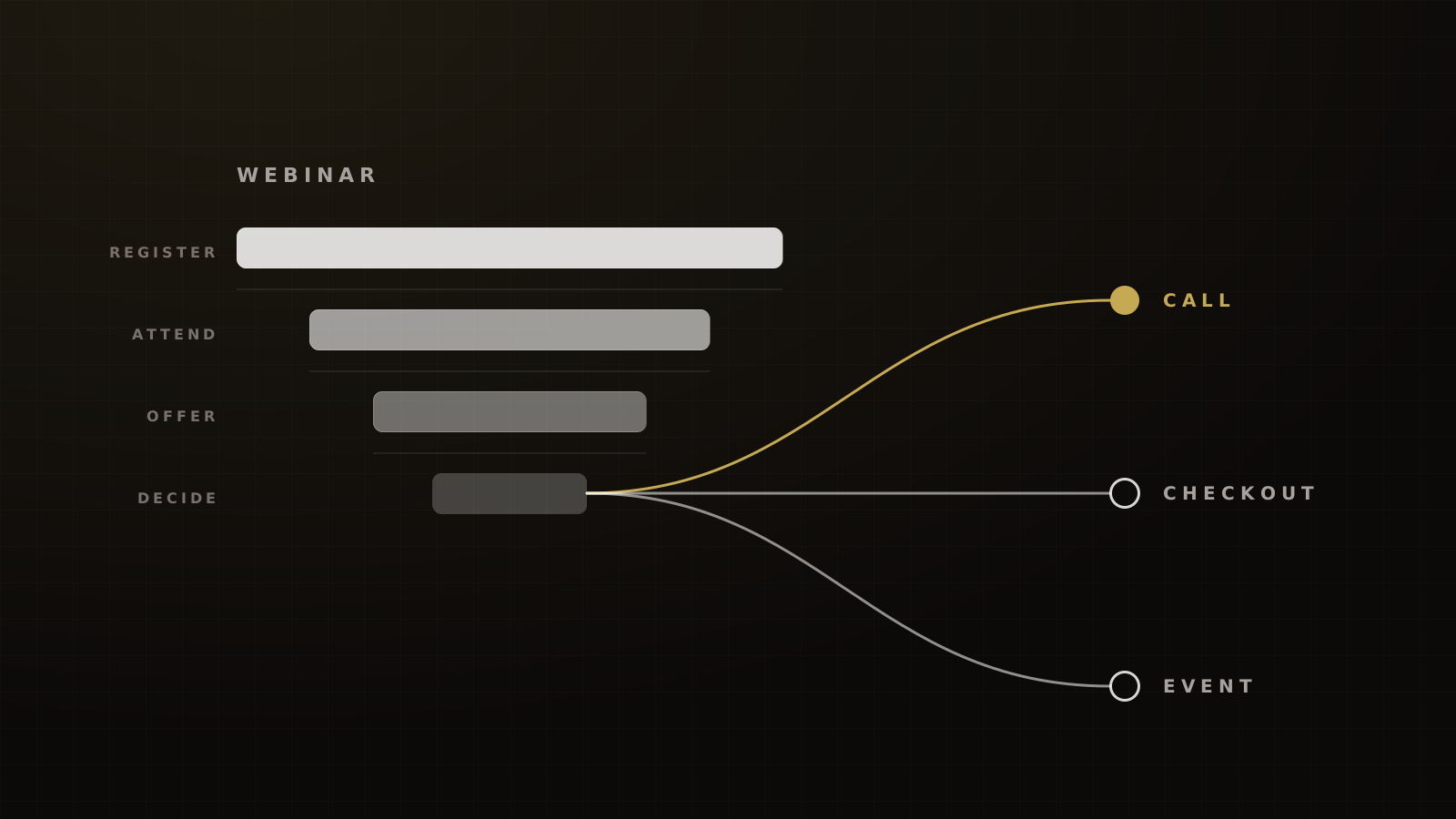
Offer-page visitors are a level warmer: they clicked through to the price. These people get a person.
Framework
The closer hand-off
- Route by intent, not by list. Offer-page visitors, checkout abandoners and 50%+ replay viewers who clicked the offer go to a closer's queue. Everyone else stays in automation.
- Dial fast. Our target is a first dial in under an hour during staffed hours, and every lead dialed within 24 hours.
- Keep trying. Our rule is at least six call attempts on every unconverted lead in its first two weeks.
- Book close in. Calls booked no more than about three days out show at 82% to 88% for us. Further out, they slip.
- Rebook the misses. We aim to rebook 30% to 40% of call no-shows within 48 hours.
- One owner. The closer who takes the lead keeps it to close or to a clear no.
Victory's routing rules. Call-attempt and booking-window rules are our own targets, not industry benchmarks.
The widely quoted "21x" comes from a 2007 InsideSales.com and MIT study of 6 companies and more than 15,000 leads. It measured the odds of qualifying a lead called within 5 minutes versus 30, not the odds of a sale.[8] Our under-an-hour target is looser, and it holds up in practice.
Checkout abandoners
Someone who reached the order form and stopped is the closest non-buyer you have. Send one message from a person, not a sequence.
A text from the closer, signed with their name: "Saw you got to the checkout. Anything I can answer?" It finds the real blocker, such as a declined card or an unclear payment plan, which an automated cart email can't.
The only public data on abandonment is ecommerce, so treat it as context. Baymard averages documented cart abandonment at 70.22% across 50 studies.[9] Klaviyo's 2026 analysis of more than 110,000 customers found abandoned-cart flows averaged a 6% click rate by email and 10.3% by text.[10] That tells you triggered messages beat blasts. It doesn't tell you what a webinar abandoner will do.
Buyers
Take buyers out of every promo sequence the moment they pay. A "last chance to join" email to someone who joined yesterday invites a refund.
Then give them a reason to start. We schedule a next-day acceleration session for new buyers: a working session where they get a first result inside 24 hours. In our experience, nothing we've tried does more against buyer's remorse, and it doubles as the no-show broadcast above.
The expiring replay
The replay comes down when the offer does. Fladlien builds his funnels this way, and his starting promo cycle runs about eight emails over seven days, ending with two emails on close day, one in the morning and one in the evening. He sees two cart-close emails as the right number for your own list. That's his experience, paraphrased, and a sensible place to start.
The deadline has to be real. The FTC's 2022 staff report lists baseless countdown timers and false limited-time messages as dark patterns.[11] If the replay expires Friday, it expires Friday.
Access settings change viewing. Livestorm found public replays averaged 14.60 on-demand views against 3.97 for registrant-only replays and 3.12 when closed.[1] ON24 customers using automated post-event nurture averaged 151 on-demand attendees against 89 without.[2] Both are correlations. No vendor publishes a replay-viewing curve by hour, so test your window. For when to automate the whole thing, see live vs evergreen webinars.
Make sure it lands
Email. Gmail requires senders of 5,000 or more messages a day to authenticate with SPF, DKIM and DMARC, offer one-click unsubscribe, honor unsubscribes within 48 hours and keep the spam rate below 0.1%, never reaching 0.3%. Gmail has been ramping up enforcement since November 2025.[12] Yahoo's rules match on the core points, with unsubscribes honored within 2 days and a spam rate below 0.3%.[13] On the domains we manage, we hold the Gmail spam rate under 0.1% and target 90%+ inbox placement on pre-send seed tests.
Delivered messages and attendance move together: Banzai's 2023 Demio data showed 35% live attendance with its email notifications against 9% without, a correlation.[14]
SMS. Never blast the replay link. Drip the sends. Don't put a raw link in the first text from a number the person hasn't heard from. Send the link in a second text, as a trigger link on your own domain, from a number on your registered A2P 10DLC campaign. We walk through why in our carrier-filtering post-mortem. After that fix, our delivery came back to 95% or better.
Clean the list before you text it. On lists texted for years without validation, we typically find only about 40% to 45% of raw contact records end up as unique, SMS-capable numbers after dedupe and line-type checks.
Opt-outs: the FCC's TCPA revocation rules took effect on April 11, 2025. Only the cross-topic "revoke-all" requirement is waived, now to January 31, 2027.[15] Our email and SMS deliverability guide covers the full setup.
The follow-up checklist
Copy this into your build doc before your next webinar. It's the checklist we run.
Webinar follow-up checklist
- Attendance tagged from the platform's attendee report (attended yes or no) the night of the webinar
- Priority order set: buyer, checkout abandoner, offer-page visitor, attendee non-buyer, replay viewer, no-show
- Buyers removed from every promo sequence on payment
- Next-day session scheduled for buyers and broadcast to no-shows
- Video Tracking trigger at 50% watched routing deep replay viewers to the offer sequence
- Offer-page visitors and checkout abandoners routed to a closer, with a first dial inside an hour
- No-show hold set before the offer sequence starts
- Replay expiry date set to the offer deadline, and kept
- SPF, DKIM, DMARC and one-click unsubscribe confirmed on the sending domain
- SMS sent by drip, no link in the first text, trigger links on your own domain, number on the A2P campaign
For the funnel these sequences sit inside, start with our webinar funnel playbook. If you want us to map the segments onto your own funnel, book a strategy call.
Frequently asked questions
Sources
- 1.Webinar Benchmark Report 2026. Livestorm, 2026-09-01.
- 2.Key takeaways from the 2025 Webinar Benchmarks Report. ON24, 2025-02-20.
- 3.B2B Webinar Benchmark Report 2026. Goldcast, 2026.
- 4.Online Marketing Made Easy, episode 292 (transcript). Amy Porterfield, 2019-12-05.
- 5.Webinar Video Analytics. HighLevel Help Center, undated, checked 2026-10-04.
- 6.Generating webinar reports. Zoom Support, undated, checked 2026-10-04.
- 7.Webinar email sequence. ActiveCampaign, 2022-02-23.
- 8.Lead Response Management Study. InsideSales.com and James Oldroyd (MIT), 2007.
- 9.Cart abandonment rate statistics. Baymard Institute, 2025-09-22.
- 10.2026 abandoned cart flow benchmarks. Klaviyo, 2026-10-02.
- 11.Bringing Dark Patterns to Light (staff report). Federal Trade Commission, 2022-09.
- 12.Email sender guidelines. Google Workspace Admin Help, living doc, enforcement update November 2025.
- 13.Sender best practices. Yahoo Sender Hub, living doc, enforced from February 2024.
- 14.Webinar Statistics 2024. Banzai (Demio), 2024-01.
- 15.Order DA 26-12 (TCPA revocation rule waiver extension). FCC Consumer and Governmental Affairs Bureau (copy hosted by ECAC), 2026-01-06.
Written by
Ray GillespieCo-Founder & COO
Ray runs day-to-day operations across every Victory engagement, building the systems, automations and AI-powered workflows that hold the machine together. He has overseen operations behind more than $120M in revenue.
Part of the guide: The Webinar Funnel Playbook: Live, Automated and Hybrid Webinars That Sell (2026)