Value Ladder Examples: What to Sell First, Second and Last in a Coaching Business
Worked value ladder examples for coaches, authors and event businesses: each rung's job and price, the price-gap rule, and a grid to measure ascension.
 Devin AlexanderCo-Founder & CEO
Published 10 min read
On this page
Key takeaways
- Sell first whatever is cheapest for a stranger to say yes to that still leads to your core offer: a free community, event or tool, then an entry product under $100.
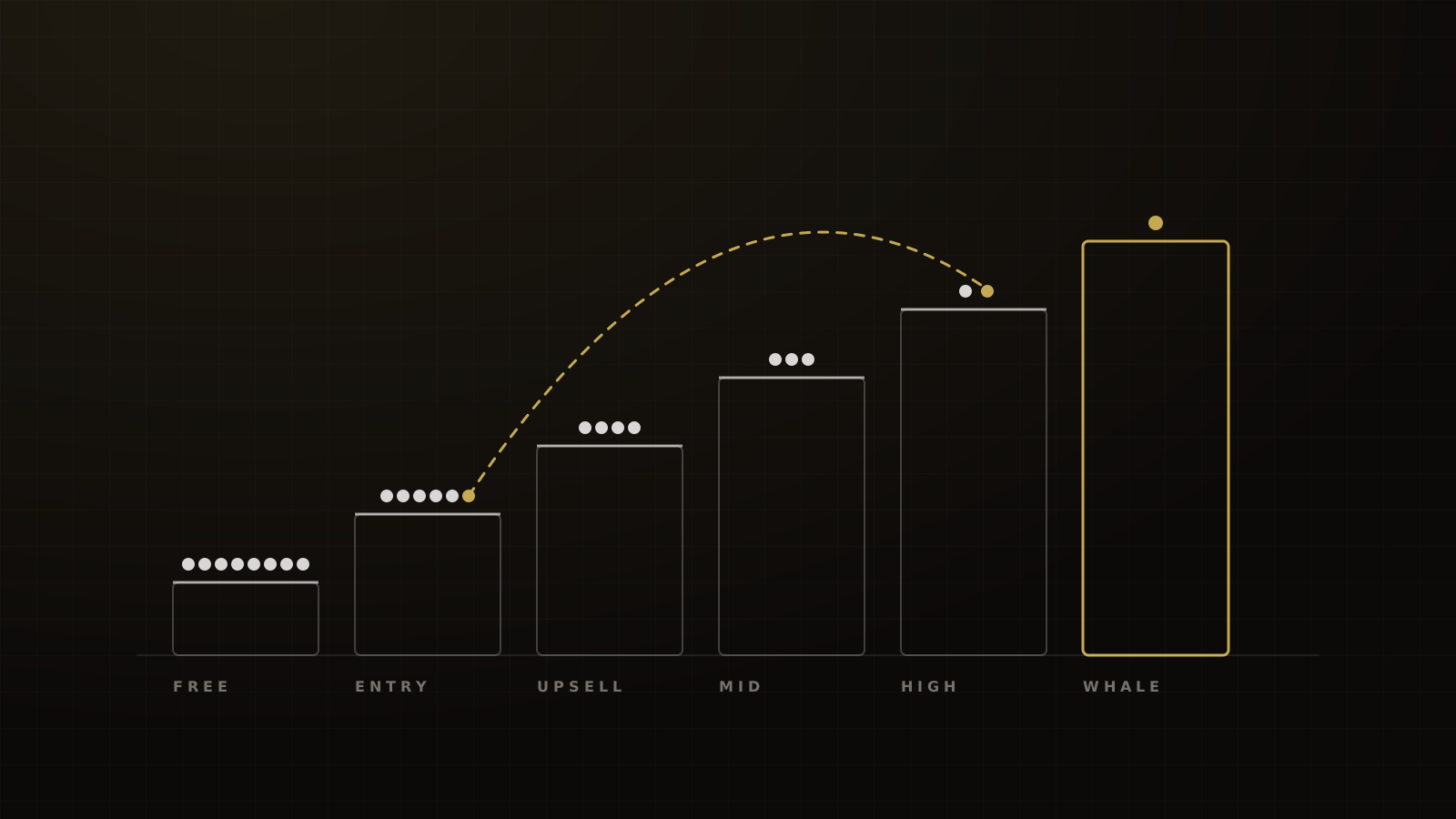
- A common coaching ladder runs free, entry under $100, a $197–$997 course or workshop, a $2,000–$3,000 program, $5,000–$10,000+ high ticket, and a hidden top tier.
- The top rungs carry the money. On Kajabi, offers at $1,000+ are 15% of the catalog but 40% of all expert earnings.[1]
- Space the rungs so each feels like a different decision. A cheap rung parked next to a big one cannibalises it.
- Buyers skip rungs. Draw the ladder, then measure the grid: who bought what, in what order, and revenue per original buyer.
Sell first whatever is cheapest for a stranger to say yes to and still leads somewhere: a free community, event or tool, then an entry product under $100. Sell second the thing that solves the next problem, usually a $197–$997 course or workshop. Then a $2,000–$3,000 program, then $5,000–$10,000+ high-ticket help, with a top tier kept off the page for the few who want more.
Two rules hold it together: space the rungs so each is a different decision, and expect buyers to skip rungs.
What a value ladder is (and isn't)
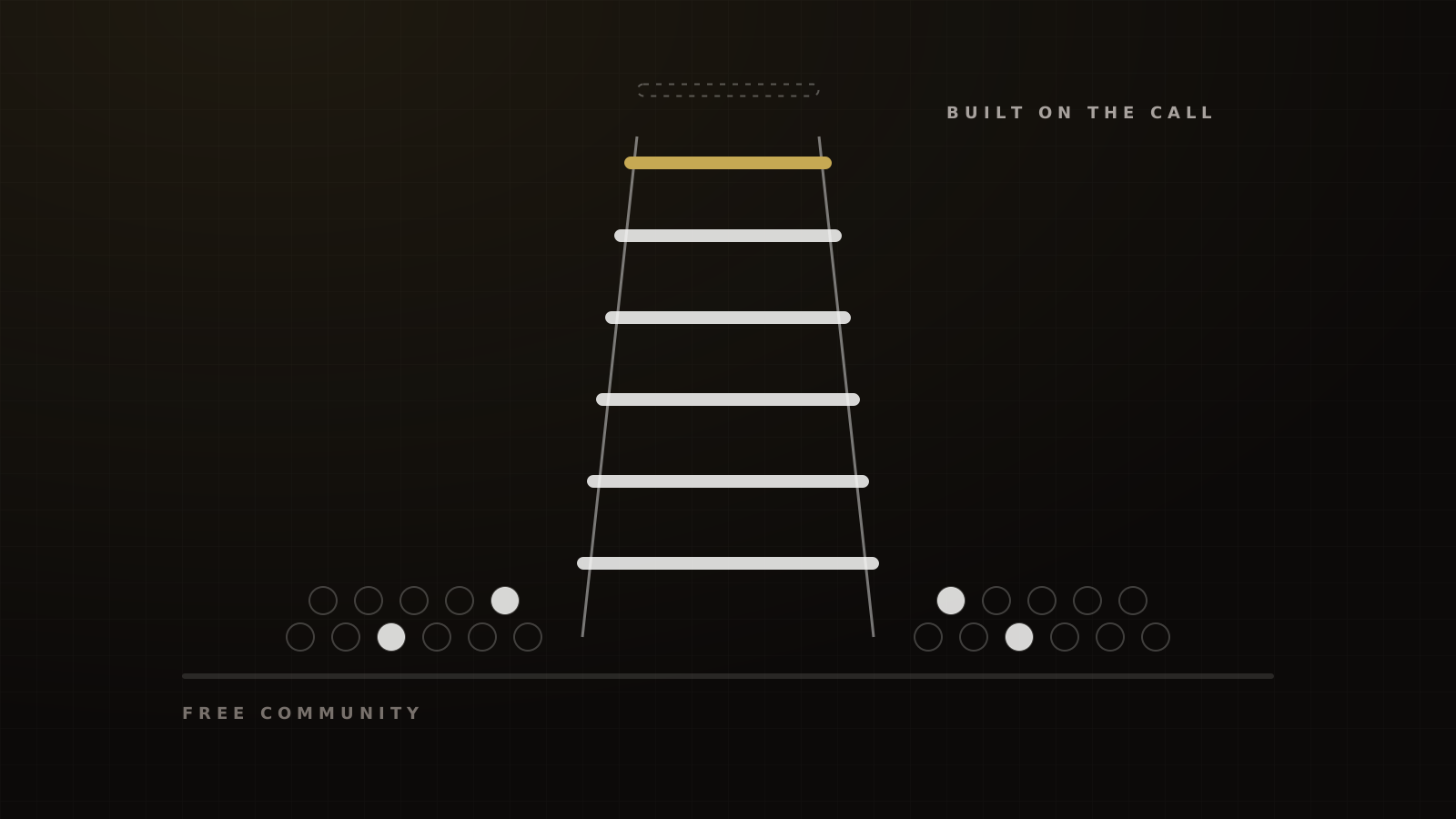
A value ladder is a sequence of offers that rise in value and price. Russell Brunson popularised it: start with a free or cheap offer, end with your most valuable service, and make each rung good enough that the buyer wants the next one. ClickFunnels breaks it into five stages: bait, front end, middle, back end and peak.[2]
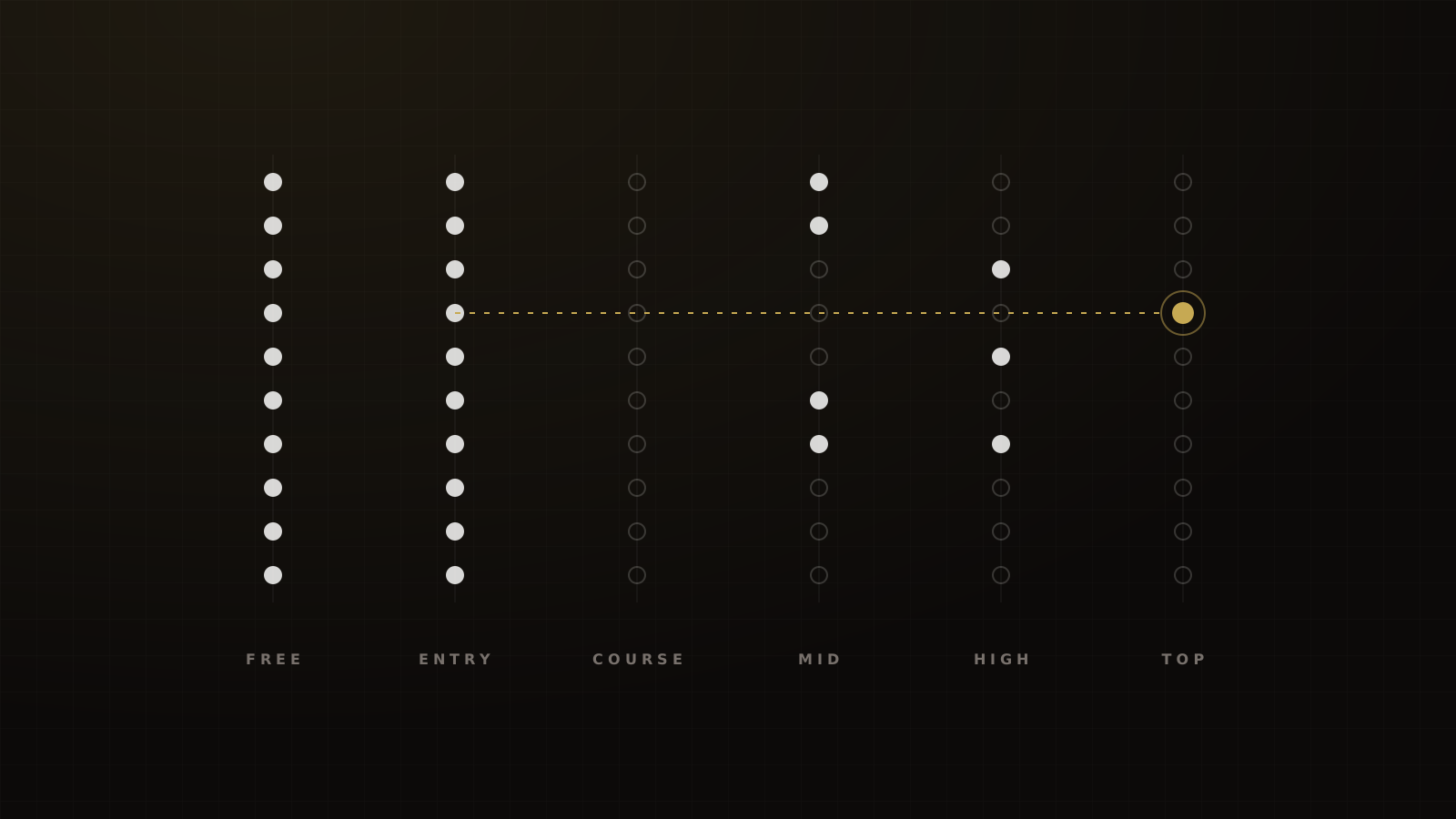
It isn't a staircase every buyer climbs. Alex Hormozi's value grid makes the point: a buyer can take offer one and then offer four, or start at three and jump to five, so he maps purchases as a grid rather than a line.[3] Bluecore's 2025 retail benchmarks show the other end of the problem: nearly three-quarters of customers buy only once.[4] A ladder is how you give the ones who'd buy again something to buy.
The six rungs and the job of each
| Rung | Price band | Its job | Delivery | Example |
|---|---|---|---|---|
| Free | $0 | Start the relationship, show who's interested | Community, event, tool | Free community, one-day event, quiz |
| Entry | Under $100 | Create a buyer and pay for the ads | Do it yourself | Template, calculator, short workshop |
| Course or workshop | $197–$997 | Solve the next problem | Do it yourself, some live | 4–6 week course or live workshop |
| Mid ticket | $2,000–$3,000 | Deepen the result with more access | Done with you, group | Group program, VIP day |
| High ticket | $5,000–$10,000+ | Deliver the transformation | Done with you or for you | 1:1 coaching, mastermind |
| Hidden top tier | Off the page | Serve the buyer who wants more | Bespoke | Private advisory, retreat |
Price bands are typical for coaching, course and event businesses. Your market sets the numbers.
Free: community, event, tool
The free rung costs the buyer nothing and tells you who's interested. A free community, a free one-day event or a free quiz all work. Run optimally, with a short promotion window, a steady reminder cadence and a full-detail confirmation page, a free one-day in-person event shows 35–45% of registrants in our experience.
Community can be free or the first paid step. Circle's 2026 report found the most common community price is $26–$50 a month, charged by 32.9% of communities, and 88% of community builders monetise with paid memberships.[5] In paid community challenges we build, live-call attendance runs above 50% of enrolled participants. Circle's 2024 benchmark found 59% of its top-tier creators report event attendance above 50%, against 33% of other creators.[6]
Entry: under $100
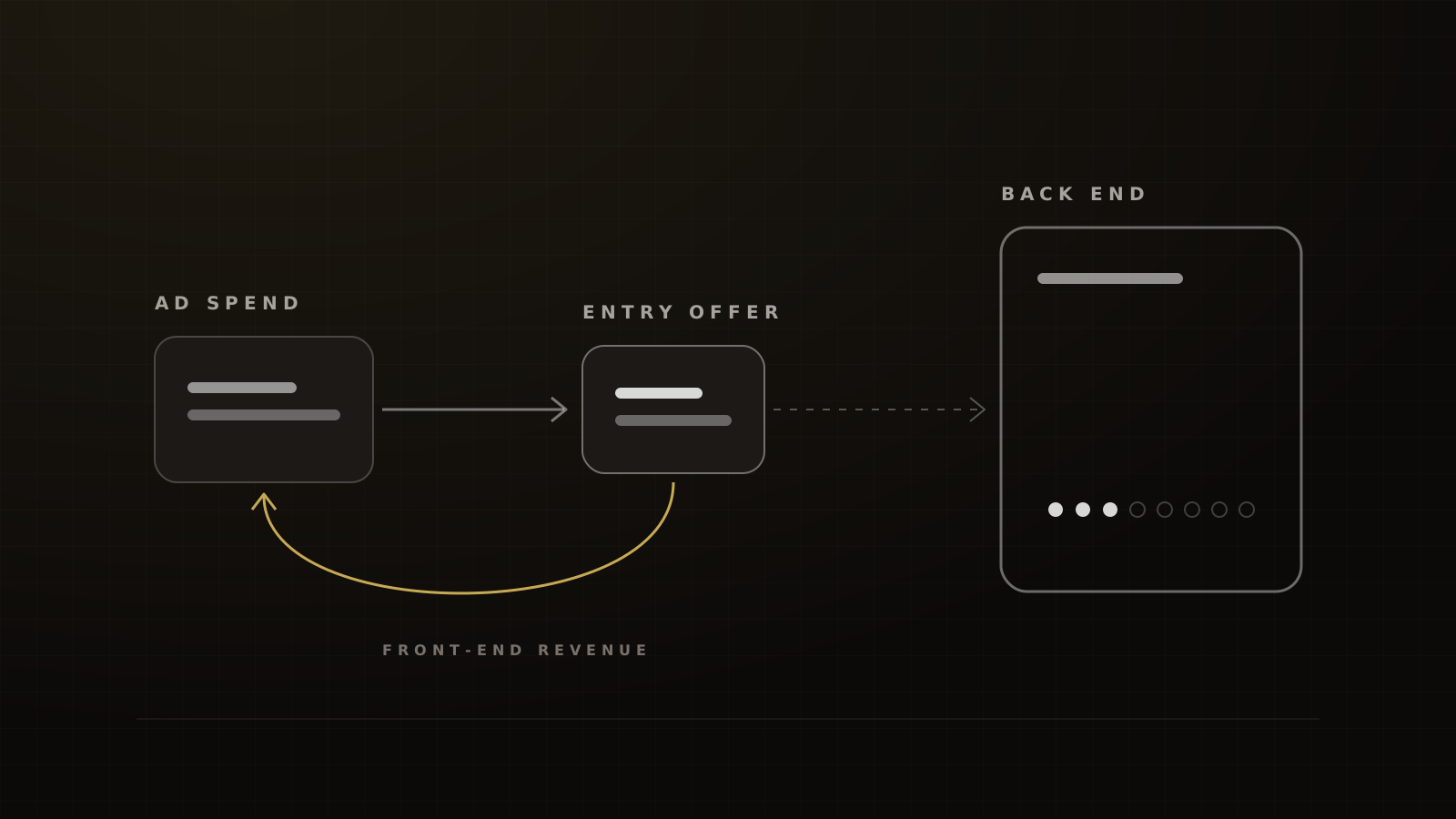
The entry rung creates a buyer and, ideally, pays for the ads that found them. For consumers, keep it under $100, often under $50. Business owners will pay up to about $1,000 for an entry offer when they can treat it as an ROI decision.
Kajabi's most popular digital-product price is $97, and prices cluster on numbers ending in 7.[1] On our funnels, cold traffic buys from a $7–$47 sales page at 3–6%, against ClickFunnels' estimate of 3–5% for digital products under $50.[7]
This is also where the first upsell lives. In our experience, a one-click upsell on a sub-$100 front end takes 8–12%. SamCart published one anonymised fitness creator's funnel: a $47 plan, a $17 bump taken by 43%, and a $197 12-week coaching upsell taken by 11%.[8] Rokt Aftersell's Shopify data shows how much placement matters: the same post-purchase offer converted 6.96% at its best spot and 0.18% at its worst.[9]
Kajabi's data also shows the limit of this rung on its own. Products under $25 are 14.8% of its catalog and 3.5% of earnings, and the median under-$25 product earns $96 lifetime.[1] An entry offer is a door, not a business.
Course or workshop: $197–$997
This rung solves the problem the entry offer exposed. A 4–6 week course, a live workshop or a cohort works well. Prices are drifting up here: Kajabi's median new digital product rose from $144 in 2023 to $179 in 2026.[1]
We default to fixed-length cohorts over open-ended courses. Consumption matters for the next rung: the more of your content someone finishes, the more likely they buy the bigger thing. Devin calls it drinking the Kool-Aid.
Mid ticket: $2,000–$3,000
The mid-ticket rung adds access: a group program, a VIP day, a small cohort with live calls. It's often the first rung sold on a call or webinar, and the first that costs real coaching hours.
High ticket: $5,000–$10,000+
High ticket delivers the transformation, usually done with you or done for you, and almost always sold on a call. The booking window matters: calls booked no more than about three days out show 82–88% for us, while RevenueHero's 2025 data on high-volume B2B teams found an average no-show rate of 15.9%.[10]
This rung is where the money is. On Kajabi, offers priced at $1,000 or more are 15% of the catalog but generate 40% of all expert earnings.[1] Experts with at least one offer at $2,500+ typically earned $174,730 lifetime, against $178 for experts whose top offer was under $50. Kajabi notes that successful experts grow into premium offers, so the arrow points both ways.[11]
The hidden top tier
Keep one rung off the page. A six-figure price on a landing page scares off the mid-tier buyer and does nothing for the whale, who should be on a call anyway.
You're going to get whales... if we don't have anything to sell them... we just start leaving money on the table.
Build it from what your best clients already ask for: more access, more speed, a private day, a retreat, done for you instead of done with you. Price it in the conversation.
Three worked ladders
These are illustrations built from patterns we see, not client results. Prices are examples.
A business coach. Free weekly training in a free community, then a $27 pricing calculator with a $17 bump, then a $497 six-week cohort, then a $3,000 group program, then $10,000 one-to-one coaching. The top tier, a private strategy day plus a year of advisory, is offered only on calls.
An author and speaker. A free monthly call, then a low-ticket paid community, then a course built on the book, then an "ask me anything" access tier, then a mastermind, then a retreat. Our offer ladder case study walks through a ladder of this shape.
An event business. A free one-day event, then a paid VIP ticket, then the stage offer, then a mastermind. Paid VIP tickets in the $100–$297 range show 85–90% for us, close to the roughly 83% check-in PheedLoop measured at paid events in 2026.[12] We price the VIP tier so its ticket revenue covers 100% or more of its own ad spend; that's a house standard, with no industry benchmark behind it. On the events we run, 8–12% of free one-day attendees buy the main stage offer. We haven't found a credible industry benchmark for that number either.
A public example. ClickFunnels publishes Stacey and Paul Martino's ladder: a free podcast, a $47 challenge, a $997 course, a $1,997 retreat and $14,997 annual coaching.[13] Notice the jump from $47 to $997. Big gaps are fine when each rung solves a clearly different problem.
The price-gap rule
Devin's rule: you wouldn't put a $1,000 upsell next to a $10,000 offer. When a cheaper option is close enough to substitute, buyers drift toward it. The working pairs are a $1,000 rung and a $5,000 rung. A $10,000 offer is often a solo offer: keep a cheaper option available, but don't push it alongside.
You'll see "each rung should cost 3–10x the last" on competing pages. It's a practitioner rule of thumb with no study behind it, and so is ours. The test is whether each rung feels like a different decision.
How many tiers to show at once is a research question, and the research is mixed:
- The middle option can pull. In a 2012 study of hypothetical purchases, adding an extreme option raised the middle option's share from 47% to 83% when buyers had incomplete information, and from 50% to 67% with complete information.[14]
- It can also stop pulling. A 2026 Journal of Consumer Research paper, six studies with 9,377 participants, found that exposure to several extreme options reduces the pull toward the middle.[15]
- Decoy tiers mostly don't replicate. Across 38 studies, Frederick, Lee and Baskin found no decoy effect outside highly abstract numeric stimuli.[16]
- Choice overload averages out. A 2010 meta-analysis found the average effect of more options was virtually zero (D = 0.02).[17]
So don't build a "good, better, best" page and expect a decoy to do the selling. Show one clear next step at a time, and keep the rest of the ladder for later conversations.
Buyers skip rungs: measure the grid
No credible public benchmark exists for how many entry buyers become high-ticket clients. The closest public figure we found is a vendor claim that 5–10% of active course completers become one-to-one coaching clients, with no method disclosed.[18] That's completers, not buyers, and you shouldn't plan on it.
So measure your own. Every month's new buyers become a cohort, tracked in one sheet:
| Entry cohort | Buyers | Bought rung 3 | Bought rung 4 | Bought rung 5 | Purchase order | Median days to next purchase | Revenue per original buyer, 90 days |
|---|---|---|---|---|---|---|---|
| January | — | — | — | — | — | — | — |
| February | — | — | — | — | — | — | — |
| March | — | — | — | — | — | — | — |
One row per monthly entry cohort. Fill it from your CRM or checkout exports. After a quarter, the last column is your real ascension economics.
What to sell first if you're starting from one offer
Design from the top down, fund from the bottom up.
Start with the offer you already sell, usually the high ticket. Ask what a buyer would pay for above it, and build that as the hidden tier. Then ask what problem a stranger has to solve before they're ready for your core offer, and sell the solution to that problem as the entry rung.
The entry rung's job is to pay for the ads. The target we hold is a front-end ROAS of 0.8–1.2 at scale, judged on the cost of each back-end close rather than on front-end profit. Our guide to the self-liquidating offer funnel covers that math, and the low-ticket funnel guide covers how to move entry buyers up.
Fill the middle last. A course or workshop between the entry offer and the high ticket is easy to add once you know which problem buyers hit after the first purchase. Price it against your high-ticket offer, not against the entry rung.
On recurring offers: we default to one-time purchases and cohorts, but subscriptions have their place. Kajabi says at least 42% of its categorized expert earnings come from recurring offers.[1] If you add one, plan for churn. Recurly's July 2026 benchmarks put education subscription churn at 4.99%, labelled a median annual rate, so confirm the period before building a model on it.[19]
The full model, with the economics of each rung, is in our offer architecture pillar. If you have one offer, or too many with no path between them, we'll map the ladder with you on a strategy call.
Frequently asked questions
Sources
- 1.What experts actually charge. Kajabi, 2026-08-05.
- 2.Value ladder: what it is and how to build one. ClickFunnels, 2022-01-17, updated 2024-04-18.
- 3.Back End: The Value Grid ($100M Lost Chapters audiobook episode), public transcript. The Game with Alex Hormozi, via Podscripts, 2025-11-14.
- 4.2025 Customer Growth Benchmarks. Bluecore, 2025.
- 5.Creator economy statistics (2026 Community Trends Report). Circle, 2026.
- 6.2024 Community Benchmark Report: Creators. Circle, 2024.
- 7.Traffic but no sales: conversion estimates by offer type. ClickFunnels, 2026-09-17.
- 8.8 upsell strategies that increased AOV by 68%. SamCart, 2026-03-06.
- 9.2026 High Trust Revenue Report. Rokt Aftersell, 2026.
- 10.Ways to reduce no-show rates in sales calls. RevenueHero, 2025-08-18, updated 2026-04-24.
- 11.The value ladder that actually works. Kajabi, 2026-08-05.
- 12.Event Data Lab #05: no-show rates by ticket type and event size. PheedLoop, 2026-04-29.
- 13.The value ladder explained. ClickFunnels, 2026-04-21.
- 14.The effect of incomplete information on the compromise effect. Judgment and Decision Making 7(2), 2012-03.
- 15.Sharif, Webb & Bhatia: extremeness aversion and multiple extreme options. Journal of Consumer Research 53(2), 2025-11-25 online, 2026-08 issue.
- 16.The limits of attraction. Frederick, Lee & Baskin, Journal of Marketing Research, 2014.
- 17.Can there ever be too many options? A meta-analytic review of choice overload. Scheibehenne, Greifeneder & Todd, Journal of Consumer Research, 2010.
- 18.Coaching revenue from courses. Ruzuku, 2026-08 (updated).
- 19.Churn rate benchmarks. Recurly, 2026-07 data.
Written by
Devin AlexanderCo-Founder & CEO
Devin architects Victory's revenue systems: team structure, comp plans, scripts and the accountability frameworks that make sales floors predictable. He has generated more than $150M in sales and trained more than 250 closers.
Part of the guide: Offer Architecture: Value Ladders, Grand Slam Offers and Self-Liquidating Front Ends