Grand Slam Offer Examples for Coaches and Agencies: Hormozi's Value Equation Applied
Build a Grand Slam Offer from your sales calls: mine objections, cut effort with done-with-you help, pick a guarantee you can afford, test the offer.
 Devin AlexanderCo-Founder & CEO
Published 8 min read

On this page
Key takeaways
- A Grand Slam Offer, in Alex Hormozi's terms, is an offer so far above its price that buyers stop shopping around.
- You build it by working his value equation: raise the dream outcome and the buyer's belief in it, and cut the time and effort it takes.
- The inputs come from your recorded sales calls, not a brainstorm. Code every objection and the exact words buyers use.
- Guarantees steer choice but don't always raise sales. A field experiment found a money-back guarantee "did not increase sales overall".[1] Pick one you can afford.
- Test the offer before you blame the ads. If people show up and don't buy, the offer is the problem.
A Grand Slam Offer is Alex Hormozi's name for an offer so good, relative to its price, that buyers stop comparing it with anyone else's. He borrows the line from his early mentor Travis Jones: "Make people an offer so good they would feel stupid saying no." ($100M Offers)
Most summaries stop at the formula. This one covers the operating steps: where the inputs come from, how to cut effort, how to pick a guarantee you can afford, and how to tell an offer problem from an ad problem. The examples at the end are illustrations, built to show the method.
The value equation in plain English
Hormozi's value equation has four parts. Two go on top and two go underneath:
- Dream outcome: what the buyer really wants.
- Perceived likelihood of achievement: how sure they are they'll get it.
- Perceived time delay: how long until they see results.
- Perceived effort and sacrifice: what it costs them in work, stress and things given up.
Value goes up when the top grows and the bottom shrinks. Acquisition.com's own checklist puts it the same way: maximize the dream outcome and the likelihood of success, minimize time and effort, and be priced above everyone else.[2]
The non-obvious part is where to push. Amateurs inflate the promise. Hormozi argues the opposite: "The best companies in the world focus all their attention on the bottom side of the equation." ($100M Offers) Faster and easier beats bigger.
Step 1: mine objections and phrases from your sales calls
Don't build an offer from a whiteboard. Build it from what buyers already told your closers.
Every recorded sales call contains the inputs: the outcome buyers describe in their own words, the obstacles they expect, and the reasons they hesitate. Pull them out and code them. Most objections fall into a handful of buckets:
- Price: "It's a lot right now."
- Time: "I don't have the bandwidth."
- Belief: "Will this work for someone like me?"
- Trust: "How do I know you'll deliver?"
- Approval: "I need to talk to my partner."
There's no published breakdown of how often each comes up on coaching or agency calls, so code your own. Start with your last 20 recorded calls.
How reps handle objections is a signal too. Gong's analysis of 67,149 recorded demo calls found average reps answer an objection with a 21.45-second "knee-jerk" monologue, while top reps pause and ask questions.[3] A long defensive answer usually means the offer itself doesn't answer the objection.
Price deserves early attention. Across 11,331 opportunities, Gong found win rates were 10% higher when pricing came up on the first call.[4] That's correlation in B2B sales, but it argues for an offer that can stand being priced early.
We run this as a standard. Every recorded sales call is auto-scored within 24 hours, with a weekly rep scorecard, and the objections go into a bank that feeds both the offer and the ads. There's no industry benchmark for audit coverage; that's simply the bar we hold. Our guide to the high-ticket sales team covers the call side.
Step 2: problems, solutions, delivery, then trim and stack
Hormozi's build process, also from $100M Offers, runs in order:
- List every problem the buyer will hit on the way to the dream outcome, in sequence.
- Turn each into a solution, phrased as "how to…".
- Pick a delivery vehicle for each: one-on-one, group or one-to-many; do-it-yourself, done-with-you or done-for-you; live or recorded.
- Trim and stack. Cut what's low value. Keep everything high value, whether it's cheap or expensive to deliver, and bundle what's left.
The delivery choice is where most coaching offers win or lose. Information is cheap and everywhere. Implementation isn't.
If it were as easy as getting information and then going and doing it, most of these people would have not had the problem in the first place. So we sell the help.
The evidence on support points the same way. On edX, about 46% of paying learners completed their course, against 3.13% of all participants.[5] In a randomized trial of 277 learners, coach-supported training was completed by 69.6%, against 40.3% for the self-guided version.[6] That trial was in mental-health training, not business coaching, and it measured completion, not sales. But completion is what produces the results that sell the next client.
Two rules for the stack:
- Tools beat more training. A template, calculator or checklist cuts effort directly. Another module adds it.
- Aim each bonus at a coded objection. Hormozi, who credits Jason Fladlien here, argues for bonuses over discounts. The "I don't have time" objection gets a done-for-you setup session, not a video about time management.
Step 3: pick a guarantee you can afford
Hormozi's four guarantee types are unconditional (refund, no questions), conditional (refund if they did the work and didn't get the result), anti-guarantee (all sales final, with a believable reason) and implied (performance pricing or revenue share).
Guarantees are less of a sure thing than most offer advice suggests. In a randomized experiment on an online labor market, covering 36,264 job posts, a platform money-back guarantee strongly steered buyers toward guaranteed sellers but "did not increase sales overall".[1] Three field experiments at a European online retailer found a money-back guarantee increased returns.[7]
Neither study was about coaching. Together, they say a guarantee moves buyers between options and costs real money in refunds. So price it before you publish it:
Expected guarantee cost = claim rate × refund amount + fees you don't get back
If a conditional guarantee would cost more than the extra sales it brings, tighten the conditions or drop it.
State it legally. Under the FTC's guarantee rule, you can say "money-back guarantee" only if you refund the full price on request, and any material conditions must be disclosed clearly.[8]
A public conditional example: Gym Launch describes a six-week challenge at $500 to $600 upfront, refunded if the participant hits their goal.[9] The refund rewards the behavior that produces the result.
For agencies, the implied guarantee is the strong one, with a condition. We tie pay to results only when we control what drives the result: the ads, the funnel and the follow-up. If the client's sales team or delivery is outside our hands, a performance guarantee becomes a bet on someone else's work.
Step 4: test the offer before you blame the ads
When sales are weak, most founders change the ads. Often it's the offer.
Find where the drop happens. If cold Meta ads get a link click-through rate in our working range of 1.8% to 2.5%, and people attend, but few buy, the traffic isn't the problem.
On a $1,000 to $10,000 webinar offer, we treat 6% to 10% of live attendees buying as what good looks like, and 1% to 3% as failing. There's no public benchmark for this; Russell Brunson's self-reported rule of thumb is that 5% makes a good webinar.
Hormozi's rule for a fading offer is to change the cheapest thing first: ad creative, then copy, then the headline or name, and only last the price and money model. That order is right for an offer that used to work. An offer that never converted needs Steps 1 to 3 first.
Three worked examples (illustrations)
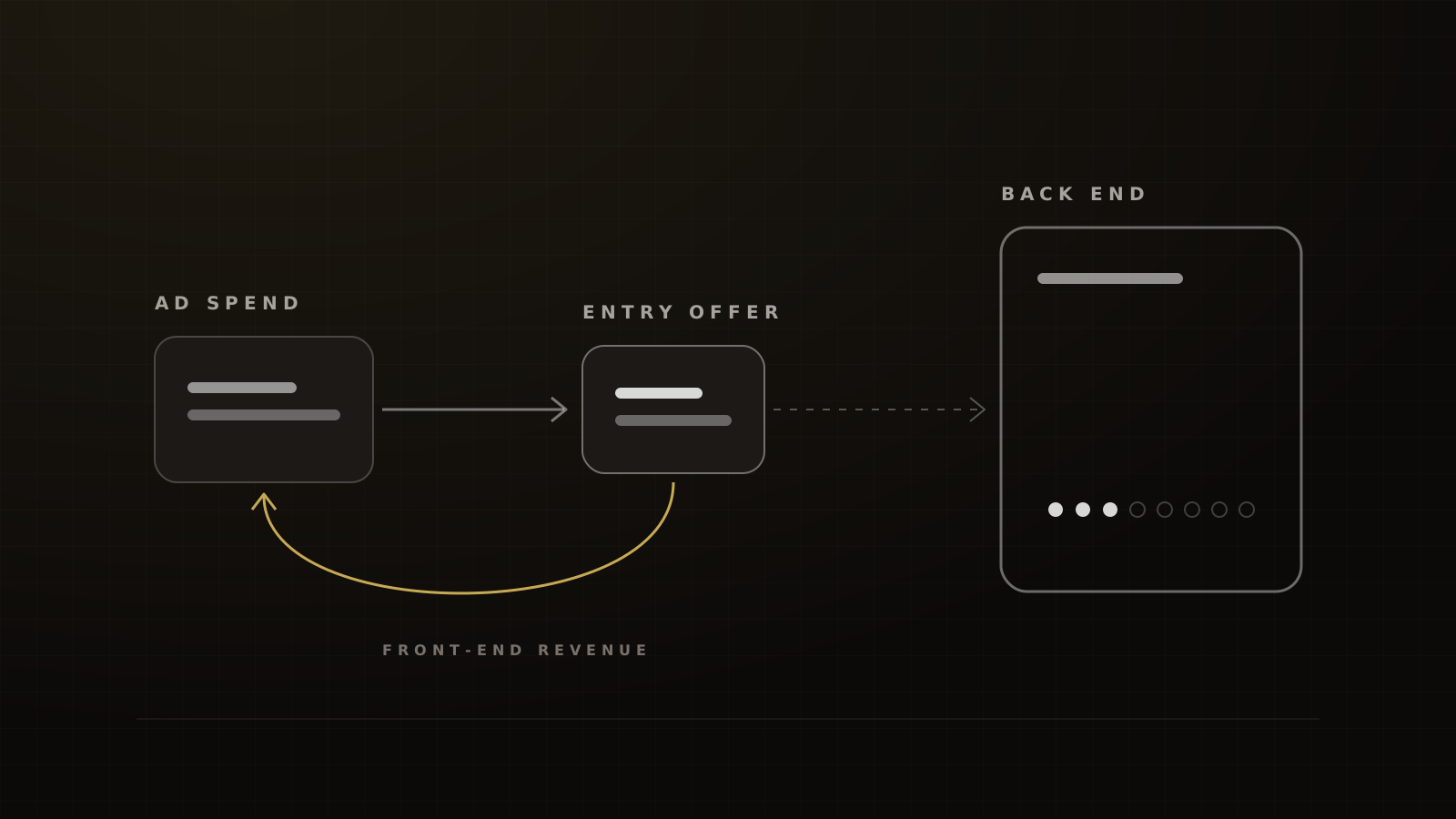
These are illustrations of the method, not client results. Hormozi's own early gym offer is the real-world version: he ran and paid for the marketing, closed the leads and handed the gyms the customers, and says he did it for 33 gyms over 18 months.[10]
| Business coach | Done-with-you agency service | Personal-development event | |
|---|---|---|---|
| Top objection coded | "I've bought courses and never finished them" | "We tried an agency and nothing changed" | "I'll get fired up and then forget it all" |
| Dream outcome | A predictable pipeline in 90 days | A funnel that converts, owned in-house | A plan they still follow 30 days later |
| Effort cut | Weekly build sessions instead of modules | We build it with their team on live calls | A workbook finished on the day |
| Time cut | Templates for the first three assets | Launch in weeks, not quarters | 30-day check-in calls after the event |
| Guarantee | Conditional: do the sessions, or keep working with us free | Implied: part of the fee tied to agreed metrics we control | Conditional: attend both days and complete the workbook, or attend the next one free |
Hypothetical offers built to show the steps. Not client results.
Notice that none of the guarantees promises income. Each ties to effort the buyer controls or to metrics the seller controls.
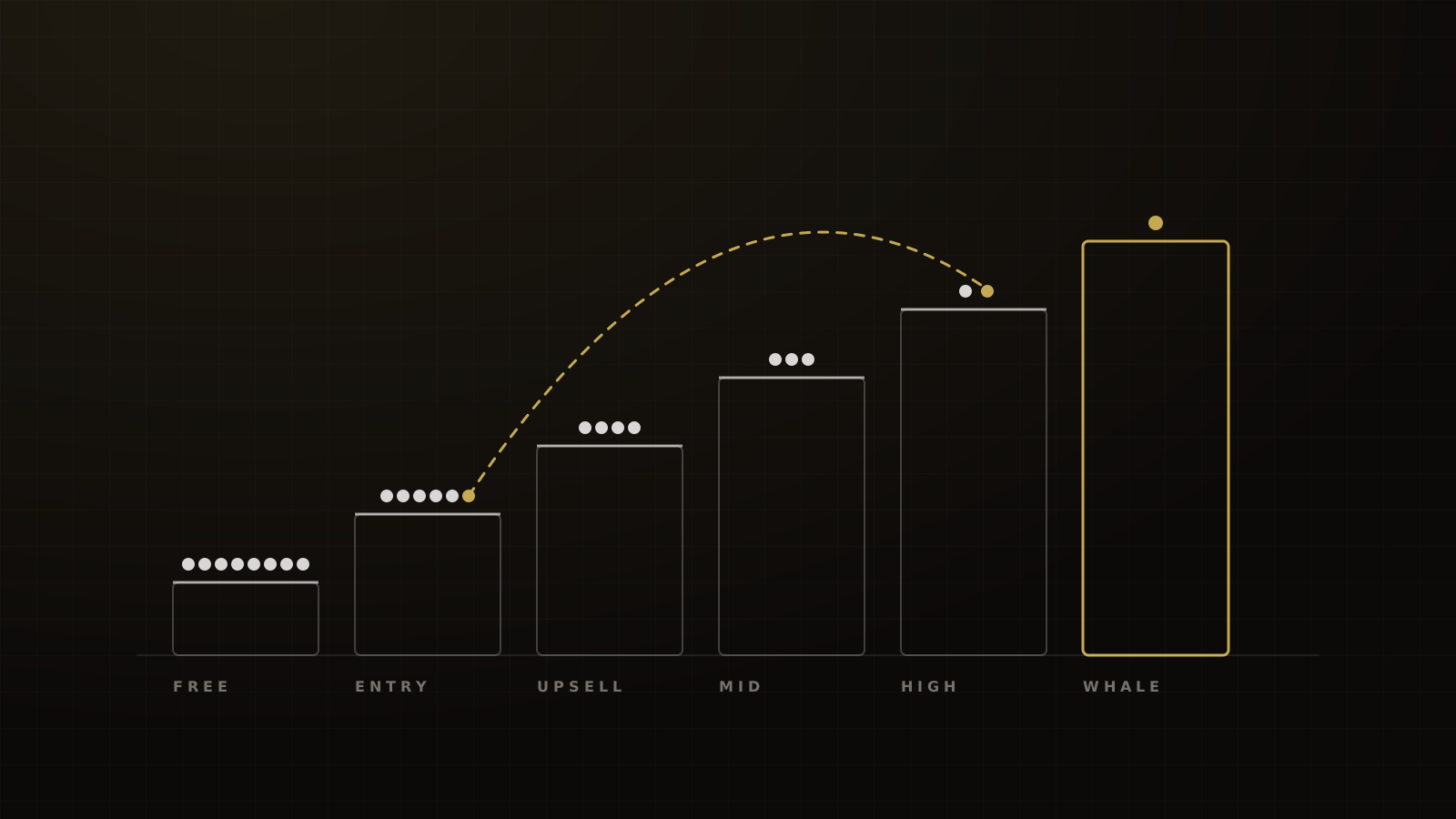
The offer is one rung. To see how it fits a full ladder, read our offer architecture guide, the value ladder examples, our take on high-ticket offer pricing and the offer ladder case study. If you want us to pressure-test yours, book a strategy call.
Frequently asked questions
Sources
- 1.Steering in online markets: the role of platform incentives and credibility. Barach, Golden & Horton, Management Science, 2020.
- 2.Pricing and value checklist. Acquisition.com, undated, checked 2026-10-04.
- 3.Handling sales objections. Gong (Chris Orlob), 2018-03-12, modified 2026-03-04.
- 4.Data reveals the best time to talk price and budget. Gong, 2020-07-22.
- 5.Study offers data to show MOOCs didn't achieve their goals. Inside Higher Ed, reporting Reich & Ruipérez-Valiente in Science, 2019-01-16.
- 6.Developing psychotherapeutic competencies in non-specialist providers: a nested RCT of coach-supported versus self-guided digital training. Mathur et al., Cambridge Prisms: Global Mental Health, 2023.
- 7.Money-back guarantees, product reviews and returns: three field experiments. Walsh & Möhring, Electronic Markets 27(4), via RePEc, 2017-11.
- 8.16 CFR 239.3: Misleading use of 'Satisfaction Guarantee', 'Money Back Guarantee' and similar representations. Federal Trade Commission, via Cornell LII, current CFR, checked 2026-10-04.
- 9.Is Gym Launch legit?. Gym Launch, undated, checked 2026-10-04.
- 10.Bonus chapters. Acquisition.com, undated, checked 2026-10-04.
- 11.Back up those earnings claims: other lessons from the FTC's Labor Task Force work. Federal Trade Commission, 2026-06-16.
- 12.Business Opportunity Rule: notice of proposed rulemaking. Federal Trade Commission, 2025-01-13.
- 13.FTC action leads to ban for owners of Automators AI e-commerce money-making scheme. Federal Trade Commission, 2024-02-27.
- 14.Air AI and its owners will be banned from marketing business opportunities to settle FTC charges. Federal Trade Commission, 2026-03-24.
Written by
Devin AlexanderCo-Founder & CEO
Devin architects Victory's revenue systems: team structure, comp plans, scripts and the accountability frameworks that make sales floors predictable. He has generated more than $150M in sales and trained more than 250 closers.
Part of the guide: Offer Architecture: Value Ladders, Grand Slam Offers and Self-Liquidating Front Ends