A/B Testing for Low-Traffic Funnels: What to Test First and When to Call It
Most low-traffic A/B tests can't reach an answer. The order we test small funnels in: tracking first, then offer, audience and message, then page details.
 Ray GillespieCo-Founder & COO
Published 9 min read
On this page
Key takeaways
- With low traffic, most page-level A/B tests can't reach a reliable answer. Even on Optimizely's platform, only 12% of experiments produced a significant win on the primary metric.[1]
- Verify tracking before you test anything: duplicate events, cross-domain checkout and consent can each fake a result.
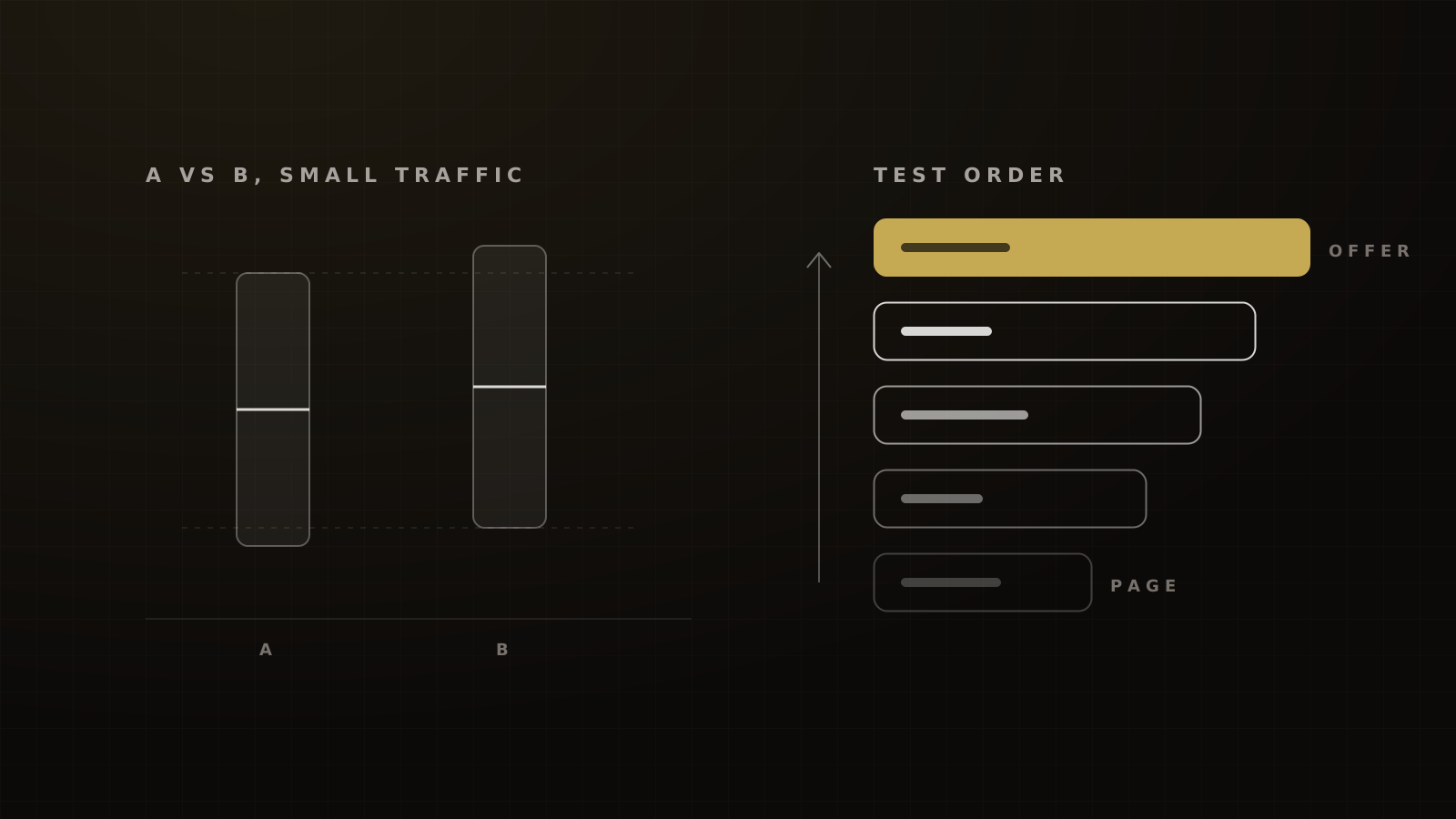
- Then test in order: offer, audience, message, and only then page details.
- Set the sample size and duration before you start. Checking significance repeatedly can turn a nominal 5% false-positive rate into 26.1%.[2]
- Once a webinar converts, stop editing the presentation. Test the pages and emails around it.
Most A/B testing advice is written for sites with millions of visitors. A coaching or event funnel with a few thousand visitors a month can't use it. Button colour tests at that volume will never reach an answer.
So spend your traffic in order. Verify tracking first. Test the big levers next: offer, audience, message. Test page details last. Change one thing at a time, decide the sample size before you start, and don't stop because the dashboard looks good.
Why most low-traffic A/B tests can't give you an answer
Start with the base rate. Across 127,000+ experiments run on Optimizely between 2018 and 2023, only 12% produced a statistically significant win on the primary metric.[1] The other 88% aren't all losers; many simply never resolved.
Wins are also small. Across 1,001 tests by experienced practitioners, 33.5% won significantly, the median winning lift was 7.5%, and the median lift across all tests was 0.08%.[3] A meta-analysis of 6,700+ ecommerce experiments found 90% moved revenue per visitor by less than 1.2% either way.[4]
Now the arithmetic. Evan Miller's rule of thumb for 80% power at 5% significance is roughly 16 × σ² ÷ δ² visitors per variant, where δ is the absolute difference you want to detect.[2] Here's what that means on the conversion rates small funnels actually have.
| Step and baseline | Lift to detect (relative) | Visitors per variant |
|---|---|---|
| Registration, 20% | +25% (to 25%) | about 1,000 |
| Registration, 20% | +10% (to 22%) | about 6,400 |
| Registration, 20% | +7.5% (to 21.5%) | about 11,400 |
| Webinar show rate, 30% | +15% (to 34.5%) | about 1,700 |
| Low-ticket purchase, 5% | +20% (to 6%) | about 7,600 |
| Sales-page purchase, 2% | +20% (to 2.4%) | about 19,600 |
Calculated with Evan Miller's rule of thumb at 80% power and 5% two-sided significance. Baselines are typical of the funnels we run: cold opt-in 15% to 22%, cold webinar show 25% to 35%, low-ticket purchase 3% to 6%. The 2% row is a hypothetical sales page.
Read the third row against the 7.5% median winning lift. Detecting a typical win on a 20% registration page takes over 11,000 visitors per variant, more than many small funnels see in a quarter. CXL's own example is starker: a 3% baseline and a 10% lift need 51,486 visitors per variation.[5]
The lesson: at a few thousand visitors a month, you can detect big swings on high-rate steps, like registration and show rate. Small tweaks on low-rate steps, like purchase, are out of reach.
Big platforms get around this with methods small funnels can't use. Microsoft's CUPED technique cut metric variance by about 50% at Bing, but it needs returning users with prior data.[6] Cold webinar traffic has none.
Step 0: make sure the test can be trusted
A test is only as good as its tracking. Before you run anything, check four things.
Trust checks before any test
- No duplicate conversions. Meta deduplicates Pixel and Conversions API events only when the event ID and event name match, within 48 hours.[7] Otherwise one registration counts twice.
- Cross-domain tracking. Without GA4 cross-domain measurement, a visitor who moves from your page to a checkout on another root domain counts as two users and two sessions.[8]
- Consent mode set first. Google's Consent Mode v2 uses four parameters, and the defaults must be set before any measurement call.[9]
- The whole chain, end to end. Buy your own product with a 100% discount code and confirm every event fires once, on the right page.
Then check the split. A sample ratio mismatch is when traffic doesn't divide the way you intended, and it showed up in about 6% of Microsoft's experiments.[10] If a 50/50 test came out 58/42, something in the setup is broken. Don't read the result.
For ad tests, use Meta's A/B testing tool. It splits the audience so nobody sees both versions, and Meta doesn't recommend testing by switching ad sets on and off, because audiences overlap and results are unreliable.[11] Keep budgets equal.
Check the ads before blaming the page, too. On the funnels we run, a working cold Meta ad for a webinar or event gets a link click-through rate of 1.8% to 2.5%. If yours is well below that, the test you need is a creative test, not a page test.
If you want to see why a page underperforms rather than whether a variant wins, use session recordings. Our Microsoft Clarity guide covers the method.
The testing order for small funnels
Jason Fladlien's optimization hierarchy is the best order we know for webinars: test the offer first, then the audience, then the message. Once a webinar converts acceptably, improve the pages and emails around it rather than the presentation, because changes to a proven webinar more often hurt than help.
We use the same order for every funnel:
Framework
The small-funnel testing order
- Tracking. Step 0 above. Nothing else counts until it's clean.
- Offer. Price, format, what's included, the guarantee. The biggest effects live here.
- Audience and timing. Who sees it and when. Cold vs warm, targeting, the ad window.
- Message. The promise, the hook, the angle of the ad and the headline.
- Page details. Layout, form, images, button copy. Last, and only on high-rate steps.
Offer, audience, message order credited to Jason Fladlien's optimization hierarchy. Constraint-first testing credited to Alex Hormozi's More, Better, New. Keyed test campaigns credited to Claude Hopkins.
The Qubit meta-analysis backs up the order. Button changes averaged −0.2% on revenue per visitor and call-to-action wording −0.3%, while scarcity averaged +2.9% and social proof +2.3%.[4] That's ecommerce data from 2017, and fake scarcity is never the answer, but the direction is clear: substance beats cosmetics.
Timing is a good example of a big lever. For our weekly evening webinar, we run ads only in the two days before each session. Running them two weeks out raised the cost per registration and lowered the show rate. No page tweak would have found that.
Hormozi's More, Better, New frames the cadence: find the step with the biggest drop, improve it one test at a time, and log every test. Claude Hopkins made the same case a century ago, testing small and keying every ad before spending big. In Scientific Advertising he wrote that "almost any questions can be answered, cheaply, quickly and finally, by a test campaign."
What to test first, by funnel stage
| Stage | Test first | Skip until later |
|---|---|---|
| Registration page | The promise, the format (live vs evergreen, one day vs three), the amount of friction | Button colour, image swaps |
| Confirmation page | A VIP or replay offer; calendar and Wallet prompts | Layout tweaks |
| Show rate | Reminder timing and channel, the ad window | Reminder copy wording |
| Offer and close | Price, payment options, checkout vs a call with a closer | Sales-page design |
Victory figures are our experience and targets, not a measured study.
On the registration page, the form layout is rarely worth a test. Across 10 Leadpages split tests, two-step and one-step opt-ins averaged 44% and 45%.[12] The amount of friction is a better question; see where should the friction go.
The confirmation page is where offer-level tests pay off fastest. In our experience 5% to 12% of free registrants take a low-priced VIP or replay offer shown right after sign-up, and the bump recovers roughly 40% to 50% of webinar ad spend. The thank-you page checklist covers what else belongs there.
At the close, test the path, not the paint: direct checkout against a booked call. Our guide to checkout vs application vs call covers when each one fits.
When to call it
Decide three things before the test starts.
- The sample size. Work it out from your baseline and the smallest lift worth acting on. CXL's point holds: magic numbers don't exist.[5]
- The duration. At least one full business cycle. Optimizely's guidance is a minimum of seven days.[13] That's a floor, not a power calculation. Two cycles is safer.
- The decision rule. Write down what you'll do if it wins, loses or ties.
Don't peek and stop. Checking for significance after every new result can push the real false-positive rate to 26.1% when you think it's 5%.[2]
For ad-side tests, Meta's learning phase sets a minimum. Ad sets usually need about 50 results in the week after the last significant edit, and CPA is higher and less stable until then.[14] So each version gets at least 7 days at the planned daily spend, or about 50 optimization events, before we judge it. Editing mid-test restarts the clock.
Use pessimistic math. When we project what a change will do, we use the low end of the range, and we check which projections break if a winning result doesn't hold.
"No difference" is a legitimate answer. If the test reached its sample size and the variants tied, keep the cheaper or simpler one and move to a bigger lever.
I'd rather launch it tomorrow than launch it perfectly next week.
That applies to iteration, not fundamentals. Launch the test fast; don't launch it with broken tracking.
When you can't reach significance
Most small funnels will hit this wall. Four options, in the order we use them:
- Make the swing bigger. Test a different offer or format, not a different headline. Big changes need fewer visitors to detect.
- Use qualitative evidence. Recordings, heatmaps and sales-call notes tell you why people leave. Fix obvious friction without a test.
- Run a careful before/after. Change one thing, hold everything else still, compare equal periods and treat the result as direction, not proof.
- Pool across launches. If you run the same event in several cities, the same test across events adds up to a usable sample.
If you're still looking for Google Optimize, it shut down on 30 September 2023,[15] and GA4 isn't a page-testing replacement. For the full set of stage benchmarks, start with our funnel CRO guide. To size a test on your own numbers, use the funnel conversion calculator; for page-level baselines, see landing page conversion rate benchmarks. For ad-side testing, the paid ads guide for coaches goes deeper. Want a second set of eyes on your test plan? Book a strategy call.
Frequently asked questions
Sources
- 1.Optimizely debuts new report revealing increased rates of experimentation. Optimizely (via PR Newswire), 2023-11-27.
- 2.How not to run an A/B test. Evan Miller, 2010-04-18.
- 3.What can be learned from 1,001 A/B tests?. Analytics Toolkit (Georgi Georgiev), 2022-10-18.
- 4.What works in e-commerce: a meta-analysis of 6,700 online experiments. Browne & Swarbrick Jones, Qubit Digital, 2017-06-22.
- 5.Stopping A/B tests: how many conversions do I need?. CXL (Peep Laja), 2015-02-20, updated 2022-12-20.
- 6.Improving the sensitivity of online controlled experiments by utilizing pre-experiment data (CUPED). Deng, Xu, Kohavi & Walker (Microsoft), WSDM 2013, 2013-02.
- 7.Handling duplicate Pixel and Conversions API events. Meta for Developers, living doc, checked 2026-10-04.
- 8.Set up cross-domain measurement. Google Analytics Help, living doc, checked 2026-10-04.
- 9.Set up consent mode on websites. Google for Developers, living doc, checked 2026-10-04.
- 10.Diagnosing sample ratio mismatch in online controlled experiments. Fabijan et al., KDD 2019, 2019-07-25.
- 11.About A/B testing. Meta Business Help Center, living doc, checked 2026-10-04.
- 12.2-step opt-in forms. Leadpages, 2020-07-28.
- 13.How long to run an experiment. Optimizely Support, 2025-06-20.
- 14.About the learning phase. Meta Business Help Center, living doc, checked 2026-10-04.
- 15.Google Optimize sunset. Google Analytics Help, living doc, checked 2026-10-04.
Written by
Ray GillespieCo-Founder & COO
Ray runs day-to-day operations across every Victory engagement, building the systems, automations and AI-powered workflows that hold the machine together. He has overseen operations behind more than $120M in revenue.
Part of the guide: Funnel CRO: Benchmarks, Diagnostics and Tests for Coaching, Course and Event Funnels